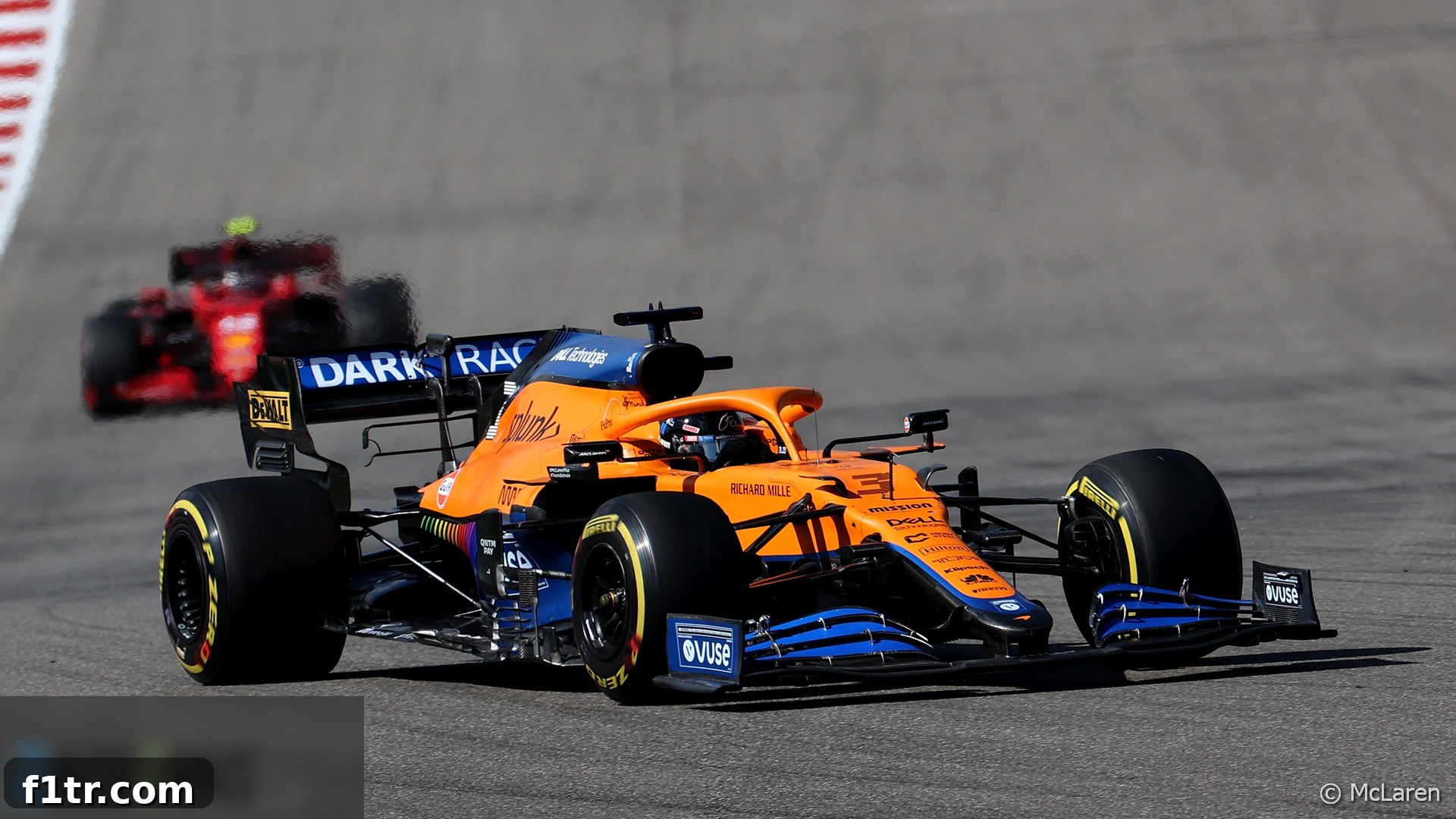
The thrilling spectacle of Formula 1 often delivers moments of intense wheel-to-wheel action, where drivers push the limits of their machinery and their rivals. One such memorable incident unfolded during the United States Grand Prix, featuring a spirited battle between McLaren’s Daniel Ricciardo and Ferrari’s Carlos Sainz Jr. This on-track duel culminated in contact, sparking an immediate, emotionally charged reaction from Sainz and a more relaxed, philosophical response from Ricciardo, igniting a discussion about the nature of hard racing in the pinnacle of motorsport.
Following their physical encounter on track, particularly at the challenging Turn 13 of the Circuit of the Americas (COTA), Carlos Sainz Jr. quickly voiced his frustration over team radio. His words were unequivocal: “that got a bit dirty,” he asserted, adding, “He did that on purpose, guys.” These strong accusations set the tone for the post-race analysis, hinting at a perceived deliberate act rather than an unavoidable racing incident.
Advert | Become a Supporter & go ad-free
Ricciardo, known for his charismatic demeanor and often jovial approach, addressed Sainz’s claims with a characteristic blend of casualness and defiance. He recounted his race engineer, Tom Stallard, informing him of Sainz’s “some endplate damage” after their contact. Reflecting on the incident, Ricciardo mused, “I guess that was from us touching unless he took a kerb somewhere. But I think my car was okay.” He then unequivocally stated his intent: “Obviously you don’t deliberately try to go into someone. But that’s a bit of ‘rubbing racing’.”
Daniel Ricciardo’s Philosophy: The Essence of “Rubbing Racing”
The term “rubbing racing” encapsulates a core philosophy embraced by many seasoned drivers, suggesting that minor contact is an inherent and acceptable part of aggressive, close-quarters competition. Ricciardo elaborated on this, explaining the risks associated with certain overtaking maneuvers: “When you put yourself on the outside, obviously you’re a little bit more exposed.” He further clarified his stance, emphasizing, “So nothing was deliberate but I guess it’s the risk he ran by trying the outside.” For Ricciardo, the incident was simply an inevitable outcome of two drivers fighting fiercely for track position, where the driver on the outside line inherently takes on greater risk.
Ricciardo didn’t shy away from Sainz’s radio comments; in fact, he embraced them with a touch of his usual humor. “That’s cool, I’m happy to be dirty,” he quipped, adding, “I’m a nice guy, so being dirty every now and then is alright.” This lighthearted response, while typical of Ricciardo, also subtly underscored his confidence in his actions, suggesting that a little controversy or perceived “dirtiness” is merely a byproduct of competitive motorsport. It’s a testament to the Australian’s approach to racing – aggressive, yet always with a smile, believing firmly in the notion that if you’re not pushing boundaries, you’re not truly racing.
Carlos Sainz Jr.’s Dual Perspective: Emotion vs. Analysis
Carlos Sainz Jr., a driver known for his meticulous approach and thoughtful analysis, later offered a more nuanced perspective on the incident, acknowledging the role of emotion in his immediate radio outburst. He admitted that his comments at the time were partly a natural, visceral reaction to the heat of battle. “He was in his right to do what he did, just the little contact that he gave me I think was avoidable and that’s what triggered my reaction on the radio when we are in a emotional situation,” said Sainz. This candid admission highlights the intense psychological pressure drivers face, where split-second decisions and physical contact can trigger immediate, unfiltered responses.
Despite his emotional reaction, Sainz, upon calmer reflection, still felt that Ricciardo’s maneuver bordered on the edge of acceptable racing. He articulated his concern that Ricciardo’s move was “in the limit of the legality” after the pair touched. This distinction between a ‘racing incident’ and an action pushing the ‘limit of legality’ is a critical one in Formula 1, often leading to steward investigations and potential penalties. Sainz detailed the classic dilemma of an inside versus outside line battle: “Obviously he’s in the inside, I’m in the outside, I have everything to lose being in the outside. But normally the car who is on the inside, you’re always trying to run the car out of road.”
The Legality and Dynamics of Wheel-to-Wheel Combat
This dynamic – where the driver on the inside line typically holds the advantage and seeks to ‘squeeze’ the outside car – is a fundamental aspect of Formula 1 overtaking. While it is legitimate for the inside driver to use the full width of the track, the rules require them to leave a car’s width for the outside driver if they are significantly alongside. The ambiguity often lies in defining “significantly alongside” and what constitutes “running out of road” legitimately versus illegally forcing a competitor off track. Sainz’s point reflects this nuanced interpretation, where the contact, in his view, crossed a line from aggressive racing to something potentially more questionable.
Interestingly, Sainz conceded that, had the roles been reversed, he likely would have adopted a similar aggressive strategy. “Obviously, I wouldn’t have tried to have contact like we had in the end, but the guy in the inside has the right to run the car on the outside out of the road,” he admitted. This acknowledgment underscores the competitive mindset prevalent among elite F1 drivers; while they may disagree on the specifics of an incident, there’s often an underlying understanding of the tactics employed by their rivals. It’s a game of brinkmanship, where drivers constantly probe the boundaries of what is allowed and what is effective.
The Thrill of Close Racing and the Role of Stewards
Such incidents are not just fleeting moments of drama; they are woven into the very fabric of Formula 1, contributing significantly to its appeal. Fans are drawn to the raw emotion, the daring overtakes, and the high stakes of every on-track skirmish. While drivers and teams might dispute the fairness of specific moves, these battles define the narrative of a Grand Prix and often become iconic moments in the sport’s history. The 2021 United States Grand Prix incident between Ricciardo and Sainz was a perfect example of this, showcasing two highly competitive drivers pushing each other to the absolute limit.
The role of race stewards in adjudicating these incidents is crucial. They must carefully review telemetry, video footage, and driver testimonies to determine if any regulations were breached. The absence of a penalty in this particular case suggests that the stewards likely deemed the contact a ‘racing incident,’ a common ruling when the blame is not clearly attributable to one driver or when the contact is considered an unavoidable consequence of aggressive, legitimate overtaking attempts. This decision, however, doesn’t always pacify the affected driver, as Sainz’s lingering feeling about the “limit of legality” demonstrated.
The United States Grand Prix: A Stage for Intense Battles
The United States Grand Prix at COTA has firmly established itself as a premier event on the Formula 1 calendar, renowned for its challenging layout, enthusiastic crowds, and often dramatic racing. The long straights followed by technical sections and elevation changes make it an ideal track for varied racing strategies and wheel-to-wheel duels. The incident between Ricciardo and Sainz only added to the legend of COTA as a venue where drivers are not afraid to put it all on the line. These battles are not just about securing points; they are about pride, reputation, and the sheer love of competition.
The 2021 season, in particular, was characterized by intense championship battles and fierce midfield fights, making every position count. Drivers like Ricciardo and Sainz, leading their respective teams, were under constant pressure to extract maximum performance and defend their territory aggressively. This context further explains the high tension surrounding an incident like the one at Turn 13, where even minor contact could have significant implications for a team’s championship aspirations or individual standings.
Advert | Become a RaceFans supporter andgo ad-free
Conclusion: The Enduring Spirit of F1 Competition
In conclusion, the contact between Daniel Ricciardo and Carlos Sainz Jr. at the United States Grand Prix encapsulates much of what makes Formula 1 so captivating. It was a clash of driving styles, a test of nerve, and a moment that highlighted the fine line between aggressive racing and potentially illicit contact. Ricciardo’s “rubbing racing” philosophy, contrasted with Sainz’s detailed concern for legality, showcased the diverse approaches within the paddock. While emotions run high in the heat of battle, the subsequent reflections from both drivers provide valuable insight into the mindset of elite competitors. Ultimately, such incidents, with their inherent drama and discussion, reaffirm the thrilling, sometimes controversial, but always compelling nature of Formula 1, where drivers constantly push the limits in pursuit of glory.
2021 United States Grand Prix
- Mercedes encouraged despite ‘toughest race for a long time’ in Austin
- For the sake of the title fight, F1 must get a grip on its track limits problem
- Pit stop problems costing Ferrari “quite a lot of points” – Sainz
- Sold-out crowd of 380,000 at COTA shows F1 can add third US race – Brawn
- While the pressure’s off I can “push myself” more – Russell
Browse all 2021 United States Grand Prix articles