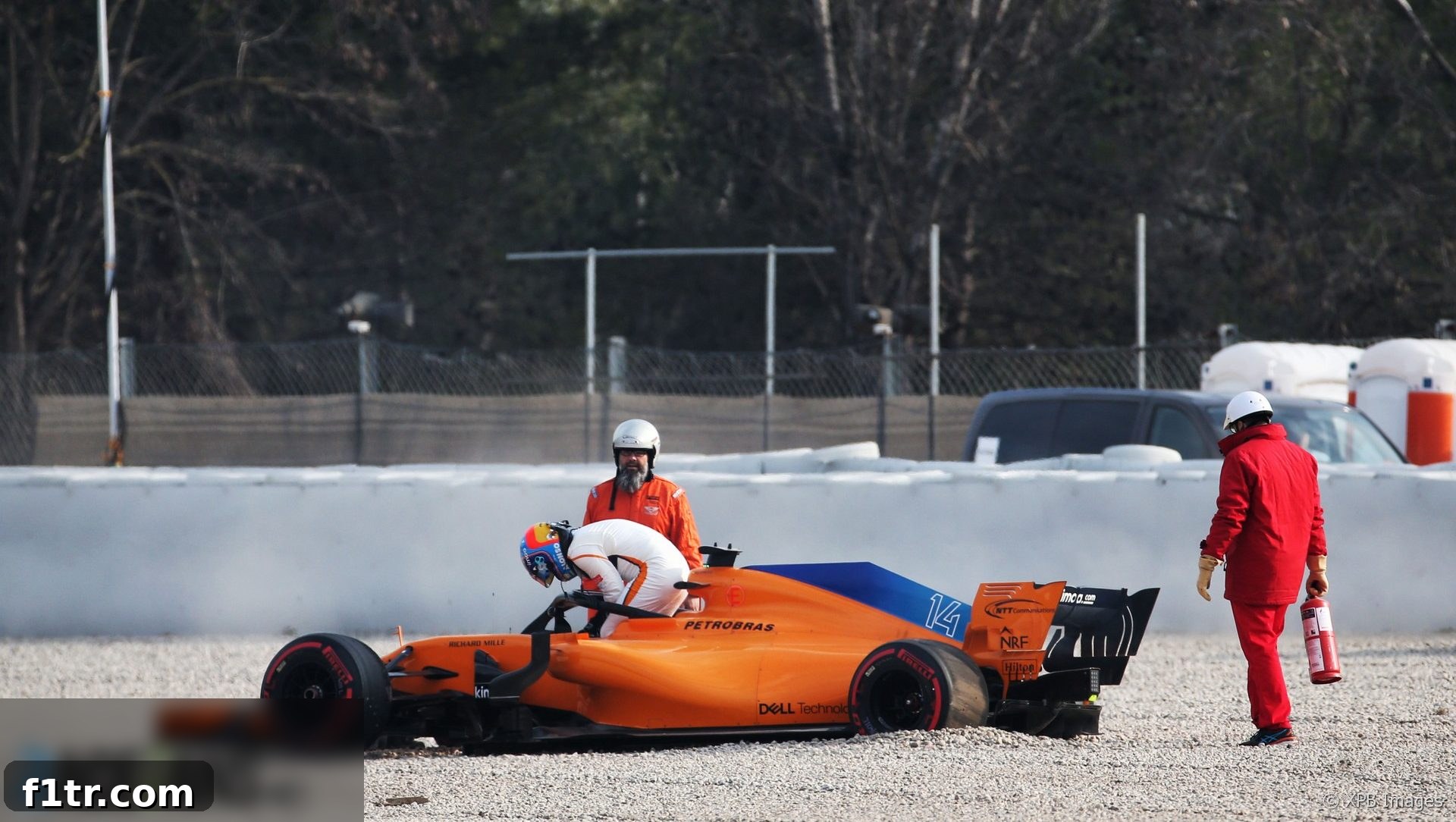
McLaren Confident After Addressing Pre-Season Reliability Hiccups
McLaren Racing Director Eric Boullier has provided an insightful update on the team’s progress, confirming that a series of persistent reliability problems encountered during the crucial pre-season testing phase have been thoroughly tackled. The Woking-based squad faced a challenging winter period, marking the second consecutive year where they completed the smallest number of laps among all competitors. This persistent issue cast a shadow, especially after their highly anticipated off-season transition from Honda to Renault power units, a move widely expected to usher in a new era of competitive performance.
Navigating the Turbulences of Winter Testing
The pre-season testing period in Formula 1 is a delicate balance of pushing limits and gathering data. For McLaren, the 2018 winter tests proved to be more challenging than anticipated on the reliability front. Key issues, including a critical wheel nut failure, a concerning oil leak, and persistent cooling problems, severely restricted their track time. Each lost lap translates to vital missed opportunities for data collection, component stress testing, and driver feedback – all indispensable elements for fine-tuning a competitive F1 challenger.
Boullier candidly acknowledged these setbacks, stating, “We didn’t have the reliability we had hoped for in winter testing.” This admission highlighted the frustration within the team, particularly given the high hopes surrounding the new Renault engine partnership. However, his subsequent reassurance provided a crucial dose of optimism: “but all the issues we faced have since been addressed back at the factory.” This declaration underscores the relentless effort and rapid problem-solving culture inherent in Formula 1, where every minute counts, especially between testing and the first race.
Behind the Scenes: McLaren’s Relentless Pursuit of Perfection
The transition to a new engine supplier is never a straightforward process in Formula 1. It involves intricate integration of a foreign power unit into an existing chassis philosophy, demanding significant design modifications and extensive validation. The reliability issues McLaren faced were likely a direct consequence of this complex adaptation period, where unforeseen interactions between the new engine and the car’s ancillary systems emerged. A wheel nut failure, for instance, could stem from a variety of factors ranging from mechanical design flaws to operational procedures under pressure. Similarly, oil leaks and cooling issues often point to packaging challenges, material stress, or calibration problems within the new power unit’s operating envelope.
Boullier’s comments shed light on the immense dedication and expertise at play behind the scenes at McLaren’s technology center. He emphasized, “There’s a huge amount of work going on behind the scenes to ensure we leave no stone unturned in our quest to extract the maximum pace we can from our new package from the first race.” This isn’t merely PR; it signifies a multi-faceted approach involving hundreds of engineers and technicians across various departments. Design engineers might be tweaking CAD models for revised components, manufacturing teams racing against the clock to produce new parts, and quality control experts meticulously inspecting every element. The aerodynamics department will also be working overtime, understanding how the new engine’s thermal characteristics and packaging affect airflow and downforce generation, a critical performance differentiator in F1.
The phrase “leave no stone unturned” perfectly encapsulates the F1 ethos. It means conducting thorough root cause analyses for every single failure, implementing robust solutions, and performing rigorous bench testing and simulations before any component is allowed back on the car. This exhaustive process is fundamental to ensuring that the issues encountered in the Spanish winter tests do not resurface during the cut-throat competition of a Grand Prix weekend.
Managing Expectations: A Realistic Outlook for the Season Start
While the team’s efforts to rectify the issues are undoubtedly commendable, Boullier also tempered expectations, acknowledging the competitive landscape of Formula 1. “We’re not expecting miracles to be worked overnight – far from it,” he added. This realistic assessment is crucial in a sport where progress is often incremental, and rivals are constantly pushing the boundaries. It suggests that while the fundamental reliability concerns have been addressed, McLaren understands that unlocking the full potential of their new package will be a season-long endeavor, requiring continuous development and optimization.
However, Boullier’s resolve remains unwavering: “but what we do know is that we’ll give it our all this weekend.” This commitment to maximum effort, regardless of the immediate performance outlook, is characteristic of a team striving to return to the pinnacle of motorsport. It sets the tone for the upcoming Australian Grand Prix, signaling that McLaren will approach the first race with determination and a focus on maximizing every opportunity.
Alonso’s Optimism: Glimmers of Potential Amidst the Challenges
Despite the persistent reliability problems that limited track time, there was a significant glimmer of hope for McLaren: the car’s raw pace. Over the eight days of testing in Spain, McLaren remarkably set the second-fastest time among all teams. While testing lap times can often be misleading – influenced by fuel loads, engine modes, and tire compounds – achieving such a competitive benchmark, even once, suggests an underlying potential within the chassis.
Two-time world champion Fernando Alonso, renowned for his ability to extract performance from any machinery, echoed this sentiment of cautious optimism. “Our car showed a lot of potential in winter testing,” he stated. For a driver of Alonso’s caliber, “potential” is a significant word. It implies that even with the teething issues of a new power unit, the fundamental aerodynamic and mechanical balance of the car felt strong. Alonso’s extensive experience allows him to discern the inherent characteristics of a car, often separating genuine chassis capabilities from transient engine limitations or setup imperfections. His positive feedback would have been a massive morale boost for the engineers.
Alonso further emphasized the learning curve involved, stating, “Although we know we still have a lot to work on, we’ve already learned a lot about the package and how all the new elements to this year’s car work together.” This highlights the iterative nature of Formula 1 car development. Even with limited mileage, every lap provides invaluable data, helping the team understand the complex interplay between the new Renault power unit, the chassis, and the updated aerodynamic package. This learning process is continuous, evolving with every session and race.
The First Real Test: The Australian Grand Prix
With pre-season testing behind them, all eyes turn to the iconic Albert Park circuit for the Australian Grand Prix, the traditional curtain-raiser of the Formula 1 season. As Alonso rightly pointed out, “Australia is its first real test, and we need to work hard all weekend to bring all the ingredients together.” The competitive pressures of a race weekend are vastly different from the controlled environment of testing. Track conditions vary, ambient temperatures fluctuate, and the constant pressure of qualifying and racing demands flawless execution from every member of the team – from the pit crew to the strategists.
For McLaren, the Australian Grand Prix will be a crucial benchmark. It will be the first opportunity to truly assess the effectiveness of their factory fixes and the genuine pace of the MCL33 in a direct head-to-head battle. The goal won’t just be to finish the race but to demonstrate improved reliability, consistent performance, and the ability to fight for strong points. A solid performance in Australia would not only validate the arduous work done at the factory but also inject much-needed confidence into the team as they embark on what promises to be a challenging yet potentially rewarding 2018 F1 season.
The journey from a perennial front-runner to a team grappling with reliability has been tough for McLaren. The switch to Renault engines was a bold step, a testament to their determination to reclaim their competitive edge. While the initial pre-season hurdles were concerning, the team’s swift and comprehensive response, coupled with encouraging signs of raw pace, suggests a foundation upon which they can build. The true measure of their success will unfold race by race, but the resolve to overcome adversity is clearly burning brightly within the heart of McLaren Racing.
2018 F1 Season Insights and Related Content
Delve deeper into the 2018 F1 season and McLaren’s journey with these related articles:
- F1 feared “death knell” for Drive to Survive after Ferrari and Mercedes snub
- McLaren staff told us we were “totally crazy” to take Honda engines in 2018 – Tost
- ‘It doesn’t matter if we start last’: How Red Bull’s junior team aided Honda’s leap forward
- Honda’s jet division helped F1 engineers solve power unit problem
- McLaren Racing losses rise after Honda split
Browse all 2018 F1 season articles