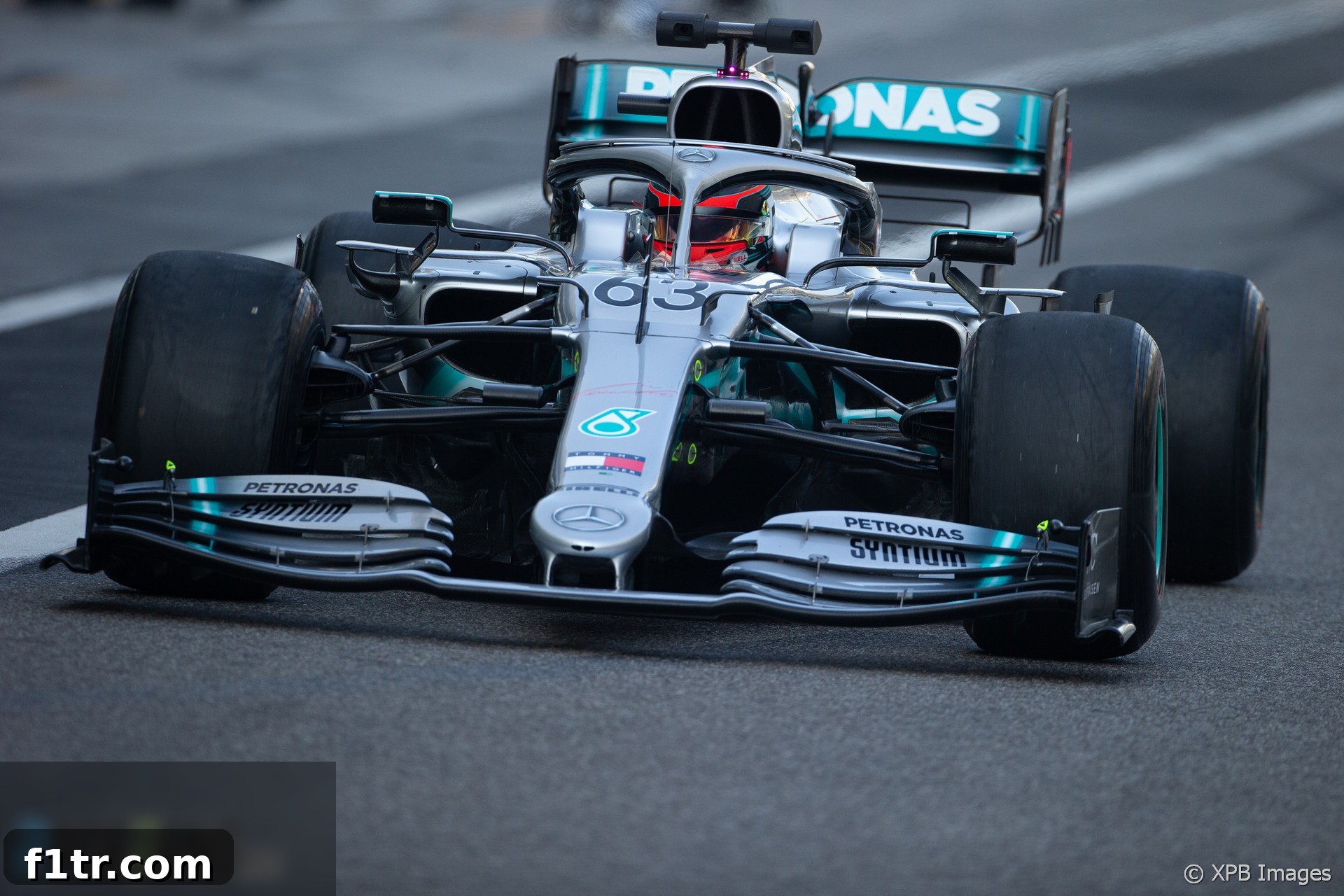
The curtain fell on the 2019 Formula 1 season with its final official test day at the Yas Marina Circuit in Abu Dhabi, offering a tantalizing glimpse into the future. It was a day dominated by Mercedes, as their highly-regarded junior driver, George Russell, steered the W10 to the fastest time, underscoring both his talent and the German team’s enduring prowess.
This critical post-season test served a dual purpose: it allowed teams to meticulously evaluate Pirelli’s new 2020-specification tyres alongside the current 2019 compounds, gathering invaluable data for the forthcoming season. For drivers, it was an opportunity to either acclimatize to new machinery, fine-tune their skills, or, in Russell’s case, demonstrate their potential to a wider audience, including their parent teams. Mercedes’ decision to entrust Russell with the final day’s running speaks volumes about their confidence in the young Briton, who already impressed throughout his debut F1 season with Williams.
Using the softer 2020-specification C5 compound, Russell posted an impressive lap time of 1’37.204. While this was marginally slower – by just eight-hundredths of a second – than Valtteri Bottas’s best time from Tuesday, achieved on the 2019 rubber, it highlighted the challenging performance characteristics of the new tyres. The subtle differences between the 2019 and 2020 compounds were a central theme of the entire two-day test, with teams striving to understand how the new rubber would impact car setup, degradation, and overall pace for the next championship challenge.
Leclerc’s Ferrari Setback and Midfield Brilliance
Ferrari, much like on the preceding day, secured the second-quickest time. This time, it was Charles Leclerc who took the reins of the SF90 from Sebastian Vettel. However, Leclerc’s session concluded prematurely and dramatically when he lost control and crashed at Turn 14. According to the Scuderia, the Monegasque driver hit a kerb, which unsettled the car and sent him into the barrier, resulting in substantial damage to the front and side of the car. Despite the incident, Leclerc’s pace prior to the crash demonstrated Ferrari’s underlying speed, albeit with a reminder of the fine margins in Formula 1 testing.
Beyond the top two, the midfield battle was equally intense and revealing. Racing Point showcased a promising performance with Lance Stroll setting the third-quickest time of the test. His lap of 1’37.999, also on the 2020 C5 compound, indicated a positive step for the team, demonstrating their potential to improve heading into 2020. This solid outing will be a confidence booster for Stroll and the entire Racing Point crew as they aim to climb further up the constructors’ standings.
Hot on Stroll’s heels was Pierre Gasly in the Toro Rosso, securing the fourth-fastest time. Gasly’s consistent strong performances since his return to Toro Rosso have been a testament to his resilience and talent. His effective tyre evaluation and strong pace further underlined the potential of the STR14 chassis, which will evolve into the AlphaTauri in 2020. This test was crucial for Gasly to provide comprehensive feedback on the new tyres and solidify his role as a key development driver.
Carlos Sainz Jnr, fresh off a stellar 2019 season with McLaren, continued his impressive form, slotting into fifth place. His focus would have been on providing crucial data for McLaren’s engineers as they prepare for a season where they aim to further solidify their position as the leading midfield team. The Spanish driver’s analytical approach and feedback are invaluable for McLaren’s ongoing development.
Significantly, Esteban Ocon, preparing for his full-time return to Formula 1 with Renault in 2020, was the only driver to complete both days of testing. This extensive track time was vital for Ocon to re-integrate himself into the demands of an F1 car and to build a rapport with his new team. His commitment to logging extensive mileage will undoubtedly benefit Renault as they look to rebound from a somewhat challenging 2019 season.
Diverse Driver Line-up and Williams’ Ongoing Struggles
The test also featured a diverse array of drivers, including some aiming for full-time seats and others gaining valuable experience. Pietro Fittipaldi, driving for Haas, made his first appearance in a Formula 1 car since the in-season test at Circuit de Catalunya six months prior. Finishing eighth, just behind Alexander Albon in the Red Bull, Fittipaldi provided Haas with essential data as they grappled with understanding their VF-19 and the nuances of the new Pirelli compounds.
Alexander Albon continued his learning curve with Red Bull, evaluating different tyre specifications and providing vital feedback for the Milton Keynes squad. For a driver who made a mid-season jump to a top team, every session on track is an opportunity to deepen his understanding of the RB15 and its intricate dynamics. Meanwhile, Antonio Giovinazzi in the Alfa Romeo, and Nicholas Latifi and Roy Nissany for Williams, rounded out the testing roster, each playing a critical role in their respective teams’ development programs.
The favourable conditions throughout the two-day test in Abu Dhabi allowed every team to complete well over 100 laps, a testament to the reliability of the cars and the efficiency of the test programs. This extensive mileage ensures a comprehensive data set for engineers to analyze over the winter break. Even Williams, who shared their car between their newly confirmed 2020 race driver Nicholas Latifi and test driver Roy Nissany, managed significant running. However, the struggles for the British team were evident, with Nissany again finishing at the bottom of the timesheets, over three-and-a-half seconds slower than his future teammate, Latifi. This performance disparity underscores the significant challenge ahead for Williams as they strive to improve their competitiveness in the upcoming season.
Abu Dhabi Test Day 2: Full Results
The final classification from the second and concluding day of the 2019 F1 post-season tyre test in Abu Dhabi is presented below. This table offers a detailed overview of driver performances, team machinery, best lap times, gaps to the leader, total laps completed, and the specific Pirelli tyre compounds utilized for their fastest laps. Analyzing this data provides critical insights into the relative pace, development focus, and tyre evaluation strategies employed by each team as they conclude their on-track activities for the 2019 calendar year and begin their preparations for the demanding 2020 Formula 1 season.
| Pos. | Car number | Driver | Team | Model | Best time | Gap | Laps | Tyres |
|---|---|---|---|---|---|---|---|---|
| 1 | 63 | George Russell | Mercedes | W10 | 1’37.204 | 145 | C5 2020 | |
| 2 | 16 | Charles Leclerc | Ferrari | SF90 | 1’37.401 | 0.197 | 103 | C5 2019 |
| 3 | 18 | Lance Stroll | Racing Point | RP19 | 1’37.999 | 0.795 | 132 | C5 2020 |
| 4 | 10 | Pierre Gasly | Toro Rosso | STR14 | 1’38.166 | 0.962 | 146 | C5 2020 |
| 5 | 55 | Carlos Sainz Jnr | McLaren | MCL34 | 1’38.729 | 1.525 | 112 | C5 2020 |
| 6 | 31 | Esteban Ocon | Renault | RS19 | 1’38.950 | 1.746 | 128 | C4 2019 |
| 7 | 23 | Alexander Albon | Red Bull | RB15 | 1’39.181 | 1.977 | 139 | C4 2019 |
| 8 | 51 | Pietro Fittipaldi | Haas | VF-19 | 1’39.682 | 2.478 | 135 | C5 2019 |
| 9 | 99 | Antonio Giovinazzi | Alfa Romeo | C38 | 1’39.811 | 2.607 | 115 | C5 2020 |
| 10 | 40 | Nicholas Latifi | Williams | FW42 | 1’40.188 | 2.984 | 107 | C4 2020 |
| 11 | 41 | Roy Nissany | Williams | FW42 | 1’43.892 | 6.688 | 38 | C4 2020 |
Looking Ahead: Implications for the 2020 F1 Season
The final test day of the 2019 season in Abu Dhabi provided a fascinating prologue to what promises to be an exhilarating 2020 Formula 1 championship. While official testing times can often be misleading due to varying fuel loads, engine modes, and test programs, they nonetheless offer valuable insights. George Russell’s performance for Mercedes serves as a strong indicator of his burgeoning talent and Mercedes’ continued dominance in car development. The significant mileage completed by all teams, particularly with the 2020 Pirelli tyres, will be crucial in shaping their car designs and strategies for the upcoming season.
The incident involving Charles Leclerc and his Ferrari underscores the challenges of pushing the limits, even in a testing scenario. It’s a stark reminder that every moment on track counts, and unforeseen events can quickly alter a team’s plan. For the midfield teams like Racing Point, Toro Rosso, McLaren, and Renault, the test offered both confirmation of progress and areas for improvement. Drivers like Lance Stroll, Pierre Gasly, and Carlos Sainz Jnr demonstrated consistency, while Esteban Ocon’s extensive running for Renault was vital for his reintegration into the sport. Williams faces an uphill battle, as evidenced by their times, highlighting the extensive work required over the winter.
Ultimately, this test day was more than just a collection of lap times; it was an intensive data-gathering exercise, a proving ground for young talent, and an essential step in the relentless cycle of Formula 1 development. The information gathered here will be meticulously analyzed, influencing design decisions, simulation models, and ultimately, the competitiveness of each team when the lights go out for the 2020 season opener. The focus now shifts from the track to the factories, where engineers and designers will work tirelessly to translate this data into championship-contending machinery.
Related Articles on the 2019 F1 Season
Explore more insights and analysis from the thrilling 2019 Formula 1 season:
- Crying in the Melbourne car park at 2019 grand prix was my career low – Ocon
- McLaren Racing reports reduced £71 million loss in 2019
- Kvyat: Hockenheim podium last year was “my biggest achievement” so far
- How the FIA’s new encrypted fuel flow meter targets Ferrari’s suspected ‘aliasing’ trick
- “He smashed my office door”: 23 must-see moments from ‘Drive to Survive’ season two
Browse all 2019 F1 season articles