Lewis Hamilton Expresses Concerns Over Mercedes W14’s Lingering Balance Issues in Pre-Season Testing
Mercedes-AMG Petronas Formula 1 Team driver, Lewis Hamilton, has openly acknowledged that the highly anticipated W14 challenger still inherits some of the critical “balance limitations” that significantly hampered its predecessor, the W13, throughout the challenging 2022 season. The seven-time world champion’s comments came during the crucial pre-season testing in Bahrain, where teams were pushing their new machinery to the limits ahead of the 2023 Formula 1 campaign.
Early Struggles and Familiar Handling Traits for the Mercedes W14
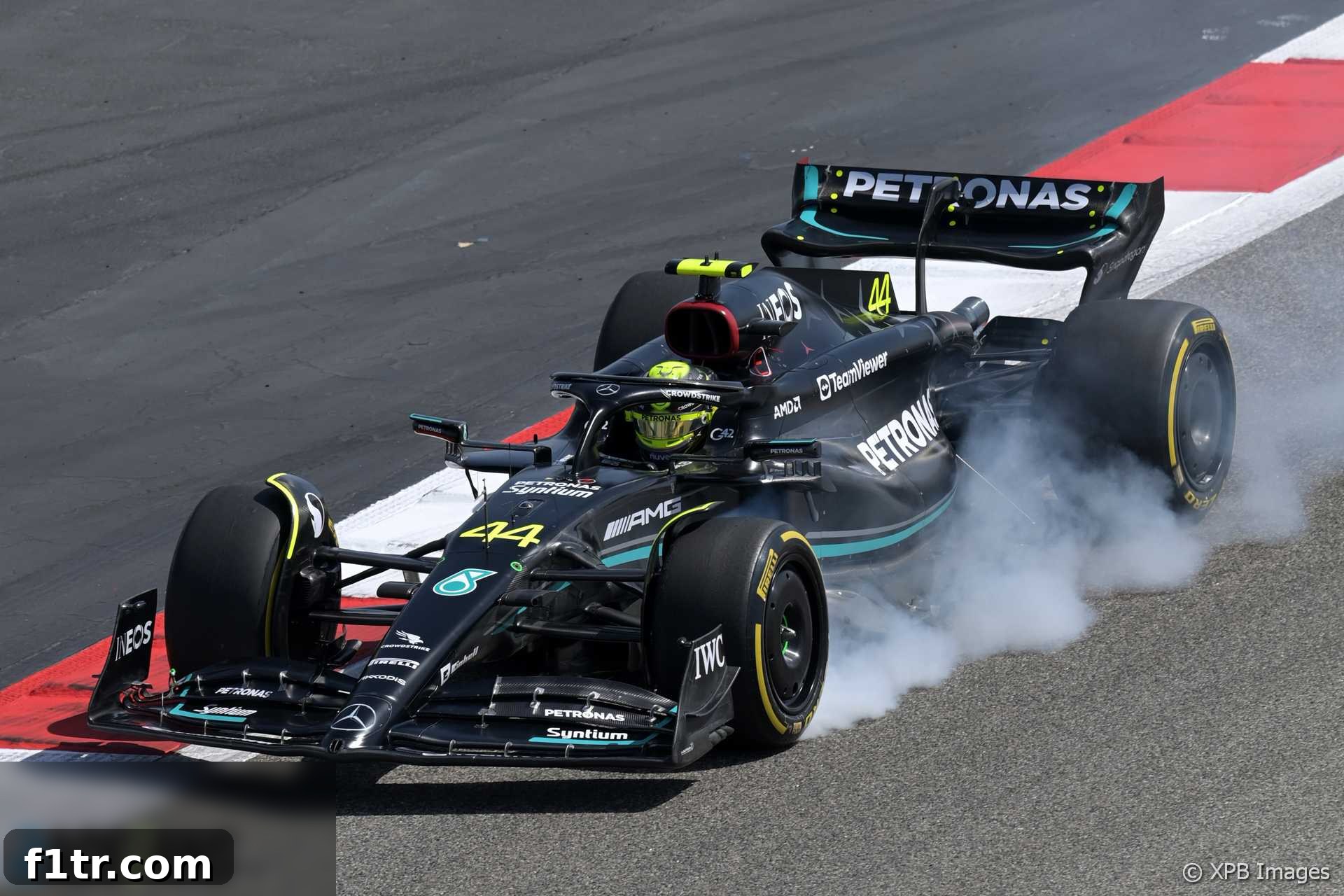
During yesterday’s early session, observers noted Hamilton visibly grappling with the rear stability of his W14, an all-too-familiar sight for fans following Mercedes’ struggles last year. Speaking at a press conference before his final stint in the car for the testing finale, Hamilton confirmed that the team’s focus remains squarely on eradicating these persistent balance issues. These problems, he highlighted, were a direct carry-over from their 2022 machine, which proved notoriously difficult to tame.
“They’re just things that we’re working through,” Hamilton explained to the media, including RaceFans. “Some of the balance limitations that we had last year are just present. So we’re diligently working through them.” This honest assessment from one of Formula 1’s most experienced drivers suggests that while Mercedes has introduced a substantially revised car for 2023, the core handling characteristics that made the W13 a handful are proving stubborn to eliminate entirely. The quest for optimal balance – the harmonious interaction between the front and rear axles – is fundamental to driver confidence and ultimately, lap time, especially under braking and through high-speed corners.
Impact of Balance Limitations on Driver Performance
The “balance limitations” Hamilton refers to typically manifest as either understeer (the front of the car not turning in sufficiently) or oversteer (the rear losing grip too easily). In the context of the W13, drivers often reported a nervous and unpredictable rear end, making it difficult to find consistency and push the car to its absolute limit, particularly during qualifying runs and in certain phases of a race. This inherent instability leads to excessive tyre degradation as drivers are forced to correct the car’s attitude more frequently, putting undue stress on the rubber. For a driver of Hamilton’s calibre, who thrives on a stable and responsive chassis, these issues can be incredibly frustrating and significantly impact his ability to extract peak performance.
The visual evidence from Bahrain testing corroborated Hamilton’s remarks. Cameras captured instances of the W14 twitching under braking and exhibiting slight tail-happy tendencies through fast direction changes. While testing is precisely for identifying and addressing such issues, the fact that these characteristics echo those of its predecessor raises questions about the fundamental aerodynamic philosophy or mechanical setup that Mercedes is currently employing. Finding the sweet spot in a Formula 1 car’s balance is a meticulous process involving countless setup changes, aerodynamic adjustments, and driver feedback loops. The team’s engineers will be poring over gigabytes of telemetry data to understand the root causes and implement effective solutions before the season opener.
Mixed Fortunes and Crucial Track Time for Mercedes
George Russell, Hamilton’s young teammate, managed to log a substantial 83 laps in today’s morning session. This valuable mileage was crucial, serving to offset some of the track time lost during Friday’s evening session when Russell’s W14 suffered an untimely hydraulic failure in the closing hours. In pre-season testing, every single lap counts, as teams strive to validate simulations, test new components, and gather vital data under real-world conditions. A hydraulic issue, even a minor one, can interrupt a meticulously planned testing programme and deprive a driver of critical setup development or long-run simulations.
Hamilton himself admitted that the testing period had been far from straightforward for Mercedes. “I think it’s difficult to sum it up,” he reflected. “I think we’ve had a couple of difficult days. Yesterday, particularly, was difficult. The first day didn’t feel too bad, yesterday was a little bit more of a struggle. I think George has had a much better morning today, a bit like the first day. I get to go in half an hour, so hopefully we’ve got the set up in a bit of a better place.” This candid reflection underscores the rollercoaster nature of pre-season testing, where teams cycle through various setups and components, often sacrificing outright pace for valuable learning opportunities. The ability to quickly identify and rectify issues is paramount, and Mercedes is certainly putting their engineering prowess to the test.
The Eradication of Porpoising: A Significant Step Forward
Despite the challenges posed by the W14’s balance, Hamilton delivered some much-needed positive news regarding one of the W13’s most debilitating flaws: porpoising. The excessive aerodynamic bouncing, which plagued all teams to varying degrees in 2022 but was particularly severe for Mercedes, has reportedly been almost entirely eliminated from the new car. “Right now, the bouncing that we had has pretty much gone,” Hamilton declared with palpable relief. “So that’s a huge step for us.”
The phenomenon of porpoising, an aerodynamic oscillation that causes the car to rapidly bounce up and down at high speeds, was a significant headache for Mercedes last season. It not only compromised performance but also subjected drivers to extreme physical discomfort and potential long-term health concerns. The W13’s rigid setup, designed to combat this bouncing, often made the car harsh over bumps and kerbs, further exacerbating the handling issues. The successful mitigation of porpoising indicates that Mercedes’ engineers have made considerable progress in understanding and controlling the W14’s aerodynamic behaviour, particularly at ride height. This achievement, while not fully resolving all issues, frees up the team to concentrate solely on optimising the car’s fundamental balance and performance. “It’s nice to drive without the bouncing for once. But there are still some underlying things that we have been working through,” Hamilton reiterated, highlighting the ongoing development process.
Hamilton’s Unwavering Motivation and Team Spirit
Even in the face of persistent technical hurdles and the disappointment of a winless 2022 season, Lewis Hamilton remains profoundly motivated by the positive mentality and relentless determination he observes within his Mercedes team. His comments paint a picture of a resilient outfit, united in its quest for improvement despite the recent setbacks. “I’m really proud of everyone in the team for continuing to remain positive after a tough year last year,” he expressed. “Amazing work through winter for us to arrive and have the mileage that we’ve had.”
Hamilton, a veteran of the sport and a cornerstone of the Mercedes team for over a decade, deeply appreciates the consistent commitment of his colleagues. “I’ve been here a long, long time and every single year they arrive with the same mental focus and determination to fix whatever issues we have. So I enjoy being in the offices, they’re back there just churning away, going through the data and really proud of everyone in the garage. So we’ll hopefully get there.” This unwavering belief in his team’s capabilities is a testament to Mercedes’ strong internal culture and their history of overcoming adversity. After years of unparalleled dominance, 2022 served as a humbling experience, but it also appears to have ignited a renewed sense of purpose within the Silver Arrows camp.
Looking Ahead: The Road to Recovery for Mercedes in 2023
The insights from Lewis Hamilton’s pre-season reflections suggest a complex start for Mercedes in the 2023 Formula 1 season. While the eradication of porpoising marks a significant engineering triumph, the lingering balance limitations present a new set of challenges that the team must address swiftly. The competitive landscape appears fierce, with rivals like Red Bull showcasing strong early form and Ferrari also looking to contend. Mercedes’ ability to quickly diagnose and rectify these handling issues will be critical to their aspirations of rejoining the championship battle.
The dedicated engineers and strategists back at Brackley and Brixworth will be working tirelessly, leveraging the vast amounts of data collected during pre-season testing to refine the W14. Formula 1 is a sport of continuous development, and even if Mercedes starts the season slightly off the pace, their formidable resources and historical capacity for mid-season turnarounds should not be underestimated. Hamilton’s steadfast leadership and the team’s collective determination will be pivotal in navigating the early races and unlocking the full potential of the Mercedes W14 as the 2023 season unfolds. The journey to reclaim their position at the pinnacle of Formula 1 has clearly begun, and it promises to be an enthralling one.
2023 F1 season
- FIA president cleared of alleged interference in two 2023 races
- First week viewing figures for new Drive to Survive season fall again
- Max who? Drive to Survive season six prefers its favourite faces
- RaceFans’ complete 2023 season review
- The F1 drivers who pulled off the 10 biggest charges through the field in 2023
Browse all 2023 F1 season articles