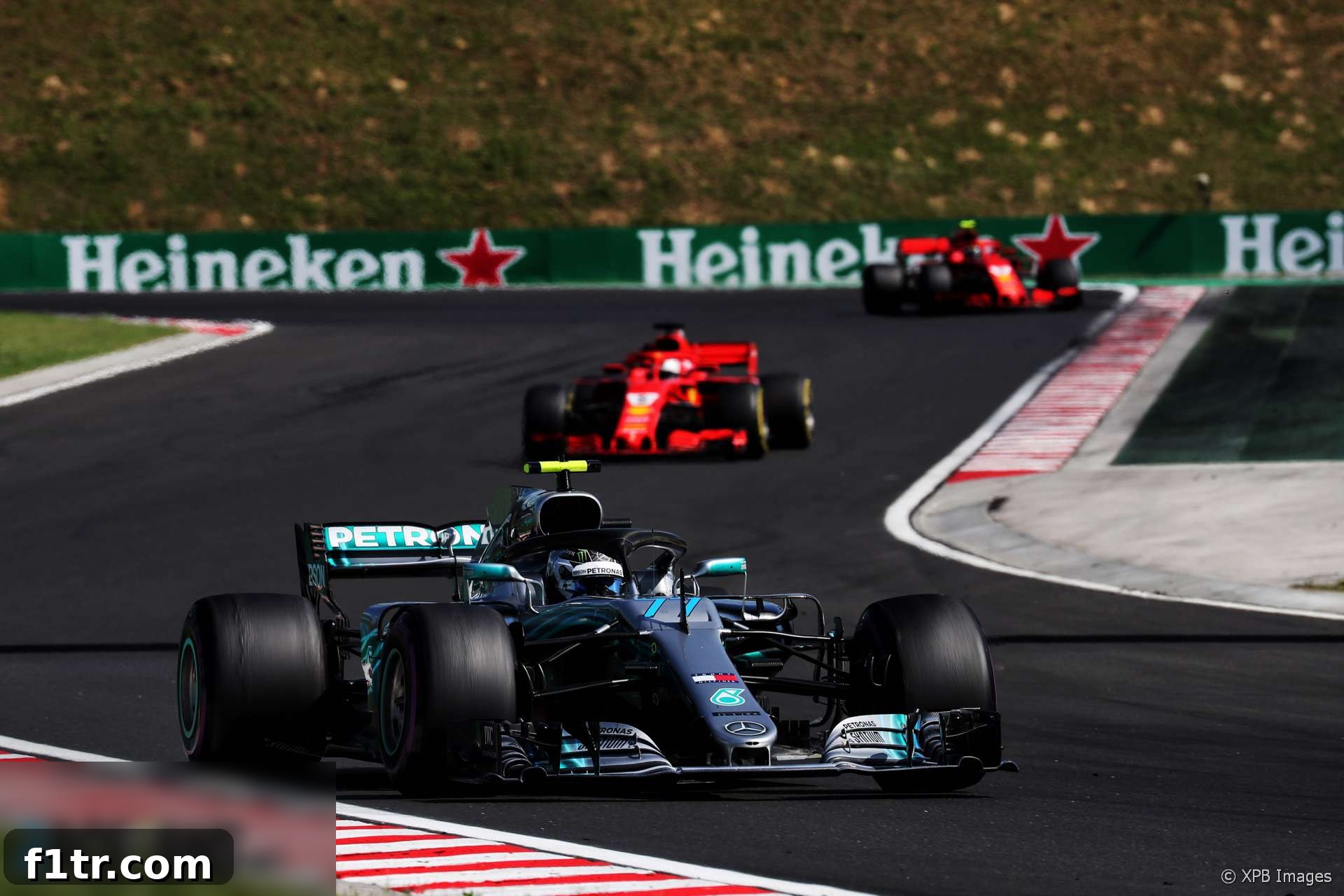
Valtteri Bottas Penalized After Hungarian Grand Prix Collision with Daniel Ricciardo
The 2018 Formula 1 Hungarian Grand Prix, held at the challenging Hungaroring circuit, was a race brimming with strategic battles and on-track intensity. Known for its tight, twisty layout and notoriously difficult overtaking opportunities, the event often delivers unexpected drama. This particular edition was no exception, culminating in a significant incident between Mercedes driver Valtteri Bottas and Red Bull Racing’s Daniel Ricciardo. Their clash, which occurred during a fiercely contested battle for fourth place in the closing stages of the race, ultimately resulted in a penalty for Bottas, casting a shadow over his performance and fueling post-race discussions.
As the Grand Prix neared its conclusion, the stakes for every position intensified. Daniel Ricciardo, celebrated for his aggressive yet precise overtaking maneuvers, made a daring attempt to pass Bottas around the outside of Turn 1. However, Bottas was facing a formidable challenge: his car was struggling for vital grip on significantly aged tyres, and he was further hampered by a damaged front wing sustained in an earlier incident. Under these compromised conditions, Bottas slid wide, making unavoidable contact with Ricciardo. The collision forced the Australian off the track, damaging his Red Bull, though both cars remarkably managed to continue the race.
Following a comprehensive review by the race stewards, Valtteri Bottas was deemed responsible for the incident. The ruling led to a 10-second time penalty applied to his final race result, alongside two penalty points added to his FIA Super Licence. This marked his first penalty points within the ongoing 12-month period, a system designed to deter repeated dangerous driving. Despite the time penalty, Bottas impressively retained his fifth-place finish, highlighting the substantial time gaps that had developed between the competitors. Interestingly, an earlier contact involving Bottas and Sebastian Vettel was scrutinized but ultimately deemed a racing incident, requiring no further investigation, underscoring the nuanced judgments made by F1 officials.
The 2018 Hungarian Grand Prix: A Race of High Stakes and Strategic Play
The Hungaroring circuit, often likened to ‘Monaco without the walls,’ presents a unique challenge in the Formula 1 calendar. Its sinuous layout, characterized by a relentless series of medium and slow-speed corners and a short main straight, places a premium on aerodynamic downforce, chassis balance, and driver precision. Overtaking is notoriously difficult, making qualifying performance and astute race strategy — particularly concerning tyre management and pit stops — absolutely crucial for success. The 2018 Hungarian Grand Prix was a classic example of this, with varying tyre degradation rates and strategic calls playing a pivotal role in shaping the race narrative from start to finish. Drivers were consistently pushing the limits, knowing that even minor errors could have significant consequences on such a demanding circuit.
Within the broader context of the 2018 Formula 1 season, this race held considerable importance. The championship battle was fiercely contested between Lewis Hamilton of Mercedes and Sebastian Vettel of Ferrari. As Hamilton’s teammate, Valtteri Bottas played a crucial role in supporting Mercedes’ constructors’ championship aspirations, often finding himself in key strategic positions on track. On the other side, Daniel Ricciardo, in what would ultimately be his final season with Red Bull Racing before his high-profile move to Renault, was determined to maximize every opportunity. For both drivers and their respective teams, every point and every position gained or lost carried immense weight, intensifying every on-track duel and making the outcome of incidents like the one at Turn 1 all the more critical.
Dissecting the Clash: Bottas and Ricciardo’s Battle for Fourth
Daniel Ricciardo’s Signature Overtake Attempt
Daniel Ricciardo, celebrated throughout his career for his daring and often spectacular overtaking maneuvers, approached Turn 1 with the clear intention of gaining a position from Valtteri Bottas. His reputation for late-braking and finding unconventional lines, even in the tightest of spaces, made him one of the grid’s most exciting overtakers. As they arrived at the Hungaroring’s opening corner, Ricciardo positioned his Red Bull on the outside, a challenging but not unprecedented line for an overtake attempt. The stewards’ subsequent review of video evidence confirmed that Ricciardo had afforded Bottas ample racing room, ensuring his car was cleanly alongside the Mercedes as he committed to the pass. It was a classic display of Ricciardo’s unwavering commitment to maximizing every opportunity on track.
Valtteri Bottas’s Compromised Defence and Loss of Control
Conversely, Valtteri Bottas was operating under a significant handicap. In the latter stages of the race, his Pirelli tyres had reached a critical state of degradation, offering considerably less grip than ideal. This challenge was compounded by damage to his front wing, which he had incurred during an earlier contact on track – reportedly with Sebastian Vettel, although the stewards did not pursue this initial incident further. A damaged front wing drastically compromises a Formula 1 car’s aerodynamic efficiency, particularly impacting crucial downforce, which in turn reduces cornering stability and braking performance. As Bottas entered Turn 1, attempting to defend his hard-earned position against Ricciardo’s aggressive advance, the cumulative effect of worn tyres and reduced downforce proved decisive. The car became unstable, leading to a lock-up of his front wheels – a common symptom of diminished grip and aerodynamic imbalance – causing his Mercedes to slide uncontrollably wide directly into Ricciardo’s path.
The Unavoidable Contact and Its Aftermath
The collision was inevitable given Bottas’s loss of control. The Mercedes made solid contact with the side of Ricciardo’s Red Bull, a forceful impact that propelled the Australian off the racing line and onto the run-off area. The severity of the shunt inflicted noticeable damage to Ricciardo’s car, particularly to crucial aerodynamic components such as his bargeboards and floor. Such damage would undoubtedly have further compromised the car’s performance for the remainder of the race, affecting its balance and overall speed. Despite the significant contact, both drivers demonstrated remarkable car control, managing to keep their vehicles running and eventually rejoining the track. While Bottas’s car appeared to suffer no immediate, significant performance loss, Ricciardo’s pace was undeniably impacted, hindering his ability to fight back effectively or maintain optimal speed throughout the remaining laps. The incident profoundly altered the dynamic of their personal battle and held wider implications for the final race classification.
The Stewards’ Scrutiny and Formal Decision
The Meticulous Investigation Process
The role of the Formula 1 stewards is paramount in upholding the sport’s regulations and ensuring fair competition. Their process for investigating on-track incidents is thorough and multi-faceted. In this specific case, as detailed in their official statement, the stewards undertook an exhaustive review of all available evidence. This included analyzing video footage from myriad angles – encompassing onboard cameras from both cars, trackside cameras positioned strategically around the circuit, and overhead aerial shots – to gain a comprehensive understanding of the event. Beyond visual evidence, they also meticulously considered telemetry data, which provides crucial insights into car performance, speed, braking points, and driver inputs. Furthermore, both drivers involved, Valtteri Bottas (Car 77) and Daniel Ricciardo (Car 3), were summoned to present their respective accounts of the incident, explaining their actions and intentions. Team representatives were also consulted, offering technical perspectives on vehicle performance and strategic considerations. This detailed and impartial approach is fundamental to arriving at a fair and objective assessment.
Bottas Held Accountable: The Rationale Behind the Verdict
After their extensive review, the stewards unequivocally ruled that Valtteri Bottas was predominantly responsible for the collision. Their reasoning specifically highlighted the confluence of factors that led to his loss of control. The official decision stated: “Bottas had a damaged front wing from an earlier incident. As the two cars approached Turn 1, Ricciardo was on the outside of the turn and gave plenty of room. With the compromised line and less downforce from the front wing Bottas locked up, and collided with Ricciardo forcing Ricciardo off the track and causing damage.” This precise explanation underscores that while Bottas was undoubtedly operating under challenging circumstances due to his car’s condition, the ultimate responsibility lay with him to maintain control of his vehicle and ensure safe passage, particularly when defending against an attacking driver who had established a clear position alongside him.
The Imposed Penalty: 10-Second Time Sanction and Penalty Points
As a direct consequence of being found primarily at fault, Bottas was issued a 10-second time penalty. This specific type of sanction is applied to a driver’s overall race time, and while it often leads to a drop in their final classified position, in Bottas’s case, he managed to retain his fifth-place finish. This outcome indicates that there was a sufficient time gap between him and the sixth-place competitor. In addition to the time penalty, Bottas also received two penalty points on his FIA Super Licence. The penalty points system is a crucial component of F1’s disciplinary framework, designed to deter repeated dangerous or unsporting driving. Drivers accumulating 12 penalty points within a 12-month rolling period face an automatic one-race ban. This incident marked Bottas’s inaugural penalty points during that active period, serving as a clear and official warning regarding his driving conduct.
The Bottas-Vettel Incident: A Different Interpretation
Earlier in the Hungarian Grand Prix, there had been another notable moment of contact involving Valtteri Bottas, this time with Sebastian Vettel. Crucially, the stewards explicitly declared that “no investigation was necessary into the earlier collision between Bottas and Vettel.” This distinction is highly significant and highlights the nuances of F1 officiating. It strongly suggests that the stewards perceived the contact between Bottas and Vettel as a ‘racing incident’ – a common occurrence in the intensely competitive world of motorsport where contact happens as a natural consequence of hard racing, and neither driver is deemed predominantly to blame, or where the contact itself is not severe enough to warrant further disciplinary action. This decision underscores the meticulous judgment applied by the stewards to differentiate between various on-track skirmishes, treating each incident on its unique merits and specific contributing circumstances.
Reactions and Wider Repercussions from the Paddock
Driver Perspectives: Frustration, Explanation, and Consequence
The immediate post-race reactions from both drivers offered clear insights into their experiences. Daniel Ricciardo expressed considerable frustration and disappointment, feeling strongly that the incident was entirely avoidable and directly cost him a potentially stronger race finish. He emphasized the damage inflicted upon his Red Bull and the lost opportunity to maximize his points tally. Valtteri Bottas, while accepting the stewards’ decision and the penalty, provided his perspective by underscoring the extreme difficulty he faced in controlling his Mercedes with severely worn tyres and the detrimental effects of his damaged front wing. He explained that he had pushed his car to its absolute limit but was ultimately unable to prevent the slide into Ricciardo, conveying a sense of helplessness rather than intentional aggression. These differing viewpoints are a common feature in Formula 1, where drivers often interpret incidents through their own competitive lenses and immediate emotional responses.
Team Stances and Broader Strategic Implications
From the team principals’ perspective, the incident also generated significant discussion. Toto Wolff, Mercedes team principal, likely acknowledged the stewards’ decision while simultaneously defending his driver, emphasizing the challenging conditions Bottas had encountered. Red Bull Racing, conversely, would have been understandably disappointed with the outcome for Daniel Ricciardo, especially considering the damage sustained by his car and the potential loss of valuable championship points. Incidents of this nature do not solely impact individual race results; they also contribute to the overarching narrative of a season, potentially influencing team strategies, internal driver dynamics, and sometimes even crucial contract negotiations. For Ricciardo, who was actively engaged in pivotal discussions regarding his future in Formula 1 at this juncture, any incident that affected his on-track performance or public perception could have added another complex layer to his decision-making process.
The Legacy of the Incident in the 2018 Formula 1 Season
While Valtteri Bottas ultimately managed to retain his fifth-place finish despite the penalty, the incident with Daniel Ricciardo at the Hungarian Grand Prix served as a stark reminder of the intense competition and exceptionally high stakes that defined the 2018 Formula 1 season. For Mercedes, it highlighted Bottas’s ongoing challenges with consistency and race management, particularly when under extreme pressure or facing car limitations. For Red Bull and Daniel Ricciardo, it represented another instance of misfortune in a season that, while having its highs, also saw its share of difficult moments and missed opportunities. The collision at the Hungaroring became a significant talking point, fueling widespread discussions among fans, pundits, and within the paddock about the delicate balance between aggressive, hard racing – an aspect that fans adore – and contact that crosses the line into a punishable offense. It also contributed to broader debates surrounding racing etiquette, the interpretation of track limits, and the consistency of stewarding decisions, all of which are integral components of the ever-evolving narrative of Formula 1.
Advert | Become a RaceFans supporter andgo ad-free
Don’t miss anything new from RaceFans
Follow RaceFans on social media:
- Join RaceFans on Facebook
- Follow RaceFans on Twitter
- Get daily email updates from RaceFans
2018 F1 season
- F1 feared “death knell” for Drive to Survive after Ferrari and Mercedes snub
- McLaren staff told us we were “totally crazy” to take Honda engines in 2018 – Tost
- ‘It doesn’t matter if we start last’: How Red Bull’s junior team aided Honda’s leap forward
- Honda’s jet division helped F1 engineers solve power unit problem
- McLaren Racing losses rise after Honda split
Browse all 2018 F1 season articles