2024 Singapore Grand Prix: Ferrari’s Leclerc Sets Blistering Pace in First Practice
Relive the key moments and crucial insights from the opening practice session for the Singapore Grand Prix at the iconic Marina Bay Street Circuit.
The highly anticipated 2024 Formula 1 Singapore Grand Prix kicked off under the dazzling lights of the Marina Bay Street Circuit with a captivating First Practice session. As teams and drivers navigated the challenging urban layout, the session provided an early glimpse into the pecking order and strategic considerations for what promises to be an enthralling race weekend. From significant car upgrades to crucial track modifications and unexpected setbacks, FP1 offered a wealth of talking points for Formula 1 enthusiasts.
Following a dramatic weekend in Azerbaijan, the driver line-up for Singapore sees the return of Kevin Magnussen to his regular Haas seat. Magnussen had served a one-race ban during the Azerbaijan Grand Prix due to an accumulation of penalty points, making his return a noteworthy change for the Haas team and a relief for fans eager to see him back in action on one of F1’s most demanding circuits.
Strategic Car Upgrades for Marina Bay’s Unique Demands
Coming just one week after the previous round, extensive car overhauls were not expected. However, several teams arrived in Singapore with specific modifications tailored to the unique characteristics of the Marina Bay circuit. Known for its high downforce requirements and intense cooling demands in the tropical heat and humidity, Singapore presents a distinct engineering challenge.
Red Bull Racing, always meticulous in optimizing their package, introduced larger front brake ducts, a vital component for managing thermal loads on a track with heavy braking zones. McLaren opted for a steeper beam wing, indicating a push for maximum rear-end downforce to aid stability and traction through the circuit’s numerous slow and medium-speed corners. These adjustments underscore the precise tuning required to extract performance on a street circuit that punishes even the slightest aerodynamic imbalance.
One of the most significant updates, however, came from Ferrari. The Scuderia debuted a brand-new front wing design, featuring revisions to the third and fourth flap elements. This upgrade is particularly noteworthy as Ferrari anticipates its effectiveness across a range of circuits, suggesting a forward-looking development path rather than a one-off for Singapore. Similarly, Aston Martin and RB also brought revised front wings, highlighting the constant pursuit of aerodynamic efficiency. Other notable changes included a revised front suspension on the Williams, aimed at improving ride and handling over the bumpy street surface, and a new rear wing on the Alpine, signaling their efforts to find a more optimal downforce-to-drag balance.
Marina Bay Circuit: Enhanced for 2024
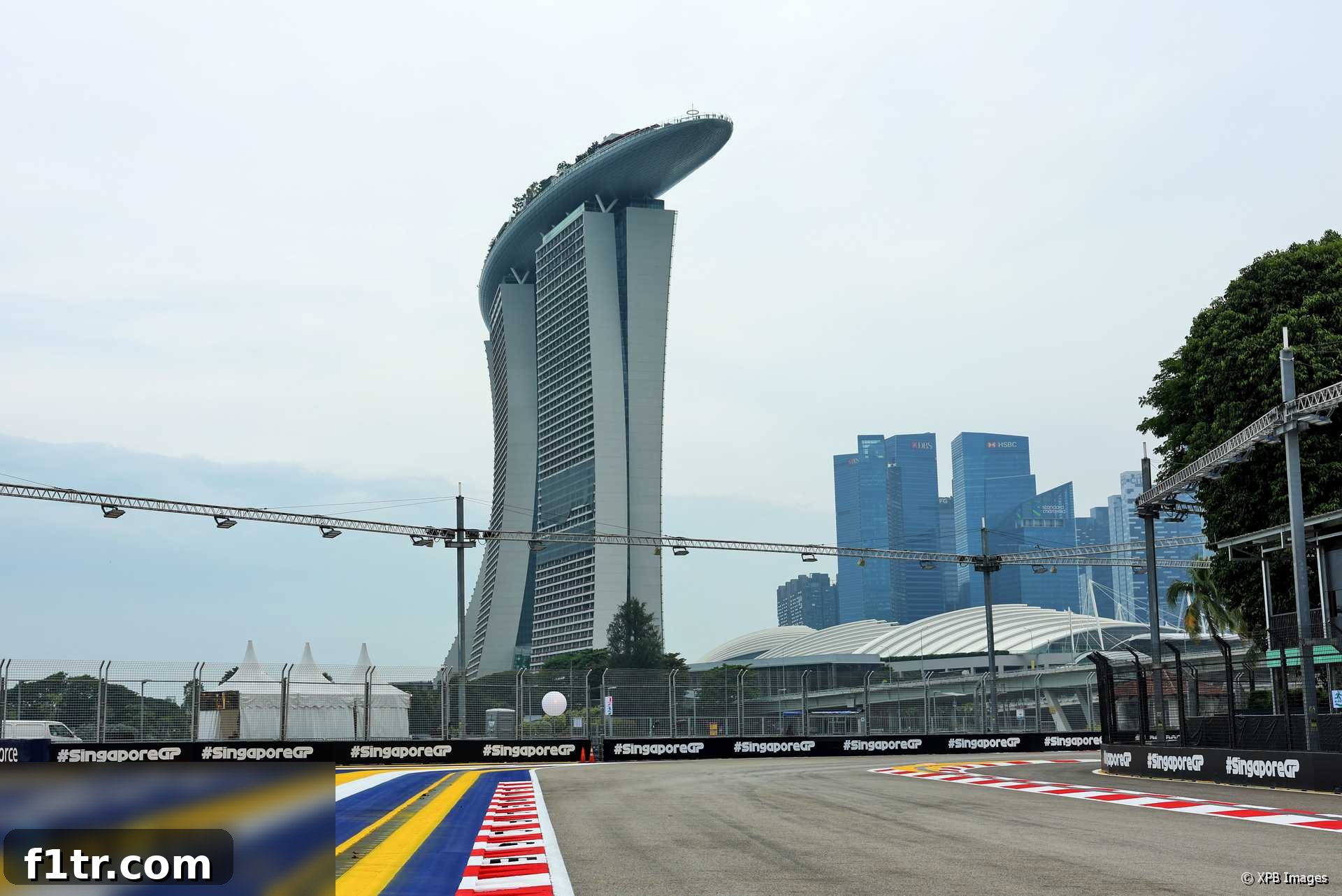
The circuit itself has undergone several modifications compared to last year, all designed to enhance racing and driver experience. The most impactful revision is the addition of a fourth DRS (Drag Reduction System) zone. This new zone runs along the revised section from Turns 14 to 16, which was itself introduced last year. Intriguingly, it utilizes the same detection point as the preceding zone from Turns 13 to 14. This creates an effective pairing of zones, offering drivers extended opportunities for overtakes and strategic advantages, potentially leading to more thrilling wheel-to-wheel action in Sunday’s race.
Beyond the DRS changes, the Marina Bay circuit has been extensively resurfaced for the 2024 event. According to FIA documentation, new asphalt covers sections from Turns 3 to 8, 10 to 12, 14 to 16, and 16 to 17. The specificity of the report, noting a small patch in Turn 16 retaining the old surface, indicates the meticulous nature of the updates. This fresh tarmac promises improved grip levels and potentially less tire degradation, which could shake up traditional strategies. Furthermore, the removal of fake grass from the run-off areas at Turns 2 and 3 should streamline recovery for drivers who might overshoot, reducing potential safety car interventions and enhancing the flow of the session.
Early Setbacks and Track Evolution in FP1
The practice session began with an immediate challenge for McLaren, as Oscar Piastri suffered a setback even before turning a wheel. A problem with his car during pit stop practice necessitated repairs to the rear-left corner, delaying his entry onto the circuit. While the team expressed optimism about getting him out before the session concluded, this early mechanical issue deprived the promising young driver of valuable track time on a demanding circuit where every lap counts.
As the session officially got underway, the Marina Bay circuit was bustling with activity. Almost every driver, with the unfortunate exception of Piastri, headed out immediately onto a noticeably dusty track. Initial lap times reflected the green and low-grip conditions, with Lando Norris setting the early benchmark for McLaren on a 1’35.522 using a set of medium compound tyres. However, the times quickly tumbled as more rubber was laid down and the track condition progressively improved, showcasing the rapid evolution typical of street circuits.
The pace escalated dramatically. Carlos Sainz Jnr initially went quickest for Ferrari with a 1’34.720 on the hard compound, demonstrating early potential for the Scuderia. Not to be outdone, Max Verstappen swiftly eclipsed this, beating Sainz’s time by three-tenths on mediums. But it was Norris who reclaimed the top spot, shaving over half a second off Verstappen’s benchmark to set a new target of 1’33.903, once again on the medium tyres. This early skirmish highlighted the competitive intent of McLaren and Red Bull right from the outset.
Amidst these rapid improvements, Mercedes’ George Russell experienced a more measured start. His engineer, Dudley, confirmed the quick track evolution: “Track is picking up very quickly. Norris on the medium a 33.9.” Russell, currently 3.7 seconds off the pace, opted for two cool-down laps before attempting to improve his time, a strategy often employed to manage tyre temperatures and prepare for a clean, fast lap.
The session wasn’t without its minor incidents. Sergio Perez briefly ran up the escape road at Turn 16, a testament to the unforgiving nature of the circuit, but expertly managed to extract his Red Bull and rejoin. Meanwhile, Piastri finally emerged from the garage, completing a slow installation lap, leaving only Daniel Ricciardo yet to register a time, another indication of the tight schedule and potential technical checks.
Yuki Tsunoda in the RB (formerly AlphaTauri) made a strong impression, sporting a thick splash of flow-vis paint on his rear wing – a clear sign of aerodynamic testing. He went quickest in the middle sector on medium tyres and set the fifth-fastest time with a 1’34.015, only to be narrowly beaten moments later by Franco Colapinto in the Williams. Colapinto’s promising pace, however, inadvertently disrupted Valtteri Bottas’ flying lap, with the Sauber driver reporting frustration over being “blocked by the Williams.”
As the session progressed, Charles Leclerc truly announced Ferrari’s intentions. The Monegasque driver vaulted to the top of the timesheets with a commanding 1’32.702. What made this even more impressive was that he achieved it on a set of hard tyres that had already completed 10 laps, indicating strong underlying pace and excellent tyre management from both driver and car. His time was almost half a second faster than Norris’s previous best, laying down a serious marker.
Williams’ Impressive Start and Soft Tyre Onslaught
Williams continued to show a resurgence in form, with Alexander Albon placing an impressive fourth on a set of hard tyres. This strong performance, building on the momentum from Baku, could be pivotal in their fight for seventh in the Constructors’ Championship. With just 13 points separating them from Haas, and Williams having out-scored their rivals 12-2 over the last two rounds, every point gained in practice and qualifying could be crucial for their championship aspirations.
As the session entered its final phase, teams began to bolt on the soft compound tyres, traditionally the fastest compound, to simulate qualifying runs. Lando Norris was the first to make the switch, prompting expectations of a session-topping time from the McLaren. Seconds later, both Max Verstappen and Lewis Hamilton followed suit, signaling the start of the ‘quali simulation’ phase.
Norris delivered, albeit with what appeared to be a somewhat ragged lap, still managing a 1’32.165 to put him over half a second clear at the top. Verstappen and Hamilton, pushing hard, recorded personal best sector times. The Red Bull driver ended up just two-tenths off Norris’s pace, while Hamilton was a further three-tenths back, indicating Mercedes might still have work to do to match the front-runners. This trio’s initial soft-tyre runs triggered a rapid shift, with almost every driver subsequently opting for the soft compound, including Leclerc, who had previously been fastest on hards.
Leclerc, now on softs, immediately went quickest of all in the middle sector – an impressive feat, especially considering Colapinto had briefly held that distinction before him. The Ferrari driver then slotted into fourth overall with a 1’32.451, behind Norris, Verstappen, and surprisingly, Alexander Albon, who managed to extract superb pace from his Williams on the soft compound.
The leaderboard continued to shuffle. A fantastic lap from Yuki Tsunoda briefly propelled him into second place, underscoring the potential of the RB car on this circuit. However, his glory was short-lived as Carlos Sainz Jnr then edged him out, going just a mere thousandth of a second slower than Norris, demonstrating the razor-thin margins at the top. Meanwhile, Bottas’s frustrations persisted, as he complained about being held up by “a Red Bull,” which was subsequently identified as Sergio Perez.
Leclerc, ever the perfectionist, found more time, closing the gap to Norris to just 0.037 seconds. Sainz, having received valuable insights from his team regarding where his teammate was gaining time, then slotted in right behind him, showcasing the internal competition and data sharing within Ferrari. Another relentless improvement from Leclerc eventually put the Ferrari firmly on top with a 1’31.763, an impressive 0.076 seconds faster than Norris. In a strategic move, the McLaren driver then switched back to his earlier set of seven-lap-old medium tyres, possibly to gather more data on long-run performance or to save his softs for later sessions.
Final Standings and Team Insights from FP1
As the chequered flag waved, signaling the end of the first practice session, Charles Leclerc’s commanding lap time stood unchallenged, firmly positioning Ferrari as a strong contender for the Singapore Grand Prix weekend. The session offered a compelling snapshot of team performances:
- Ferrari: 1’31.763 – Leclerc’s pace suggests Ferrari has found a sweet spot, particularly with their new front wing.
- McLaren: 1’31.839 (+0.076s) – Norris demonstrated competitive speed, but the gap to Leclerc indicates work remains. Piastri’s limited running was a clear disadvantage.
- Red Bull: 1’32.097 (+0.334s) – Verstappen was solid, but Red Bull appeared to be holding back or still fine-tuning for Singapore’s unique challenges. Perez faced brake issues.
- RB: 1’32.263 (+0.5s) – Tsunoda’s strong performance was a highlight, placing RB firmly in the midfield battle.
- Williams: 1’32.451 (+0.688s) – Albon continued Williams’ impressive run, indicating a genuine threat for points.
- Aston Martin: 1’32.610 (+0.847s) – A respectable start, with room for improvement in subsequent sessions.
- Mercedes: 1’32.679 (+0.916s) – Both Hamilton and Russell highlighted traction issues, suggesting fundamental setup challenges to overcome.
- Alpine: 1’32.694 (+0.931s) – A close fight within the midfield, Alpine showing reasonable pace.
- Haas: 1’33.377 (+1.614s) – Magnussen’s return provided some data, but the team has ground to make up.
- Sauber: 1’33.485 (+1.722s) – Bottas faced traffic, hindering his ability to extract full potential.
Challenges and Frustrations on the Streets of Singapore
Despite his early setback, Oscar Piastri managed to log a commendable 18 laps, a testament to McLaren’s quick repairs and his determination. However, his session nearly ended prematurely as he glanced the barrier at the exit of Turn 10, a stark reminder of the circuit’s unforgiving nature and the fine margins at play. This incident underscored the pressure on Piastri to quickly adapt and build confidence after missing crucial early running.
Lewis Hamilton voiced significant frustration over his car’s traction, complaining vehemently on team radio: “I’m trying to reduce the traction metrics. You guys have got to fix this man. I’m being as soft as I can.” This comment resonated with his struggles from the previous weekend’s race, where he was reportedly told his traction metrics were “2,000 higher than George’s,” leading to significant tyre overheating. Such issues on a traction-heavy circuit like Singapore will be a major concern for Mercedes.
Sergio Perez also reported a crucial issue, stating he “can’t stop the car with the front-right,” highlighting a potential braking imbalance or lock-up tendency that Red Bull will need to address urgently. Meanwhile, an interesting intra-team dynamic unfolded at Ferrari as Leclerc complained about his teammate, Sainz, getting in his way while preparing for a flying lap – a minor but common frustration on busy practice tracks.
The session concluded with Yuki Tsunoda expressing his discontent: “Mate, everything too late.” His race engineer, Ernesto Desiderio, offered reassurance, replying, “Yuki, we’re trying our best here.” This exchange perfectly encapsulated the frantic and often challenging nature of FP1, where teams are scrambling for data and optimal setup within a very limited timeframe.
Ultimately, Charles Leclerc’s exceptional pace secured Ferrari the top spot in the first practice session for the 2024 Singapore Grand Prix. While only practice, his performance, especially on older hard tyres and then delivering a strong soft-tyre lap, signals Ferrari’s strong potential this weekend. The session left teams with plenty of data to analyze and adjustments to make before the crucial qualifying sessions, promising an exciting and unpredictable remainder of the Singapore Grand Prix weekend.
For a full report on the 2024 Singapore Grand Prix First Practice session, click here.
2024 Singapore Grand Prix Further Reading
- Ricciardo’s brake woe and why Perez thought he had an engine problem: Singapore GP radio
- ‘Perez is only quicker when he has DRS’: How Hulkenberg’s Haas beat a Red Bull – again
- Mercedes explain “clear mistake” strategy call which left Hamilton “so angry”
- “Sometimes I wonder why I do this”: How Hamilton endured a slog to sixth in Singapore
- F1’s rules need surgery as well as sticking plaster after fastest lap controversy
Browse all 2024 Singapore Grand Prix articles