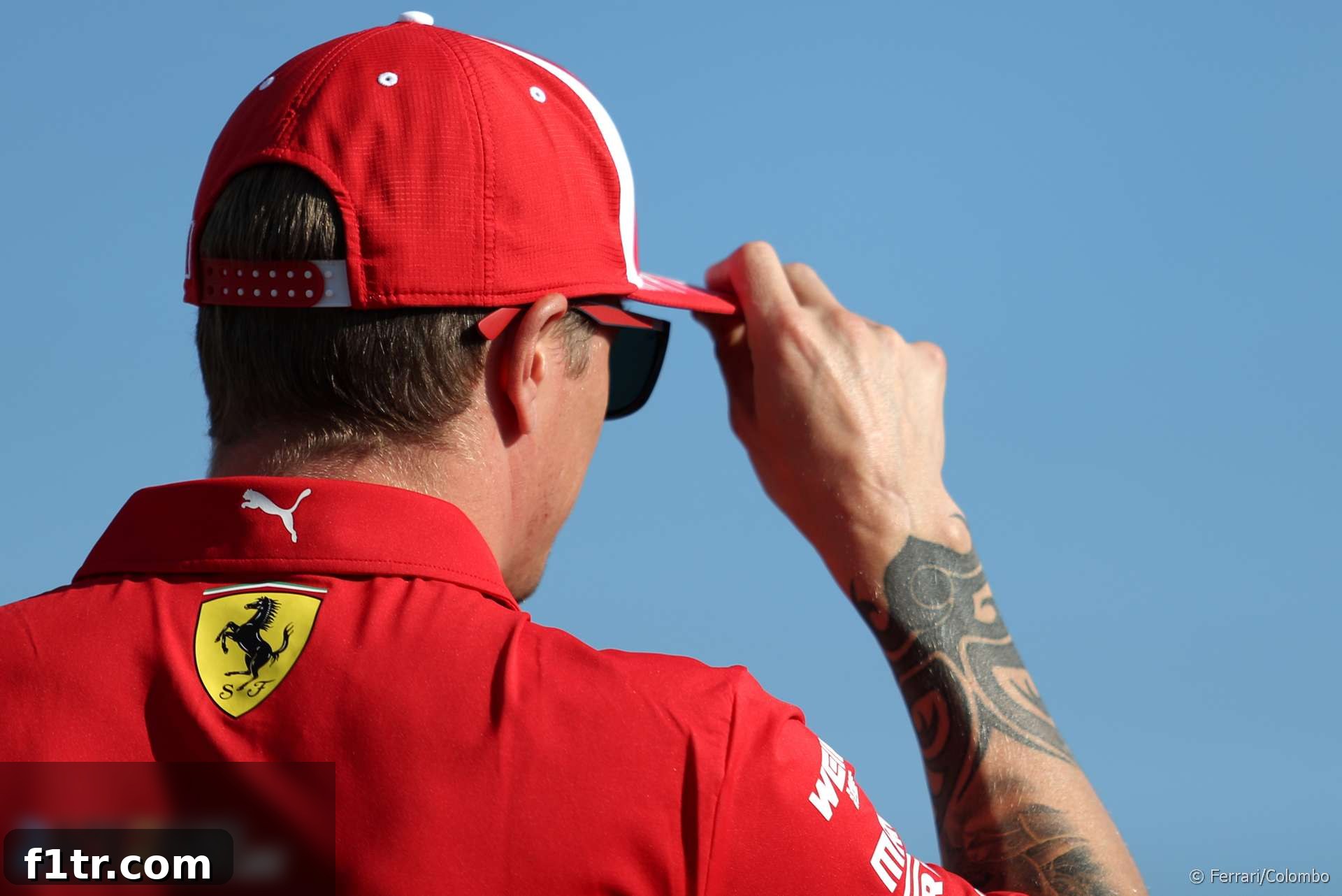
For the second time in his illustrious career, Kimi Räikkönen, often dubbed “The Iceman,” departed from the iconic Ferrari Formula 1 team. This move inevitably sparks debate: Was this a cold, calculated decision by Ferrari based on recent performance, or did sentimentality and external pressures once again lead to the premature release of their most recent world champion?
The history of Ferrari’s driver decisions is often complex and sometimes controversial. Consider the precedent set in 2009 when the Scuderia brought in Fernando Alonso. While many anticipated Räikkönen’s contract might be severed, the team chose to retain him over Felipe Massa. This was a particularly brutal call, given Massa was sidelined due to a severe injury. Such decisions highlight the high-stakes, often unsentimental nature of Formula 1, especially within a team like Ferrari.
Rumours had swirled that Räikkönen’s strong mid-season form, which included multiple podium finishes, might secure his position for another year. Even Louis Camilleri, Ferrari’s new CEO and a self-professed “dear friend” of Räikkönen, suggested at Monza that the final decision was still pending. However, the path was already set. Sergio Marchionne, Camilleri’s predecessor, whose unexpected passing earlier in the year sent shockwaves through the F1 world, had been a vocal and ardent supporter of Charles Leclerc. Marchionne’s clear preference for Leclerc to join Ferrari was ultimately honored, showcasing the enduring influence of his vision.
Few in the paddock would dispute that Charles Leclerc, undoubtedly one of the season’s breakout stars, had earned his chance in a top-tier team. His raw talent, blistering speed, and impressive maturity had caught the eye of many, making his promotion seem almost inevitable. Yet, this undeniable fact does not automatically imply that Räikkönen deserved to lose his seat. Ferrari’s typically concise press releases, exemplified by the mere 21 words announcing Leclerc’s arrival, offered no explicit justification for replacing a 20-time Grand Prix winner with a driver who, at that point, had only 14 Grand Prix starts under his belt. This silence from Maranello often fuels speculation and deeper analysis into the underlying reasons.
Analyzing Räikkönen’s Second Stint at Ferrari (2014-2018)
To truly understand Ferrari’s decision, one must delve into Räikkönen’s performance since his return to the team in 2014. A natural comparison arises with his predecessor, Felipe Massa. Has Räikkönen truly performed better than Massa in the same machinery? This question requires a nuanced look at various performance metrics.
Kimi Räikkönen, despite setting the fastest lap in Formula 1 history just ten days prior to this announcement, is not primarily known as a ‘one-lap specialist.’ His greatest strength has consistently been his race pace – his ability to manage tires, maintain consistent speed, and execute overtakes over longer runs. Therefore, it comes as little surprise that his qualifying statistics might not always measure up perfectly against certain teammates who excel in single-lap pace.
| Qualifying Scores | |||
|---|---|---|---|
| Felipe Massa | 17 | 57 | Fernando Alonso |
| Kimi Räikkönen | 3 | 16 | Fernando Alonso |
| Kimi Räikkönen | 22 | 51 | Sebastian Vettel |
Upon his return to Ferrari in 2014, Räikkönen partnered with Fernando Alonso, a driver widely considered one of the most complete and formidable talents of his generation. In line with expectations given Alonso’s extraordinary qualifying prowess, Räikkönen was significantly out-qualified, mirroring the struggles Massa had faced against Alonso in previous seasons. The comparison highlights the immense challenge of being paired with a driver of Alonso’s caliber.
However, Räikkönen’s qualifying record fared considerably better when paired with Sebastian Vettel. In 2016, a season where Ferrari strategically prioritized development for the significant 2017 rules changes, Räikkönen notably managed to out-qualify Vettel over the entire season. This achievement underscored his latent speed and ability to extract performance when the car suited his driving style. Nevertheless, this trend began to reverse in subsequent seasons. By the current year, Räikkönen’s qualifying performance had begun to resemble the challenging situation he faced against Alonso four years prior. While he might have started ahead of Vettel in two of the last three races leading up to this decision, this was largely an anomaly against the prevailing pattern of the season, where Vettel consistently held the upper hand on Saturdays.
Points Contribution and Teammate Comparisons
Ultimately, a driver’s contribution to their team’s championship aspirations is best quantified by the points they score. In every season since his 2014 return to Ferrari, Räikkönen never emerged as the team’s top scorer. However, a superficial glance suggests he performed better than his predecessor, Felipe Massa, in terms of points accumulation.
Felipe Massa, in his final three seasons with Ferrari, scored roughly half of Fernando Alonso’s points haul. While Räikkönen performed slightly worse in his initial season back alongside Alonso, his performance from 2015 onwards alongside Sebastian Vettel showed a more competitive points ratio. This raises an obvious and critical question: Was Räikkönen genuinely performing better than Massa, or was he simply held to a less exacting standard by competing against Vettel, rather than Alonso, over the last four seasons? The stark numbers from 2014, where Alonso utterly dominated Räikkönen, lend compelling weight to this argument.
Furthermore, one must consider the points Vettel squandered in the current season due to various errors – costly incidents in Baku, Paul Ricard, Hockenheim, and Monza significantly impacted his championship challenge. Had Vettel maintained a cleaner record, it would have been considerably more challenging to build a convincing case in favor of Räikkönen’s overall points contribution relative to his teammate.
Ferrari’s Unspoken Dynamics: A One-Driver Team?
Another crucial interpretation of Ferrari’s approach lies in its historical tendency to favor one driver more strongly than the other. This dynamic was most famously pronounced during the era of Michael Schumacher, where the team’s resources and strategy were unequivocally focused on supporting their lead driver. The stark fact that Ferrari had not achieved a race win with both of its drivers in a single season since 2008 raises pertinent questions about whether the team truly dedicates equal effort and resources to both cars. This potential imbalance could, in part, explain why a driver, even one as capable as Räikkönen, might struggle to secure victories or consistently outperform their designated number one.
The Unignorable Fact: A Winless Streak
Despite all the nuanced analyses of qualifying pace, points comparisons, and team dynamics, one stark fact looms large over Räikkönen’s second tenure at Ferrari: since his return in 2014, he has had a race-winning car in three out of five seasons, yet he has failed to secure a single victory. However favorably one assesses his efforts, and recalling near misses like Monaco and Hungary in the previous year where he could have easily triumphed, it remains an undeniable blot on his record. In the ultra-competitive world of Formula 1, particularly at a team like Ferrari, a winless streak in competitive machinery is often the ultimate determinant of a driver’s fate.
Beyond the Scuderia: Kimi’s New Chapter at Sauber
To Räikkönen’s immense credit, instead of contemplating retirement, he made a decisive choice to continue his racing career, signing with Sauber for 2019. This decision reflects his unwavering passion for the sport and his competitive spirit. His previous stint at Lotus famously demonstrated that when Räikkönen is placed within an unpolitical, no-nonsense team environment, and provided with a chassis that genuinely suits his driving style, he is capable of delivering his very best. It is entirely plausible that his performance at Sauber could surpass what has been witnessed from him since 2014, as he steps away from the intense scrutiny and pressure cooker environment of Ferrari.
Charles Leclerc’s Challenge and Räikkönen’s Enduring Legacy
Meanwhile, Charles Leclerc will make the inverse journey, stepping into Räikkönen’s seat at Ferrari. How Leclerc fares against Sebastian Vettel will provide invaluable further insight into whether Räikkönen was indeed “hard done by” or if his performance truly had stagnated. If Leclerc immediately shines and outperforms Vettel, it might suggest Räikkönen was indeed struggling to extract the car’s full potential. Conversely, if Leclerc faces similar challenges or finds it difficult to match Vettel, it could underscore the immense pressure and unique demands of driving for the Scuderia, potentially softening the judgment on Räikkönen’s final years.
Conclusion: A Complex Farewell for an F1 Icon
Kimi Räikkönen’s second departure from Ferrari is a multifaceted story, woven from threads of performance statistics, team politics, historical precedents, and the emergence of new talent. While Räikkönen’s unwavering popularity and occasional flashes of brilliance will be fondly remembered, Ferrari’s decision to promote Charles Leclerc signals a clear shift towards securing their future. It was a move driven by a desire for renewed vigor and a long-term vision, yet it doesn’t diminish Räikkönen’s significant contributions or the enduring enigma of his time at Maranello. As Räikkönen embarks on a new chapter with Sauber and Leclerc takes on the immense challenge at Ferrari, the F1 world will watch keenly, eager to see how these pivotal career moves shape the narratives of two very different, yet equally compelling, drivers.
2018 F1 Season Highlights and Related Articles
- F1 Feared “Death Knell” for Drive to Survive After Ferrari and Mercedes Snub
- McLaren Staff Told Us We Were “Totally Crazy” to Take Honda Engines in 2018 – Tost
- “It Doesn’t Matter If We Start Last”: How Red Bull’s Junior Team Aided Honda’s Leap Forward
- Honda’s Jet Division Helped F1 Engineers Solve Power Unit Problem
- McLaren Racing Losses Rise After Honda Split
Browse all 2018 F1 season articles