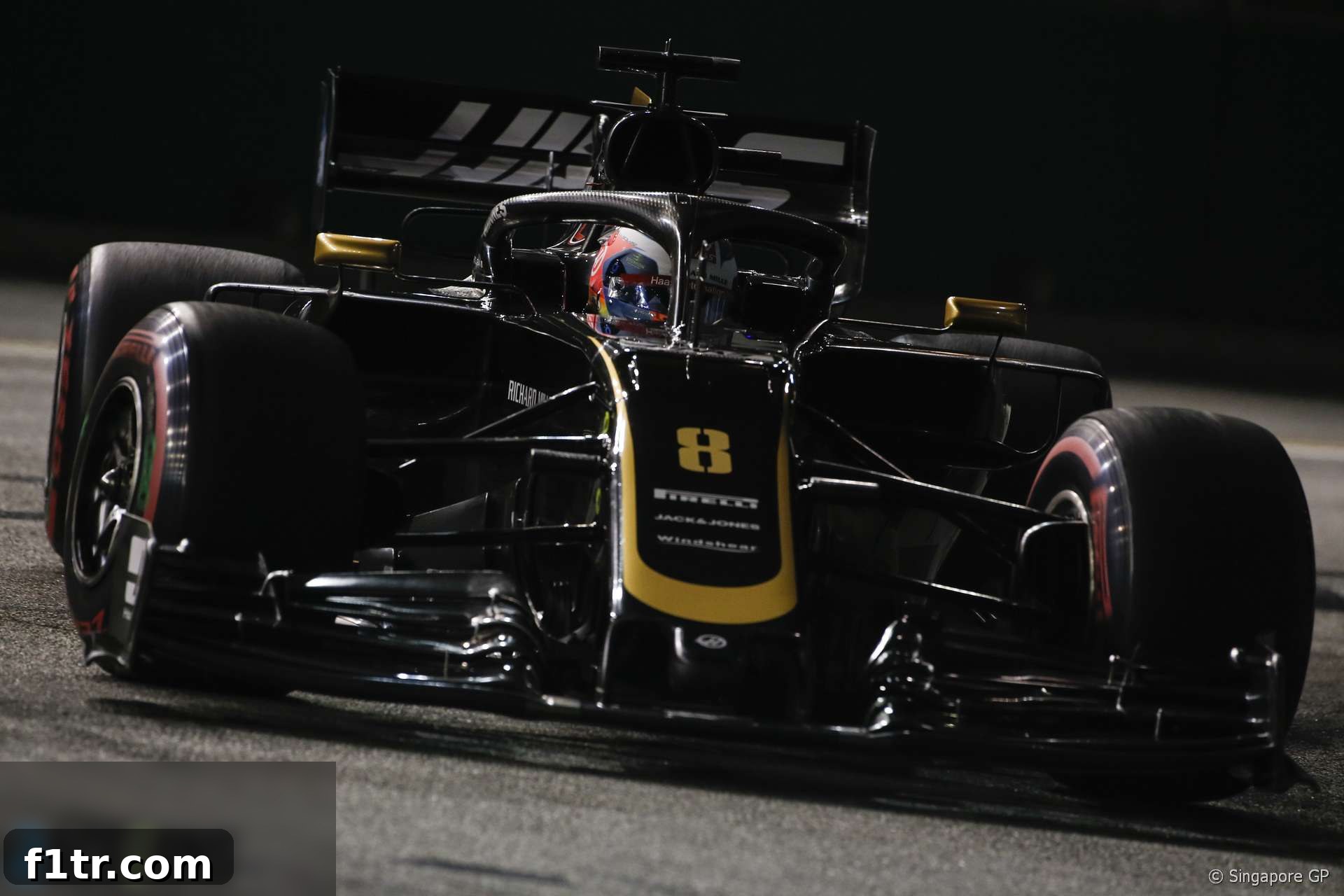
In the high-stakes world of Formula 1, where split-second decisions and aggressive racing define championship battles, incidents on track are an inevitable part of the spectacle. One such moment unfolded during the thrilling 2019 Singapore Grand Prix, involving then-rookie George Russell and seasoned competitor Romain Grosjean. Their collision, which led to Russell’s retirement from the race, sparked immediate debate, but ultimately concluded with a significant ruling from the race stewards: no penalties would be issued to either driver.
The incident occurred on the challenging Marina Bay Street Circuit, notorious for its tight turns and unforgiving walls, which often amplify the consequences of even minor contact. As the Grand Prix unfolded, both Russell, driving for Williams, and Grosjean, representing Haas F1, found themselves locked in a wheel-to-wheel battle for position. The critical moment arrived as the two cars navigated the intricate sequence of Turns 7 and 8.
According to the detailed report from the stewards, the sequence began as the drivers exited Turn 7. Grosjean, having gained momentum, made a move on Russell on the outside approach to Turn 8. By the entry point of Turn 8, Grosjean’s car was fully alongside Russell’s, a clear indication of intense, close-quarters racing. As they proceeded through the apex of Turn 8, Grosjean maintained his position on the outside. However, Russell, having secured the inside line, began to pull ahead slightly as the corner progressed.
The stewards’ investigation meticulously analyzed telemetry data, onboard camera footage, and driver testimonies to piece together the events. Their conclusion highlighted a classic ‘racing incident’ scenario. They determined that as both cars exited Turn 8, each driver steadfastly held their chosen racing line. The critical factor leading to the contact was that these lines, while individually legitimate, regrettably converged. With both Russell and Grosjean pushing the limits and racing fiercely for every inch of track, the unavoidable consequence was a collision.
This ruling underscored a fundamental principle in motorsport officiating: when evaluating on-track incidents, stewards aim to determine if one driver is “wholly or predominantly at fault.” In this particular case, the stewards found that the responsibility was shared. Their official statement articulated this clearly, noting that “both drivers contributed to the incident, and that both drivers could have mitigated the incident.” This assessment led to the crucial decision: since neither driver was deemed solely or overwhelmingly responsible for the contact, no further action, such as a time penalty or grid drop, was deemed appropriate.
The outcome, while decisive, did not quell the immediate reactions from the drivers involved. George Russell, clearly frustrated by his early exit from the race, was quick to attribute blame to his competitor. He publicly accused Grosjean of not utilizing the available track space at the corner’s exit, suggesting that the Haas driver had room to maneuver and avoid the contact. Russell’s perspective, common among drivers in the heat of the moment, emphasized what he perceived as a preventable error by Grosjean, failing to grant sufficient racing room. For a rookie driver like Russell, every lap and every position gained was crucial for experience and team morale, making such an early retirement particularly bitter.
Romain Grosjean, however, offered a contrasting view. The experienced Frenchman staunchly maintained that he had no additional space to prevent the collision. From his vantage point, he was committed to his line, fighting for position, and felt he had been left with insufficient room by Russell as the lines tightened. Grosjean’s defense highlighted the often-subjective nature of on-track judgments, where each driver’s perception of “available space” can differ significantly based on their position, speed, and immediate objectives. This divergence in opinion is a recurring theme in F1, illustrating the fine margins and intense pressures under which drivers operate.
The stewards’ decision to classify the incident as a “racing incident” without assigning blame to either party is a testament to the complexities of Formula 1 racing. It acknowledges that in the pursuit of performance, drivers will inevitably push boundaries, leading to situations where contact is a consequence of hard racing rather than malicious intent or clear negligence. Such rulings are vital for maintaining the competitive spirit of the sport, encouraging drivers to race wheel-to-wheel without excessive fear of retrospective penalties for every minor touch, while still deterring truly dangerous or reckless driving.
For George Russell, then in his debut season with Williams, the incident represented another challenging moment in a year marked by learning and battling at the back of the grid. While frustrating, it also served as a valuable lesson in managing close-quarters racing and dealing with the aftermath of on-track incidents. For Romain Grosjean, who has had his fair share of controversial moments throughout his career, the non-penalty outcome was a relief, allowing him to continue his race without further impediment or reputational damage. The 2019 Singapore Grand Prix itself was a memorable event, and this particular collision, despite not resulting in penalties, added another layer of intrigue to the race’s narrative, sparking discussions among fans and pundits about racing etiquette and the role of the stewards.
In essence, the George Russell and Romain Grosjean collision at the 2019 Singapore Grand Prix serves as a prime example of the delicate balance between aggressive racing and fair play in Formula 1. The stewards’ meticulous approach and reasoned judgment allowed for a decision that upheld the competitive nature of the sport, acknowledging the shared responsibility when two drivers, operating at the very limit, find their paths converging on the unforgiving confines of a street circuit. It was a stark reminder that in the heat of battle, even the most experienced and talented drivers can find themselves caught in a moment where a collision becomes an unfortunate, yet unpunishable, consequence of racing hard.
Stay Connected with the World of F1
Never miss a beat from the exhilarating world of Formula 1! Join our vibrant community and keep up-to-date with all the latest news, analyses, and exclusive content from every Grand Prix. Engage with fellow enthusiasts and dive deeper into the sport you love.
- Connect with us on Facebook for daily updates
- Follow our Twitter feed for breaking news and live commentary
- Subscribe to our daily email newsletter for comprehensive F1 insights straight to your inbox
Explore More from the 2019 F1 Season
The 2019 Formula 1 season delivered countless memorable moments, from thrilling overtakes to unexpected podiums and significant off-track developments. Delve into our archives to revisit key events and stories that shaped that remarkable year. Below is a selection of related articles offering deeper insights into the championship and its many facets:
- Crying in the Melbourne car park at 2019 grand prix was my career low – Ocon
- McLaren Racing reports reduced £71 million loss in 2019
- Kvyat: Hockenheim podium last year was “my biggest achievement” so far
- How the FIA’s new encrypted fuel flow meter targets Ferrari’s suspected ‘aliasing’ trick
- “He smashed my office door”: 23 must-see moments from ‘Drive to Survive’ season two
Browse all 2019 F1 season articles