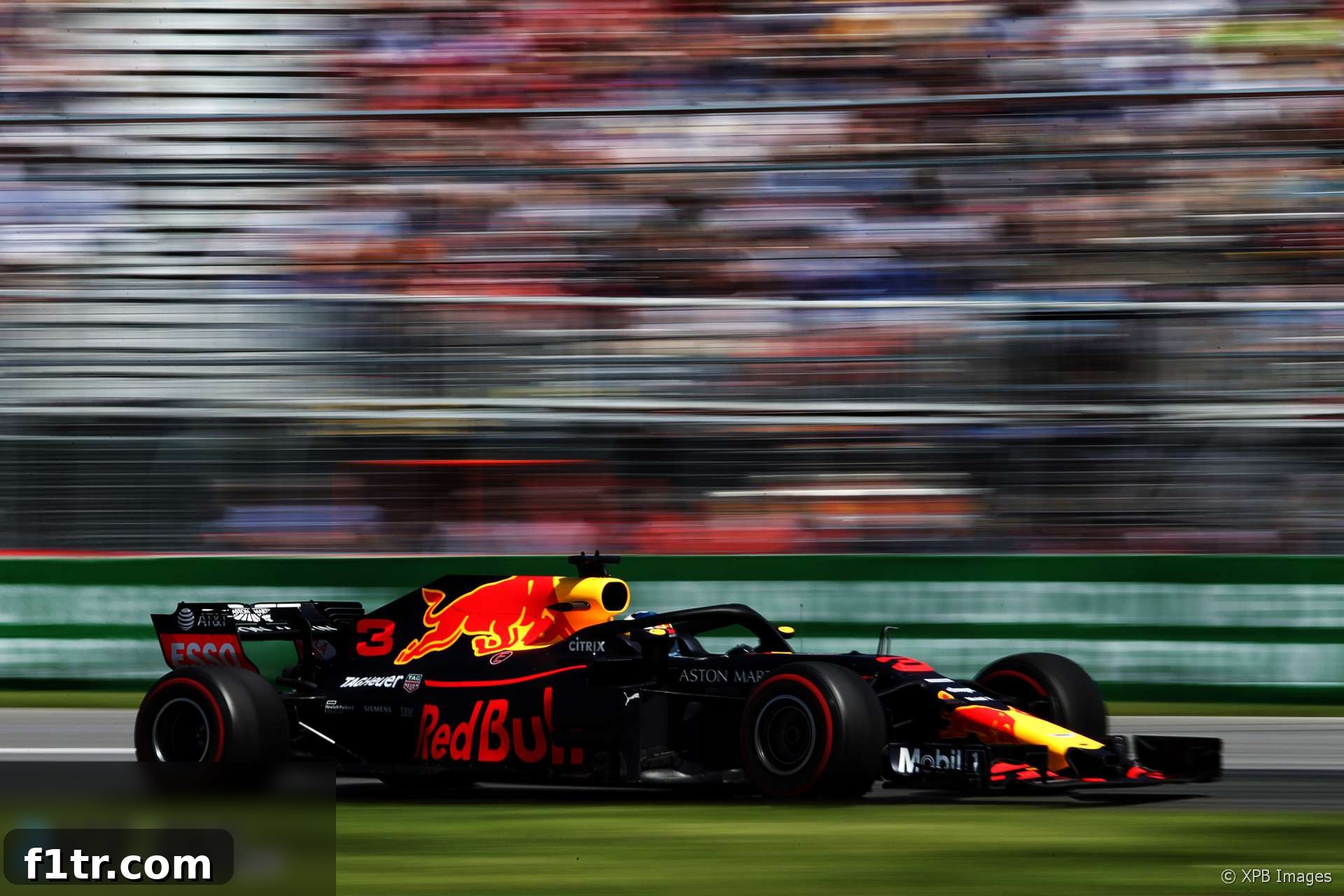
Red Bull Racing has made a critical component change on Daniel Ricciardo’s car, replacing a part on his MGU-K unit without incurring a penalty, a move that signals the team’s meticulous approach to navigating Formula 1’s stringent power unit regulations. This development comes at a crucial juncture in the season, as teams push the boundaries of performance while carefully managing the finite number of components permitted under FIA rules.
The MGU-K, or Motor Generator Unit – Kinetic, is a vital component of Formula 1’s hybrid power units. It’s responsible for recovering kinetic energy from braking and converting it into electrical energy, which can then be deployed to boost acceleration. Its efficiency and reliability are paramount to a car’s overall performance and lap times. Teams are allowed a limited number of these complex and expensive components per season, and exceeding that allocation typically results in grid penalties, significantly hindering a driver’s race prospects.
For Daniel Ricciardo, this MGU-K situation has been a recurring concern. He had already utilized two new MGU-K units earlier in the season. Under the current regulations, deploying a third new MGU-K would trigger an automatic grid penalty, forcing him to start further down the field. To circumvent this, Red Bull’s strategy this weekend involved reintroducing an older, previously used MGU-K unit into his car. This tactical decision highlights the delicate balance teams must strike between optimizing performance and avoiding detrimental penalties.
The FIA, Formula 1’s governing body, confirmed on Friday that Red Bull had indeed replaced a transmission fastener on Ricciardo’s MGU-K. This procedure necessitated breaking one of the official FIA inspection seals, which are put in place to ensure compliance and prevent unauthorized modifications to power unit components. However, the FIA’s technical regulations, specifically appendix two, item 13, explicitly permit the replacement of certain parts, such as this transmission fastener, without incurring a penalty. This nuance in the rulebook allowed Red Bull to address a potential issue with the unit without jeopardizing Ricciardo’s starting position for the race. Such intricate details of the regulations often become critical in a championship battle, as teams continuously seek any legitimate advantage or means to mitigate potential disadvantages.
This MGU-K adjustment was not the only significant change to Ricciardo’s car this weekend. He also received a comprehensive upgrade package from engine supplier Renault, featuring a new engine, turbocharger, and MGU-H (Motor Generator Unit – Heat). The MGU-H is another critical component of the hybrid system, recovering energy from the exhaust gases. This ‘B-spec’ power unit upgrade was eagerly anticipated by Red Bull, promising enhanced performance and reliability. However, the initial rollout of these new components proved challenging. Ricciardo experienced significant installation problems, which unfortunately led to a considerable loss of track time during both practice sessions on Friday.
The Australian driver expressed his frustration regarding the issues, stating, “We had some problems this morning and they tried to fix it during lunch but it didn’t improve. We had to try and fix that. In the end it was a bit better but we made some improvements.” His comments underscore the intricate nature of integrating new power unit elements. Even seemingly minor installation glitches can have a profound impact on a car’s balance, performance, and the driver’s ability to gather crucial data and fine-tune the setup for qualifying and the race. Lost practice time can be particularly damaging, especially when introducing a major upgrade package, as it limits the opportunity to understand and optimize its full potential. The team’s engineers faced immense pressure to resolve these teething problems swiftly, ensuring Ricciardo could extract maximum performance from the upgraded package when it truly counted.
Ricciardo’s teammate, Max Verstappen, also underwent a component change this weekend, but for his gearbox. Importantly, Verstappen was able to do so without incurring a penalty. This exemption was due to his previous gearbox having been replaced at the Monaco Grand Prix, a circuit notorious for its demanding nature on mechanical components. Formula 1 regulations stipulate that a gearbox must be used for six consecutive race weekends. If a replacement is made before this cycle is complete, a grid penalty is issued. However, if a gearbox is replaced due to an incident or deemed irreparable, and the team can demonstrate this to the FIA, a penalty may be waived or the ‘six-race rule’ reset under certain conditions, as was the case for Verstappen in Monaco.
Verstappen was not alone in making a strategic gearbox change. Several other prominent drivers also had new gearboxes fitted for this weekend’s event, all without incurring penalties. These included Sebastian Vettel, Kimi Raikkonen, Sergio Perez, Lance Stroll, Carlos Sainz Jnr, Fernando Alonso, and Charles Leclerc. In each of these instances, the drivers had successfully completed the required six consecutive races with their original gearboxes. This timing allows teams to introduce fresh components, often new-spec units or simply ensuring peak reliability, without the associated grid demotion. It’s a common tactical move in Formula 1, carefully planned to maximize performance at key races or to ensure durability through demanding parts of the calendar. The ability to swap out an older gearbox for a new one, penalty-free, offers a crucial advantage in maintaining competitive edge and preventing potential mechanical failures that could prematurely end a race.
The meticulous management of power unit components and gearboxes is a testament to the immense complexity and strategic depth of modern Formula 1. Every decision, from a minor fastener replacement to a full engine upgrade, carries significant implications for performance, reliability, and championship aspirations. Red Bull’s handling of Ricciardo’s MGU-K, alongside the team’s ongoing efforts to integrate Renault’s ‘B-spec’ engine, demonstrates the relentless pursuit of perfection and the necessity of navigating the sport’s technical rulebook with utmost precision. As the season progresses, these strategic component changes will undoubtedly continue to play a pivotal role in the ever-evolving battle for supremacy on the track.
Stay Connected with Latest F1 News
Follow us on social media for real-time updates and exclusive content:
- Join us on Facebook
- Follow us on Twitter
- Get daily email updates directly to your inbox
Explore More Formula 1 Content
Dive deeper into related topics and previous seasons:
- F1 Technical Regulations Explained: Power Units and Penalties
- Red Bull and Ricciardo: A Season of Highs and Lows
- The Evolution of Renault F1 Power Units
- F1 Gearbox Strategy: Timing Your Component Changes
- Driver Performance: The Impact of Mechanical Issues
Browse all Formula 1 Season Analysis articles