Formula E Race Director Scot Elkins Explains Diriyah E-Prix Safety Car Incident Amid Safety Concerns
Advert | Become a Supporter & go ad-free
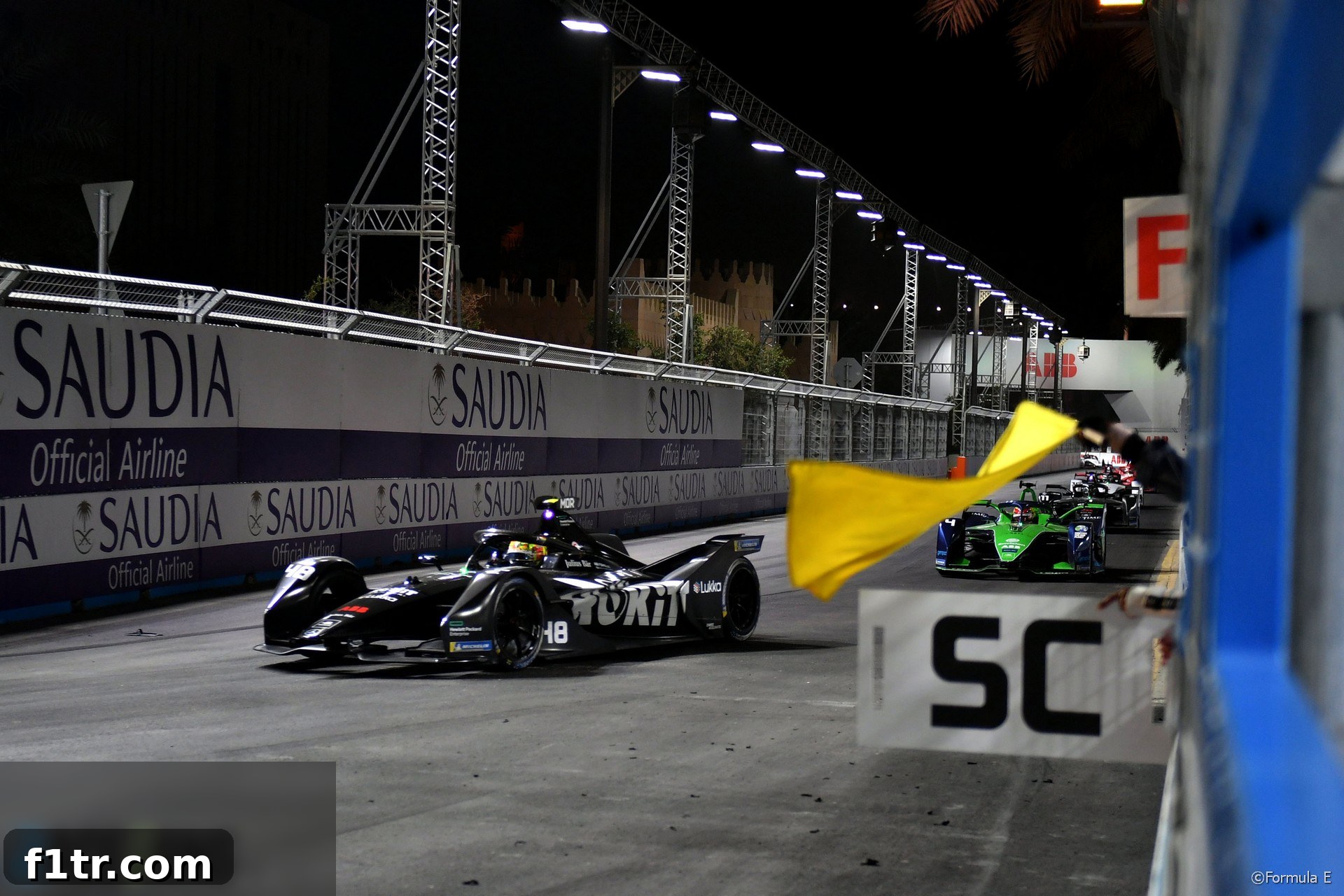
In the aftermath of a contentious Safety Car period during the Diriyah E-Prix, FIA Formula E Race Director Scot Elkins has offered a comprehensive defense of his team’s actions, insisting that “all safety measures were taken into account.” The second race of the weekend in Saudi Arabia concluded under a shroud of debate following a late-race incident involving Alexander Sims and his Mahindra, which triggered a sequence of events that raised significant safety questions among drivers and spectators alike.
With just under ten minutes remaining in the thrilling electric vehicle race, Alexander Sims experienced a spin at Turn 6. This incident necessitated the deployment of the Safety Car, a standard procedure designed to neutralize the race and allow marshals to safely attend to the stricken vehicle. However, what transpired next led to alarming scenes on the track, sparking widespread concern and prompting a detailed explanation from the race director.
The Diriyah E-Prix Incident: A Timeline of Concern
The initial deployment of the Safety Car was standard, but the subsequent recovery operation quickly deviated from expectations. A telehandler vehicle, dispatched to recover Sims’s Mahindra, appeared to block a significant portion of the narrow street circuit. This obstruction caused the Safety Car and the entire field of competing vehicles to bunch up suddenly, leading to several drivers making contact with the cars ahead of them. The immediate aftermath saw drivers reacting sharply, with Robert Frijns notably describing the incident as “quite dangerous,” a sentiment echoed by many in the paddock and among the fanbase.
Compounding the anxieties, as Sims’s vehicle was being recovered, cars continued to pass alarmingly close to the suspended Mahindra. Astonishing footage showed Mitch Evans’s Jaguar driving past while the dangling Mahindra was precisely in line with the Halo safety device on his car. This close proximity to a suspended, potentially unstable vehicle under Safety Car conditions ignited a passionate debate on social media about the adequacy of the safety protocols and the decision-making process during the critical moments of the race.
Scot Elkins’ Defense: Navigating Safety and Strategy
Addressing the press, including RaceFans, about the controversial late Safety Car and the decision not to red flag the race, Scot Elkins explained the rationale behind the race control’s actions. Elkins clarified that the primary intention was to manage the incident swiftly and efficiently, bringing the race to a natural conclusion without further significant disruption. He admitted that the recovery process for the Mahindra took considerably longer than anticipated, which contributed to the unforeseen complications.
“It should have been very smooth,” Elkins explained, detailing the pre-planned logistics. “We know where the equipment is, we know where the incident is and then we know where we’re taking the car after we retrieve it.” He further elaborated on the specific setup for the Diriyah E-Prix, noting, “In this case, we had equipment at Turn 5, we had an incident between Turns 7 and 6 and we had a hole at Turn 8.” The race director was confident that, based on historical data and previous experiences, such a recovery operation should have been completed within approximately four minutes. “So, really, it should’ve been very simple to just come out, pick it up and move it and drop it off and go back to racing – and that was the intention. And again, based on our historical references and what we’ve seen in the past, that should have taken about four minutes and then it didn’t, and that was the issue.”
Addressing the widespread concerns about the potential dangers of drivers passing close to the suspended car, Elkins unequivocally stated that he and his team had taken every reasonable step to ensure the safe recovery of the car and the safety of the drivers. He highlighted a key measure taken to mitigate risk: “I think everybody would notice that the Safety Car slowed down to under 10km/h going through there, almost to the point of where the entire field stopped.” This extreme reduction in speed was a deliberate decision to enhance safety, allowing recovery personnel ample space and time, and minimizing the risk posed by the proximity to the lifting vehicle and the suspended car.
The Challenges of Street Circuits and Acknowledged “Error”
Elkins also underscored the unique difficulties presented by street circuits, which are inherently narrower and offer less margin for error compared to purpose-built race tracks. “But, again, as a street circuit, it’s narrow. It’s difficult to do that,” he acknowledged. Despite these challenges, he maintained that all essential safety protocols were in place. “But we were taking all of those safety measures into account – again, really slowing the safety car down really, really slowly.”
However, Elkins did admit to one crucial communication oversight during the intense moment. “That’s probably the one error – of not giving everybody a heads up that the Safety Car was slowing down, because it did back up a little bit and was a little bit discombobulated.” This lack of immediate communication about the unusually slow pace was identified as the root cause of the sudden bunching and minor collisions within the field. Despite this, he stressed that the underlying safety measures were robust: “But it surely wasn’t anything that we were doing in any way that we wouldn’t normally do on a street circuit.”
Street Circuits: The Unique Demands of Formula E Safety
The incident at Diriyah serves as a stark reminder of the inherent complexities and unique safety challenges associated with motorsport on street circuits. Unlike permanent tracks with expansive run-off areas and strategically placed recovery zones, temporary street circuits are characterized by their tight confines, unforgiving barriers, and limited space for emergency operations. Formula E, by its very nature, thrives on bringing electric racing to the heart of global cities, making these urban environments an integral part of its identity. This commitment, however, means that race control must constantly navigate a delicate balance between delivering thrilling, close-quarters racing and maintaining the highest possible safety standards for drivers, marshals, and spectators.
Managing incidents on such circuits demands instantaneous, precise decision-making, where seconds can determine the outcome of a potentially dangerous situation. The Diriyah incident highlighted how quickly a routine Safety Car procedure can escalate into a precarious scenario when unforeseen variables, such as a telehandler obstructing the track, come into play. It also brings into focus the continuous evolution of safety protocols within motorsport, particularly in a relatively young and innovative series like Formula E, which constantly pushes boundaries both on and off the track.
Reactions and Future Implications for Motorsport Safety
The strong reactions from drivers like Robert Frijns, coupled with the considerable fan outcry on social media, underscore the critical importance of transparent and effective safety management in motorsport. Such incidents inevitably lead to intense scrutiny from the FIA, the sport’s governing body, which typically conducts thorough post-event reviews to identify areas for improvement. While Scot Elkins’ explanation provides valuable insight into race control’s perspective, the discussions generated by the Diriyah E-Prix highlight the ongoing need for continuous enhancement of safety guidelines, communication systems, and marshal training, especially in dynamic environments like street circuits.
Ensuring future safety in Formula E, and indeed all motorsport categories, is a collaborative endeavor involving race directors, teams, drivers, and governing bodies. Lessons learned from incidents like this are invaluable, leading to potential refinements in Safety Car procedures, clearer communication protocols for extreme slowdowns, and even advancements in vehicle recovery technology and techniques. Ultimately, the commitment to driver and marshal safety remains paramount, even as Formula E strives to deliver the exhilarating, unpredictable racing that its global fanbase has come to expect.
Formula E
- McLaren to quit Formula E at end of season
- Wehrlein beats Jaguar pair to title in dramatic Formula E finale
- Wehrlein’s London win sets up thrilling three-way title showdown in finale
- Da Costa takes hat-trick of wins in chaotic second Portland race
- Da Costa inherits Portland win from Evans after Cassidy spins lead away
Browse all Formula E articles