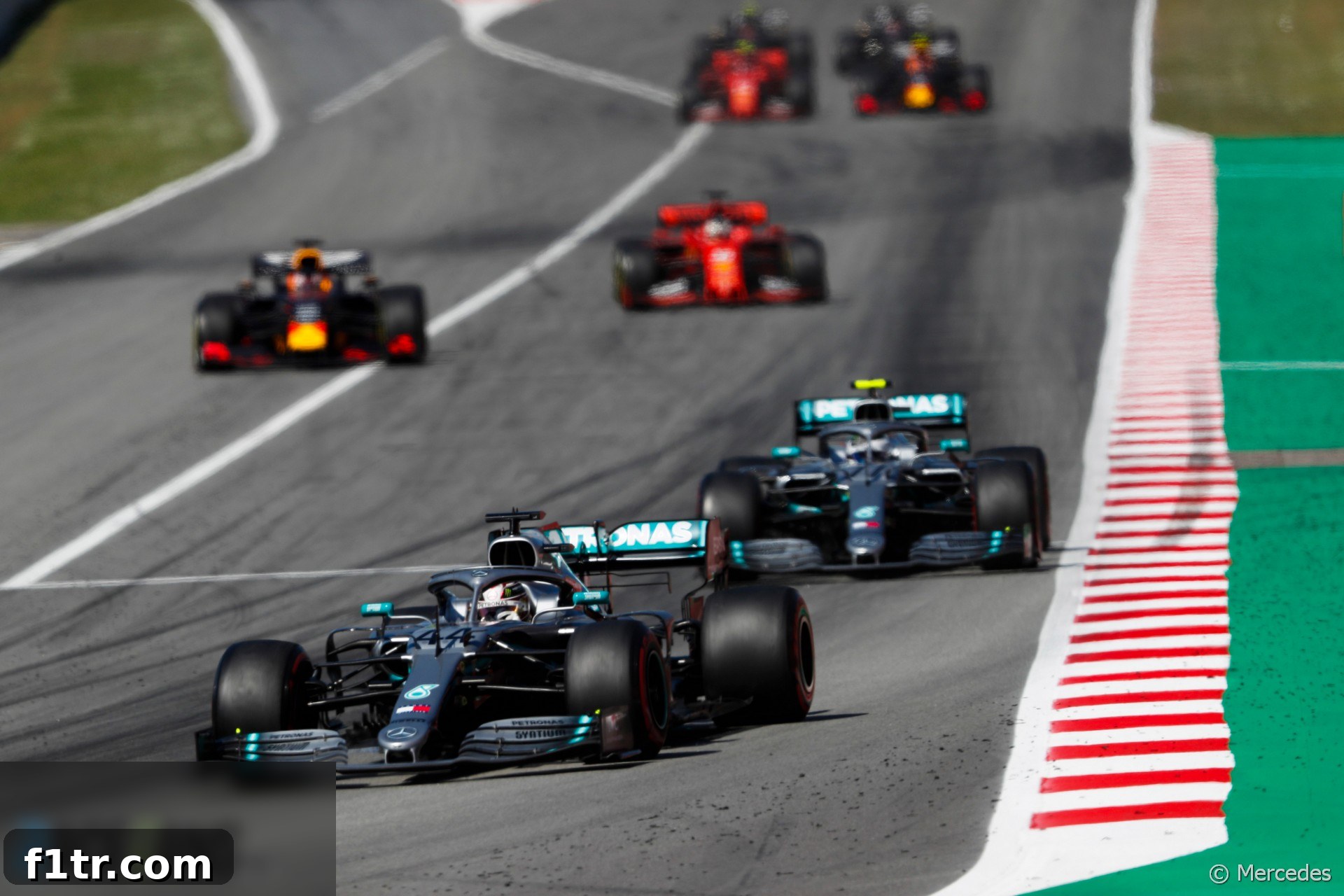
Lewis Hamilton Dominates Spanish Grand Prix with Strategic Fastest Lap Amidst Mercedes Team Orders
The 2019 Formula 1 season introduced a compelling new element to Grand Prix weekends: a bonus point for the driver who set the fastest lap, provided they finished within the top ten. This seemingly minor tweak to the regulations quickly proved to be a significant strategic factor, adding another layer of intrigue to races and often sparking a late-race scramble. Nowhere was this more evident than at the 2019 Spanish Grand Prix, where Mercedes-AMG Petronas Motorsport commanded a dominant one-two finish, yet the battle for that single fastest lap point became a focal point of intra-team strategy involving both Lewis Hamilton and Valtteri Bottas.
The Circuit de Barcelona-Catalunya, known for its challenging layout and often processional races, saw Mercedes once again demonstrate their formidable pace. After a safety car period in the closing stages of the race, the field bunched up, setting the stage for a tense restart and opening a window for drivers to push for that coveted extra point. It was in this critical phase that Lewis Hamilton, ever the opportunist, seized the initiative, ultimately claiming the fastest lap with an impressive time of 1’18.492 on the second lap following the safety car’s withdrawal.
Hamilton’s Masterclass: Seizing the Fastest Lap Advantage
Lewis Hamilton, already in a commanding lead, was acutely aware of the strategic value of the fastest lap point. With the field neutralised by the safety car, tires were cooler, and the potential for a final push was ripe. Hamilton recounted his approach, highlighting his team’s timely reminder and his calculated execution. “The team reminded me about the fastest lap,” Hamilton explained, indicating the constant communication and strategic focus within Mercedes. “I went for it, I can’t remember what lap it was, but initially I pulled a really nice gap, like five seconds after a couple of laps, a really good couple of decent laps, and then I think after that I did the fastest lap. Then I was about to go again but they said that I had it.”
This illustrates Hamilton’s meticulous approach; rather than simply chasing a lap time, he first ensured he had sufficient clear air ahead to unleash the car’s full potential without being compromised by dirty air from his teammate. Building a five-second buffer allowed him the freedom to push the limits, managing his tires and battery to extract the maximum performance exactly when it mattered. This calculated burst of speed not only secured the fastest lap but also underscored his ability to manage various race-ending scenarios, securing every available point for his championship campaign.
Bottas’s Challenge and the Imposition of Team Orders
While Hamilton celebrated his extra point, Valtteri Bottas found himself in a familiar and often frustrating position behind his teammate. Bottas, too, had made an attempt to snatch the fastest lap, demonstrating his own ambition and desire to maximise his points haul. His effort, however, came with the inherent disadvantage of running in Hamilton’s wake, a challenge he openly acknowledged. “The first lap of the restart I tried to see if there’s any opportunity for me to get him,” said Bottas, referring to his initial thought of challenging for the lead. When that opportunity didn’t materialise, his focus shifted to the fastest lap.
Bottas continued: “There wasn’t, so the next lap I went to charging mode on the battery so I fully charged it, tried the lap after but I felt I’d already lost the edge of the new tyre. So Lewis had it one lap earlier so he got it. Obviously for me being right behind him it’s quite impossible with the same car to set a quicker lap time.” This candid admission highlights the significant aerodynamic disadvantage faced by a car following closely behind another, often referred to as “dirty air.” Even with a fully charged battery and fresh tires (relatively speaking after the safety car), the loss of aerodynamic grip makes it incredibly difficult, if not impossible, to match or surpass a time set by a leading car in clean air, especially when both vehicles are identical Mercedes W10s.
Bottas’s quickest time stood at 1’18.737, a mere 0.245 seconds slower than Hamilton’s benchmark. Soon after his attempt, the clear directive from the Mercedes pit wall came through his radio: “OK Valtteri so instruction you’re not going for fastest lap until the end, Lewis has got fastest lap.” This communication explicitly signalled the team’s decision to consolidate Hamilton’s fastest lap point and prevent any unnecessary risks or energy expenditure by Bottas. It was a clear example of team orders being strategically deployed to protect a valuable championship point and manage the race outcome.
The Strategic Implications of Mercedes Team Orders in F1
Team orders are an integral, albeit often controversial, aspect of Formula 1. In the context of the 2019 Spanish Grand Prix, Mercedes’ decision to instruct Bottas to back off from pursuing the fastest lap was a calculated strategic move. With Hamilton having already secured the point, further attempts by Bottas posed several risks:
- Unnecessary Stress on Components: Pushing for a fastest lap requires maximum attack, potentially stressing the engine, gearbox, and tires. With a comfortable one-two already secured, Mercedes had no incentive to take such risks.
- Fuel Consumption: A flat-out lap consumes more fuel, which could be critical if there were unforeseen late-race events or fuel management issues.
- Risk of Error: Driving at the absolute limit, even in clear air, carries an inherent risk of a driver error or an off-track excursion, which could jeopardise a one-two finish.
- Consolidating Championship Points: Mercedes, a team renowned for its meticulous attention to detail and championship strategy, would have viewed Hamilton’s fastest lap as a confirmed point that didn’t need further contestation, especially from within their own garage.
This decision also subtly reinforced the pecking order within the team, a dynamic often at play in F1. While both drivers were theoretically free to race, the team’s overarching goal was always to maximise constructors’ and drivers’ championship points, and in 2019, Hamilton was the leading contender for the drivers’ title.
The Intricate Battle Within: Hamilton vs. Bottas in 2019
The 2019 season saw Valtteri Bottas start strongly, challenging Hamilton more directly than in previous years. However, incidents like the one in Spain, where Bottas was asked to concede the fastest lap, highlighted the subtle ways in which the team managed the competition between its two drivers. For Bottas, it was a constant balancing act between his personal ambition and his role as a team player. His frustration was palpable, yet his professionalism meant adhering to team directives.
These moments were crucial in shaping the season’s narrative. While Bottas had his moments of brilliance, the consistent strategic backing and Hamilton’s undeniable skill often meant the Finn played a supporting role, particularly as the championship battle progressed. The fastest lap point, though just one point, often served as a microcosm of this larger dynamic, illustrating how every single point was meticulously fought for and strategically allocated within the dominant Mercedes team.
The Fastest Lap Rule: A Strategic Twist to Formula 1
The introduction of the fastest lap point in 2019 was designed to inject more excitement into the latter stages of races, encouraging drivers to push harder even if their race position was secure. The Spanish Grand Prix provided a perfect example of how this rule could influence strategy, even if it didn’t always lead to overt wheel-to-wheel battles. Teams like Mercedes had to factor this extra point into their overall race management, considering tire wear, fuel levels, and driver positioning.
While some argued that the rule predominantly benefited dominant teams with a significant performance advantage – allowing them to create a gap, pit for fresh tires, and claim the point without jeopardising their race position – it undeniably added another layer of strategic depth. It forced teams and drivers to think beyond just crossing the finish line first, encouraging them to consider every available point in the championship standings. For fans, it meant an additional talking point and an extra dimension to follow during the closing laps of a Grand Prix.
Conclusion: A Glimpse into F1’s Competitive Chess Match
The fastest lap scenario at the 2019 Spanish Grand Prix was a vivid illustration of Formula 1’s blend of raw speed, calculated strategy, and complex team dynamics. Lewis Hamilton’s ability to execute a perfect fastest lap after a safety car, coupled with Mercedes’ decisive team orders, showcased the level of sophistication involved in competing at the pinnacle of motorsport. It highlighted not just the talent of the drivers but also the intricate strategic decisions made by the teams, all aimed at maximising every single point in the relentless pursuit of championship glory.
While Valtteri Bottas’s frustration was understandable, the outcome was a testament to Mercedes’ strategic acumen and Hamilton’s unparalleled skill in extracting performance under pressure. The incident reinforced the notion that in Formula 1, every point matters, and sometimes, the most exciting battles are fought not just on the track, but also within the confines of team strategy and radio communications.
Engage More with the World of Formula 1
Stay connected and never miss an update on the latest in Formula 1:
- Join RaceFans on Facebook
- Follow RaceFans on Twitter
- Get daily email updates from RaceFans
Explore More from the 2019 F1 Season
Delve deeper into the unforgettable moments and analyses from the 2019 Formula 1 season:
- Ocon Reflects on 2019 Melbourne Grand Prix as Career Low
- McLaren Racing Reports Reduced £71 Million Loss in 2019
- Kvyat: 2019 Hockenheim Podium Was My Biggest Achievement So Far
- FIA’s New Fuel Flow Meter Targets Ferrari’s Suspected ‘Aliasing’ Trick in 2019
- “He Smashed My Office Door”: Must-See Moments from Drive to Survive Season Two
Browse all 2019 F1 season articles