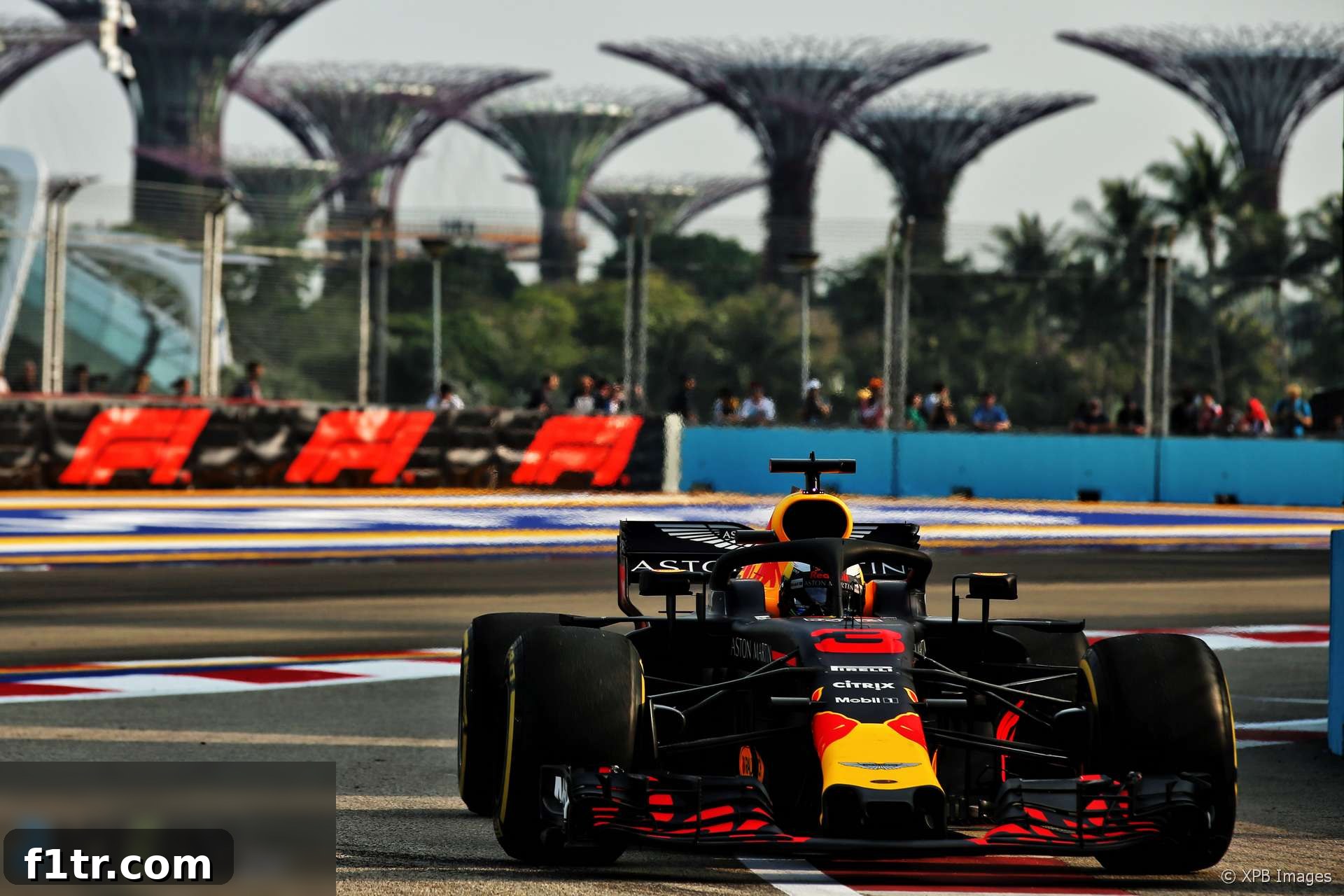
The highly anticipated Singapore Grand Prix weekend roared to life with an emphatic statement from Red Bull Racing, as both Daniel Ricciardo and Max Verstappen seized the top positions in the opening Free Practice 1 (FP1) session. This commanding start at the iconic Marina Bay Street Circuit immediately sent ripples through the paddock, signalling Red Bull’s formidable early pace and setting the stage for what promises to be an electrifying battle under the city-state’s floodlights.
Red Bull’s charge was brilliantly led by Daniel Ricciardo, who showcased his renowned street circuit prowess by recording the quickest lap time of 1’39.711. This impressive benchmark was achieved on the hyper-soft tyres, the softest compound available for the demanding Singapore circuit. Ricciardo’s performance was particularly striking as his lap time was just two-tenths of a second slower than the pole position time from the previous year. This feat is made even more significant given a minor but impactful modification at Turn 16, which shortened the track by two metres. Such changes can subtly alter racing lines and optimal car setups, making Ricciardo’s instant adaptation and blistering pace a clear indicator of Red Bull’s strong package and their readiness to challenge at the front.
Following closely in his teammate’s wake, Max Verstappen secured the second-quickest time, further cementing Red Bull’s dominant start to the weekend. Verstappen’s session, however, wasn’t without its challenges. His initial high-speed run on the hyper-soft tyres, which demonstrated immense potential, was unfortunately hampered by traffic in the critical final sector, specifically impeded by Carlos Sainz Jnr. Had Verstappen enjoyed a clear lap, many in the paddock believe he would have been a strong contender for the top spot, possibly even surpassing Ricciardo’s time. This incident, while frustrating for the young Dutchman, highlighted the inherent speed of the Red Bull RB14 chassis on the tight Marina Bay layout and the team’s overall strong performance capabilities. The combined efforts of both drivers underscored Red Bull’s position as an immediate frontrunner.
The highly competitive Ferrari stable found themselves in hot pursuit, with both cars finishing behind the Red Bull duo in third and fourth positions. Sebastian Vettel, often a master of street circuits and under pressure in the championship battle, demonstrated impressive speed, setting the third-fastest time. He managed to get within a mere three-tenths of a second of Ricciardo’s leading time, also utilizing the grippy hyper-soft tyres. This indicated that while Red Bull enjoyed an early advantage, Ferrari’s ultimate pace was not far behind, suggesting that crucial fine-tuning and strategic adjustments could see them close the gap significantly. Kimi Raikkonen rounded out the top four, ensuring Ferrari remained firmly in contention and setting the stage for an intriguing strategic contest as the weekend progresses. Their performance hinted at a tight battle for pole position and race victory.
In a noticeable contrast to their rivals, the Mercedes-AMG Petronas F1 Team opted for a more conservative and strategic approach during FP1. Both reigning world champion Lewis Hamilton and teammate Valtteri Bottas chose not to deploy the softest hyper-soft tyre compound. This decision was largely influenced by their tyre allocation strategy for the weekend, having brought fewer sets of hyper-softs compared to Red Bull and Ferrari. Furthermore, FP1 sessions at Marina Bay are typically conducted in warmer and more humid conditions than the cooler evening temperatures experienced during qualifying and the race. This makes harder compounds more suitable for initial setup verification, data collection, and understanding the car’s balance without unnecessarily wearing out the softer, more performance-oriented tyres. Consequently, Lewis Hamilton ended the session one-and-a-half seconds adrift of Ricciardo, running on the harder soft compound. While this placed him sixth, it doesn’t necessarily reflect Mercedes’ true pace, which is expected to be unveiled in subsequent sessions when cooler track temperatures and softer tyres allow them to extract maximum performance. Their strategic focus appears to be on long-run pace and race day execution.
The midfield battle also provided its share of excitement and notable performances, particularly from the Renault F1 Team. Nico Hulkenberg delivered a standout performance, expertly harnessing the performance gains offered by the hyper-soft tyres to propel his Renault to an impressive fifth place. This strong showing saw him slot in ahead of Lewis Hamilton, emphasizing the significant advantage of the softer rubber on a circuit where mechanical grip is paramount. His teammate, Carlos Sainz Jnr, further underscored Renault’s competitive potential, securing the seventh-fastest time, notably placing him ahead of Mercedes’ Valtteri Bottas. These strong performances from both Renault drivers signal their clear intent to be key players in the competitive “best of the rest” battle, aiming for crucial championship points in what is always a challenging Grand Prix. Their early pace suggests they could be a dark horse for a strong qualifying performance.
However, the unforgiving nature of the Marina Bay Street Circuit was also on display, leading to an early exit for the highly-rated future Ferrari driver Charles Leclerc. Driving for Sauber, Leclerc had been showing promising pace, registering the ninth-quickest time before an unfortunate incident brought his session to a premature end. As he navigated the iconic Andersen Bridge section of the track, Leclerc made heavy contact with the inside barrier. The impact was substantial, causing significant damage that wiped out his front-right suspension. This incident served as a potent reminder of the fine margins on a street circuit, where even a slight misjudgment can have costly consequences, leading to lost track time and extensive repair work for the team. Despite the setback, Leclerc’s earlier pace reaffirmed his raw talent and potential. Completing the top 10 was Romain Grosjean of the Haas F1 Team, demonstrating consistent, albeit unspectacular, performance typical of their steady midfield presence.
At the other end of the performance spectrum, Stoffel Vandoorne continued to endure a challenging season, with FP1 in Singapore adding to his woes. The McLaren driver completed a mere 11 laps, spending a significant portion of the session in the garage while his team diligently worked on his car. Further compounding his frustrating start, he was forced to return to the pits shortly after rejoining the track late in the session, indicating persistent technical issues or unresolved setup problems. This marked yet another difficult outing for Vandoorne and the McLaren team, highlighting the ongoing struggles with their car’s performance and reliability. McLaren’s persistent difficulties underscore the vast performance gap that existed between the top teams and those grappling with fundamental car issues during this particular F1 season, making for a challenging start to the weekend for the Belgian driver and the Woking outfit.
The Marina Bay Street Circuit itself is a pivotal character in the narrative of any Singapore Grand Prix weekend. As a highly technical and demanding street circuit, driver precision, optimal car setup, and meticulous tyre management are paramount for success. The unique combination of high humidity and intense heat, even during the celebrated night sessions, places immense physical stress on the drivers and extreme thermal loads on the cars and their components. Teams utilize FP1 not just for lap times, but to gather critical data on tyre degradation across all available compounds (hyper-soft, ultra-soft, and soft), assess brake performance, and fine-tune cooling strategies. The circuit’s tight, unforgiving corners and ever-present concrete barriers leave absolutely no margin for error, as tragically demonstrated by Leclerc’s session-ending incident, emphasizing the razor-thin line between pushing the absolute limit and overstepping it.
This initial glimpse into the Singapore Grand Prix weekend suggests a fierce and captivating contest is brewing at the front of the pack, with Red Bull emerging as the early pace-setters. Ferrari appears to be very much in contention, lurking just behind and ready to pounce, while Mercedes strategically holds back, carefully planning to unleash their full potential in the more crucial qualifying and race sessions. The midfield promises intense battles for every position, and the inherently challenging nature of the Marina Bay Street Circuit ensures that more twists and turns, drama, and unexpected developments are almost guaranteed as the weekend progresses towards Sunday’s main event. Formula 1 enthusiasts can undoubtedly anticipate a fascinating blend of raw speed, strategic brilliance, and the trademark high-stakes drama that only racing under the stunning lights of Singapore can deliver.
| Pos. | No. | Driver | Car | Best lap | Gap | Laps |
|---|---|---|---|---|---|---|
| 1 | 3 | Daniel Ricciardo | Red Bull-TAG Heuer | 1’39.711 | 27 | |
| 2 | 33 | Max Verstappen | Red Bull-TAG Heuer | 1’39.912 | 0.201 | 27 |
| 3 | 5 | Sebastian Vettel | Ferrari | 1’39.997 | 0.286 | 23 |
| 4 | 7 | Kimi Raikkonen | Ferrari | 1’40.486 | 0.775 | 21 |
| 5 | 27 | Nico Hulkenberg | Renault | 1’41.105 | 1.394 | 26 |
| 6 | 44 | Lewis Hamilton | Mercedes | 1’41.232 | 1.521 | 28 |
| 7 | 55 | Carlos Sainz Jnr | Renault | 1’41.329 | 1.618 | 23 |
| 8 | 77 | Valtteri Bottas | Mercedes | 1’41.429 | 1.718 | 28 |
| 9 | 16 | Charles Leclerc | Sauber-Ferrari | 1’42.035 | 2.324 | 24 |
| 10 | 8 | Romain Grosjean | Haas-Ferrari | 1’42.108 | 2.397 | 21 |
| 11 | 9 | Marcus Ericsson | Sauber-Ferrari | 1’42.408 | 2.697 | 23 |
| 12 | 11 | Sergio Perez | Force India-Mercedes | 1’42.412 | 2.701 | 25 |
| 13 | 20 | Kevin Magnussen | Haas-Ferrari | 1’42.452 | 2.741 | 20 |
| 14 | 14 | Fernando Alonso | McLaren-Renault | 1’42.630 | 2.919 | 23 |
| 15 | 31 | Esteban Ocon | Force India-Mercedes | 1’43.177 | 3.466 | 25 |
| 16 | 10 | Pierre Gasly | Toro Rosso-Honda | 1’43.240 | 3.529 | 25 |
| 17 | 28 | Brendon Hartley | Toro Rosso-Honda | 1’43.485 | 3.774 | 30 |
| 18 | 18 | Lance Stroll | Williams-Mercedes | 1’43.849 | 4.138 | 30 |
| 19 | 35 | Sergey Sirotkin | Williams-Mercedes | 1’44.036 | 4.325 | 29 |
| 20 | 2 | Stoffel Vandoorne | McLaren-Renault | 1’45.160 | 5.449 | 11 |
First Practice Visual Gaps
Daniel Ricciardo – 1’39.711
+0.201 Max Verstappen – 1’39.912
+0.286 Sebastian Vettel – 1’39.997
+0.775 Kimi Raikkonen – 1’40.486
+1.394 Nico Hulkenberg – 1’41.105
+1.521 Lewis Hamilton – 1’41.232
+1.618 Carlos Sainz Jnr – 1’41.329
+1.718 Valtteri Bottas – 1’41.429
+2.324 Charles Leclerc – 1’42.035
+2.397 Romain Grosjean – 1’42.108
+2.697 Marcus Ericsson – 1’42.408
+2.701 Sergio Perez – 1’42.412
+2.741 Kevin Magnussen – 1’42.452
+2.919 Fernando Alonso – 1’42.630
+3.466 Esteban Ocon – 1’43.177
+3.529 Pierre Gasly – 1’43.240
+3.774 Brendon Hartley – 1’43.485
+4.138 Lance Stroll – 1’43.849
+4.325 Sergey Sirotkin – 1’44.036
+5.449 Stoffel Vandoorne – 1’45.160
Drivers more than ten seconds off the pace omitted from this visual representation.
Go ad-free for just £1 per month>> Find out more and sign up
2018 Singapore Grand Prix Coverage
- How Singapore showed F1’s problem with processions again
- 2018 Singapore Grand Prix Star Performers
- Top ten pictures from the 2018 Singapore Grand Prix
- Hamilton closes on title as Mercedes deny Ferrari in Singapore
- Vote for your 2018 Singapore Grand Prix Driver of the Weekend
Browse all 2018 Singapore Grand Prix articles