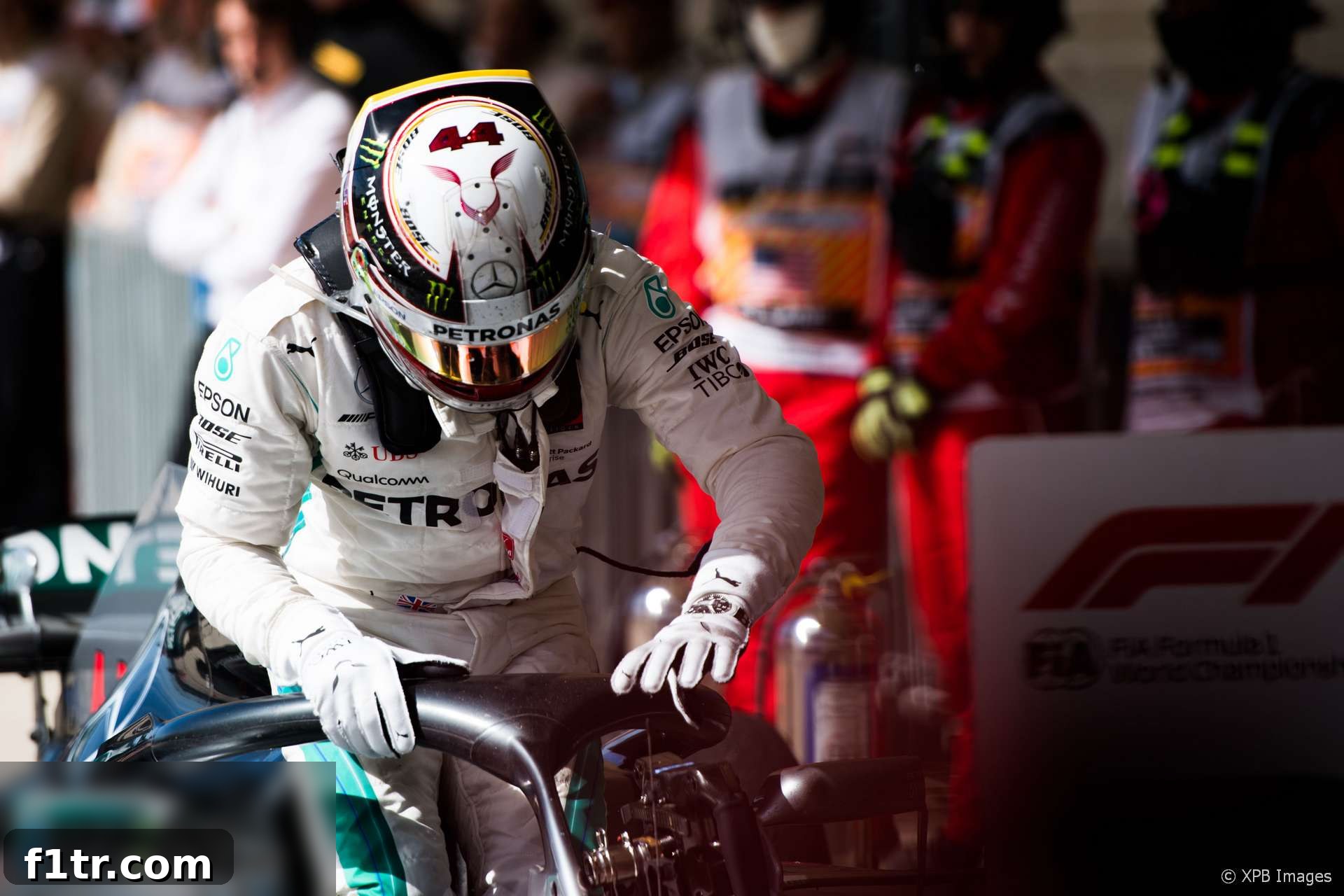
In the high-stakes world of Formula 1, where every millisecond and every component can dictate the outcome of a race, even a driver of Lewis Hamilton’s caliber can find victory slipping away. The United States Grand Prix proved to be a stark reminder of this brutal reality, as Hamilton, despite securing a dominant pole position, was unable to convert it into a win. The reigning champion articulated a confluence of factors that conspired against him, painting a vivid picture of the intricate challenges faced by an F1 team on a race weekend, from last-minute mechanical woes to unexpected race-day setbacks and unforeseen shifts in competitive dynamics.
Speaking to the media in the aftermath of the Grand Prix, Hamilton specifically highlighted a critical, last-minute mechanical intervention that undoubtedly rattled the Mercedes-AMG Petronas F1 Team camp on Sunday morning. “You saw the car was in a million pieces this morning, so it wasn’t ideal for the race,” he remarked, underscoring the frenetic activity around his Mercedes W09 just hours before the race began. This unexpected disruption stemmed from a sudden requirement to change his car’s water pump – a complex, time-consuming operation that demands extensive dismantling and reassembly, consuming precious time and adding immense pressure to the technical crew. Such an intense pre-race scramble can inevitably distract from the meticulous final preparations typically undertaken before a major race, potentially influencing the car’s ultimate performance and the driver’s mental readiness.
The water pump incident wasn’t an isolated event; it was compounded by another critical issue discovered earlier in the weekend. Mercedes engineers had identified a problem with the fuel pump on Valtteri Bottas’s car. Proactive analysis of team data indicated a potential susceptibility in Hamilton’s vehicle as well, prompting a preventative fuel pump replacement on his car. While a necessary measure to avert a catastrophic mid-race failure, these back-to-back mechanical interventions meant Hamilton’s car underwent significant, unscheduled work just before the race. Such eleventh-hour repairs are a significant logistical challenge for any F1 team, consuming valuable time that would otherwise be spent on optimizing setup, reviewing strategy, or allowing the driver undisturbed preparation. Hamilton acknowledged the potential impact, suggesting, “Probably if we hadn’t had to have a morning like that, our race outcome would have been a bit different.”
Beyond the technical hurdles encountered in the garage, Hamilton observed a distinct and concerning shift in the competitive landscape once the lights went out. He noted a measurable swing in the balance of power, particularly in favour of their fierce rivals, Ferrari. “I think they gained some pace and we lost some,” he stated, hinting at a potential delta in performance that surprised the Mercedes team, especially given their dominant qualifying performance. This observation wasn’t just a casual remark; it triggered an immediate call to action within the team. “I’ve asked them to go and dig, find out why,” Hamilton revealed, emphasizing the rigorous data analysis and investigative work that would ensue back at the factory to understand the subtle nuances that led to this unexpected performance disparity. Factors such as track evolution, ambient temperature changes, or even subtle setup adjustments by rivals could all contribute to such a shift, making the detective work crucial for future races.
The complexities of a Formula 1 race are immense, and often, victory can hinge on minute details that escape immediate detection. Hamilton’s challenging afternoon was further complicated by unforeseen circumstances on track. During the intense wheel-to-wheel battles and high-speed running, his car sustained damage to its floor, likely from debris. In Formula 1, the floor of the car is a crucial aerodynamic component, responsible for generating a significant portion of the vehicle’s overall downforce through the intricate management of airflow beneath the chassis. Even minor damage, such as a small crack or a piece of carbon fiber breaking off, can disrupt this airflow, leading to a measurable loss of aerodynamic efficiency and grip. “Plus in the race, for example, there was some debris, some damage on the floor, all these different things add up through the race. There was a couple of tenths from floor damage,” Hamilton explained, quantifying the tangible impact of this seemingly small incident on his lap times. While other competitors might have faced similar challenges, this specific issue undeniably hampered his ability to extract maximum performance from the car.
Adding another layer to his already challenging afternoon, Hamilton also alluded to “another problem which, we don’t know how much time that was.” This vague yet telling statement highlights the intricate nature of F1 machinery, where multiple issues can arise simultaneously, some of which may only be fully understood through extensive post-race telemetry analysis. Such unknown variables can be incredibly frustrating for a driver, making it difficult to adapt and push the car to its absolute limits without full confidence in its integrity. These lingering questions often require weeks of detailed analysis by engineers back at the factory to pinpoint the exact cause and effect, further complicating the immediate understanding of the race outcome.
Perhaps the most significant strategic deviation for Hamilton during the race stemmed from an unexpected and severe case of blistering on his rear tyres. Tyre management is a cornerstone of modern F1 strategy, and Mercedes is typically renowned for its ability to preserve tyre life and execute optimal one-stop races, leveraging their car’s often gentle treatment of Pirelli rubber. However, at the United States Grand Prix, this advantage evaporated. Hamilton was ultimately compelled to make a second pit stop, an unscheduled intervention that severely compromised his track position and overall race pace, forcing him to fight through traffic rather than maintain a clear track ahead.
“Today an outlier was that we didn’t have great pace and we had worse tyre usage than everyone else, which is rarely ever the case,” he reflected, highlighting the unusual nature of their tyre struggles. Blistering occurs when the intense heat generated by cornering, acceleration, and braking causes the rubber compounds beneath the tyre surface to separate, leading to bubbles and eventually chunks of rubber breaking off. This phenomenon dramatically reduces grip, compromises handling, and necessitates a tyre change for safety and performance reasons. “I think we were forced into a two-stop race for certain things that we had that weren’t ideal with the car,” Hamilton elaborated, suggesting that the car’s inherent balance or other unidentified issues might have exacerbated the tyre degradation, pushing them beyond the planned one-stop window. The decision to pit twice was not a strategic choice but a forced reaction to an escalating problem, throwing their meticulously planned strategy out the window. “We didn’t know that was going to be the case when we got into the race. It was a real struggle. The car was a real handful today,” he concluded, conveying the sheer difficulty of controlling a car that was not performing as expected and battling severe tyre issues throughout the demanding Circuit of the Americas.
The collective impact of these diverse challenges – from the frantic pre-race mechanical scramble involving water and fuel pump replacements, to the shifting competitive landscape with Ferrari gaining unexpected pace, from unexpected aerodynamic damage due to debris on track, to unprecedented tyre degradation leading to blistering – underscores the demanding environment of Formula 1. Even with a driver as skilled and determined as Lewis Hamilton, and a team as meticulously organized and successful as Mercedes, a perfect storm of technical glitches and race-specific issues can derail a seemingly assured victory. The incident serves as a powerful testament to the fine margins that define success and failure at the pinnacle of motorsport, where even the smallest variables can combine to alter the course of a race.
For the Mercedes-AMG Petronas F1 Team, the United States Grand Prix presented a valuable, albeit challenging, learning opportunity. Post-race analysis would be exhaustive, delving into every data point, every sensor reading, and every engineer’s report to pinpoint the root causes of the fuel pump concern, the water pump’s failure, the perceived loss of pace relative to Ferrari, the precise impact of the floor damage, and most critically, the unexpected tyre blistering. Understanding these intricate elements is paramount for a team consistently striving for perfection and looking to maintain its competitive edge in the fiercely contested championship battle. Such setbacks, while undoubtedly disappointing in the immediate aftermath, often fuel innovation and improvement, driving engineers and strategists to dig deeper, refine processes, and fortify their machines against future vulnerabilities. The resilience of a championship-winning team is often defined not solely by how they avoid problems, but by how effectively and systematically they diagnose and overcome them, turning every challenge into a stepping stone for future success.
Ultimately, while the outcome in Austin was not the desired one, it provided rich data and crucial insights that would undoubtedly be fed back into the development cycle. It reminded everyone that Formula 1 is a complex dance between human ingenuity, cutting-edge technology, and the unpredictable forces of racing. Lewis Hamilton’s honest assessment laid bare the multi-faceted nature of defeat, even from a position of strength, reinforcing the notion that in F1, victory is never guaranteed, and every single element, no matter how small, contributes to the grand narrative of a race weekend. The pursuit of perfection is an ongoing journey, and even the best teams and drivers encounter days where the stars simply don’t align.
Further Reading: The 2018 F1 Season and Beyond
- F1 feared “death knell” for Drive to Survive after Ferrari and Mercedes snub
- McLaren staff told us we were “totally crazy” to take Honda engines in 2018 – Tost
- ‘It doesn’t matter if we start last’: How Red Bull’s junior team aided Honda’s leap forward
- Honda’s jet division helped F1 engineers solve power unit problem
- McLaren Racing losses rise after Honda split
Explore More Articles from the 2018 F1 Season