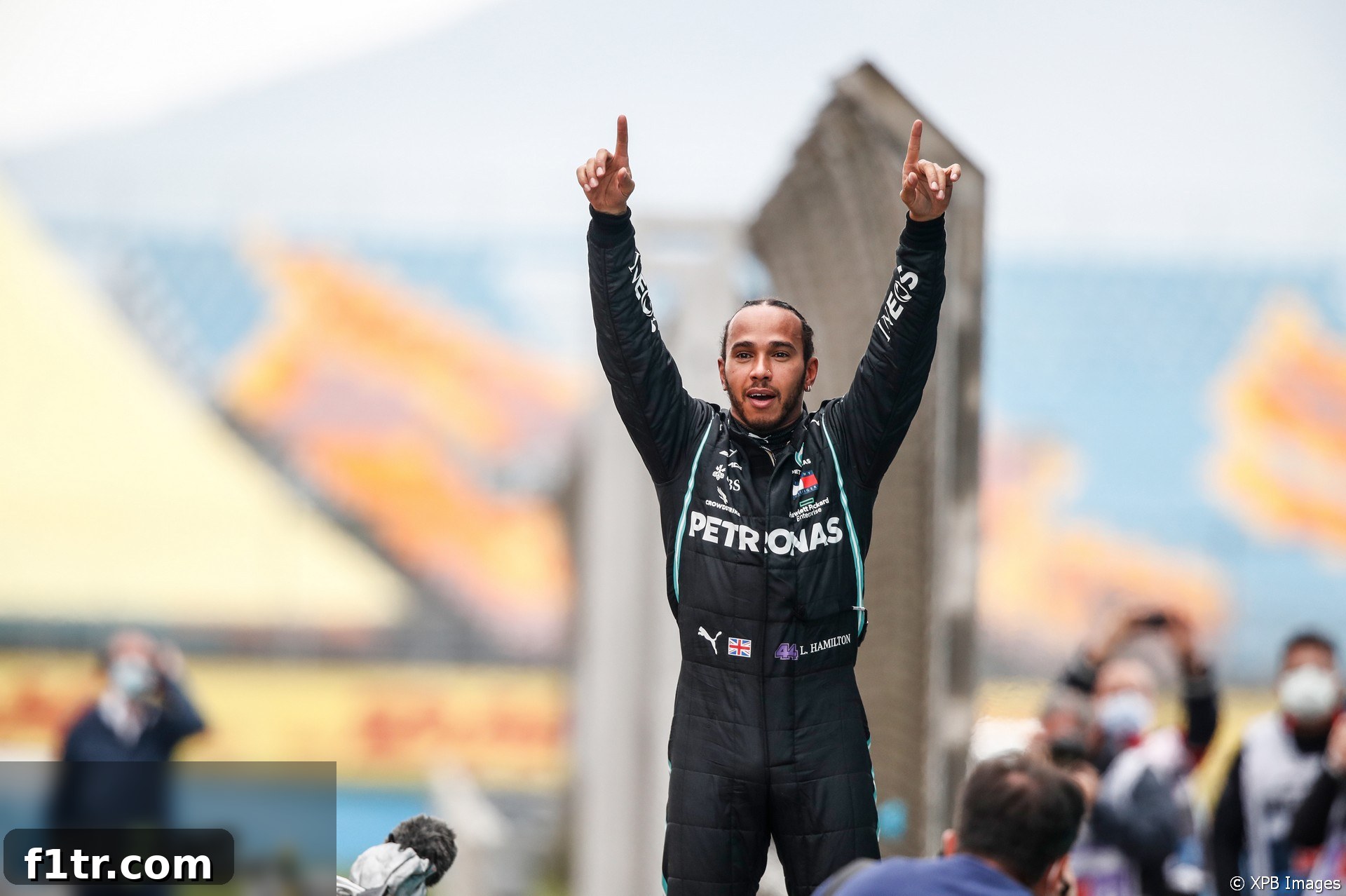
In a truly breathtaking display of skill, strategy, and sheer determination, Sir Lewis Hamilton etched his name deeper into the annals of Formula 1 history by securing his seventh Formula 1 World Championship at the 2020 Turkish Grand Prix. The Mercedes-AMG Petronas driver delivered an unforgettable performance, navigating a chaotic and rain-soaked Istanbul Park circuit to claim a dominant victory, thus equalling Michael Schumacher’s long-standing record for the most drivers’ titles.
The race itself was a spectacle of high drama and unpredictable outcomes, perfectly encapsulating the challenges of top-tier motorsport under extreme conditions. From his starting position of sixth on the grid, Hamilton masterfully managed the treacherous surface, which had been freshly re-laid and offered notoriously low grip, exacerbated by persistent rainfall throughout the event. This unique combination created a level playing field where driver skill and adaptability were paramount, and Hamilton rose to the occasion with characteristic brilliance.
The path to victory was far from straightforward. Hamilton meticulously worked his way through the field, demonstrating exceptional car control and strategic acumen. While many of his rivals succumbed to spins or struggled with tire degradation, Hamilton maintained a remarkable consistency, steadily closing the gap to the front-runners. His ability to preserve his intermediate tires for an extended period proved to be a critical factor, allowing him to bypass the need for an additional pit stop that many others were forced into.
A pivotal moment arrived when Hamilton overtook Sergio Perez of Racing Point for the lead. Perez had been driving an outstanding race himself, inheriting the lead from his teammate Lance Stroll and expertly defending his position against intense pressure. However, Hamilton’s relentless pace and strategic advantage ultimately proved insurmountable, as he swept past Perez to seize control of the race, never looking back. He extended his lead with incredible speed, crossing the finish line a commanding half-minute ahead of his closest competitor, a testament to his unparalleled mastery of the conditions.
Sergio Perez’s drive was undoubtedly one of the highlights of the Grand Prix. Starting from third, the Mexican driver showcased incredible resilience and tire management, particularly on the delicate intermediate compound. After Lance Stroll, who had surprised everyone by claiming pole position and leading much of the first half of the race, began to struggle significantly with his tires as the track started to dry in places, Perez seamlessly took over the mantle. Stroll’s challenge faded as his tires lost their edge, eventually necessitating an extra pit stop that dropped him down the order and ended his hopes of a podium finish.
The battle for the remaining podium spots was equally enthralling. On the final lap, Charles Leclerc of Ferrari launched an audacious attack on Sergio Perez for second place. The move, however, proved to be overly ambitious, as Leclerc ran wide at Turn 12. This error not only allowed Perez to reclaim a well-deserved second position but also gifted Sebastian Vettel, Leclerc’s Ferrari teammate, a surprise third place on the podium. Vettel, who had quietly navigated the challenging conditions, capitalized on Leclerc’s mistake to secure his first podium finish of the 2020 season, a bittersweet moment for Ferrari.
The Red Bull Racing duo, Max Verstappen and Alexander Albon, had initially shown strong pace and were considered strong contenders for victory early in the race. Verstappen, in particular, looked menacing and was pressuring the leaders. However, both drivers experienced significant setbacks. Verstappen suffered a pirouette while attempting to overtake Perez, costing him valuable track position. Albon replicated his teammate’s error with a spin later in the race. Verstappen’s day was further complicated by a second spin in the closing stages, illustrating the fine margins and unforgiving nature of the conditions that day.
These incidents opened the door for other drivers to make their mark. Carlos Sainz Jr. of McLaren seized the opportunity, driving a clean and aggressive race to secure a superb fifth place, finishing ahead of both Red Bull cars. Lando Norris, Sainz’s McLaren teammate, also had a strong showing, claiming eighth position after executing a decisive overtake on Lance Stroll, who never fully recovered his pace after his additional pit stop. Stroll ultimately finished ninth, while Daniel Ricciardo secured the final championship point for Renault, concluding a challenging but ultimately rewarding race for many.
Conversely, Valtteri Bottas’s hopes of extending the championship battle vanished almost as quickly as they began. The Finnish driver endured a horrid afternoon, suffering multiple spins throughout the race. His title aspirations took a critical hit on the very first lap when Esteban Ocon was inadvertently knocked into a spin ahead of him, causing Bottas to take evasive action and spin himself. He continued to struggle with the low-grip conditions, his car seemingly unwilling to cooperate. The sight of his teammate, Lewis Hamilton, lapping him late in the race served as a stark, symbolic representation of the championship’s conclusion. Bottas eventually finished a distant 14th, marking one of his toughest outings of the season.
This seventh championship solidifies Lewis Hamilton’s status as one of, if not the greatest, drivers in the history of Formula 1. Equalling Michael Schumacher’s seven titles is a monumental achievement that few believed would ever be matched. His consistent excellence, combined with Mercedes-AMG Petronas’s unwavering engineering prowess, has created an era of unprecedented dominance. The Turkish Grand Prix victory was a microcosm of Hamilton’s career: the ability to perform under immense pressure, to adapt to changing circumstances, and to extract every ounce of performance from himself and his machine.
The Road to a Record-Equalling Seventh Title: Dissecting Hamilton’s Istanbul Masterclass
The 2020 Turkish Grand Prix will forever be remembered as one of Lewis Hamilton’s most iconic race wins, a performance that showcased every facet of his legendary talent. The newly resurfaced Istanbul Park circuit, combined with persistent rain, presented a riddle that only a select few could even begin to solve. The track surface, which had been laid just weeks before the event, was exceptionally smooth and offered minimal grip, even in dry conditions. When heavy rain began to fall on race day, it transformed the circuit into an ice rink, creating an almost unprecedented challenge for all competitors.
Hamilton’s start was conservative but calculated, initially losing a position to Daniel Ricciardo. However, he quickly found his rhythm, understanding the nuances of the slippery track faster than many of his rivals. While others struggled with maintaining temperature in their intermediate tires, or pushed too hard and spun, Hamilton drove with a delicate yet aggressive touch. He patiently waited for opportunities, observing how the track evolved and how his competitors were coping. This observational intelligence allowed him to make informed decisions about tire management and when to push.
His crucial long stint on a single set of intermediate tires was the cornerstone of his strategy. As the track slowly began to dry in some sections, many drivers pitted for fresh intermediates, believing the older sets would degrade too rapidly. Hamilton, however, felt his tires were still performing optimally. He communicated this to his race engineer, Bono, and together they made the brave decision to stay out. This gamble paid off spectacularly. The older intermediates had worn down just enough to expose the harder compound beneath, providing him with surprisingly consistent grip and pace that his rivals on newer tires simply couldn’t match.
This strategic brilliance, coupled with his peerless driving, allowed Hamilton to effortlessly glide past drivers who were locked in fierce battles or struggling to find traction. His overtakes were clean, decisive, and executed with an air of inevitability. The moment he passed Sergio Perez for the lead was less a sudden lunge and more a gradual, irresistible progression to the front, underlining his complete control over the race’s narrative. His final margin of victory wasn’t just a testament to his speed, but to his mental fortitude and ability to remain calm amidst the chaos that engulfed his rivals.
Beyond the race itself, this seventh championship underscored Hamilton’s incredible journey in Formula 1. From his debut season in 2007, where he narrowly missed the title, to his first championship in 2008 in dramatic fashion, and then his dominant era with Mercedes since 2014, his career has been a masterclass in sustained excellence. To draw level with Michael Schumacher, widely regarded as the sport’s greatest prior to Hamilton’s recent achievements, is an astonishing feat that transcends mere statistics. It speaks to a longevity, a dedication, and a relentless pursuit of perfection that defines truly legendary athletes.
The emotional scenes after the race, with Hamilton shedding tears in his cockpit and celebrating with his team, perfectly captured the weight of the achievement. It was a moment of profound personal significance, not just another trophy, but the culmination of years of hard work, sacrifice, and overcoming challenges both on and off the track. The 2020 Turkish Grand Prix will not merely be remembered as a race where a championship was won, but as the day Lewis Hamilton solidified his place amongst the pantheon of sporting immortals.