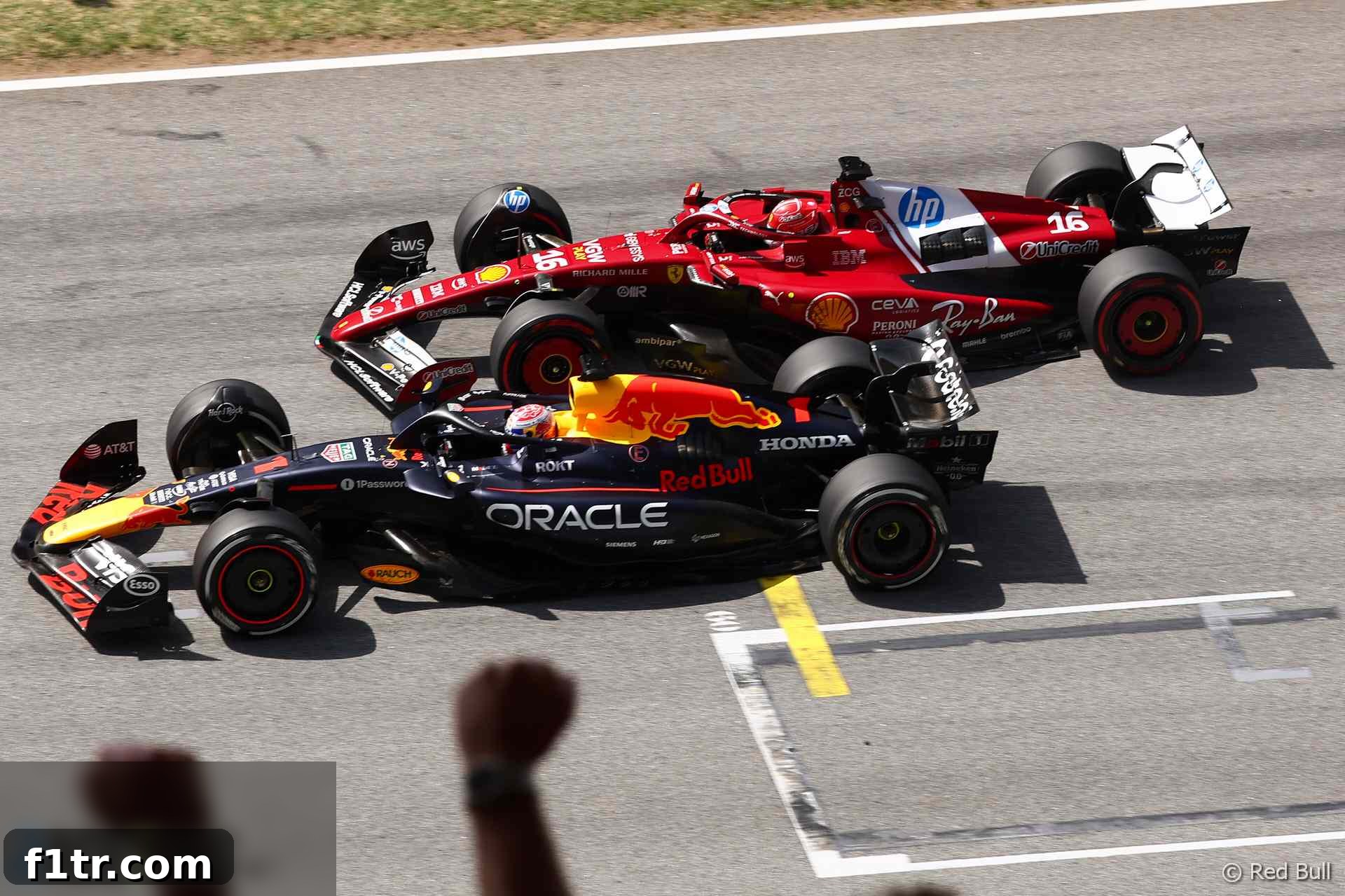
The Fédération Internationale de l’Automobile (FIA) has taken a significant step towards greater transparency in Formula 1 by publicly releasing its comprehensive guidelines and penalty framework for stewards. This unprecedented move provides invaluable insight into the meticulous process behind critical race decisions, aiming to foster more informed discussions among fans and media alike.
Advert | Become a Supporter & go ad-free
These latest guidelines, a refinement of previous iterations, officially came into effect between the conclusion of the last season and the commencement of the 2025 championship. Their introduction follows a period marked by a series of contentious incidents during the 2021 season, prompting the sport’s governing body to seek enhanced clarity and consistency in officiating.
The initial version of these guidelines was first revealed by RaceFans in April 2022. However, the FIA has refrained from publishing subsequent revisions until now, making this release a crucial update for the sport’s stakeholders.
FIA President Mohammed Ben Sulayem underscored the rationale behind this move, acknowledging that stewards have historically faced “extreme and wholly unwarranted criticism” for their rulings. He firmly believes that the public dissemination of these guidelines, which function as a complementary framework to the official rulebook, will lead to a more nuanced understanding and constructive discourse surrounding F1 penalty decisions.
“To unequivocally demonstrate the rigor with which our stewards approach their challenging role, we are today making public the Penalty and Driving Standards Guidelines that serve as a critical aid in their decision-making,” stated Ben Sulayem. “This initiative is designed to equip both fans and members of the media with a significantly deeper and more accurate insight into the intricate mechanisms through which decisions are reached in the pinnacle of motorsport, Formula 1.”
He further elaborated on the evolution and significance of these documents: “The Penalty Guidelines have been an indispensable tool for nearly a decade, providing a consistent framework. Meanwhile, the Driving Standards Guidelines, first introduced in 2022 and continuously refined, have successfully integrated the most vital perspectives – those of the drivers themselves – to establish a genuine reference point for navigating various complex racing scenarios.”
The most recent iteration of these essential guidelines was forged through intensive discussions between FIA representatives and Formula 1 drivers during last year’s Qatar Grand Prix. Among the notable incidents understood to have been raised by drivers during this pivotal meeting was the fiercely contested battle for position between Max Verstappen and Lando Norris at the United States Grand Prix, an encounter that highlighted ambiguities in the existing framework.
Advert | Become a RaceFans supporter andgo ad-free
This particular incident directly prompted a key revision to the guidelines for the 2025 season. The updated text now explicitly states that a driver is entitled to be given sufficient room by a rival when executing an overtake on the outside of a corner, provided their “front axle is ahead of the front axle of the other car at the apex.” This specific guideline subsequently became a focal point of debate during the Saudi Arabian Grand Prix earlier this year when Max Verstappen received a time penalty for an off-track overtake on Oscar Piastri, a move Verstappen argued was necessitated by his rival forcing him wide. The stewards explicitly referenced this updated guideline in their official decision, highlighting its immediate and tangible impact on race officiating.
FIA Driving Standards Guidelines v4.1: A Comprehensive Framework for Fair Racing
Published February 20, 2025
It is imperative to understand that these documents serve as GUIDELINES and NOT as absolute REGULATIONS. Their purpose is to assist and inform, rather than dictate, every single decision.
Many on-track incidents inherently demand a degree of subjective judgment from the stewards. In these complex situations, the stewards are guided by the invaluable experience of their dedicated Driver Stewards, combined with the comprehensive framework of these guidelines and, of course, the overarching FIA Regulations.
A fundamental principle dictates that if, through careful analysis of points A and B detailed below, it is unequivocally established that an overtaking driver has earned priority in a maneuver, then the onus shifts to the defending driver. It becomes the explicit responsibility of the defending driver to actively avoid any collision or to prevent forcing the overtaking driver off the track.
Special attention is also drawn to the crucial note contained within Point F on page 3, which provides specific guidance for defending drivers who may leave the track while attempting to defend their position.
A. Overtaking on the INSIDE of a Corner: Defining Legitimate Inner-Line Maneuvers
For a driver attempting an overtake on the inside of a corner to be rightfully entitled to be given sufficient room by their competitor, a series of precise conditions must be met, ensuring the maneuver is both controlled and fair:
- i) Significant Overlap at Apex: The overtaking car must position its front axle at least alongside the mirror of the other car. This crucial positional advantage must be established prior to, and maintained consistently through, the corner’s apex. This prevents overly optimistic or late lunges from behind.
- ii) Controlled Entry and Execution: The overtaking car must be driven in a fully controlled and stable manner, with particular emphasis on maintaining composure from the corner entry right through to the apex. This explicitly discourages and penalizes uncontrolled “dive-in” maneuvers that often result in contact or compromise the defending driver’s line unfairly.
- iii) Reasonable Racing Line and Track Limits: In the estimation of the Stewards, the overtaking driver must have demonstrated a commitment to a reasonable racing line. Crucially, they must also be demonstrably capable of completing the entire overtaking maneuver while remaining strictly within the designated track limits. This ensures that no lasting advantage is gained by cutting the corner or running wide off track during the pass.
B. Overtaking on the OUTSIDE of a Corner: Mastering the More Challenging Line
Overtaking on the outside of a corner is universally recognized as a more inherently difficult and nuanced maneuver to successfully execute. Consequently, the criteria for being given room reflect this increased challenge, focusing on clear commitment and control:
- i) Clear Front Axle Advantage at Apex: For the overtaking car to be entitled to racing room, including at the corner exit, its front axle must be clearly ahead of the front axle of the other car at the apex of the corner. This demands a definitive commitment to the outside line and a demonstrable positional advantage.
- ii) Controlled Driving Throughout: The maneuver must be executed in a consistently controlled manner, from the initiation of the corner entry, through the apex, and critically, upon exiting the corner. Any lack of control at any stage compromises the legitimacy of the move.
- iii) Ability to Hold the Line: The overtaking driver must demonstrate the ability to successfully make the corner, completing their trajectory while remaining strictly within the prescribed track limits. This prevents using off-track excursions to complete what would otherwise be an impossible overtake.
C. Chicanes and S-Bends: Navigating Complex Corner Sequences
In multi-apex corner sequences such as chicanes and S-bends, the guidelines outlined for both inside and outside overtakes may apply to each individual element of the combination. However, as a general rule and for consistency, priority will typically be given to the car that has established a legitimate position in the first corner element of the sequence.
IMPORTANT NOTES for Stewards’ Decisions: A Holistic Perspective
All decisions rendered by the Stewards are meticulously made in strict adherence to the established rules, primarily the F1 Sporting Regulations (“F1SR”), the FIA International Sporting Code (“ISC”), and Appendix L Chapter IV (The Code of Driving Conduct on Circuits).
Recognizing that racing is an inherently dynamic and fluid process, these guidelines, while indicating specific relative car positions at various points, do not dictate a rigid checklist. Instead, the Stewards will consistently adopt a holistic approach, carefully examining how the entire situation unfolded when reviewing any incident. This comprehensive review includes, but is not limited to, considering the following crucial factors:
- i) Incident Genesis: How did the cars arrive at the point of the incident? This includes assessing factors such as late braking, aggressive “diving in,” or any unexpected movement under braking.
- ii) Maneuver Timing and Optimism: Was the maneuver initiated too late, or was it an overly “optimistic” attempt with a low probability of clean execution?
- iii) Driver Perception and Anticipation: What could each driver reasonably perceive, know, or anticipate given their position, speed, and track conditions at the time?
- iv) Track-Bound Completion: Do the Stewards believe, objectively, that the maneuver could have been completed successfully while remaining within the confines of the track?
- v) Car Dynamics: Were there any contributing factors such as understeer, oversteer, or wheel locking that impacted the incident?
- vi) Driver Positioning and Handling: Did either driver position or handle their car in a manner that directly contributed to, or exacerbated, the incident?
- vii) Corner Type Contribution: Did the specific characteristics of the corner – such as camber, presence of kerbs, curvature, or unique apexes – play a role in the incident?
- viii) Tyre Condition: What were the relative conditions of the tyres, including age, compound, and available grip, as these can significantly influence car behavior?
Advert | Become a RaceFans supporter andgo ad-free
D. Track Limits: Upholding Fairness and Safety Boundaries
Adherence to track limits is considered paramount for both the fairness of competition and the safety of all participants. Consequently, Article 33.3 of the F1 Sporting Regulations will be enforced with strict rigor:
“Drivers must make every reasonable effort to use the track at all times and may not leave the track without a justifiable reason. Drivers will be judged to have left the track if no part of the car remains in contact with it and, for the avoidance of doubt, the white lines defining the track edges are considered to be part of the track, but the kerbs are not….”
Notes on Track Limits Enforcement:
- In Free Practice sessions, invalid lap times will only be deleted in specific circumstances where such classification might be required to determine a grid order.
- For Sprint Qualifying or traditional Qualifying sessions, any lap time found to be in infringement will be deleted. Furthermore, the time of the subsequent lap may also be deleted if it is deemed that a benefit was carried over from the initial infringement.
- During the Sprint Session and the Race, acknowledging the dynamic nature of racing, invalid lap times will be deleted and typically a “three strikes” system will be applied. Upon reaching the third strike, a Black & White Flag will normally be issued, preceding any further penalties under Article 54.3 of the F1SR. To be absolutely clear, any invalid lap will count as a “strike” with the following specific exceptions:
- If a driver exceeds track limits following an obvious and unavoidable loss of vehicle control.
- If a driver exceeds track limits intentionally to avoid an imminent collision, such as a typical Lap 1, Turn 1 incident.
- If a driver has been definitively considered by the stewards to have been “forced off” the track by another car.
- If a driver exceeds track limits and is subsequently penalized for gaining a lasting advantage or for an unsafe re-join, the track limits infraction itself will not count as an additional strike.
- If a driver exceeds track limits during an incident for which they are already penalized for another reason, e.g., causing a collision.
E. Impeding: Maintaining Clear Racing Lines
Beyond the enforcement of Article 37.5 of the F1 Sporting Regulations regarding impeding, drivers are sternly reminded of Article 33.4, which states: “At no time may a car be driven unnecessarily slowly, erratically or in a manner which could be deemed potentially dangerous to other drivers or any other person.” This broad article encompasses any action that could impede another driver’s progress or safety.
F. Giving Back a Lasting Advantage: Ensuring Fair Play
The procedure detailed in Article 33.3 will be rigorously applied to address situations where a lasting advantage is gained:
“Should a car leave the track the driver may re-join, however, this may only be done when it is safe to do so and without gaining any lasting advantage. At the absolute discretion of the Race Director a driver may be given the opportunity to give back the whole of any advantage he gained by leaving the track.”
Notes on Lasting Advantage:
If a car leaves the track (or cuts a chicane) while defending a position and subsequently re-joins the track in the same position, it will generally be considered by the stewards that a lasting advantage has been gained. Therefore, in such circumstances, the position should typically be relinquished, as prescribed by the rules. It falls within the sole discretion of the Stewards to definitively determine whether the driver of a car was indeed “defending a position” at the time of the incident.
G. Moving on the Straight: Defining Acceptable Defensive Maneuvers
Appendix L, Chapter IV, Article 2 provides clear directives on defensive movements on a straight:
“More than one change of direction to defend a position is not permitted. Any driver moving back towards the racing line, having earlier defended his position off-line, should leave at least one car width between his own car and the edge of the track on the approach to the corner. However, manoeuvres liable to hinder other drivers, such as deliberate crowding of a car beyond the edge of the track or any other abnormal change of direction, are strictly prohibited. Any driver who appears guilty of any of the above offences will be reported to the Stewards.”
Notes on Moving on the Straight:
In this specific context, tactical moves designed to break the slipstream of a following car may be deemed acceptable, provided the following car is at a safe distance, taking into account relative speeds and their current position on the track. This nuance recognizes the strategic elements of defensive driving while upholding safety standards.
H. Moving under Braking: Maintaining Predictability in Braking Zones
When a driver is actively defending a position, absolutely no change in direction by the defending car is permitted once the deceleration phase (braking) has commenced, with the sole exception of following the established racing line. This rule is critical for maintaining predictability and safety in high-speed braking zones, preventing dangerous late-stage weaving.
I. Re-joining the Track: Ensuring Safe Re-Integration
Maintaining racing speeds within run-off areas after an excursion is explicitly unacceptable. Drivers on the track must under no circumstances be forced to alter their speed or racing line to avoid a car re-joining the track. Re-joining must be done safely and without impacting other competitors.
J. Safety Car: Protocols for Resumption of Racing
To proactively minimize the likelihood of accidents occurring before the Safety Car (SC) returns to the pits, Article 55.14 will be rigorously enforced as follows:
“In order to avoid the likelihood of accidents before the safety car returns to the pits, from the point at which the lights on the car are turned out drivers must proceed at a pace which involves no erratic acceleration or braking nor any manoeuvre which is likely to endanger other drivers or impede the restart.”
Advert | Become a RaceFans supporter andgo ad-free
Notes on Safety Car Protocols:
The actions of the lead driver during a Safety Car period, particularly as it prepares to pit, can have a profound impact on the safety of the entire restart procedure. While the leading driver possesses the right to dictate the pace and choose the exact point at which to accelerate for the restart, this prerogative does not absolve them of their fundamental responsibility to avoid creating a potentially dangerous situation, as explicitly defined in the Code Appendix L Ch IV 2(e). This underscores the balance between tactical advantage and collective safety.
APPENDIX 1: Contextualizing the Evolution of These Guidelines
In 2022, in direct response to persistent requests from Formula 1 drivers for enhanced clarity on how F1 Stewards would interpret the rules under specific racing circumstances, a crucial agreement was reached: to establish a comprehensive set of Driving Standards. These standards would serve as vital GUIDELINES for the investigation of incidents and for the consistent application of any subsequent penalties. This framework proved highly successful throughout the 2022 season and underwent minor modifications for 2023 following further extensive consultations with both drivers and teams.
A significant and far-reaching update to these guidelines was implemented immediately prior to the start of the 2025 season. This major revision was the direct outcome of a productive meeting between the FIA Formula 1 Stewards and the drivers, convened in Qatar in late 2024, addressing emerging racing complexities and driver feedback.
Concurrently, the FIA Drivers’ Commission embarked on an ambitious project: to integrate the existing Formula 1 Driving Standards Guidelines into a single, cohesive document applicable across all circuit racing categories. This initiative aims to standardize officiating principles from grassroots racing to the pinnacle of motorsport.
A paramount objective for the FIA Drivers’ Commission is the unwavering commitment to ensure that younger drivers competing in lower categories are exposed to and evaluated by the identical standards that they will encounter upon their eventual graduation to the highest echelons of the sport. This consistency is vital for talent development and progressive understanding of racing ethics.
The core objectives that underpin the FIA Drivers’ Commission’s decision to publish these standardized driving standards guidelines across all FIA championships are to actively facilitate and vigorously promote the following:
- Safe racing practices that prioritize driver well-being.
- Hard, competitive racing that encourages skill and bravery within defined boundaries.
- Fair racing, ensuring equitable treatment and judgment for all competitors.
- Sporting justice, upholding the integrity and spirit of competition.
- Consistency in officiating and interpretation across all racing categories.
- Standardization of driving standards and the operational procedures of race direction across every level of motorsport.
Rationale: The Principles Guiding the Guidelines
The philosophical underpinnings of these guidelines are multifaceted, aiming to strike a balance between promoting exciting racing and ensuring safety and fairness:
- i) Incentivizing Overtaking: Overtaking maneuvers should be actively incentivized as a core component of exciting racing. Conversely, defending a position in an unfairly aggressive or dangerously unpredictable manner is explicitly unacceptable and will be penalized.
- ii) Junior Driver Development: It is critically important that junior drivers operate under the identical set of guidelines as those in F1. However, a slightly reduced tolerance for infringements should be applied in junior categories due to the inherently higher risk of accidents stemming from their comparatively lesser experience. A stricter application of these rules in lower formulas is considered essential for the robust and safe development of junior drivers.
- iii) Event-Wide Application: It is imperative to reiterate that these guidelines will be applied consistently throughout the entirety of every event, from free practice to the race. The Race Director and Stewards will remain available to provide clarification on any questions drivers and teams may have regarding the guidelines.
- iv) Stewards’ Presence: The Stewards and the appointed Driver Advisor will, whenever logistically possible, attend all drivers’ briefings to ensure direct communication and understanding.
- v) Consistent Enforcement: The application of these guidelines should be enforced uniformly across the entire event, with particular and unwavering attention to respecting yellow flags and adhering to track limits.
- vi) Clarity of Infractions: Regarding track limits, the Stewards will always ensure that any alleged infractions are unequivocally clear. Drivers will consistently be given the benefit of the doubt when the evidence of an infraction is not absolutely conclusive.
- vii) Driver Steward/Advisor Appointment: A dedicated Driver Steward or Driver Advisor should be appointed for each racing category or series, mirroring the successful implementation of this role within Formula 1.
Advert | Become a RaceFans supporter andgo ad-free
FIA Penalty Guidelines: A Detailed Breakdown of Consequences
The following tables detail the standard penalties applied for various offenses across different sessions in Formula 1. These guidelines aim to ensure consistency and proportionality in penalizing infringements, contributing to fair and disciplined racing. ‘PP’ columns denote penalty points assessed against a driver’s license.
|
Offence |
SR Article |
Free Practice |
PP |
Qualifying |
PP |
Race |
PP |
|---|---|---|---|---|---|---|---|
|
Sanctions |
|||||||
|
Receiving five reprimands, four of which were imposed for a driving infringement |
18.2 |
Ten grid places |
0 |
Ten grid places |
0 |
Ten grid places (mandatory) |
0 |
|
Personnel Curfew and Covers On Breaches |
|||||||
|
Breach of Personnel Curfew |
23.6 & 23.5 |
Pit lane start for both Competitor cars (mandatory) |
0 |
||||
|
Breach of “Covers On” Time |
23.6 & 38.2a) i) |
Pit lane start for both Competitor cars (mandatory) |
|||||
|
Receiving Mechanical Assistance |
|||||||
|
Re-joining by use of mechanical assistance |
26.4 |
Disqualification |
0 |
||||
|
Use of Tyres |
|||||||
|
Use of tyres without appropriate identification |
30.3(e) |
Grid place penalty |
0 |
Grid place penalty |
0 |
Disqualification |
0 |
|
Failing to change incorrect tyres within three (3) laps |
30.5(b) |
10s stop and go (mandatory) |
0 |
||||
|
Failing to use two different specifications of dry-weather tyres (or during the race in Monaco, failing to use three sets of any specification & two different specifications of dry-weather tyres) |
30.5(m) |
Disqualification (mandatory) |
0 |
||||
|
Failing to use two different specifications of dry-weather tyres (race suspended and not re-started) (or during the race in Monaco, failing to use two different specifications of dry-weather tyres and/or failing to use at least three sets of any specification of tyres) |
30.5(m) |
30 seconds (mandatory) |
0 |
||||
|
During the race in Monaco, using only one set of tyres of any specification (additional to the above) |
30.5(m) |
30 seconds (mandatory) |
0 |
||||
|
Failing to use wet-weather tyres, when required to do so, if the race is started behind SC |
30.5 (n) |
10s stop and go (mandatory) |
0 |
||||
|
Offence |
SR Article |
Free Practice |
PP |
Qualifying |
PP |
Race |
PP |
|
Leaving the Track |
|||||||
|
Leaving the track and gaining a lasting advantage |
33.3 & App. L, Ch. IV, 2 (c) |
Potential loss of the lap time and/or up to Reprimand |
0 |
Loss of the lap time and/or up to Three grid places |
0 |
10s Penalty (Baseline) up to Drive Through |
0 |
|
Leaving the track and re-joining unsafely |
33.3 & App. L, Ch. IV, 2 (c) |
Potential loss of the lap time and/or up to Reprimand |
0 |
Loss of the lap time and/or up to Three grid places |
1 |
5s Penalty up to Drive-Through |
2 |
|
Leaving the track without a justifiable reason – Track limits |
33.3 or App. L, Ch. IV, 2(c) |
Potential loss of the lap time and/or up to Reprimand |
0 |
Lap Deleted |
0 |
Lap Deleted / Strike |
0 |
|
Driving Infringements |
|||||||
|
Driving unnecessarily slowly – gain of a sporting advantage |
33.4 or App. L, Ch. IV, 2(e) |
Warning / Reprimand |
0 |
Reprimand or Grid Place Penalty (re Min Delta) |
0 |
5s/10s Penalty |
0 |
|
Driving unnecessarily slowly in a dangerous manner |
33.4 or App. L, Ch. IV, 2(e) |
Grid Place penalty |
3* |
Grid Place penalty |
3* |
10s Penalty (Baseline), |
3* |
|
Driving erratically or in a manner which could be deemed potentially dangerous to other drivers or any other person. The following (non-exhaustive) list are possible examples of the above: |
33.4 or App. L, Ch. IV, 2(e) |
Reprimand or Grid Place penalty |
0 |
Reprimand or Grid Place penalty |
0 |
10s Penalty (Baseline), Drive-Through or 10s stop and go (or a grid place penalty if the driver failed to finish the race) |
3* |
|
Offence |
SR Article |
Free Practice |
PP |
Qualifying |
PP |
Race |
PP |
|
Driving with / failing to stop of a car with significant & obvious damage |
26.10 |
Reprimand or Grid Place penalty |
0 |
Reprimand or Grid Place penalty |
0 |
10s Penalty (Baseline), Drive-Through or 10s stop and go (or a grid place penalty if the driver failed to finish the race) |
3* |
|
Causing a collision |
App. L, Ch. IV, 2(d) |
Reprimand or Grid Place penalty |
0 |
Reprimand or Grid Place penalty |
0 |
10s Penalty (Baseline), |
3* |
|
– Causing a collision with no immediate and obvious sporting consequence |
As above |
0 |
As above |
0 |
Reprimand/5s/10s Penalty (or grid place penalty if the driver failed to finish the race) |
0 |
|
| – Causing a collision with apparent deliberate or reckless intent |
Drop of 10 or more grid positions |
4 |
Drop of 10 or more grid positions |
4 |
10 Stop and go, or any time penalty exceeding 30 seconds (or grid place penalty if the driver failed to finish the race) |
4 |
|
|
Forcing a driver off the track |
App. L Ch. IV, 2(b) |
Reprimand or Grid Place penalty |
0 |
Reprimand or Grid Place Penalty |
0 |
10s Penalty (Baseline), |
2 |
| – Forcing a driver off the track recklessly |
Drop of 10 or more grid positions |
3 |
Drop of 10 or more grid positions |
3 |
10 Stop and go, or any time penalty exceeding 30 seconds (or grid place penalty if the driver failed to finish the race) |
3 |
|
|
Offence |
SR Article |
Free Practice |
PP |
Qualifying |
PP |
Race |
PP |
|
Impeding another driver |
37.5 or App. L, Ch. IV, 2 |
Warning |
0 |
Three grid places |
0 |
||
| – Impeding another driver dangerously or with apparent intent |
Five grid places |
3 |
Five grid places |
3 |
|||
|
More than one change of direction to defend a position |
App. L Ch. IV, 2(b) |
5s Penalty up to Drive-Through |
3* |
||||
|
Moving in the braking zone |
App. L Ch. IV, 2(e) |
Warning |
0 |
Warning |
0 |
B/W Flag (possible for first offence, penalties thereafter) |
0 |
| -Moving in the braking zone “in a manner deemed potentially dangerous” |
Warning |
0 |
Warning |
0 |
5s or-up to Drive-Through |
3* |
|
|
Crossing a line or missing a bollard at pit entry |
App. L Ch. IV, 4(d) |
RD Warning |
Reprimand |
0 |
5s or 10s Penalty |
1* |
|
| -Crossing a line or missing a bollard at pit entry dangerously |
Three grid places |
2 |
Three grid places |
2 |
Drive-Through or 10s stop and go |
3 |
|
|
Crossing a line at pit exit |
App. L Ch. IV, 6(c) |
RD Warning |
Reprimand |
0 |
5s or 10s Penalty |
1* |
|
| -Crossing a line at pit exit dangerously |
Three grid places |
2 |
Three grid places |
2 |
Drive-Through or 10s stop and go |
3 |
|
|
Exceeding the maximum time between SC lines without a justifiable reason |
Event Notes & ISC 12.2.1 (i) |
Reprimand |
0 |
Reprimand |
0 |
||
|
Flag Signals App. L, Ch. IV, 1 — “The instructions detailed in Appendix H to the International Sporting Code are deemed to be part of this code of driving conduct. All drivers must abide by them.” |
|||||||
|
Failing to slow for single yellow flags or lights on the track or overtaking another car |
26.1 (a) & App. H 2.5.5 b) |
Five grid places |
2 |
Five grid places |
2 |
10s Penalty or Drive-Through |
3* |
|
Failing to slow for double yellow flags or lights on the track or overtaking another car |
26.1 (b) or (c) & App. H 2.5.5 (b) |
Ten grid places |
3* |
Ten grid places |
3* |
10s stop and go |
3* |
|
Failing to slow for red flags or lights on the track |
App. H 2.5.4.1(b) |
Ten grid places |
4* |
Ten grid places |
4* |
10s stop and go or Black Flag |
4* |
|
Offence |
SR Article |
Free Practice |
PP |
Qualifying |
PP |
Race |
PP |
|
Failing to respect blue flags or lights on the track |
App. H, 2.5.5(e) & App. L, Ch. IV, 2(a) |
Refer to Impeding – Art 37.5 |
5s or 10s Penalty |
1 |
|||
|
Failing to respect a black flag on the track |
App. H, 2.5.4.1 (d) |
Rear of Grid |
5 |
Disqualification |
5 |
Disqualification |
5 |
|
Failing to respect a black and orange flag on the track |
App. H 2.5.4.1 (e) |
Rear of Grid |
5 |
Disqualification |
5 |
Disqualification |
5 |
|
Pit Lane Speed limits |
|||||||
|
Speeding in the pit lane during reconnaissance laps or after the chequered flag |
34.7 |
Team Fine |
0 |
||||
|
Speeding in the pit lane during practice |
34.7(a) |
Team fine |
0 |
Team fine |
0 |
||
|
Speeding in the pit lane in order to gain an advantage |
34.7(b) |
||||||
|
Speeding in the pit lane during a race by less than 6km/h |
34.7(c) |
5s Penalty |
0 |
||||
|
Speeding in the pit lane during a race by between 6-15km/h |
Drive-Through |
0 |
|||||
|
Speeding in the pit lane during a race by more than 15km/h |
10s stop and go |
0 |
|||||
|
Pit Entry, Pit Lane and Pit Exit |
|||||||
|
Entering the pit lane when the pit entry is closed |
34.15(b) |
10s stop and go (mandatory) |
0 |
||||
|
Failing to stop at a red light at the pit exit during practice |
37.2 |
Reprimand or up to Three grid places |
0-2 |
Reprimand or up to Three grid places |
0-2 |
||
|
Failing to stop at a red light at the pit exit during a race |
53.1 |
10s stop and go |
3* |
||||
|
Start Procedure |
|||||||
|
Burnouts or bite point checks during reconnaissance laps in Pit Lane |
44.1 |
5s Penalty |
0 |
||||
|
All wheels not fitted at the 5-minute signal |
43.5 or 44.4 |
10s stop and go (mandatory) |
0 |
||||
|
Offence |
SR Article |
Free Practice |
PP |
Qualifying |
PP |
Race |
PP |
|
Team personnel on the grid after the 15 second signal |
43.7 or 44.6 |
||||||
|
For a car on the grid: |
Start from the pit lane (mandatory) |
0 |
|||||
|
For a car in the pit lane: |
Drive-Through Penalty (Mandatory) |
0 |
|||||
|
Failing to start the race from the pit lane if team personnel were on the grid after the 15 second signal |
43.7(a) or 44.6 (a) |
10s stop and go (mandatory) |
0 |
||||
|
Failing to enter the pit lane if out of position at the SC1 line at end of formation lap |
43.10 or 44.9 |
10s stop and go (mandatory) |
0 |
||||
|
Failing to start the race from the pit lane if a driver caused the start to be aborted |
45.2 or 47.2 |
10s stop and go (mandatory) |
0 |
||||
|
Jump start / Incorrect Starting Location |
48.1 |
5s or 10s Penalty |
0 |
||||
|
Safety Car and VSC Procedures and Formation laps behind SC. |
|||||||
|
Entering the pit lane during the formation laps |
49.4 |
Start the race from the pit lane (mandatory) |
0 |
||||
|
Changing tyres before the race start if the formation lap(s) have been carried out behind the SC |
30.5n |
10s stop and go (mandatory) |
0 |
||||
|
Failure to re-establish position before SC1 (“Standing Start”) |
49.6(a) |
Start from Pit Lane |
|||||
|
Failing to enter the pit lane if out of position at the SC1 line on the formation lap |
49.6(a) |
10s stop and go (mandatory) |
0 |
||||
|
Driving unnecessarily slowly, erratically or in a manner which could be deemed potentially dangerous to other drivers or any other person whilst the safety car is deployed |
55.5 & App. L, Ch. IV, |
5s or 10s Penalty or Drive-Through or 10sec stop and go |
2 |
||||
|
Offence |
SR Article |
Free Practice |
PP |
Qualifying |
PP |
Race |
PP |
|
Failing to keep within ten cars lengths of the car in front during SC |
55.7 |
5s or 10s Penalty or Drive-Through |
2* |
||||
|
Exceeding minimum time set by ECU behind safety car |
55.7 |
2 or 3 red sectors: 5s penalty* |
1 |
||||
|
4 red sectors: 10s penalty* |
2 |
||||||
|
5 red sectors: drive-through* |
3 |
||||||
|
6 red sectors: 10s stop-and-go* |
3 |
||||||
|
Overtaking the SC and place given back |
55.8 |
No Further Action |
|||||
|
Overtaking the SC (See list of exceptions in Sporting Regulations) |
55.8 |
10s stop and go |
3 |
||||
|
Overtaking another car behind the SC and place given back |
55.8 |
No Further Action |
|||||
|
Overtaking another car behind the SC (See list of exceptions in Sporting Regulations) |
55.8 |
-10s Penalty |
2 |
||||
|
Failing to keep within ten cars lengths of the SC |
55.10 |
5s or 10s Penalty or Drive-Through |
2 |
||||
|
Failing to enter the pit lane behind the SC |
55.11 |
Drive-Through (mandatory) |
3 |
||||
|
Overtaking in Pit Entry / Pit Exit when SC using the pit lane |
55.11 |
10s Penalty, Drive-Through or 10s Stop-and-go |
3* |
||||
|
Entering the pits during SC unless for the purpose of changing tyres |
55.12 |
Drive-Through |
3 |
||||
|
Offence |
SR Article |
Free Practice |
PP |
Qualifying |
PP |
Race |
PP |
|
Exceeding the VSC speed limit |
56.5 |
2 or 3 red sectors: 3 place grid drop* |
1 |
2 or 3 red sectors: 3 place grid drop* |
1 |
2 or 3 red sectors: 5s penalty* |
1 |
|
4 red sectors: 3 place grid drop* |
2 |
4 red sectors: 3 place grid drop* |
2 |
4 red sectors: 10s penalty* |
2 |
||
|
5 red sectors: 5 place grid drop* |
3 |
5 red sectors: 5 place grid drop* |
3 |
5 red sectors: drive-through* |
3 |
||
|
6 red sectors: 5 place grid drop* |
3 |
6 red sectors: 5 place grid drop* |
3 |
6 red sectors: 10s stop-and-go* |
3 |
||
|
Exceeding VSC minimum delta time at VSC end |
56.5 |
Any red value: 5s penalty |
1 |
||||
|
Red value >3 sec: 10s penalty |
2 |
||||||
|
Red value >5 sec: drive-through |
3 |
||||||
|
Overtaking another car when the VSC is in operation and place given back |
56.6 |
No Further Action |
|||||
|
Overtaking another car when the VSC is in operation |
56.6 |
||||||
| – 1 Car |
10s Penalty |
2 |
|||||
| – 2 Car[s] |
Drive-Through |
2 |
|||||
|
-More than 2 Cars (May take into account mitigating circumstances) |
10s Stop-and-go |
3 |
|||||
|
Stopping and Resuming a Race |
|||||||
|
Car being moved from the fast lane before a race is resumed. |
57.5 |
Must enter pits at restart and join back after last car. (mandatory) |
0 |
||||
|
All wheels not fitted at the 5-minute signal |
58.3 |
10s Stop & Go (mandatory) |
0 |
||||
|
Team personnel touching car or equipment connected at 15 second signal |
58.5 |
Start from Pit Lane (mandatory) |
0 |
||||
|
Offence |
SR Article |
Free Practice |
PP |
Qualifying |
PP |
Race |
PP |
|
Failing to start from pit lane after team personnel touching car or equipment connected at 15 second signal. |
58.5 |
10s Stop & Go (mandatory) |
0 |
||||
|
Failing to enter the pit lane if out of position at the SC1 line on the lap the SC enters the pits (Standing Re-Start) |
58.7(a) |
10s Stop & Go (mandatory) |
0 |
||||
|
Overtaking behind the SC during a race re-start |
58.9 |
Either Drive-Through or 10s Stop & Go (mandatory) |
2 |
||||
|
Pit Stops |
|||||||
|
Unsafe release from a pit stop |
34.14(a) |
Team fine |
0 |
Team fine |
0 |
5s or 10s Penalty or Drive-Through |
0 |
|
Unsafe release from a pit stop where the driver is at fault |
34.14(a) |
Reprimand |
0 |
Reprimand |
0 |
5s or 10s Penalty or Drive-Through |
1 |
|
Releasing a car in an unsafe condition during a practice session |
34.14(c) |
Team fine |
0 |
Team fine or up to Three grid |
0 |
||
|
Releasing a car in an unsafe condition during a race |
34.14(d) |
10s Stop & Go (mandatory) or Team Fine (if car retires) |
0 |
||||
|
Driving a car knowing it to be in an unsafe condition following releasing a car in an unsafe condition |
34.14(e) |
Five grid places |
3 |
Five grid places |
3 |
Ten grid places for the next race |
3 |
|
Penalty Improperly Served |
|||||||
|
Failure to comply with in-race penalty procedure |
54.4 (e) |
Increment of penalties listed under Art. 54.3a to 54.3d, or Discretion of the Stewards if breach is relating to a penalty under Art. 54.3d. |
0 |
||||
|
Offence |
SR Article |
Free Practice |
PP |
Qualifying |
PP |
Race |
PP |
|
Technical |
|||||||
|
Change of PU Elements in excess of allowance: |
28.2 / 28.3 |
10 Grid Place (mandatory) |
10 Grid Place (mandatory) |
||||
|
Failing to stop for weighing, car brought back untouched |
35.1(b) |
Reprimand |
0 |
Reprimand |
0 |
||
|
Failing to stop for weighing, car not brought back or worked on |
35.1(b) |
Team fine or Grid places |
0 |
Disqualification from qualifying results |
0 |
||
|
Breach of the weighing provisions |
35.5 |
Grid places |
0 |
Disqualification from qualifying results |
0 |
Disqualification from race results |
0 |
|
Breach of Pre-Sprint Parc Fermé |
40.9 |
Pit lane start (mandatory) |
0 |
||||
|
Technical Infringement |
n/a |
Team fine or Grid places |
0 |
Disqualification from qualifying results |
0 |
Disqualification from race results |
0 |
|
Drivers Equipment |
|||||||
|
Breach of ISC Appendix L requirements for safety equipment or apparel 1st offence |
App. L, Ch. III ISC |
Fine up to €40,000 for driver, part may be suspended for 12 months |
0 |
Fine up to €40,000 for driver, part may be suspended for 12 months |
0 |
Fine up to €40,000 for driver, part may be suspended for 12 months |
0 |
|
Breach of ISC Appendix L requirements for safety equipment or apparel 2nd offence |
App. L, Ch. III ISC |
Fine up to €50,000 for driver (plus implementation of previously suspended amount). |
0 |
Fine up to €50,000 for driver (plus implementation of previously suspended amount). |
0 |
Fine up to €50,000 for driver (plus implementation of previously suspended amount). |
0 |
|
Breach of ISC Appendix L requirements for safety equipment or apparel 3rd offence |
App. L, Ch. III ISC |
Fine up to €60,000 for driver. |
0 |
Fine up to €60,000 for driver. |
0 |
Fine up to €60,000 for driver. |
0 |
|
Intentional and deliberate false declaration by Competitor on Self Scrutineering Form |
31.1/31.3 |
Fine of up to €100,000 for competitor |
|||||
Advert | Become a RaceFans supporter andgo ad-free
The FIA also outlines guidelines for breaches of its International Sporting Code (ISC), covering professional conduct, ethical standards, and broader sporting integrity. These penalties emphasize the FIA’s commitment to maintaining a respectful and safe environment across all motorsport disciplines.
|
Offence |
ISC Article |
Penalty Guideline Range (1) |
|||||
|---|---|---|---|---|---|---|---|
|
International Sporting Code Breaches NB: Stewards retain the discretion to take into account any mitigating and/or aggravating circumstances so as to adapt the relevant penalty to the situation. |
|||||||
|
Any words, deeds or writings that have caused moral injury or loss to the FIA, its bodies, its members or its executive officers, and more generally on the interest of motor sport and on the values defended by the FIA. |
ISC 12.2.1.f |
Offence occurring in a controlled environment (2), fine up to €5,000, depending on mitigating or aggravating circumstances (3). For very serious offences, more severe penalties under the ISC may be imposed. |
|||||
|
Any Misconduct. To be understood in particular, but not limited to, the general use of language (written or verbal), gesture and/or sign that is offensive, insulting, coarse, rude or abusive and might reasonably be expected or be perceived to be coarse or rude or to cause offense, humiliation or to be inappropriate, assaulting (elbowing, kicking, punching, hitting, etc.), incitement to do any of the former. |
ISC 12.2.1.l |
Offence occurring in a controlled environment (2), fine up to €5,000, depending on mitigating or aggravating circumstances (3). For very serious offences, more severe penalties under the ISC may be imposed. |
|||||
|
Any Misconduct involving the abuse of officials. See Table Below (4). |
ISC 12.2.1.l |
Sporting Penalty, See Table Below (4) |
|||||
|
Any public incitement to violence or hatred. |
ISC 12.2.1.n |
Fine up to €20,000. For very serious offenses, more severe penalties under the ISC may be imposed. |
|||||
|
The general making and display of political, religious and personal statements or comments notably in violation of the general principle of neutrality promoted by the FIA under its Statutes, unless previously approved in writing by the FIA for International Competitions, or by the relevant ASN for National Competitions within their jurisdiction. |
ISC 12.2.1.o |
Fine up to €20,000. A public apology and repudiation of comments may be also required. For very serious offenses, more severe penalties under the ISC may be imposed. |
|||||
|
Failure to comply with the instructions of the FIA regarding the appointment and participation of persons during official ceremonies at any Competition counting towards a FIA Championship. |
ISC 12.2.1.p |
Fine up to €5,000, depending on mitigating or aggravating circumstances (3) and may be suspended in whole or part for the first offence within a two-year period. |
|||||
Advert | Become a RaceFans supporter andgo ad-free
Note 1: Tailoring Penalties for First Offenses
Penalties for a first offense within a two-year period, with the specific exceptions of misconduct towards officials (Article 12.2.1.l) or a breach of ISC Article 12.2.1.n, may be reduced. This reduction can be applied due to the presence of mitigating circumstances, which might include imposing a fully suspended penalty or, in genuinely exceptional cases, issuing a formal warning instead.Note 2: Understanding “Controlled” vs. “Non-Controlled” Environments
“Controlled Environments” refer to contexts such as, but not limited to, official media interviews, formal press conferences, and podium ceremonies, where public conduct is expected to be exemplary. “Non-Controlled Environments” encompass situations like, but not limited to, private radio transmissions between a car and its team, or recordings made while on circuit. Alleged breaches of ISC Articles 12.2.1.f or 12.2.1.l that occur in “non-controlled” environments may typically be treated as private conversations, unless multiple breaches occur within a short timeframe, involve racial or discriminatory language, or include the abuse of officials, in which case they may be treated more seriously.Note 3: Factors Influencing Fine Adjustments
The baseline fine of €5,000, where applicable, may be either reduced or increased based on a careful assessment of mitigating or aggravating circumstances. These circumstances are detailed in Appendix B of the ISC and are copied below for reference:4. Mitigating circumstances can include, but are not limited to:
- a. The status of the driver (e.g., unpaid amateur, rookie professional, or a high-profile, long-standing professional driver), acknowledging varying levels of experience and public scrutiny.
- b. The status or profile of the championship in which the offense occurred, recognizing the different pressures and implications across series.
- c. Personal circumstances directly relating to the alleged offender, such as:
- A reaction to offensive, aggressive, or abusive behavior initiated by another individual.
- In the specific case of ISC Art 12.2.1.p, a pre-advised medical condition verified by a qualified medical practitioner.
- d. The alleged offender’s previous record of consistent good behavior and adherence to regulations.
5. Aggravating circumstances, which can lead to increased penalties, include, but are not limited to:
- a. Premeditated actions, as definitively determined by the Stewards, indicating a deliberate intent to infringe.
- b. Multiple offenses, especially if these infringements occur within a short period of time, demonstrating a pattern of non-compliance.
The baseline fine of €5,000 may be increased by multiples of 2 or 3 when the inherent seriousness of the offense unequivocally warrants a significantly higher financial penalty.
Note 4 Table of Sporting Penalties for Misconduct involving officials:
Offence Article During a competition (except during a sprint session or race) PP During a sprint session or race PP ** Any Misconduct involving the abuse of officials by a DRIVER. ISC 12.2.1.l Min. 3 Grid Place Penalty in the next race (escalating if needed) Min. 5s Penalty (escalating if needed). ** Any Misconduct involving the abuse of officials by a TEAM MEMBER ISC 12.2.1.l Min. 3 Grid Place Penalty for BOTH cars in the next race (escalating if needed) Min 5s Penalty for the associated driver (escalating if needed). Advert | Become a RaceFans supporter andgo ad-free
Note 5: Alternative Penalties Beyond Fines
Alternative penalties, which can be applied instead of or in addition to fines, may also be imposed. These include, for instance, requiring the driver to dedicate a specified amount of time to FIA promotional, awareness, or educational activities during an event, fostering a greater sense of responsibility and engagement.IMPORTANT GENERAL NOTES REGARDING PENALTIES:
- Penalty Points Restriction: Penalty points are explicitly NOT permitted to be imposed by the Stewards if the primary penalty for an infringement is either a reprimand or a fine.
- Maximum Penalty Points Indication: An asterisk (*) next to a penalty point value denotes the maximum number of penalty points that may be imposed, with the exact number left to the discretion of the Stewards based on the severity of the infringement.
- Point Expiration: Accumulation of penalty points is not permanent; points assessed against a driver’s license expire after a period of 12 months from their imposition.
- License Suspension Threshold: Should a driver accumulate 12 or more penalty points on their license, their license will be automatically suspended for the Event immediately following the one during which they reached this threshold.
- Post-Suspension Reset: After serving a one-race suspension due to accumulated penalty points, 12 points are automatically removed from the driver’s license, allowing for a fresh start.
- Stewards’ Discretion and Norms: The points indicated in the guidelines are intended to serve as the norm for a particular offense under typical circumstances. While Stewards may vary these points to account for mitigating or aggravating circumstances, their authority to increase assessed points is intended for use only in exceptional and rare circumstances.
- Holistic Incident Review: The penalties outlined in these guidelines represent the standard sanctions historically applied in usual circumstances. It is crucial to remember that the Stewards meticulously review each incident within its unique context and reserve the right to assess the full range of penalties available under the International Sporting Code as deemed appropriate.
- Unserved Single 5s Penalties: In cases where a driver incurs a single 5-second penalty but is unable to serve it due to retiring from the race, the Stewards will generally not convert this into a grid penalty for a subsequent race. However, if a driver has accumulated more than one penalty, the Stewards may indeed convert the 5-second penalty (and any other unserved penalties) into a grid penalty for the following event.
- Pre-Race Session Infringements: Penalties for infringements that occur while the pit lane is open prior to the start of a sprint session or race, and/or during reconnaissance laps undertaken before a sprint session or race, will normally be evaluated using the guidelines established for free practice sessions.
- Changes Indication: Changes from previous versions of these guidelines are indicated in PINK text.
This comprehensive publication marks a pivotal moment for Formula 1, fostering greater understanding and accountability within the sport’s officiating system. By making these detailed guidelines readily available, the FIA underscores its commitment to fair play, consistent decision-making, and enhancing the overall transparency and integrity of Formula 1 racing.
Miss nothing from RaceFans
Get a daily email with all our latest stories – and nothing else. No marketing, no ads. Sign up here:
Formula 1 News & Updates
- GT Driver Killed in Multi-Car Crash at Nürburgring Qualifiers
- Should F1 Change Tracks or Racing Guidelines to Tackle Dangers in 2026 Rules?
- Controversies, Norris, Newey and More: Five New Motorsport Books Reviewed
- One of F1’s Greatest Races Happened 15 Years Ago Today – Or Did It?
- “Overtaking is Overtaking”: Domenicali Denies F1’s Yo-Yo Racing is “Artificial”
Browse All Formula 1 Articles