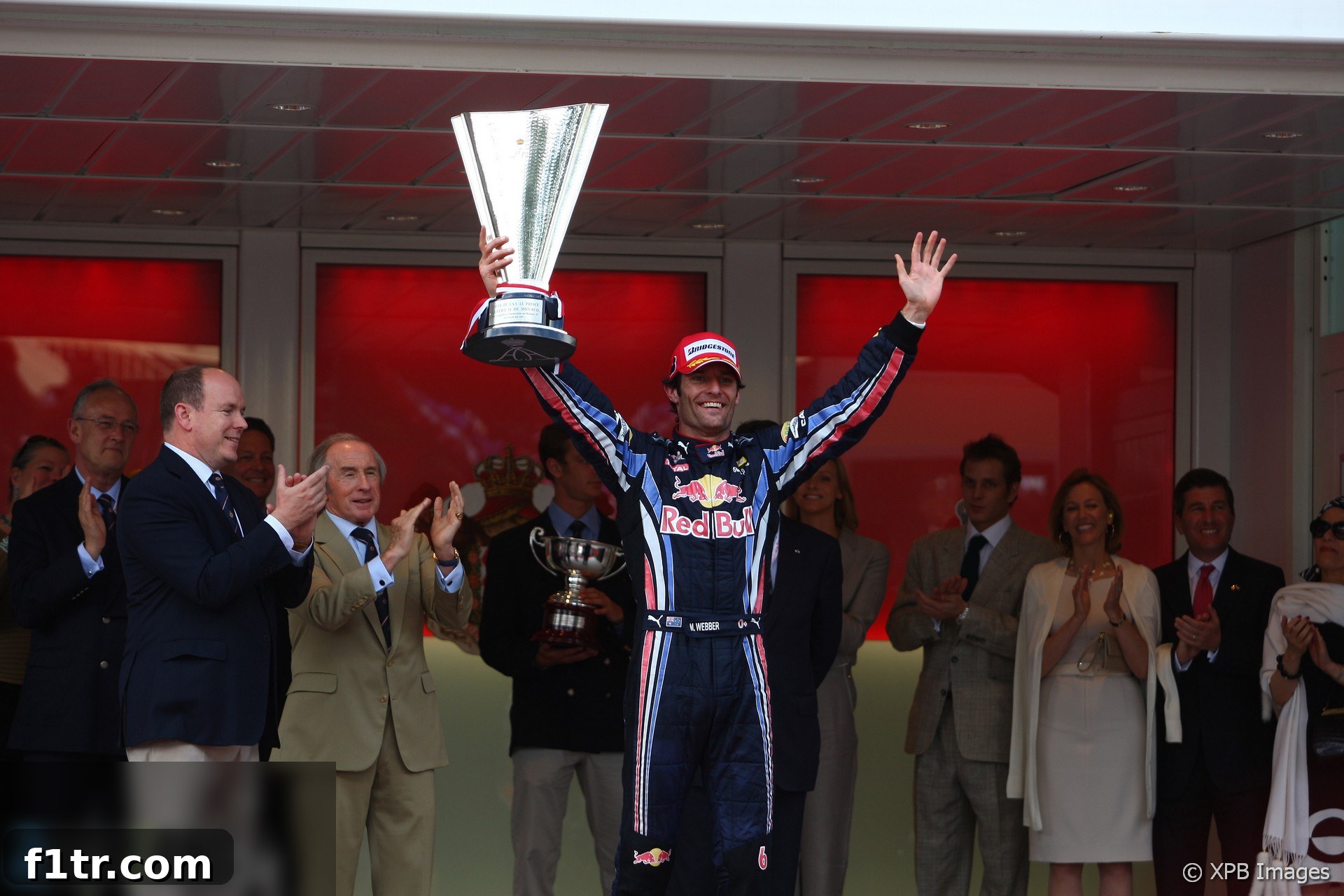
Mark Webber delivered a masterful performance at the iconic Monaco Grand Prix, dominating every single lap and leading Red Bull Racing to a sensational one-two victory in the prestigious principality. The Australian driver showcased unparalleled focus and skill, navigating a race fraught with incident and multiple safety car interventions, ultimately securing a truly memorable triumph. This victory not only solidified Webber’s reputation as a top-tier competitor but also underscored Red Bull’s growing might in the 2010 Formula 1 season.
The legendary street circuit of Monaco, renowned for its unforgiving nature and the constant threat of unpredictable events, lived up to its reputation. The race was punctuated by no fewer than four safety car periods, each triggered by a series of dramatic crashes that reshaped the flow of the grand prix. Yet, through it all, Webber remained an epitome of composure. With each restart, he coolly re-established his commanding lead, meticulously managing the gap to his closest pursuers and never relinquishing his control over the proceedings.
A late scare threatened to derail his perfect run when two backmarkers, locked in their own battle, collided directly in front of him. This incident necessitated the final deployment of the safety car, setting the stage for a tense conclusion. As the safety car peeled into the pits on the very last lap, the race concluded amidst significant controversy. Michael Schumacher executed a daring pass on Fernando Alonso for sixth place just as the green flags waved, an maneuver that immediately sparked heated debate and an investigation by the race stewards regarding the rules governing restarts under such circumstances.
Webber’s Commanding Start and Early Race Dynamics
From the moment the lights went out, Mark Webber asserted his authority. Starting from a well-deserved pole position, he held his lead flawlessly into the treacherous Sainte Dévote corner, displaying the calm confidence that would define his entire race. Behind him, his Red Bull teammate, Sebastian Vettel, made an electrifying start, capitalising on his grid position to decisively overtake Robert Kubica and snatch second place. This immediate Red Bull one-two placed the team in an enviable strategic position right from the outset.
Kubica, meanwhile, found himself in a frantic three-way battle for third. As he braked for the first corner, Lewis Hamilton was on his right, and Felipe Massa on his left. In a testament to his car control and race craft, the Polish driver managed to skilfully hold off both McLaren and Ferrari challenges, maintaining his hard-won third position.
First Safety Car: Hulkenberg’s Crash and Alonso’s Bold Strategy
The race’s early rhythm was abruptly shattered on the very first lap. Nico Hülkenberg’s promising race came to a premature and dramatic end when his Williams crashed heavily in the iconic Monaco tunnel. This high-speed impact scattered debris across the track, necessitating the immediate deployment of the safety car – the first of many such interventions. The incident highlighted the unforgiving nature of Monaco, where even the slightest misjudgment can have severe consequences.
For Fernando Alonso, who had endured a nightmare qualifying session and was forced to start the race from the pit lane, this early safety car presented an unexpected stroke of fortune. Seizing the strategic opportunity, the Ferrari team immediately called him in. Alonso swapped his super-soft tyres for the more durable medium compound, effectively completing his mandatory pit stop without losing significant time under green flag conditions. This audacious gamble was a testament to Ferrari’s quick thinking and Alonso’s determination, instantly placing him back in contention, albeit at the tail end of the field.
Mid-Race Resurgence and Shifting Tactics
When the safety car retreated and the race restarted, the front-runners maintained their positions, with Webber leading Vettel, followed by Kubica, Massa, and Hamilton. A notable mention went to Rubens Barrichello, who had made an impressive start to elevate his Williams car into sixth place, showcasing his enduring talent and experience.
Meanwhile, Alonso embarked on his relentless charge through the backmarkers. His sheer speed and aggressive driving were evident as he systematically dispatched the cars of the newer teams. He spent several tense laps duelling with Lucas di Grassi before finally making a decisive pass at the Nouvelle Chicane, a notoriously difficult overtaking spot. Alonso’s rapid progress was so swift that it began to pose a strategic threat to the leaders. McLaren, keenly aware of the Ferrari’s pace, opted to bring Hamilton in for his pit stop earlier than planned, specifically to ensure he remained ahead of the rapidly approaching Alonso.
This move triggered a chain reaction, prompting most of the remaining front-runners to make their mandatory pit stops. However, the top five positions remained largely unchanged after the pit stop cycle. Nico Rosberg initially delayed his pit stop, hoping to gain an advantage, while Kamui Kobayashi briefly held up a train of cars including Massa, Hamilton, and Alonso. But once Kobayashi retired, Rosberg was forced to pit and consequently found himself rejoining the track behind his teammate, Michael Schumacher.
Second Safety Car: Barrichello’s Dramatic Exit
The second safety car period was initiated on lap 30 by another significant incident involving a Williams car. Rubens Barrichello, who had been enjoying a strong race, appeared to suffer a mechanical failure on the left-rear corner of his FW32. The car snapped violently, pitching him into the barriers at Massenet with considerable force. As parts of the car flew off, Vitantonio Liuzzi was forced to brake hard to avoid the debris and the stricken Williams.
In a bizarre and memorable moment, once Barrichello’s car came to a rest, he dramatically tossed his steering wheel out of the cockpit in frustration. The wheel bounced onto the racing line and was subsequently run over by a passing HRT car, adding another layer of chaos to the unfolding scene. This incident brought out the safety car once again, completely erasing the comfortable ten-second lead Webber had painstakingly built up.
Third and Fourth Safety Cars: Unforeseen Obstacles and Dramatic Collision
Shortly after the race restarted following Barrichello’s crash, the safety car was mysteriously summoned for a third time. The reason was quickly identified: a loose drain cover on the circuit posed a significant hazard to the cars, necessitating another intervention to allow marshals to secure it. These frequent safety car periods underscored the inherent challenges of racing on city streets and continually compressed the field, adding layers of tension to an already dramatic event.
With overtaking notoriously difficult on the narrow streets of Monaco, there was little change in positions among the front-runners during these periods. Despite having run almost the entire race distance on the same set of tyres, Alonso maintained a comfortable margin over Schumacher, a testament to his earlier strategic pit stop and careful tyre management.
However, the drama was far from over. The race’s final safety car period was triggered by an alarming and spectacular collision between Karun Chandhok and Jarno Trulli. Trulli, having spent much of the later part of the race frustrated behind the slower HRT driver, attempted a daring pass on the approach to Rascasse. As the two cars converged, Chandhok turned in, resulting in their wheels tangling. In a terrifying moment, Trulli’s Lotus sprang into the air, crashing down dramatically onto Chandhok’s roll hoop.
Thankfully, both drivers emerged from the wreckage uninjured, with Chandhok instinctively ducking down into his cockpit during the impact. The severity of the crash necessitated the immediate deployment of the safety car, setting up a nail-biting finish to the Monaco Grand Prix.
Controversial Finish and Championship Implications
The safety car made its final exit on the very last lap of the race, leaving a single lap of green-flag racing. Webber, maintaining his composure one last time, accelerated cleanly to the finish line, securing his second consecutive victory of the season and a truly dominant performance at Monaco. The celebration for his flawless drive was immense, yet behind him, the final moments of the race unfolded into immediate controversy.
As the safety car pulled in, Michael Schumacher executed a daring, some would say illegal, pass on Fernando Alonso. Schumacher crossed the line ahead of the Ferrari driver, sparking intense debate and an immediate investigation by the stewards. The core of the controversy revolved around a specific rule concerning overtaking under safety car conditions on the final lap, leading to a complex unraveling of events by the race officials after the chequered flag.
Webber’s impeccable win propelled him into a joint lead in the Drivers’ Championship alongside his teammate Sebastian Vettel. This remarkable result also saw Red Bull Racing seize the lead in the Constructors’ Championship from McLaren, who managed to get only Hamilton’s car to the finish line, highlighting a shift in the competitive landscape of the season.
Adding to McLaren’s woes, former championship leader Jenson Button suffered a particularly unfortunate retirement on only the second lap due to overheating issues. It later emerged that a cover had mistakenly been left over one of his car’s radiators on his way to the pits, leading to critically high engine temperatures and forcing him to pull over, a costly error that impacted his championship defence.
The 2010 Monaco Grand Prix will be remembered for Mark Webber’s flawless display of dominance, Red Bull’s formidable one-two, and a dramatic conclusion that sparked a heated debate, all against the iconic backdrop of Monte Carlo. It was a race that had everything: strategic gambles, high-speed crashes, and a touch of controversy, reaffirming Monaco’s status as one of Formula 1’s most captivating events.
2010 Monaco Grand Prix Analysis:
- Race Report: Mark Webber’s Dominant Victory
- Driver Performances: Alonso’s Charge from the Pit Lane
- Controversy Explained: Schumacher’s Final Lap Pass
- Championship Implications: Red Bull Takes the Lead
Browse all 2010 Monaco Grand Prix articles