The Epic San Marino Grand Prix: A Battle of Champions at Imola
The 2005 San Marino Grand Prix at the iconic Autodromo Enzo e Dino Ferrari circuit in Imola delivered one of the most memorable and nail-biting Formula 1 races in recent history. While it ultimately culminated in Fernando Alonso’s third victory of the season, extending his championship lead, it also served as a stark warning: his seemingly smooth path to the title would be anything but easy. The race initially saw Kimi Raikkonen storm into an early lead, only for Michael Schumacher to stage a breathtaking comeback from a distant starting position, challenging Renault’s reign right to the very last, thrilling lap.
From the outset of first qualifying, it was unmistakably clear that the race narrative would primarily revolve around a titanic struggle between three titans of the sport: Alonso, Raikkonen, and Schumacher. Each driver represented a different facet of the championship battle, with Ferrari, in particular, under immense pressure to perform on their beloved home soil, a circuit steeped in their rich legacy. Meanwhile, Giancarlo Fisichella, Alonso’s teammate at Renault, once again struggled to find his rhythm, making an unforced error during his crucial first qualifying lap that severely compromised his starting position. In a commendable display of adaptability, Alex Wurz, deputizing for the injured Juan Pablo Montoya, managed to convert a disadvantageous early running slot into a provisional eighth place, showcasing his considerable talent despite his last-minute call-up. However, the biggest surprise of qualifying came from Jenson Button’s BAR-Honda, which provisionally secured an impressive fifth place on the grid, hinting at a strong performance for the British team.
Many pundits and fans alike had virtually written off Michael Schumacher after a rare and uncharacteristic mistake at Rivazza during qualifying relegated him to a distant 13th on the final grid. This was a particularly bitter pill for Ferrari to swallow, compounded by his teammate Rubens Barrichello only managing tenth. Combined, this represented Ferrari’s worst qualifying performance at Imola since the track hosted the Italian Grand Prix way back in 1980, a grim and undeniable indicator of the significant challenges facing the Scuderia at the dawn of the 2005 Formula 1 season. The weight of expectation was heavy, and their home Grand Prix seemed set to be another disappointment.
Kimi Raikkonen, demonstrating McLaren’s raw one-lap pace, managed to extend his slender 0.003-second advantage over Alonso from the first qualifying session to a more significant 0.558 seconds, ultimately securing a dominant pole position. This substantial leap in performance immediately fueled intense speculation within the paddock that McLaren had opted for an aggressively light fuel load on Raikkonen’s car to gain a critical grid advantage – a strategy often considered a gamble and not entirely typical for the Woking-based squad known for its conservative approach. Behind the front row, Jenson Button continued to impress, leapfrogging Mark Webber to snatch a vital third place for BAR-Honda. Jarno Trulli, in the Toyota, yet again showcased his exceptional prowess in qualifying, putting a considerable margin between himself and his teammate Ralf Schumacher. Trulli started fifth, while Ralf Schumacher, who had also been promoted by Felipe Massa’s unfortunate ten-place grid penalty for an engine change, began from tenth position.
Raikkonen’s Early Dominance and Heartbreak at Imola
If McLaren’s qualifying strategy was indeed to run Raikkonen light, it proved to be a gamble that offered tantalizing promise before ending in cruel and agonizing disappointment. From the moment the lights went out, Raikkonen showcased astonishing pace, scorching away from the grid and establishing an immediate two-second lead over Alonso after just a single lap. He steadily continued to extend his advantage, his blistering pace suggesting a dominant performance was unequivocally on the cards, echoing the potential seen in pre-season testing. However, fate intervened dramatically on lap nine when his driveshaft catastrophically failed, forcing him to retire abruptly from the lead, bringing his race to a premature and heartbreaking end. The irony that this marked McLaren’s first mechanically-induced retirement of the season offered absolutely no comfort. Coming after a tyre valve failure had already ruined his Malaysian Grand Prix, this latest setback seriously compromised Raikkonen’s championship aspirations, dealing a severe and perhaps irreversible blow to his title hopes so early in the highly competitive 2005 season.
With Raikkonen’s unfortunate exit, Fernando Alonso seamlessly inherited the lead, suddenly enjoying a brief but comfortable gap to second-placed Jenson Button, who in turn had a further margin over Jarno Trulli. However, just behind Trulli, a fascinating and intense mini-battle developed, creating a temporary traffic jam that promised excitement. This group included Mark Webber, Takuma Sato, Alex Wurz, Jacques Villeneuve (who was finally enjoying a much-needed spell of good fortune with Sauber), and Rubens Barrichello. Webber, having lost positions to Trulli and Sato off the grid, executed a clever and daring re-pass on the Japanese driver around the outside of the challenging Tosa and Piratella corners – a testament to his bravery and car control. While Michael Schumacher famously ran Juan Pablo Montoya cleanly off the circuit at the very same spot the previous year, Sato was perhaps a touch too generous with his racing space this year. However, Sato soon made amends for this slight tactical error, demonstrating his opportunistic flair with a smart and well-timed pass as the initial crucial round of pit stops commenced, proving his fighting spirit and ability to adapt.
Go ad-free for just £1 per month>> Find out more and sign up
Schumacher’s Ascendant Charge and Mid-Race Drama
As the frontrunners bustled in and out of the pit lane, primarily making relatively little progress in terms of direct on-track overtaking, a vastly different and potentially race-winning strategy was unfolding further down the field. Alex Wurz and, more significantly, Michael Schumacher, remained out on track for considerably longer stints, pushing their cars and tyres to the absolute limit. Jenson Button had briefly managed to chip away at Alonso’s lead, posting a couple of fastest laps, showcasing the BAR-Honda’s potential. However, this proved to be only a temporary burst of speed in the run-up to his own first pit stop. The real pace, the true dormant potential of the Ferrari F2005, was finally unleashed by Schumacher. He began to reel off a series of red-hot, blistering laps, consistently breaking track records and demonstrating the car’s newfound performance and his own unparalleled skill behind the wheel. When he finally pitted, his strategic masterclass, combined with his raw, unmatched speed, meant he emerged in an astonishing third place, having climbed from running as low as twelfth position – a clear and unequivocal signal that the seven-time World Champion was not only back in contention but a serious threat for victory.
Meanwhile, the middle of the pack provided its share of thrilling and, at times, controversial action, not least involving Sauber’s Felipe Massa. The young Brazilian launched two determined and aggressive attempts to overtake David Coulthard’s Red Bull at the notoriously tricky Rivazza corner. In his first lunge, Massa attacked from too far back, succeeding only in chopping the front wing from his own Sauber, a clear misjudgment of distance and speed. Undeterred and perhaps overly ambitious, he tried again, once more attempting an overtake from an improbable distance, and this time thumped directly into the side of Coulthard’s car, forcing the veteran Scot off the circuit in a dangerous maneuver. This aggressive action, which left many questioning the consistency of the stewarding, arguably should not have gone unpunished. While no one within the sport wants to stifle the thrill and excitement of overtaking in Formula One, allowing drivers to barge into one another with fragile open-wheeled cars carries inherent dangers for both competitors and spectators, and risks undermining the integrity and sportsmanship of fair racing.
The Climactic Duel: Schumacher vs. Button and Alonso’s Unwavering Defense
With his Ferrari F2005 now truly flying and performing optimally, Michael Schumacher wasted no time setting his sights on Jenson Button, who was running ahead in second place. He decimated the Briton’s advantage at an incredible rate, often closing the gap by up to two seconds per lap, showcasing a pace that few others could match. Schumacher finally caught Jenson with just a few laps remaining before the crucial final round of pit stops. For a moment, it seemed he might be stuck behind the BAR-Honda, perhaps unwilling or unable to risk a potentially championship-damaging pass so early in the season. However, on lap 45, fortune, which often favors the brave, smiled upon the German maestro. Button made a small, uncharacteristic error at Acqua Minerali and then inexplicably failed to defend his position effectively at the Variante Alta chicane, leaving a critical opening. Schumacher seized the opportunity with clinical precision, breezing past Button. With Alonso concurrently heading into the pits for his own final scheduled stop, Schumacher suddenly found himself in the lead of a Grand Prix for the first time that year, igniting the Tifosi’s hopes and sending a roar through the stands.
It was around this crucial and highly dramatic moment that viewers in Britain were infamously distracted by broadcaster ITV’s unusual (to say the least) timing of advert breaks – an issue that sparked considerable public debate and criticism. However, the intensity of the race action itself was more than enough to hold global attention, overshadowing any minor broadcast blips for those fully immersed in the on-track battle.
Schumacher made his final pit stop on lap 49, rejoining the track from the pits just 1.5 seconds behind Alonso. Immediately, Schumacher demonstrated a vastly superior speed compared to the young Spaniard. This pace advantage was perhaps even greater than that offered by the newly refined Ferrari F2005, as Alonso was crucially running his Renault engine at significantly reduced revs. This was a necessary precautionary measure after a serious problem had been discovered with the power unit during practice sessions earlier in the weekend, adding another layer of significant challenge and vulnerability to Alonso’s defensive strategy. He was driving not just against Schumacher, but also against the limitations of his own machinery.
A Finish for the Ages: Twelve Laps of Pure F1 Drama at Imola
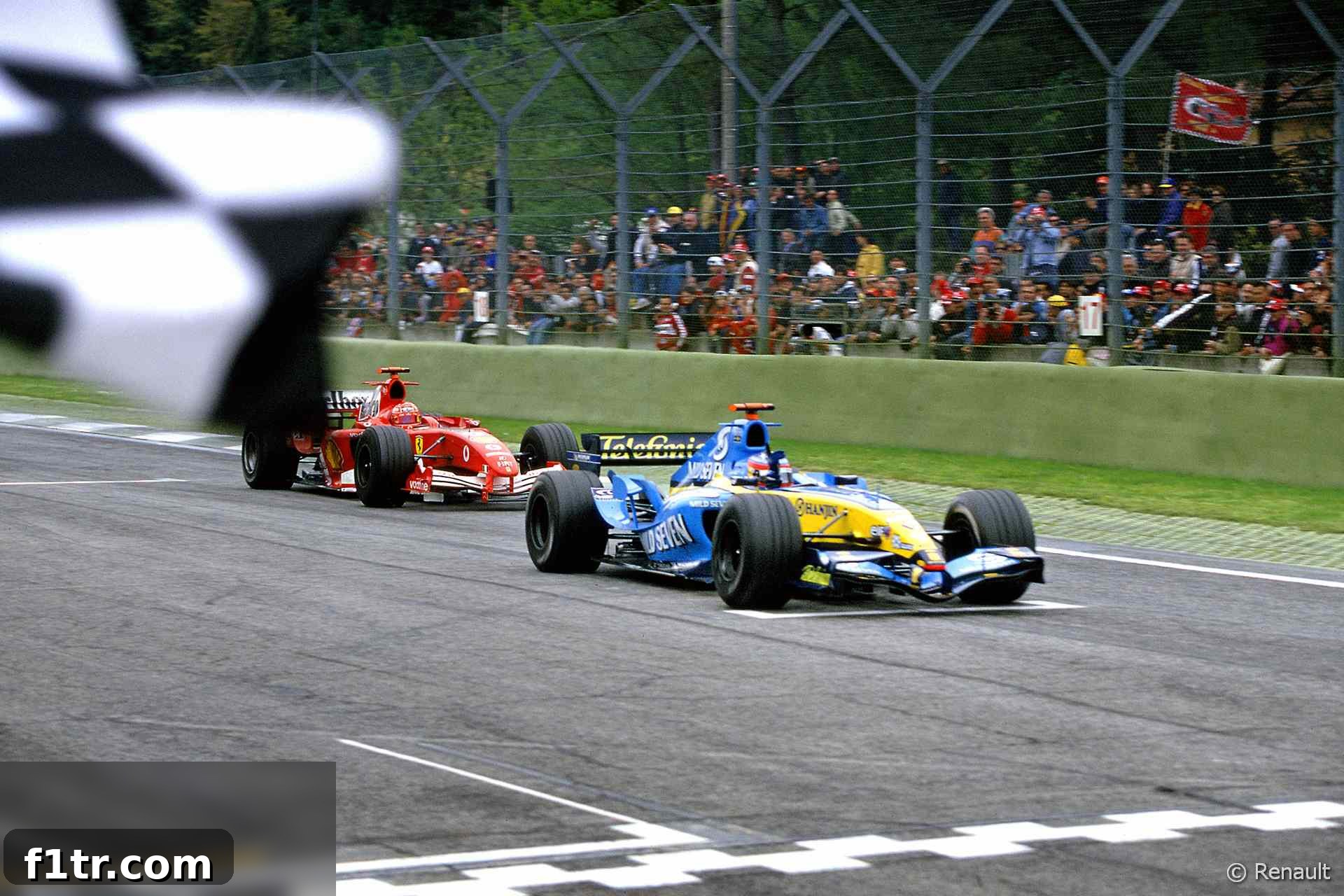
What followed for the next twelve gripping laps was an exhilarating cat-and-mouse chase, a true masterclass in both defensive and attacking driving at the pinnacle of motorsport. Schumacher relentlessly hounded Alonso without mercy, pushing the Renault driver to his absolute physical and mental limits. At one point, the Ferrari was able to draw almost alongside the Renault as they navigated the demanding descent from Piratella to Acque Minerali, a high-speed section. However, there simply wasn’t enough space for Schumacher to complete the overtake, forcing him to back off. While Schumacher’s challenge was undeniably relentless and aggressive, it perhaps seemed to lack the ultimate clinical, almost ruthless, aggressive edge that had defined many of his past decisive overtakes. He didn’t appear to actively try and lure Alonso into compromising defensive moves or force a mistake through intimidation. Alonso, to his immense credit, responded with a display of resilience, composure, and strategic driving that is too rarely seen in Schumacher’s rivals during his era of dominance. He placed his car perfectly, utilized every inch of the track, anticipated every move, and absorbed every attack, expertly fending off the most successful driver in Formula 1 history with unwavering precision.
They crossed the finish line separated by a mere 0.215 seconds – an incredibly tight margin that delivered one of the closest and most compelling real racing finishes witnessed in years, an instant classic. This epic duel, however, served as a serious and resounding wake-up call for both Fernando Alonso and the entire Renault team: Ferrari were unequivocally back, and in a very big way, signalling that the championship would be a fierce fight. The race also brought serious concerns regarding the reliability of Renault’s machinery, further highlighted by Fisichella’s second consecutive retirement due to mechanical failure, as a collapsed rear-left suspension tragically pitched him into the Tamburello wall early in the race, ending his day prematurely. Ferrari, too, failed to get both cars to the finish for a second race running; but, critically, it was the important car – Schumacher’s – that not only finished but pushed for victory, providing invaluable data and a massive morale boost.
Other Notable Performances and Championship Outlook
Beyond the epic front-row battle that captivated the world, the San Marino Grand Prix saw several other drivers deliver commendable performances throughout the field. Jenson Button finally secured a much-needed podium finish for BAR-Honda, a significant boost for the team after a challenging start to the season. His teammate Takuma Sato backed this up with a strong fifth place, expertly sandwiching Alex Wurz, who drove a quietly understated but absolutely faultless race to claim an impressive fourth position in his substitute role, proving his enduring talent. The Williams drivers, however, had a generally disappointing outing; Nick Heidfeld finished an unspectacular eighth, and Mark Webber, who had started an optimistic fourth on the grid, floundered to ninth. Jacques Villeneuve, cruelly denied points in Bahrain, delivered a solid sixth place for Sauber, offering tangible hope that this result might mark the beginning of better times for the 1997 World Champion. Jarno Trulli finished seventh, while Ralf Schumacher initially finished eighth but subsequently lost his points after officials slapped him with a 25-second post-race penalty for an alleged ‘unsafe incident’ involving Heidfeld, a decision Toyota immediately announced their intention to appeal.
With a rejuvenated Michael Schumacher now in fighting form and a fired-up Kimi Raikkonen chasing him down, Fernando Alonso found himself under maximum pressure as the exhilarating Formula 1 circus prepared to head to a sold-out Circuit de Barcelona-Catalunya in just two weeks’ time. If Schumacher could translate his incredible race pace into a strong qualifying performance and unleash the same awesome speed at Barcelona, it would undoubtedly demand an even more incredible effort than the one Alonso displayed at the close of the San Marino Grand Prix to secure victory in Spain. The championship battle had truly ignited, promising an enthralling, unpredictable, and fiercely contested season ahead, where every point would matter immensely.
Formula 1 Insights & Analysis
Browse all Formula 1 articles