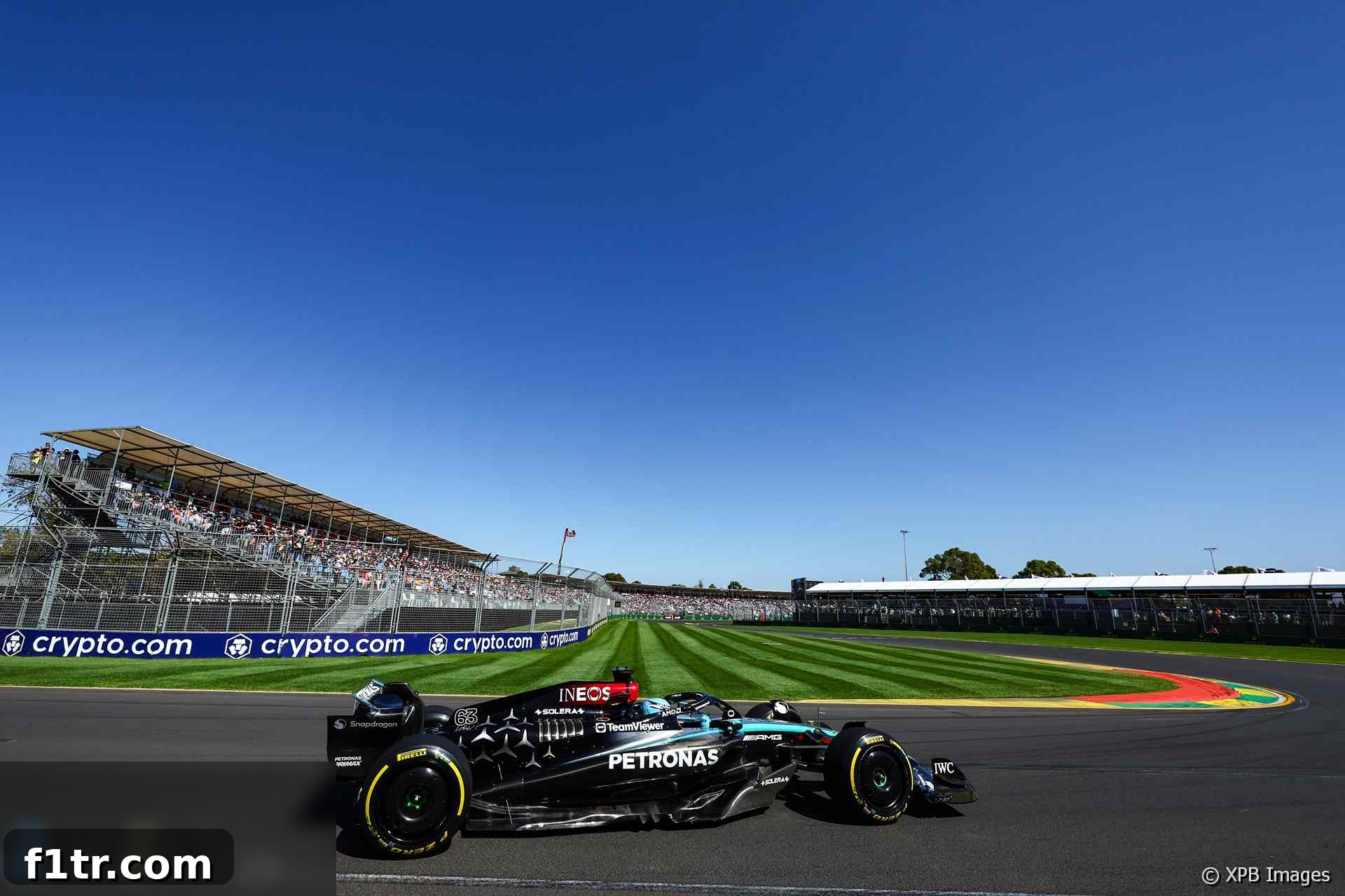
The recent Australian Grand Prix proved to be a pivotal, albeit challenging, weekend for Mercedes-AMG Petronas Formula One Team. Despite the disappointing results, which saw neither Lewis Hamilton nor George Russell score points, the race provided critical insights into the underlying performance deficiencies of their W15 challenger. This understanding, as technical director James Allison highlighted, is the first crucial step towards unlocking the car’s full potential and returning the Silver Arrows to the sharp end of the grid.
Mercedes arrived in Melbourne with cautious optimism, yet the weekend quickly unravelled. Lewis Hamilton’s race ended prematurely with a power unit failure, a rare mechanical setback for the seasoned seven-time world champion. Adding to the team’s woes, George Russell, battling valiantly for a points-scoring position, suffered a dramatic crash on the penultimate lap while pursuing Fernando Alonso, bringing out a virtual safety car and leaving Mercedes with a painful double retirement. Beyond the DNFs, the sheer pace of the W15 was a significant cause for concern throughout the event. Russell could only manage seventh in qualifying, while Hamilton astonishingly failed to make the cut for Q3, a highly unusual occurrence for a driver of his caliber in a Mercedes car.
The stark contrast between their Friday and Saturday performance offered Mercedes a vital clue. In the final practice session (FP3), both drivers showcased a more competitive edge, consistently appearing within the top five on the timesheets. This flicker of potential, immediately followed by a struggle for pace in qualifying and the race, suggested a pattern that Allison and his team were quick to investigate. “Almost no set-up changes occurred between FP3 and qualifying,” Allison explained in a detailed video analysis released by the team. He noted the standard adjustments for qualifying, such as reducing fuel load and increasing engine power, but emphasized that no significant alterations were made to the car’s fundamental setup. This indicated that the car itself, rather than a specific setup choice, was reacting differently to changing track conditions.
This inconsistency has become a recurring theme for Mercedes in the nascent stages of the 2024 season. Allison articulated the emerging pattern: “Most weekends we have a period in the weekend where we are feeling good about the car, confident about the car, but then in the ‘paying’ sessions, in qualifying and the race, that slips through our fingers.” The key correlation identified by the team’s engineers points directly to track temperature. Allison stated, “the strongest correlation that we can make at the moment is that our competitiveness drops when the track is warm, when the day is at its warmest and therefore the tyre temperatures rise with those of the track. The times when we have been at our best have been all in the sessions which are the coolest and so that gives us some clues about what we need to do as we move forward from here.”
This revelation is profoundly significant in Formula 1, where tire management and operating windows are paramount. Modern F1 tires are incredibly sensitive to temperature. When a track warms up, it transfers more heat into the tires, often pushing them beyond their optimal operating window. For Mercedes, this manifests as reduced grip, increased degradation, and an overall lack of confidence for the drivers. The car becomes less predictable, especially through high-speed corners, and maintaining consistent lap times becomes an arduous task. Conversely, in cooler conditions, the W15 appears to keep its tires within their ideal temperature range more effectively, allowing the drivers to extract more performance and feel more connected to the car. This suggests a fundamental issue with how the W15 either generates or manages tire temperature in hotter environments, or perhaps how its aerodynamic and mechanical characteristics interact with the tires when they are operating at higher temperatures.
Understanding this temperature-dependent performance swing is a massive breakthrough for the Brackley-based squad. Knowing the ‘what’ now allows them to focus on the ‘why’ and ‘how’ to fix it. The team’s immediate efforts will center on a multi-pronged approach, beginning with conventional setup adjustments. Allison confirmed that with this clearer understanding, they can “work into the weekend a programme that is dedicated towards trying to move the temperature and the temperature balance front to rear in your favour using all the conventional set-up tools on the car.” This includes meticulously tweaking elements like wing angles, ride height, suspension stiffness, anti-roll bar settings, and brake bias. Each of these components plays a crucial role in how loads are transferred through the car to the tires, directly influencing their temperature and wear rates. Such work can be extensively carried out back at the factory using advanced simulation tools, dyno testing, and Driver-in-the-Loop (DiL) simulators, allowing engineers to model and predict the effects of various setup changes before hitting the track.
However, the technical director also alluded to the possibility that setup changes alone might not be sufficient. If, after exhausting the available degrees of freedom in terms of setup, the core issue persists, it indicates deeper, more inherent problems within the W15’s design. This is where the challenge becomes “harder at that point because that will be that there are underlying characteristics in say the aerodynamic map that you’ve engineered or the suspension characteristic that is aggravating that particular feature.”
An “aerodynamic map” refers to how the car’s bodywork and various aero elements generate downforce and airflow across different speeds, yaw angles, and ride heights. If the W15’s aero map is inherently unstable or generates inconsistent downforce distribution in hotter conditions, it could lead to erratic tire temperatures and a lack of balance. For instance, if the front wing or floor design creates excessive turbulence or disrupts airflow over the tires at certain speeds, it could prevent them from working optimally. Similarly, the “suspension characteristic” is critical. The suspension system dictates how the car reacts to bumps, how weight is transferred during cornering and braking, and crucially, how the tire maintains contact with the track surface. If the W15’s suspension kinematics are causing the tires to overheat, scrub excessively, or lose their optimal contact patch in warmer conditions, then a more significant redesign might be necessary. This could involve changes to wishbone geometry, damper settings, or even the overall suspension architecture. These deeper design tweaks are considerably more complex and time-consuming, requiring significant resources and often a sacrifice of short-term performance for long-term gains.
Allison elaborated on the nature of these solutions, distinguishing between approaches that can be “either quick and dirty or a little more involved and a bit more complicated.” Quick fixes might involve adding minor aerodynamic elements or making small mechanical adjustments that don’t require re-homologation of major components. More involved changes, however, could entail significant modifications to the car’s chassis, floor, or suspension elements, potentially requiring factory production updates and a longer lead time to implement. Such extensive redesigns are a testament to the team’s commitment to fully understanding and rectifying the W15’s fundamental flaws, rather than merely patching over symptoms.
The path ahead for Mercedes is undoubtedly challenging. Rivals like Red Bull and Ferrari have demonstrated a more consistent performance envelope across various conditions, indicating that managing tire temperatures and overall car balance in hot environments is achievable. Mercedes’ task now is to systematically apply their newfound understanding, leveraging their formidable engineering prowess and resources. The upcoming races will be crucial testbeds for their implemented solutions, both in terms of setup optimization and any potential design evolutions. While the double DNF in Australia was a bitter pill to swallow, the silver lining is the clarity it provided. For Mercedes, understanding the problem is the most vital first step towards crafting a solution and steering the W15 back towards the front of the competitive Formula 1 grid.
2024 Australian Grand Prix
- Alonso calls Australian GP penalty a ‘one-off I’ve had too many of’
- Red Bull saw warning sign of Australian GP brake problem on Saturday – Verstappen
- Failing to punish Alonso would have “opened a can of worms” – Russell
- Leclerc sure “many team principals” are pursuing Sainz for 2025 seat
- “Don’t put me under pressure” – The best unheard team radio from Melbourne
Browse all 2024 Australian Grand Prix articles