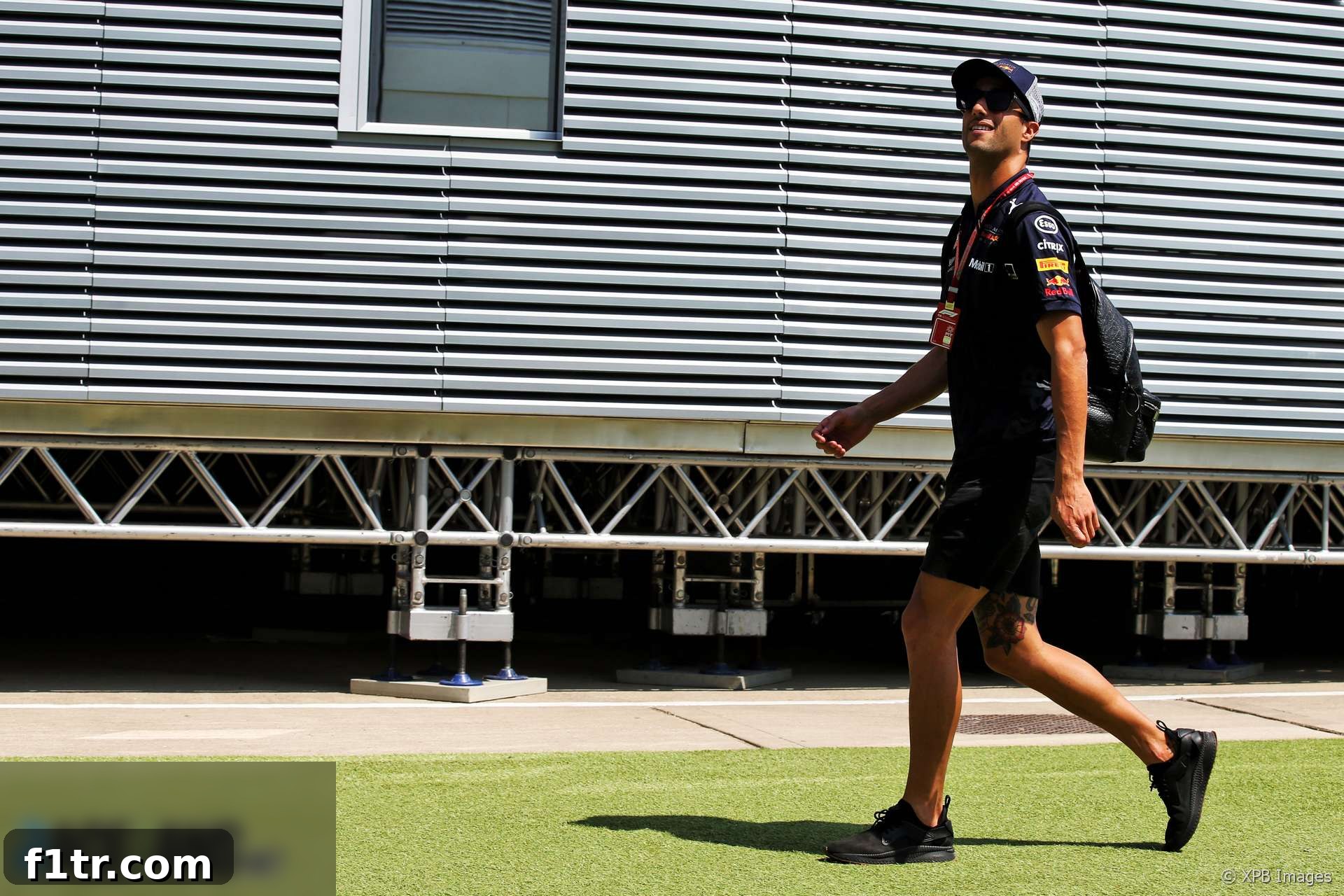
Daniel Ricciardo Weighs Crucial Red Bull Future Amid Honda Engine Switch
Daniel Ricciardo, one of Formula 1’s most charismatic and talented drivers, finds himself at a critical juncture in his career. The Australian star has confirmed that Red Bull Racing has presented a compelling case for him to extend his tenure with the team beyond the current season. This decision is intricately linked to Red Bull’s significant strategic shift: transitioning from Renault to Honda power units starting next year, a move that carries both immense potential and inherent risks for the championship hopeful.
The impending change in engine supplier is undoubtedly the cornerstone of Ricciardo’s deliberation. With his contract set to expire, the choice before him is profound: commit to a partnership with an engine manufacturer that has had a tumultuous recent history in F1, or explore opportunities elsewhere. Ricciardo has indicated that he is satisfied that Red Bull’s decision to embrace Honda is not merely an “emotional” reaction to past frustrations with Renault, but a well-researched and calculated strategic play.
Red Bull’s Strategic Rationale: Beyond Emotion
Speaking to media, including RaceFans, at Silverstone, Ricciardo shed light on the nature of his discussions with the team. “I’ve obviously heard the team out more than once, and they’ve given me good reason,” he stated, emphasizing the depth of their dialogue. For Ricciardo, understanding the foundation of Red Bull’s pivot to Honda was paramount. He stressed the importance of ensuring the decision wasn’t simply a knee-jerk response to the challenges experienced with their current engine partner.
“The important thing to understand for me why they’ve done it is it can’t just be purely on emotions like ‘ah, it’s gone [wrong] with Renault,’ whatever, and we’re just doing it because we want to change,” Ricciardo elaborated. This highlights a crucial aspect of high-stakes F1 decision-making: the need for objective analysis over reactive impulses. For a driver like Ricciardo, whose prime years are now, aligning with a team that makes data-driven, long-term strategic choices is vital for his championship aspirations.
He added, “They’ve obviously done their homework and they strongly believe that it is a good thing, not just an emotional decision. They’ve done what they can to try and encourage me to make it happen.” This suggests Red Bull has provided comprehensive data, performance projections, and perhaps even insight into Honda’s ambitious development plans. Their efforts to reassure Ricciardo underscore his immense value to the team and their desire to retain his services as they embark on this new chapter.
The Honda Gamble: A New Era for Red Bull
Red Bull’s decision to switch to Honda power units for 2019 marks a significant turning point for the Milton Keynes outfit. Having achieved four consecutive Constructors’ and Drivers’ championships with Renault from 2010 to 2013, the relationship has since been strained by a perceived lack of competitive power and persistent reliability issues in the V6 turbo-hybrid era. The move to Honda, despite their challenging return to F1 with McLaren from 2015 to 2017, represents a bold and calculated risk.
Honda’s recent partnership with Red Bull’s sister team, Toro Rosso, has shown promising signs of progress. While not yet a championship-winning engine, the Japanese manufacturer has demonstrated a steep learning curve and a willingness to invest heavily in its F1 program. This period with Toro Rosso has served as a crucial proving ground, allowing Red Bull to closely monitor Honda’s development trajectory and assess their true potential before committing to a full factory partnership. Ricciardo’s reassurance that Red Bull has done its “homework” likely stems from a detailed examination of this data and confidence in Honda’s future roadmap.
The prospect of a Red Bull-Honda alliance is tantalizing for many F1 enthusiasts. Should Honda successfully deliver a competitive and reliable power unit, Red Bull’s chassis design prowess could once again make them formidable championship contenders. However, the uncertainties remain, making Ricciardo’s commitment a high-stakes bet on future performance.
Championship Aspirations and Persistent Reliability Challenges
Despite the ongoing contract talks and engine supplier dilemma, Daniel Ricciardo remains fiercely focused on his performance on track and his ultimate goal: the Formula 1 World Championship. His 2018 season, while featuring two impressive victories, has also been marred by a disproportionate number of retirements, a factor that profoundly impacts his championship standing.
An exhaust problem forced Ricciardo out of a recent race, adding another frustrating DNF to his tally. When queried by RaceFans about the cumulative effect of these retirements on his championship hopes, Ricciardo demonstrated his characteristic resilience, refusing to concede defeat. “I think we’re doing pretty well considering we’ve only finished six out of nine,” he observed, acknowledging the team’s raw pace when the car holds together. However, he quickly added a dose of realism: “[But] doing alright is not enough to be there, and I think especially because we are not dominating every race on every circuit we go to, we need to finish more.”
Ricciardo meticulously broke down his retirements: “Two were technical and one was obviously the incident with Max [Verstappen].” This highlights a critical challenge for Red Bull: ensuring both power unit and chassis reliability, while also managing on-track incidents. The cumulative effect of these DNFs is a significant points deficit that becomes increasingly difficult to overcome as the season progresses.
Looking ahead, the road doesn’t get easier. “We’ve got to try and finish more. I’m very likely going to have a penalty in Germany,” Ricciardo revealed, alluding to the inevitable grid penalties associated with exceeding the allowed number of power unit components. Such penalties further complicate his championship charge, forcing him to fight through the field and potentially compromising race strategies.
Despite the mounting obstacles, Ricciardo’s fighting spirit remains undimmed. “The odds are against us but I still don’t think it’s impossible. There’s still too long to go to say it’s out.” This steadfast belief in his own ability and the team’s potential, even when facing significant headwinds, is a testament to his championship mentality. For him, every race, every point, every opportunity to demonstrate his prowess is critical, especially during a period of such intense personal and professional decision-making.
The Summer Break Deadline and Future Implications
Both Daniel Ricciardo and Red Bull team principal Christian Horner have publicly indicated their intention to make an announcement regarding Ricciardo’s future before the sport’s traditional summer break. This timeline adds an extra layer of urgency to the negotiations and signifies a desire from both parties to resolve the situation swiftly, allowing everyone to focus squarely on the remainder of the championship.
Ricciardo’s decision holds immense implications not only for his own career trajectory but also for the broader Formula 1 driver market and Red Bull’s long-term competitiveness. Should he choose to stay, it would signal a profound faith in the Red Bull-Honda project and a commitment to building a new era of success with the team. Conversely, a departure would open up a highly coveted seat at Red Bull, sparking a frenzy in the driver market and forcing the team to seek a top-tier replacement. This decision is one of the most anticipated in recent F1 memory, shaping narratives and trajectories for seasons to come.
Related Formula 1 Content
- Exploring Honda’s F1 Journey: From McLaren Struggles to Red Bull Partnership
- The High Stakes of Driver Contracts in Modern Formula 1
- Power Unit Penalties: How They Impact Championship Battles
- Max Verstappen and Daniel Ricciardo: A Look Back at Their Rivalry
- Red Bull Racing’s Strategic Vision: A Deeper Dive into Team Management
Browse all Formula 1 news and analysis