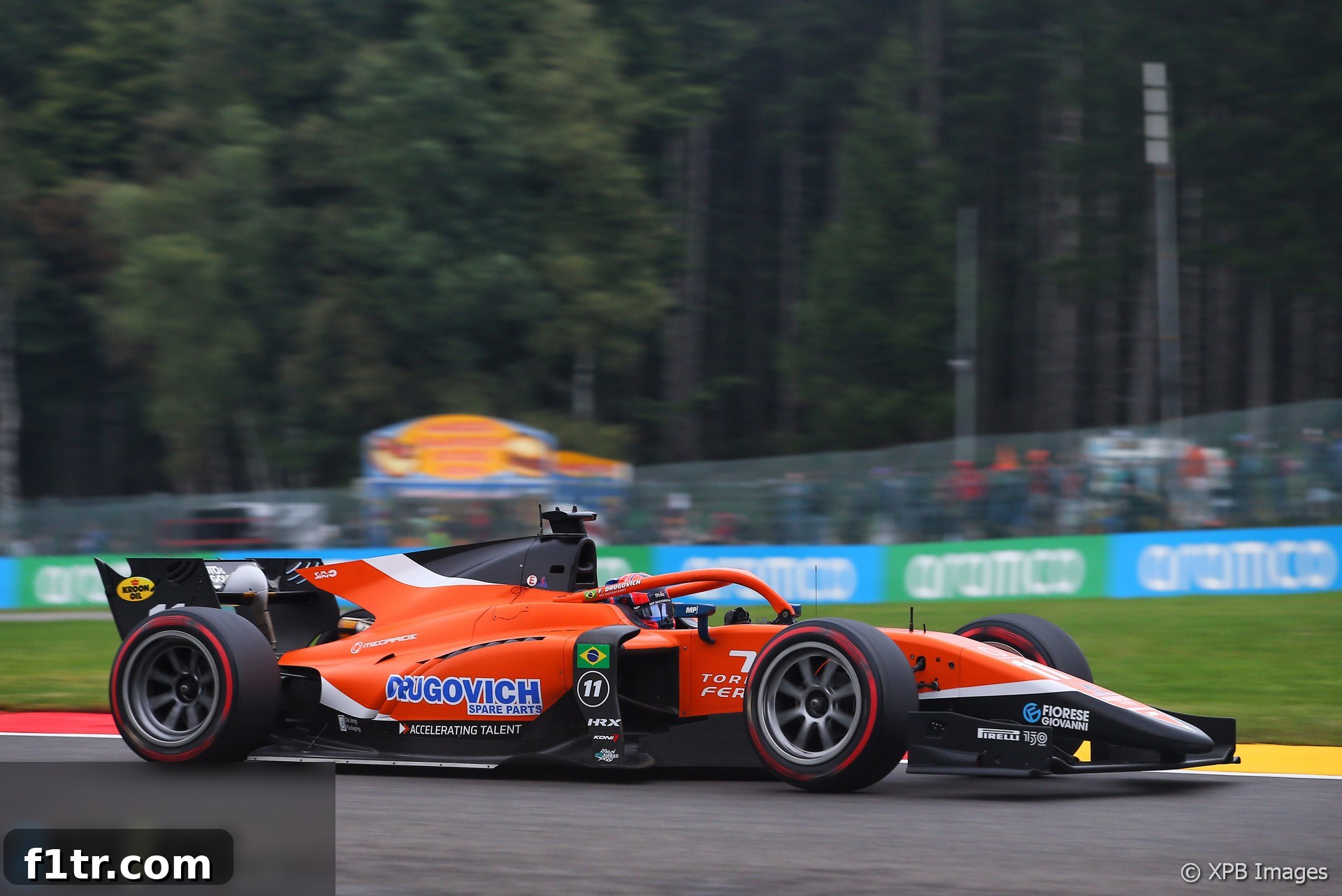
The exhilarating world of Formula 2, often lauded as the final proving ground for aspiring Formula 1 stars, recently saw its competitive edge overshadowed by a concerning trend of mechanical unreliability at the iconic Spa-Francorchamps circuit. While championship leader Felipe Drugovich successfully extended his advantage, he, along with several other front-running drivers, revealed their own struggles with technical glitches, painting a stark picture of the challenges faced in the demanding feeder series.
Advert | Become a Supporter & go ad-free
F2 Reliability Concerns Surface at Spa: Drivers Battle Unseen Foes
Last Sunday’s feature race in Spa-Francorchamps was a pivotal moment in the Formula 2 championship. While Prema Racing’s Theo Pourchaire was forced to retire from contention due to an undeniable technical fault with his ART-run car, seemingly handing a significant advantage to his title rival, it turns out Pourchaire was not alone in his mechanical woes. MP Motorsport’s Felipe Drugovich, who expertly converted his pole position into a second-place finish, substantially growing his championship lead over the Sauber junior to 43 points, disclosed that his own race began with a heart-stopping reliability scare.
The Spa-Francorchamps circuit, known for its high speeds and challenging sectors, provides an ultimate test for both driver and machine. For a series designed to showcase raw talent, the intrusion of mechanical failures adds an unwelcome layer of unpredictability and frustration. Drivers are not only battling each other and the track but also the hidden vulnerabilities within their meticulously engineered cars.
Felipe Drugovich’s Close Call: A Championship Leader’s Frightening Start
Drugovich, who has consistently displayed remarkable composure throughout his dominant season, recounted a terrifying moment even before the race officially began. “I don’t know if they showed [it] or something, but I had a pretty big issue on the formation lap,” he revealed. The MP Motorsport driver explained, “I had no power as well. For some reason, the engine needed a lap or something to clean up.” This loss of power during the crucial formation lap could have easily derailed his entire race, leaving him vulnerable to the pack and jeopardizing his pole position advantage. Imagine the immense pressure of preparing for a high-stakes race, only to be confronted with a car that isn’t performing as expected.
Despite the initial scare, Drugovich’s experience highlights the fine margins in motorsport. “I think still after the start, luckily I got a very good start, but still in the Kemmel straight I felt it wasn’t perfect,” he added. It wasn’t until the second lap that his car finally settled. “So from lap two on it was fine, but I was very scared and I was very worried.” This candid admission underscores the psychological toll reliability issues take on drivers, forcing them to push the limits while simultaneously managing unexpected technical limitations. While he benefited from Pourchaire’s retirement, Drugovich was quick to express his empathy, stating, “I think it’s not nice to see so many cars breaking down and having issues but we drivers cannot do anything. We just have to cope with it.” This collective sentiment speaks volumes about the pervasive nature of these challenges within the Formula 2 paddock.
Jack Doohan’s Masterclass in Management: Victory Despite the Glitches
The winner of the Spa-Francorchamps feature race, Virtuosi Racing’s Alpine junior Jack Doohan, echoed Drugovich’s concerns regarding the prevailing unreliability of Formula 2 machinery. Doohan, whose impressive drive secured him the top step of the podium, revealed he also had to contend with a significant power issue during the race. His comments shed light on the deeper implications of such problems for a driver’s career trajectory and public perception.
“It’s not ideal as, in the end, at the end of the season or whether it be during the season, everyone looks at statistics, everyone looks at the results on the paper,” Doohan elaborated. “At the end of the year, unfortunately not many people remember a DNF for reliability issues or a mechanical failure.” This profound insight highlights the cruel reality for young drivers striving for recognition in a fiercely competitive environment. A retirement, regardless of its cause, remains a blank space in the statistics, potentially obscuring a driver’s true performance and talent in the eyes of future employers or evaluators.
Doohan further detailed his in-race management of the issue: “Today, I didn’t want to mention it much, especially over the radio – for some reason in third gear I had low power and it wasn’t pulling. So I was either having to go to second [gear] or short shift to fourth.” This demonstrates the exceptional adaptability and mental fortitude required from these athletes. Not only did Doohan have to find alternative ways to navigate the circuit effectively, but he also consciously chose to withhold information from his engineers to avoid causing unnecessary distress, recognizing that little could be done mid-race. “It was something that we thought I had to manage. I was a little bit worried, but I didn’t want to say anything over the radio to distress the engineers or anything because there’s not much you can really do except for crack on.” His resolve ultimately paid off, allowing him to secure a crucial victory. “So, I’m happy that it held on, but that’s just the era we are in. We are in mechanical cars and unfortunately these things can happen,” he concluded, acknowledging the inherent risks of motorsport.
Liam Lawson’s Qualifying Handicap: The Ripple Effect of F2 Reliability
Adding to the chorus of concern, Carlin’s Liam Lawson, who impressively secured third place behind Drugovich and Doohan, also disclosed that he had encountered technical difficulties. The Red Bull junior explained that his issues impacted his starting position, underscoring how reliability problems can have a detrimental ripple effect throughout a race weekend.
“From my side, we had the same issue, I think a similar issue to Jack in qualifying,” Lawson stated. “That’s why we were starting sixth and not further up.” A compromised qualifying session due to an unseen mechanical fault means a driver starts further down the grid, immediately facing an uphill battle to make up positions. This not only makes the race more challenging but also increases the risk of incidents in the mid-pack. Lawson echoed Doohan’s sentiment about the long-term impact on a driver’s record: “It’s frustrating to have them, and I think, like Jack said, you get to the end of the year and you look back and sort of calculate all the points that you missed and… definitely it changes your result a lot, but I guess it is what it is.” The cumulative effect of missed points due to reliability can significantly alter championship outcomes and, critically, influence a driver’s prospects for an F1 seat, where every single point and perceived performance is scrutinized.
The Broader Implications of F2 Reliability Challenges
The widespread reports of mechanical issues among top Formula 2 drivers at Spa-Francorchamps raise important questions about the series’ reliability standards and their impact on the integrity of the competition. As a spec series, F2 aims to level the playing field, ensuring that driver talent is the primary differentiator. However, when multiple drivers face significant power or technical problems, it inevitably introduces an element of chance that can detract from the pure meritocracy the series strives for.
For aspiring Formula 1 drivers, F2 is more than just a race; it’s an audition. Consistent performance, the ability to capitalize on opportunities, and demonstrating peak potential are paramount. When reliability issues interfere, it not only robs drivers of potential points but also distorts the true picture of their capabilities. Teams and manufacturers invest heavily in these young talents, and unforeseen mechanical failures can undermine their development and evaluation processes.
While motorsport is inherently mechanical, and breakdowns are an accepted part of the sport, the concentration of such issues among leading contenders at a crucial championship stage warrants attention. It highlights the ongoing challenge for series organizers to balance cost control, performance, and robust reliability in a highly competitive environment. Ultimately, for the fans, the drivers, and the future of motorsport, a consistent and reliable platform is essential to truly identify and celebrate the next generation of racing champions.
Advert | Become a RaceFans supporter andgo ad-free
More on Formula 2
- Formula 2 to debut in Miami and Montreal after Iran war cancellations
- Ex-McLaren junior Dunne’s move to Alpine finally confirmed
- Schumacher says his IndyCar feels like ‘an F2 car, just with better tyres’
- The Formula 2 team with an older driver line-up than almost half the F1 grid
- FIA to award more F1 superlicence points to IndyCar drivers from 2026
Browse all Formula 2 articles