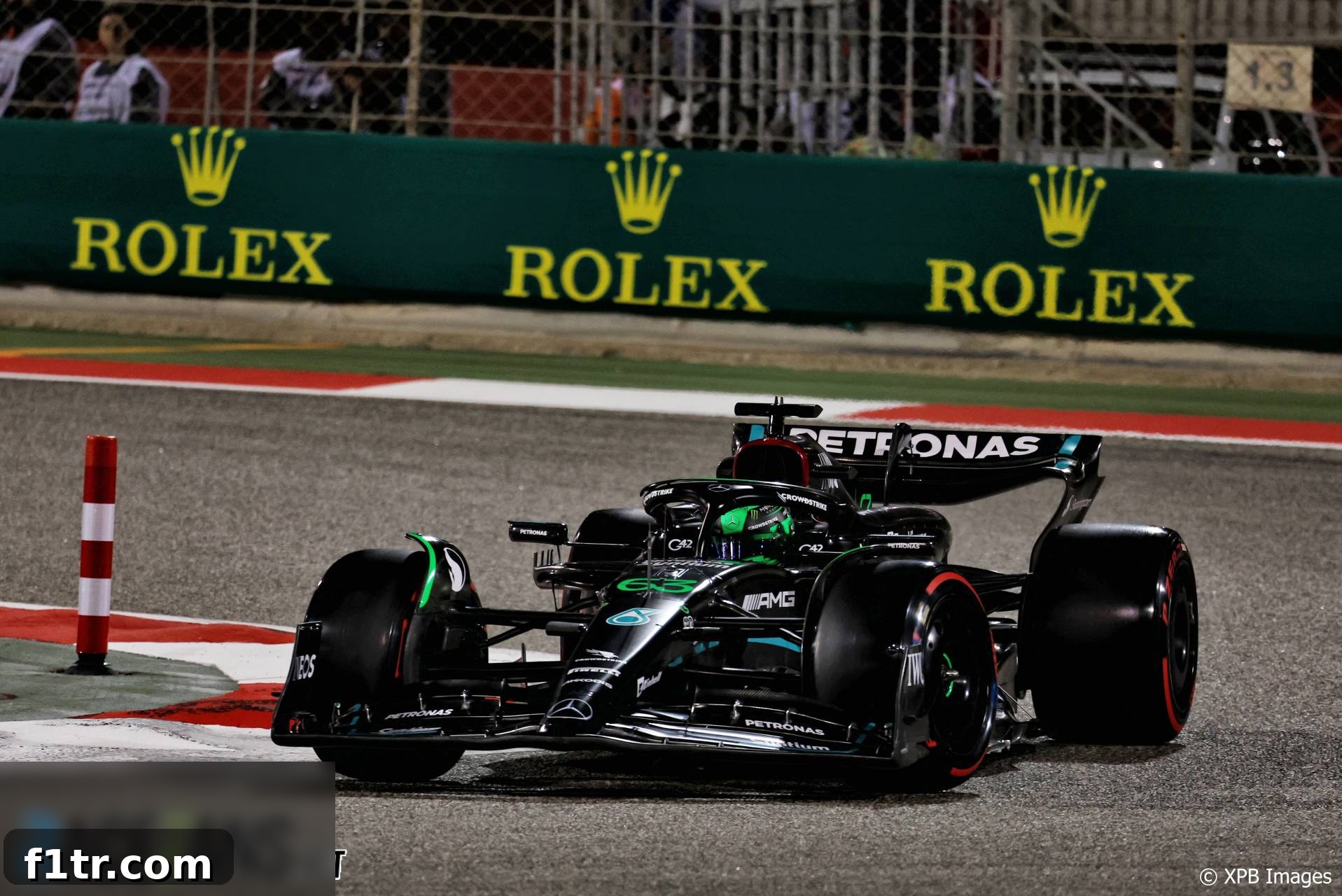
The Mercedes-AMG Petronas Formula 1 Team has openly admitted that a fundamental shift in its car philosophy is essential, following a challenging start to the 2023 season that mirrored the performance struggles of the previous year. Despite high hopes for their W14 challenger, the team found itself significantly off the pace during the season-opening Bahrain Grand Prix, prompting a candid re-evaluation of its innovative yet underperforming aerodynamic concept.
Twelve months after facing a similar deficit to the front-runners at the same Sakhir circuit, Mercedes drivers George Russell and Lewis Hamilton secured sixth and seventh positions on the grid for the Bahrain season opener. While a marginal improvement in absolute terms, finishing 0.632 seconds behind pole-sitter Max Verstappen, the relative gap to the championship-leading Red Bull Racing team remained disappointingly consistent. This persistent performance gap has ignited an urgent discussion within the Silver Arrows camp about the efficacy of their unique car design, particularly its distinctively slim ‘zero’ sidepods.
Lewis Hamilton, a seven-time world champion and a prominent voice within the team, had voiced his concerns even before qualifying, expressing doubts about Mercedes’ ability to bridge the gap to their rivals if they continued with their current design concept. His observations proved prescient, as the W14 demonstrated a clear lack of competitive edge against the dominant Red Bulls and even the rapidly improving Aston Martins and Ferraris.
Toto Wolff’s Candid Admission: A Call for Fundamental Change
Team Principal Toto Wolff, known for his pragmatic approach and unflinching honesty, wasted no time in confirming the team’s stark realization. Speaking to media outlets, including RaceFans, in Bahrain, Wolff declared, “I don’t think this package is going to be competitive, eventually.” This statement marks a significant departure from the team’s previous stance of refining their existing concept, signaling an imminent and radical overhaul of their Formula 1 car design philosophy.
Wolff emphasized that the decision to change was not taken lightly, especially after considerable development efforts over the winter break aimed at extracting more performance from the W14. He underlined the collaborative and non-dogmatic spirit within the team, asserting that “there is no holy cows” when it comes to engineering solutions. The imperative now is to “regroup, sit down with the engineers… and decide what is the development direction we want to pursue in order to be competitive to win races.” This open-minded approach is crucial for a team accustomed to championship dominance, as they seek to identify and implement a new path forward.
The “Zero Sidepod” Concept: A Bold Experiment that Faltered
Mercedes’ unique “zero sidepod” concept, first introduced with the W13 in 2022, was a bold interpretation of the new technical regulations. Designed to maximize airflow to the floor and diffuser, it aimed to generate substantial ground effect downforce. While conceptually innovative, its real-world performance proved challenging. The W13 was notoriously difficult to drive, plagued by severe “porpoising” – an aerodynamic phenomenon where the car bounces violently at high speeds – and a general lack of aerodynamic stability. Despite extensive efforts to mitigate these issues, the car consistently lagged behind Red Bull and Ferrari.
For the W14, Mercedes focused on addressing the porpoising problem, which Wolff confirmed they had largely cured. However, the anticipated performance gains from this correction did not materialize sufficiently to propel them back into championship contention. “We hit our targets,” Wolff admitted, referring to the team’s internal development goals for the W14. “That’s why we gave it our best shot. And the moment comes and the stopwatch comes out and that showed us that it’s simply not good enough. We haven’t got enough downforce and we need to find solutions to fix that.” This revelation highlights that while they solved one problem, the fundamental aerodynamic efficiency and downforce generation of the zero sidepod concept remained a critical weakness, especially compared to their rivals.
The Road Ahead: Strategic Decisions and Team Unity
Wolff’s comments represent a more immediate and decisive approach than initially suggested by the team’s technical director, Mike Elliott, who had indicated a “wait and see” strategy for the first few races before committing to major changes. This shift underscores the urgency and the depth of the performance deficit Mercedes perceives. The team principal’s decisive leadership aims to galvanize the entire technical department towards a new, more promising design philosophy.
Crucially, Wolff was quick to dismiss any notion of blaming individuals within the team. “In this team we blame the problem and not the person,” he asserted, taking ultimate responsibility himself. “And at the end I have responsibility so I would need to fire myself if I want to do something.” This emphasis on collective problem-solving and shared accountability is vital for maintaining morale and fostering a positive development environment, especially during challenging times. Wolff reminded everyone of the team’s formidable track record, stating, “We have all the ingredients to be successful. It’s people and infrastructure that won eight consecutive championships in a row and we got it wrong last year.”
The team’s error, according to Wolff, was in believing they could fix the underlying issues of the W13 by sticking to the same core concept for the W14. “We thought we can fix it while sticking to this concept of car and it didn’t work out. So we just need to switch our focus onto what we believe can be the right direction, what is it where we are missing.” This honest assessment lays the groundwork for a more open and agile development process, free from the constraints of a failing design philosophy.
The data collected from the Bahrain Grand Prix weekend will be “very important” in shaping the team’s future direction. Wolff explained, “We’re seeing on the GPS where we are lacking performance and we see where we are good. So we just need to sort out what that is and whether this is sticking wider sideboards on the car or the really subtle things that bring performance, is a different question. But definitely we will within the group embark on an untreaded path.” This commitment to exploring entirely new avenues signifies a willingness to re-evaluate every aspect of their car’s design, from fundamental aerodynamic architecture to the smallest detail, to regain their competitive edge.
Implications for the 2023 Season and Beyond
While Wolff acknowledges that Mercedes can still win races this season, the primary focus now extends beyond immediate podiums. “It’s not only like last year that you’re scoring podiums and eventually you get there. I’m sure we can win races this season but it’s really the mid- and long-term that we need to look at which decisions you need to take.” This strategic foresight reflects a team thinking not just about individual race victories, but about returning to consistent championship contention. The decision to fundamentally alter the car’s philosophy is a long-term play, likely involving significant redesigns that might not yield immediate results but are crucial for future success.
This critical juncture for Mercedes comes at a time when Formula 1’s competitive landscape is more intense than ever. Red Bull Racing has established a dominant position, while Aston Martin has made remarkable strides, challenging the traditional front-runners. Ferrari also remains a potent force. Mercedes’ ability to pivot effectively and rapidly implement a new, successful design will be the ultimate test of their engineering prowess and resolve. The history of Formula 1 is replete with examples of teams that successfully reinvented themselves after periods of struggle, and Mercedes, with its unparalleled resources and talent, aims to be one of them.
Conclusion: A New Era for Mercedes F1
Mercedes’ admission of needing a fundamental change in their Formula 1 car philosophy marks a pivotal moment in their modern F1 history. Moving away from the “zero sidepod” concept, a design that defined their initial struggle under the new regulations, signals a courageous and necessary step. The team’s transparency, coupled with Toto Wolff’s unwavering leadership and commitment to its people, provides a strong foundation for recovery. As they embark on this “untreaded path,” the world of Formula 1 will keenly watch how the Silver Arrows adapt, innovate, and ultimately strive to reclaim their position at the pinnacle of motorsport, reminding everyone that even champions must sometimes reinvent themselves to stay ahead in the relentless pursuit of speed.
Bringing the F1 news from the source
RaceFans strives to bring its readers news directly from the key players in Formula 1. We are able to do this thanks in part to the generous backing of our RaceFans Supporters.
By contributing £1 per month or £12 per year (or the equivalent in other currencies) you can help cover the costs involved in producing original journalism: Travelling, writing, creating, hosting, contacting and developing.
We have been proudly supported by our readers for over 10 years. If you enjoy our independent coverage, please consider becoming a RaceFans Supporter today. As a bonus, all our Supporters can also browse the site ad-free. Sign up or find out more via the links below:
- Become a RaceFans Supporter
- RaceFans Supporter FAQ
More from the 2023 Bahrain Grand Prix
- FIA no longer applying its limit on F1 cars ‘porpoising’
- Why F1’s 2023 tyres are requiring drivers to change their management style
- The familiar and unfamiliar problems holding McLaren back at the start of 2023
- ‘Not like a rookie’: How McLaren glimpsed Piastri’s potential in curtailed debut
- “I’m a shouty guy”: Tsunoda told to rein in “emotional” radio chatter
Browse all 2023 Bahrain Grand Prix articles