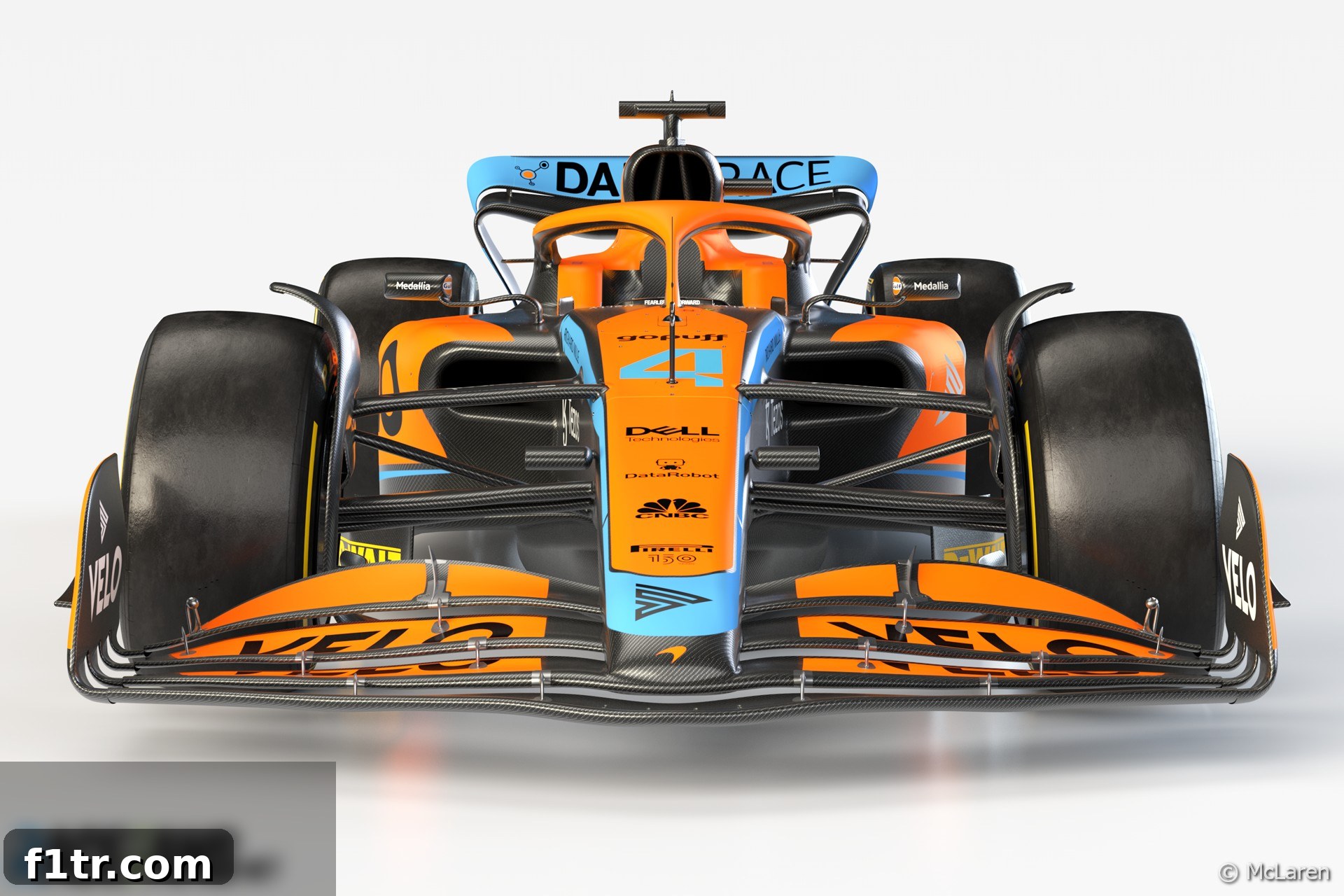
As the Formula 1 community braced for one of the most significant regulatory overhauls in its modern history, McLaren Technical Director James Key offered a candid insight into the initial phase of the 2022 season. Key confidently predicted that all ten teams would undertake substantial modifications to their new cars even before the first official race of the season. This foresight underscored the unprecedented challenge and continuous development cycle inherent in adapting to the dramatically revised technical regulations, which promised to reshape the competitive landscape of the sport.
Advert | Become a Supporter & go ad-free
The initial unveilings of the 2022 challengers presented a mixed bag of approaches, reflecting varying levels of secrecy and development stages among the teams. Haas kicked off the revelation period by presenting digital renders of an early iteration of their VF-22, offering a glimpse but little concrete detail. Red Bull followed suit, showcasing their RB18 livery draped over a generic FOM (Formula One Management) show car, a strategic move to keep their actual design under wraps. In contrast, Aston Martin made a bolder statement, revealing a genuine car that not only appeared in public but also completed its inaugural shakedown at Silverstone. These diverse strategies highlighted the high stakes involved in protecting intellectual property and managing expectations in a brand-new regulatory era.
Speaking at the much-anticipated launch of McLaren’s MCL36 at their state-of-the-art Technology Centre, James Key confirmed McLaren’s commitment to presenting a truly representative machine. He emphasized that the car displayed was precisely the one destined for the crucial opening pre-season test in Barcelona, a vital opportunity for teams to gather real-world data and validate their designs. Prior to this, the MCL36 would also complete a filming day, providing an early opportunity for systems checks and initial feedback from drivers Lando Norris and Daniel Ricciardo, albeit with strict mileage limitations.
Key’s pride in McLaren’s transparency was palpable. “I think we can be proud of presenting a real car, because it absolutely is,” he stated, reinforcing the team’s confidence in their initial design. “It’s the car we’ll be taking to Barcelona.” He acknowledged, however, the universal practice of strategic concealment. “Yes, we’ve hidden a few bits and pieces for obvious reasons – there are some sensitive areas.” This subtle admission highlighted the competitive nature of Formula 1, where every aerodynamic nuance and mechanical innovation is a closely guarded secret. It also hinted at the ongoing evolution of the car, with development already well underway.
Elaborating on the team’s ambitious development roadmap, Key articulated that the MCL36 would be a continually evolving entity. “As far as the development plan is concerned, like every team I’m sure, we have development steps to come early on, because it is still very much a learning process at this stage.” This statement underscored the iterative nature of F1 car design, particularly under new regulations where initial concepts serve as a baseline for continuous refinement. Fans and rivals alike could expect to see visible changes. “We’ll be bringing some updates to Bahrain and the next parts are already in process now. I think we’ll see the car change. I’m sure everyone’s car is going to change.” This declaration served as a testament to the relentless pursuit of performance that defines Formula 1, where standing still is akin to moving backwards.
The radical shift in regulations for 2022, which profoundly impacted numerous facets of car design, demanded a highly structured and adaptable development strategy. James Key outlined three pivotal phases that McLaren, and indeed every team on the grid, would navigate as they launched the MCL36 and approached the new season. These phases were not merely sequential steps but rather an interconnected loop of learning, assessment, and adaptation, crucial for unlocking the full potential of their new-generation cars.
“I think there’s three phases to this,” Key explained. “The first is learning your car – does it correlate, does it do what you expect it to do? You have directions on how you want to develop and how you want to move forward.” This initial phase is foundational, focusing on the critical link between simulation and reality. Teams spend countless hours in computational fluid dynamics (CFD) analysis and wind tunnel testing, generating vast amounts of data. The real challenge comes in verifying whether the car performs as predicted on track. Driver feedback becomes invaluable here, as their subjective sensations are cross-referenced with objective telemetry data to identify discrepancies and validate aerodynamic models. Understanding how the car behaves in different conditions, from various track surfaces to tire degradation, forms the bedrock for all subsequent development decisions.
The second phase, as described by Key, introduces the crucial element of competitive positioning. “The next is getting a rough idea of where you are – we don’t know. I think that will change dramatically through the season anyway. But getting a rough idea may bring some developments that are already in process now, based on our own knowledge, forward for example, just to try and plug the gap.” This stage is characterized by significant uncertainty. In a new regulatory era, no team truly knows their standing relative to competitors until the cars hit the track for testing and, more definitively, for the first race. This period is a frantic race against time to identify performance gaps and rapidly deploy solutions. It means having a flexible development pipeline, ready to fast-track parts or adjust design priorities based on the emerging competitive landscape. Plugging these gaps quickly can be the difference between a strong start and playing catch-up for the remainder of the season.
The final and perhaps most intriguing phase revolves around the influence of the competition. “Then there’s all the information you get from nine other teams. They’ve all faced the same challenges and problems that we have to try to squeeze as much performance out of a set of regulations which appear to be simpler, but actually are surprisingly complex in nature. Looking at what others are doing and where the trends are beginning to emerge, I think it will influence all of us as to what we do next and how we approach our development process.” This phase highlights the perpetual “arms race” that is Formula 1. While teams meticulously guard their secrets, visual observation, analysis of on-track performance, and even photographic scrutiny of rivals’ cars provide invaluable insights. Design trends often emerge as teams discover optimal solutions to common regulatory challenges. A competitor’s innovative interpretation of the rules, once identified, can rapidly influence the development direction of other teams, leading to a convergence of design philosophies as the season progresses. This constant cross-pollination of ideas, within the bounds of legality, ensures a dynamic and ever-evolving grid.
Advert | Become a RaceFans supporter andgo ad-free
The 2022 regulations were designed with the noble intention of fostering closer racing and enabling cars to follow each other more effectively, primarily through a reintroduction of ground effect aerodynamics and simplified wing designs. On the surface, these rules might have appeared to streamline the design process. However, as Key astutely observed, they were “surprisingly complex in nature.” The intricacies of managing the underbody airflow to generate ground effect, coupled with limitations on other aerodynamic surfaces, presented a fresh set of engineering puzzles. Teams had to virtually relearn how to extract performance from entirely new aerodynamic philosophies, balancing downforce generation with drag reduction and sensitivity to ride height. This underlying complexity meant that every design decision carried profound implications, making the initial learning and adaptation phases even more critical.
Ultimately, James Key’s insights painted a vivid picture of a Formula 1 season poised for dramatic shifts and intense development battles. The period immediately following car launches and leading into pre-season testing was not merely a prelude but an integral part of the championship campaign. Every team, regardless of their initial design philosophy or reveal strategy, embarked on a journey of continuous evolution. The MCL36, like its counterparts across the grid, was set to be a dynamic machine, constantly refined and updated as McLaren strove to master the new regulations, learn from its own data, and intelligently react to the innovations emerging from its rivals. This constant state of flux promised an exhilarating and unpredictable season, where the ability to adapt and develop at speed would be paramount to success.
2022 F1 season
- Mercedes told me “you’re wrong” about 2022 car’s problems – Hamilton
- FIA confirms all 10 F1 teams complied with 2022 cost cap
- Steiner “not ashamed” of panning “slow” Schumacher in Drive to Survive
- Albon believes year out of F1 improved him as a driver
- Hamilton sees diversity gains in F1 years on from his ‘traumatising’ experience of racism
Browse all 2022 F1 season articles