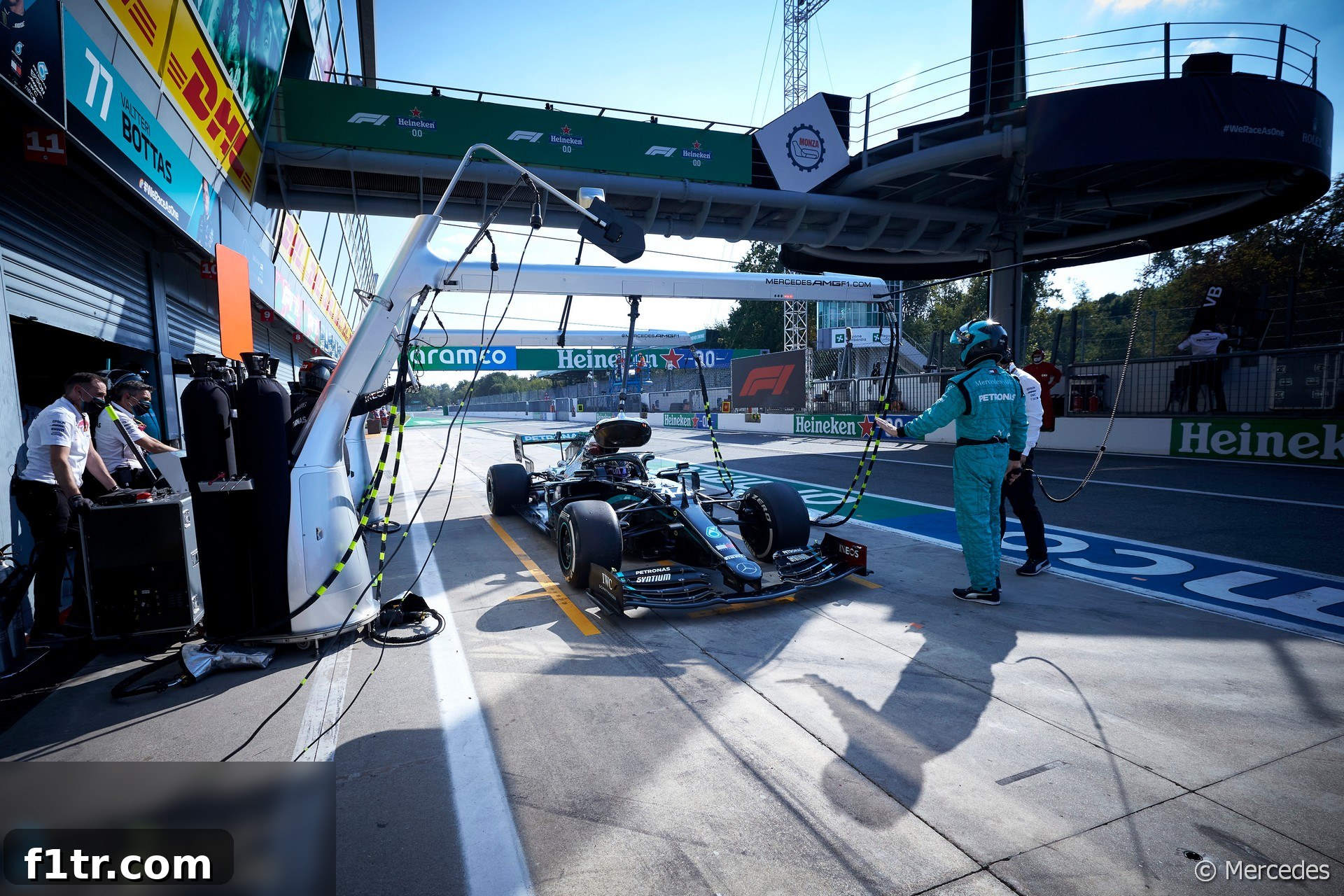
In the high-stakes world of Formula 1, where every second counts, a single miscommunication can be the difference between victory and defeat. This stark reality was brutally illustrated at the Autodromo Nazionale Monza, where Mercedes, and specifically Lewis Hamilton, saw a potential race win slip away due to a critical pit lane infringement. The incident, which led to a significant penalty for the reigning champion, sparked widespread debate about team communication, driver awareness, and the unforgiving nature of F1 regulations.
Advert | Become a Supporter & go ad-free
Mercedes’ failure to inform Hamilton promptly that the pit lane had been closed during a Safety Car period proved costly. On the surface, it might seem like a simple error that other teams should have avoided. Indeed, only one other team, Alfa Romeo, made the same mistake. However, a deeper examination of the circumstances reveals the intense pressure and unique timing challenges faced by each team, particularly Mercedes at the head of the pack.
The Monza Meltdown: How Mercedes Missed a Critical Call
The incident unfolded on lap 20 of the Italian Grand Prix. The Safety Car was deployed after Kevin Magnussen’s Haas retired and needed to be pushed into the pit lane entrance. This necessitated the immediate closure of the pit lane, a measure not always associated with every Safety Car deployment, and thus one that caught some teams off guard. Typically, a Safety Car period at this stage of a race prompts most drivers who haven’t made their mandatory pit stop to dive into the pits for fresh tires, capitalizing on the reduced time loss. This conventional wisdom likely played a role in the initial instincts of both drivers and teams.
A Race-Altering Decision: The Safety Car and Closed Pit Lane
As the Safety Car was deployed, Hamilton was comfortably leading the race, positioned closest to the pit lane entry. He was approaching the challenging Parabolica corner, holding a significant 16-second advantage over second-placed Carlos Sainz Jnr. This commanding lead, ironically, put him in the most precarious position regarding the pit lane closure. For Hamilton, slowing down to the mandatory delta time under Safety Car conditions meant he was just 19 seconds away from the pit lane entry line. This incredibly narrow window was all Mercedes had to relay the crucial information: “Pit lane closed.”
The Costly Delay: Mercedes’ Communication Breakdown
The official stewards’ document later indicated that the pit lane was closed 12 seconds before Hamilton crossed its entry line, suggesting an even tighter operational window for Mercedes. Tragically for Hamilton and his team, the message took 23 seconds to reach him. By the time his race engineer, Pete Bonnington, urgently informed him to “Stay out, pit lane entry should be closed,” Hamilton had already committed. He had crossed the pit lane entry line and was lining up for his pit stop, making his infringement irreversible. This crucial five-second delay ultimately cost him a potential victory and resulted in a stop-and-go penalty, effectively ending his challenge for the win.
A Tale of Two Teams: Comparing Response Times
The critical question that emerged from this incident was whether other teams would have fared better under similar circumstances. While Mercedes’ delay was fatal for Hamilton, it’s essential to acknowledge the varying degrees of pressure on different teams. Those further down the field, like McLaren with Sainz, had the luxury of an additional 16 seconds to react, and drivers even further back enjoyed even more time to process the unfolding situation and receive instructions.
Red Bull’s Prompt Alert: Verstappen’s Near Miss
One team, however, stood out for its remarkably swift response: Red Bull. Consistently impressive with their well-drilled pit crew and sharp strategies, Red Bull wasted no time. Max Verstappen was informed that the pit lane entrance was closed just 18 seconds after the Safety Car was deployed. Had Hamilton received such a timely warning, he would have been little more than a second from the pit lane entrance. A last-second swerve, though incredibly difficult at high speed, might have just saved him from the costly mistake. The drama of the situation was not lost on the Red Bull pit wall, where Hamilton’s unfolding plight provided a moment of amusement, underscoring the cut-throat nature of F1 competition:
| To Verstappen | The pit lane entry is currently closed. |
| To Verstappen | Pit lane entry is closed. |
| To Verstappen | Lewis has pitted under a pit lane entry closed… |
| To Verstappen | Stay out Max, please, stay out. |
McLaren’s Vigilance: Sainz Avoids a Pitfall
McLaren also deserves significant credit for preventing Carlos Sainz from making the same error as Hamilton. Sainz, having seen his rival enter the pit lane, naturally expressed concern and confusion:
| To Sainz | Carlos the pit lane entry, at the moment, is closed. Pit lane entry is closed. |
| Sainz | OK it should be closed for everyone. They cannot do this to me. |
| To Sainz | We want to pit but if it’s closed we can’t box. |
| Sainz | I kept going. |
| To Sainz | Copy. |
| Sainz | Are you sure it’s closed? Hamilton pitted though. |
| To Sainz | Stay out is correct Carlos. Hamilton pitted but he should not have done so. |
McLaren’s clear and resolute instructions, despite Sainz’s observation of Hamilton pitting, were pivotal. This incident also served as a crucial alert for other teams who might not have immediately recognized the pit lane closure. Some clearly only registered the situation at the eleventh hour.
Sergio Perez, running fourth behind the two McLarens, initially received instructions that “we will be stopping” when the Safety Car was deployed. Fortunately, his engineer quickly corrected the call, hurriedly warning him “pit entry is closed” as he came within sight of it, narrowly averting another penalty.
While Mercedes’ reaction time was too slow for Hamilton, they were able to provide Valtteri Bottas with ample warning, as he was running 28 seconds behind his teammate at the time, highlighting how quickly the pressure eased for drivers further back.
Alfa Romeo’s Missed Opportunity: The Longest Delay
However, the most striking example of a miscue, given the available time, came from Alfa Romeo. From the moment the Safety Car was deployed until Antonio Giovinazzi illegally entered the pits, his team had a generous 75 seconds – almost a full minute more than Mercedes – to realize the pit lane entrance was closed. The fact that nearly all of their rivals had stayed out should have been a significant clue, yet it seemingly failed to register. Giovinazzi’s radio was functional, as they instructed him to pit at the exit of the Ascari chicane, proving the communication channel was open. This highlights a lapse in real-time strategic assessment that was far more pronounced than Mercedes’ lightning-fast dilemma.
The Driver’s Eye: Spotting the Signals
Beyond team communication, a critical aspect of F1 racing involves drivers’ individual awareness of trackside signals. Mercedes’ failure to warn Hamilton was indeed a significant factor, but Hamilton also missed crucial visual cues. The red cross signals on the outside of Parabolica were clearly displayed, indicating the pit lane entrance was closed. This begs a fundamental question: did any driver independently spot these lights without prior notification from their team?
George Russell: The Alert Driver
Indeed, one driver did. Take a bow, George Russell. After the Safety Car deployment, his team initially warned him that the “pit lane will be busy.” However, it was Russell himself who spotted the illuminated red cross signals at Parabolica and proactively inquired if the pit lane entrance was closed, which his team then confirmed. This demonstrated a commendable level of situational awareness and adherence to F1 safety protocols, a trait highly valued in the sport. His quick thinking allowed him to avoid a similar fate to Hamilton, highlighting the dual responsibility of both team and driver in navigating complex race scenarios.
Beyond Communication: The Broader Implications
The Monza incident served as a potent reminder of the razor-thin margins in Formula 1 and the multi-layered challenges teams face. It underscores the vital importance of redundant systems, clear communication protocols, and constant vigilance, both from the pit wall and in the cockpit. While technology in F1 is advanced, the human element—the ability to react under immense pressure, process information instantly, and make the right call—remains paramount.
The penalty not only cost Hamilton a victory but also dramatically reshaped the race outcome, leading to an unexpected winner and a thrilling finish. It also provided valuable lessons for all teams, prompting reviews of their internal procedures for reacting to unexpected Safety Car deployments and closed pit lane scenarios. The incident undoubtedly led to enhanced training for race engineers and strategists, emphasizing the need to cross-reference multiple data streams—from official race control messages to trackside visuals—before issuing critical instructions to drivers. Furthermore, it reinforced the principle that while teams provide guidance, the ultimate responsibility for observing track signals and adhering to regulations rests with the driver.
This episode at Monza will forever be etched in Formula 1 history as a prime example of how even the most dominant teams and drivers can be undone by a fleeting lapse in judgment or communication, turning a commanding lead into a costly error within mere seconds. It’s a testament to the unpredictable drama that makes Formula 1 such a captivating spectacle.
Advert | Become a RaceFans supporter andgo ad-free
2020 F1 season
- Grosjean to make F1 test return tomorrow for first time since Bahrain horror crash
- Pictures: Wrecked chassis from Grosjean’s Bahrain fireball crash to go on display
- Bottas vs Rosberg: Hamilton’s Mercedes team mates compared after 78 races each
- F1 revenues fell by $877 million in Covid-struck 2020 season
- Hamilton and Mercedes finally announce new deal for 2021 season
Browse all 2020 F1 season articles