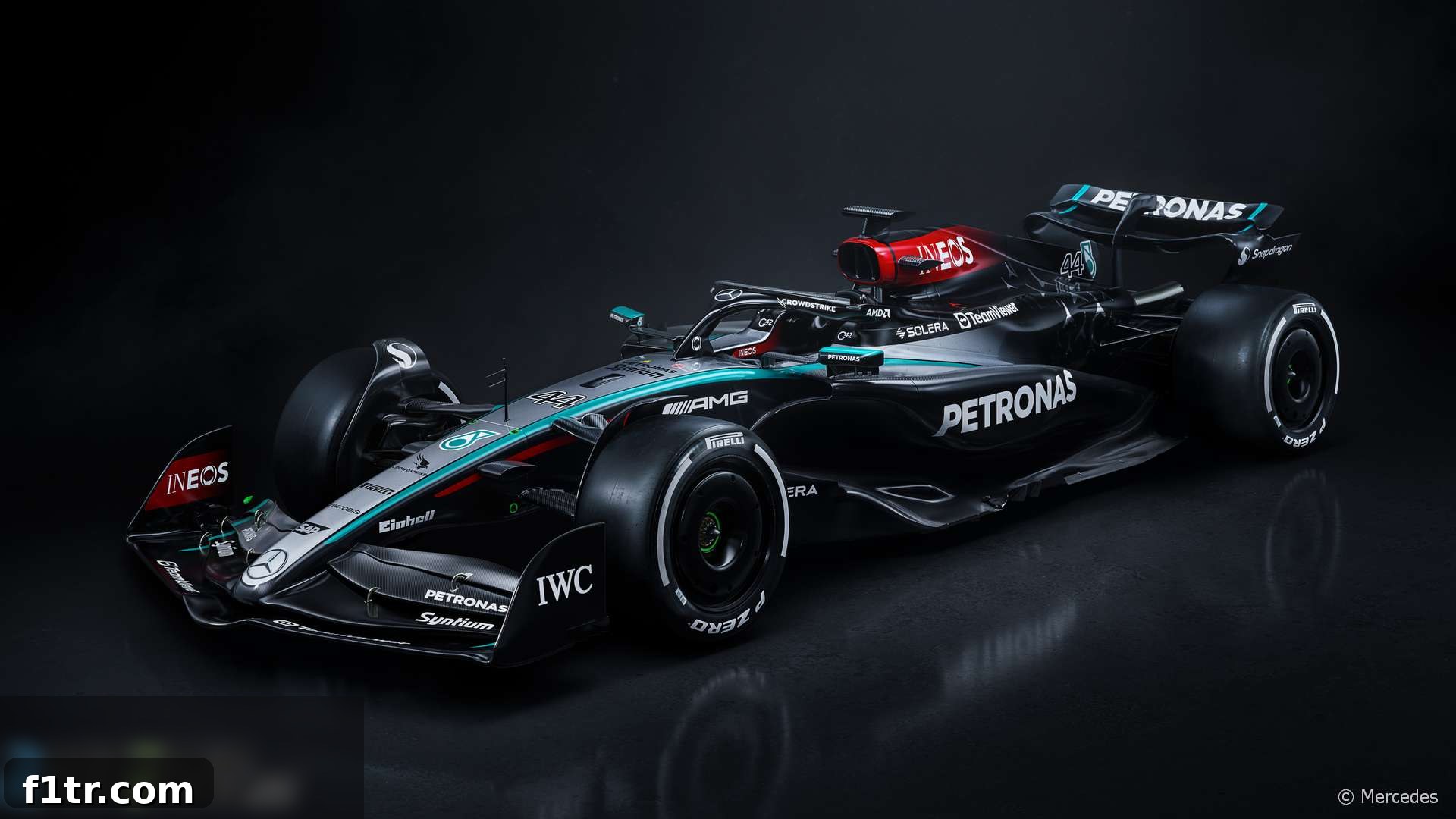
The dawn of a new Formula 1 season always brings with it a wave of anticipation, but few car launches capture the global motorsport spotlight quite like Mercedes-AMG Petronas F1 Team’s reveal. At a highly-anticipated event held at the iconic Silverstone circuit, Mercedes pulled back the covers on their 2024 challenger, the W15. This car holds immense significance, not only as the embodiment of Mercedes’ renewed championship aspirations but also as the final machine Lewis Hamilton will pilot for the illustrious German outfit before his monumental move to Ferrari in 2025.
The W15 represents a comprehensive overhaul from its predecessor, the W14, a car that starkly highlighted the challenges Mercedes faced under the latest ground effect regulations. The W14, for all its potential, holds the unenviable record of being only the third Mercedes-produced F1 car in the modern era to conclude a season without a single Grand Prix victory – a stark contrast to the team’s dominant hybrid era. This historical context underscores the immense pressure and expectation surrounding the W15, which is tasked with restoring Mercedes to its winning ways and providing Lewis Hamilton with a fitting farewell.
Visually, the W15 continues the predominantly black color scheme that has become synonymous with the team in recent years. However, a significant aesthetic change sees the return of the classic Mercedes silver, gracefully gracing the front of the car along the nose cone. This blend of heritage and contemporary identity is more than just cosmetic; it tells a story of the team’s journey. More critically, beneath the surface, the W15 marks a decisive departure from the ill-fated ‘zero sidepod’ concept that Mercedes championed for the past two seasons. This innovative, yet ultimately problematic, design philosophy has been abandoned in favor of an approach that appears to draw inspiration from the more conventional, and demonstrably successful, ‘downwash’ sidepod designs seen on rivals, particularly Red Bull Racing. This strategic shift signals a pragmatic acceptance of what works best within the current ground effect regulatory framework and a renewed focus on performance over conceptual novelty.
For Lewis Hamilton, the W15 symbolizes the closing chapter of an extraordinary era. This machine will be the 12th and final Mercedes F1 car he drives, culminating a partnership that has rewritten Formula 1 history books. Alongside his talented teammate, George Russell, Hamilton embarks on his third and final season as part of Mercedes’ driver lineup. Their partnership, though challenged by the car’s performance in recent years, has been characterized by mutual respect and a shared ambition to bring Mercedes back to the pinnacle of the sport. The announcement of Hamilton’s ‘blockbuster’ move to Ferrari for the 2025 season sent shockwaves throughout the F1 world, making this year’s campaign not just a fight for championship glory, but a poignant swansong for one of the sport’s most successful driver-team pairings.
Team Principal and CEO Toto Wolff candidly described the W15 as a “complete relaunch” for Mercedes. His words reflect the profound introspection and strategic recalibration that have taken place within the team over the winter break. “We know we have a mountain to climb to fight at the very front. There are no miracles in this sport,” Wolff stated, tempering expectations with a dose of realism. Yet, his message was imbued with unwavering resolve: “But our ambition and determination are strong. Since charting this new course, development has progressed well. We had several items on our priority list for this car. We will soon see if we’ve made the step we’ve aimed for.” These comments highlight Mercedes’ commitment to a methodical, data-driven approach, acknowledging the formidable challenge posed by their rivals while expressing quiet confidence in the significant strides made in the W15’s development. The shift away from the zero sidepod concept, in particular, demonstrates a willingness to admit past missteps and adapt decisively, which is a hallmark of truly competitive teams.
Wolff also shed light on the revised livery, explaining that the return of silver to the front of the car was made possible by critical weight-saving measures implemented throughout the W15’s design and construction. “Performance was always at the forefront of our minds with the black livery last year,” Wolff affirmed. “Weight is a crucial factor in this current generation of cars. We knew that, once we were in a position to do so, we would bring back the Mercedes silver to accompany the black that has become a pillar of our team identity.” This statement reveals the intricate balance between aesthetics, brand identity, and raw performance in modern Formula 1. The black livery, initially adopted in 2020 to promote diversity and anti-racism, then continued as a weight-saving exercise, has now partially made way for the iconic silver. This signifies not just a reduction in structural weight but also perhaps a symbolic return to the ‘Silver Arrows’ heritage, bolstered by a more robust understanding of the car’s overall mass. The livery is further enhanced by distinctive color accents, including the special shade of red, affectionately dubbed ‘Toto rosso,’ used on the nose, rear wing, and roll hoop, honoring team part-owners Ineos. Additionally, the vibrant green of long-standing title sponsors Petronas provides important highlights, creating a visually striking and purposeful design.
The immediate next step for the W15 is its inaugural shakedown run at the Silverstone circuit. This crucial initial outing is not about setting blistering lap times, but rather a vital opportunity for the team to conduct system checks, verify basic functionality, and ensure all components are working as intended under race conditions, albeit with limited mileage. It’s the first real-world validation of countless hours of design, simulation, and manufacturing. Last season, Mercedes managed to secure a commendable second place in the Constructors’ Championship, notably jumping ahead of Ferrari in the standings despite the W14’s inherent difficulties. This achievement underscored the team’s operational excellence and strategic prowess, even when their car wasn’t the fastest on the grid. However, the inability to clinch a single Grand Prix victory marked a significant milestone, being the first season since 2011 where Mercedes failed to stand atop the podium. This drought has fueled the team’s determination, making the W15’s performance not just a matter of competitive pride but a testament to their engineering resurgence.
The unveiling of the Mercedes W15 represents more than just a new car; it’s a statement of intent, a commitment to innovation, and a heartfelt tribute to a departing legend. With a significantly revised aerodynamic concept, a refreshed livery, and the formidable pairing of Hamilton and Russell, Mercedes aims to reclaim its position at the sharp end of the grid. The 2024 Formula 1 season promises to be a captivating spectacle, and the W15, Lewis Hamilton’s final ride in silver and black, is poised to play a central role in shaping its narrative.
Pictures: 2024 Mercedes F1 Launch
Related Content
- The Future of Formula 1 Regulations and Car Design
- Tracing Lewis Hamilton’s Storied Career with Mercedes
- Ground Effect Aerodynamics: A Deep Dive into F1’s Current Era
- Team Principals Under Pressure: Leading an F1 Giant
- The Evolution of F1 Liveries: Beyond Aesthetics
Browse all Formula 1 articles