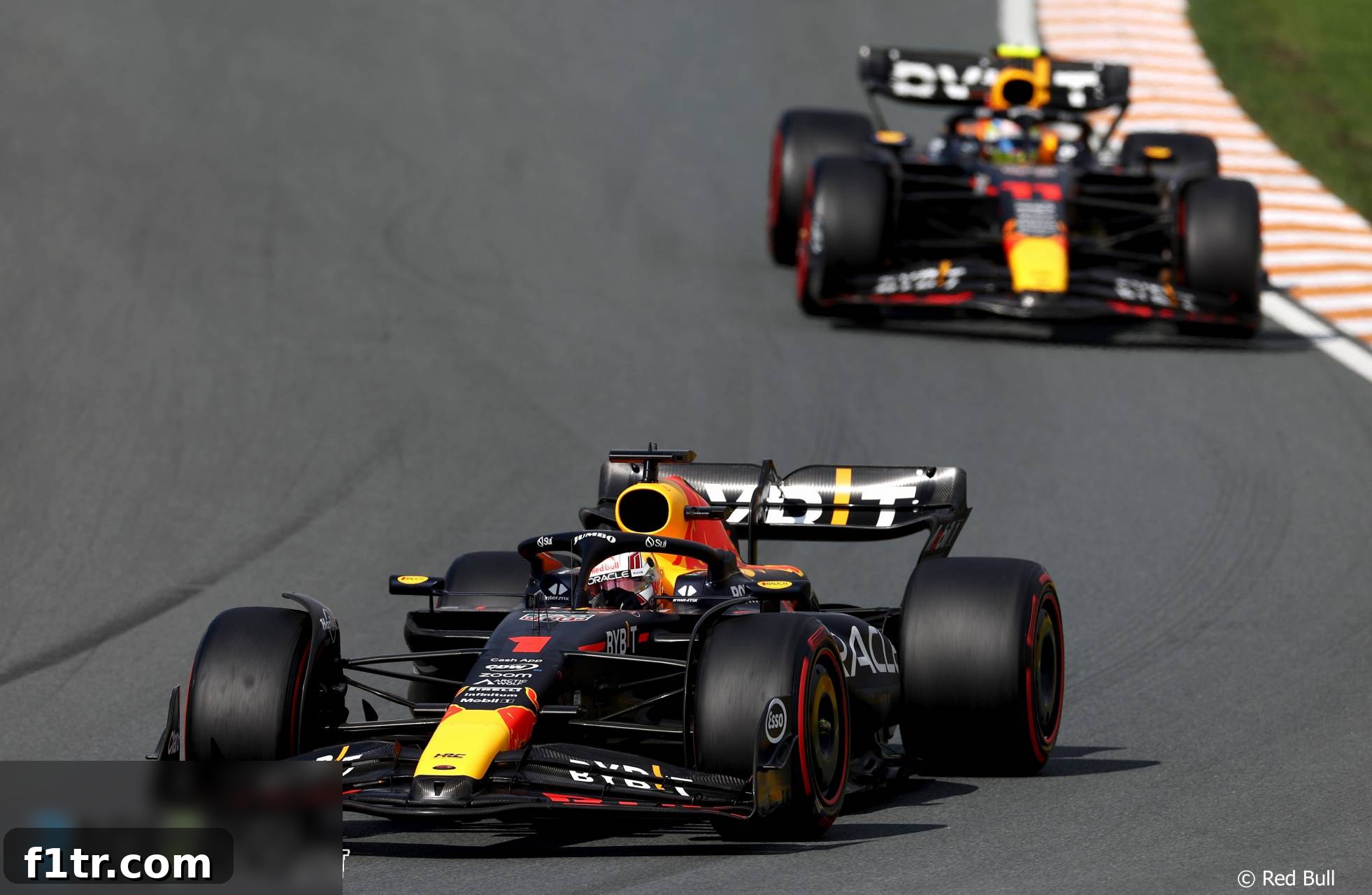
Max Verstappen’s “Bullshit” Verdict on Red Bull Car Design Claims
In a candid and typically blunt assessment, Formula 1 sensation Max Verstappen has vehemently dismissed suggestions that Red Bull’s dominant RB19 car is engineered specifically to suit his unique driving style, rather than that of his teammate, Sergio Perez. “Bullshit,” was the reigning world champion’s unequivocal response, cutting through the swirling speculation.
Verstappen’s stellar performance in the 2023 season has been nothing short of historic. As the runaway leader in the points standings, he has clinched an astonishing 11 victories out of the 13 Grands Prix held so far. His Red Bull colleague, Sergio Perez, has secured the remaining two wins, highlighting a significant performance gap within the team. This disparity has inevitably fueled narratives that the RB19, a masterpiece of engineering in 2023, might be intrinsically biased towards Verstappen’s preferences.
Adaptability, Not Design Bias: Verstappen’s Driving Philosophy
However, Verstappen maintains that such claims are entirely unfounded. Speaking to media, including RaceFans, at Monza, the Dutch driver offered a clear perspective on his approach. “It’s not like that,” he stated. “I just drive the car I get the fastest way possible.” His philosophy, he explained, is rooted in pure speed and adaptability, rather than dictating design choices.
“I’m not there to tell the guys to give me more front end because that’s how I like it. I just say ‘design me the fastest car and I’ll drive around that’,” Verstappen elaborated. This statement underscores a crucial element of elite motorsport: the ability of a top driver to mold their technique to the machinery at hand. He emphasized that every year brings a different car, with its own unique characteristics. “Every single year it’s just different. Every car drives a little bit different. People will say, ‘what is your driving style?’. My driving style is not something particular – I adapt to what I need for the car to go quick.”
Verstappen further stressed the critical importance of a driver’s capacity to adjust. “For me, what is very important is that you are able to adapt your driving style to what the car needs.” This profound insight challenges the common misconception that drivers possess an immutable style that the car must then accommodate. Instead, Verstappen positions himself as a chameleon behind the wheel, constantly evolving his approach to extract the absolute maximum performance from his equipment, regardless of its inherent traits.
The Evolving RB19: A Challenge for Sergio Perez
While Verstappen showcases unparalleled adaptability, his teammate Sergio Perez has openly admitted to struggling with the RB19’s evolution throughout the season. Following Verstappen’s record-equalling ninth consecutive win, the Dutchman reflected on how he had unlocked further performance from the car since the last race he didn’t win, in Azerbaijan four months prior. This pivotal moment proved to be a turning point, further widening the performance chasm between the two Red Bull drivers.
Perez is acutely aware of the breakthrough his teammate achieved at that crucial Baku race. “It’s certainly something to do with his balance, to do with how he’s driving the car and looking after the tyres,” Perez commented, acknowledging Verstappen’s superior grasp of the car’s nuances. “Something that he found, and he’s been operating in that balance-wise, and he was able to cope with it already in Baku.” This suggests a specific aspect of car setup or driving technique that Verstappen mastered, giving him a distinct edge.
The challenge for Perez isn’t new. Last year, he observed a similar pattern: as Red Bull introduced upgrades to the RB19, the car, paradoxically, became more difficult for him to drive effectively. He has experienced the same phenomenon this season. This highlights a critical aspect of Formula 1 development: while upgrades are designed to enhance overall performance, they can sometimes alter a car’s characteristics in ways that favor one driver’s natural tendencies over another’s, or demand a significant adaptation period.
“I think every driver through their career or through each season, you get some upgrades to the car that adapt easier to your driving style than others,” Perez explained. “Sometimes you will put a part in it and you will straight away go faster with it. Sometimes you will have to adapt to it.” This perfectly encapsulates the delicate balance between car development and driver harmony. A new aerodynamic package or suspension tweak, while yielding faster lap times overall, might shift the car’s balance, front-end bite, or mid-corner stability, requiring a different approach from the driver.
Perez openly admitted his struggles in this regard: “It’s something that we are all facing through our times during the season with the upgrades. And I haven’t been able to adapt as quickly as I should and I had to change my driving style a bit to adapt into the car more than in the beginning of the season, for example, when things were coming more naturally. But that’s something that most drivers at some point we go through.” His candor sheds light on the immense pressure F1 drivers face to continuously evolve their technique in response to an ever-changing machine.
Qualifying Discrepancies and the Dutch Grand Prix
The performance gap between the two Red Bull drivers has been particularly pronounced in qualifying sessions. Over the 13 Grands Prix this year, Perez has only out-qualified Verstappen on merit once, at the Miami Grand Prix. The qualifying session at Zandvoort, affected by damp conditions, offered a stark illustration of this disparity, with Perez a significant 1.3 seconds slower than his teammate.
Perez attributed this substantial gap to the challenging conditions, rather than a fundamental flaw in his pace. “In Zandvoort, it was mainly getting the conditions right and exploiting everything out of the car. The differences, if you don’t get the conditions right, you will see a big delta. It’s how it works sometimes.” While weather can indeed magnify performance differences, the magnitude of the gap at Zandvoort underscores Verstappen’s exceptional ability to find grip and confidence in treacherous conditions, a hallmark of truly elite drivers.
Despite the notable deficit, Perez attempted to downplay the long-term impact of his qualifying struggles, drawing parallels to other drivers experiencing similar gaps. “We’ve seen with other drivers those sorts of gaps,” he noted. He maintains a pragmatic outlook on the championship battle, reminding that consistency over an entire season is paramount. “It’s a long season in F1 and it doesn’t really matter, in my opinion, where we are now, it only matters where we are able to finish and then we can summarise our season in Abu Dhabi.”
Perez acknowledged going through a “tough patch” during the middle of the season, a period where his struggles with the car were most acute. However, he expressed optimism for the races ahead. “Definitely I went through a bit of a tough patch through the middle of the season where I was struggling the most with the car. But I think that’s all behind us and we should be having good races from now on.”
Perez’s Admirable Praise for Verstappen’s “Extreme” Talent
As Max Verstappen stands on the brink of scoring a record-breaking tenth consecutive Grand Prix victory, Sergio Perez offered profound praise for his teammate’s exceptional abilities. He urged observers to “appreciate what Max is doing” in his car, recognizing the sheer magnitude of his current performance.
“The level that he is driving at the moment, it’s extreme,” Perez stated, highlighting the unprecedented standard Verstappen has set. “I think the ability he has to perform at his 100-per-cent every single weekend, no matter which conditions he’s driving at. It’s something that is quite hard to see as his team mate.” This acknowledgment from a direct competitor within the same machinery speaks volumes about Verstappen’s current form.
Perez further elaborated on Verstappen’s unparalleled consistency and relentless pursuit of perfection: “It doesn’t really matter what’s happened, whether we have a good margin or bad margins or the car is becoming difficult. He’s been able to extract 100-per-cent, out of him, out of the car, pretty much every weekend.” This analysis from a seasoned driver provides a rare glimpse into the psyche and skill set required to dominate Formula 1. It’s not just about raw speed, but the unwavering mental fortitude and technical prowess to consistently maximize potential, irrespective of external factors or the car’s inherent quirks.
Conclusion: A Champion’s Adaptability vs. Teammate’s Challenge
Max Verstappen’s blunt dismissal of claims that the Red Bull RB19 is tailored to his preferences underscores a crucial aspect of his unparalleled dominance: a profound ability to adapt to any machinery. His philosophy emphasizes the driver’s role in conforming to the car’s needs, rather than the other way around. While this adaptability has propelled Verstappen to historic success, it has simultaneously presented a significant challenge for his teammate, Sergio Perez, who has openly grappled with the evolving characteristics of the RB19.
Perez’s struggles with upgrades and qualifying pace highlight the intricate dance between car development and driver synergy in Formula 1. Despite his difficulties, Perez maintains a resilient outlook, acknowledging Verstappen’s “extreme” level of performance with admirable sportsmanship. As Verstappen continues to rewrite the record books, his unwavering adaptability and Perez’s ongoing quest for harmony with the RB19 remain defining narratives of the exhilarating 2023 Formula 1 season.
Related F1 Insights:
Explore more discussions from the 2023 Italian Grand Prix and beyond:
- Despite close battles at Monza, F1 drivers want more powerful DRS
- Monza “frustrating” for Alonso but Aston Martin expect better form in coming races
- F1 changed rules to stop Mercedes in 2021 but we won’t ‘cry foul’ now – Wolff
- McLaren will bring ‘follow-up to Austria upgrade’ before focusing on 2024 car
- Magnussen explains why his driving style rarely works with the Haas VF-23
Browse all 2023 Italian Grand Prix articles