Monaco Horror Crash: F1 Drivers Demand Answers After Mick Schumacher’s Haas Splits Apart
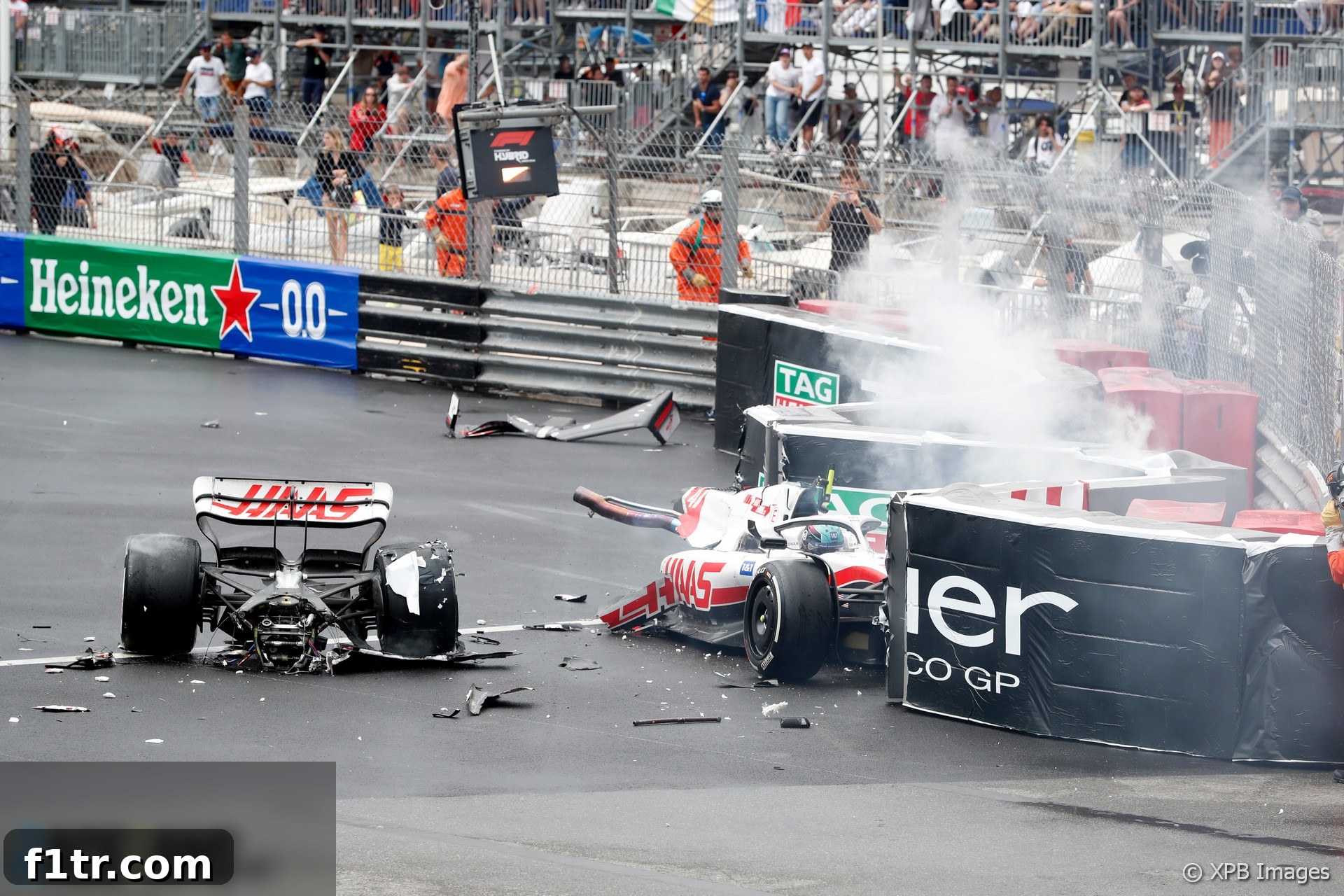
The devastating crash suffered by Mick Schumacher during the Monaco Grand Prix sent shockwaves through the Formula 1 paddock, prompting drivers to call for a thorough investigation and critical learning from the incident. Schumacher’s Haas car dramatically split in two following a high-speed impact, a sight that immediately raised alarms about car safety in the current era of heavier F1 machinery.
Advert | Become a Supporter & go ad-free
The Devastating Impact: A Near Miss at the Swimming Pool Chicane
The incident occurred on lap 27 of the iconic Monaco street circuit, as Schumacher lost control of his VF-22 at the unforgiving Swimming Pool Chicane. The car spun violently, impacting the barriers with a staggering force measured at 22G. The sheer energy of the collision caused the rear section of the car, including the gearbox and power unit, to detach completely from the chassis, scattering debris across the track.
In the immediate aftermath, there was palpable concern throughout the pit lane and among spectators. However, F1’s robust safety standards proved their worth once again, as Mick Schumacher, though shaken, was thankfully uninjured after being taken to the circuit medical centre for precautionary checks. The relief was universal, but it quickly gave way to serious questions regarding the car’s structural integrity under such extreme loads.
“I was glad that he’s fine because that was a scary one,” remarked Alpine driver Esteban Ocon, encapsulating the collective sentiment of relief mixed with lingering apprehension. The sight of a modern Formula 1 car breaking apart in such a manner is always unsettling, a stark reminder of the immense forces at play in the pinnacle of motorsport.
Drivers Voice Concerns: A Shared Sense of Alarm and the Weight Debate
The severity of Schumacher’s Monaco crash quickly became a talking point among his fellow competitors, many of whom expressed surprise and concern over the way the car disintegrated. The incident brought to the forefront discussions about vehicle construction, safety standards, and the potential impact of the 2022 regulations, particularly the increased minimum weight of the cars.
Fernando Alonso’s Critical Analysis: Echoes of Jeddah and the Weight Factor
Veteran driver Fernando Alonso, Ocon’s team-mate at Alpine, described Schumacher’s crash as “massive” and drew an immediate parallel to the younger German driver’s previous heavy shunt during qualifying for the Saudi Arabian Grand Prix. Alonso’s observations were particularly poignant, highlighting a recurring pattern that warrants closer scrutiny.
“I remember also seeing the Jeddah accident and then again the car split in two,” said Alonso. “The gearbox was not in the chassis and again [in Monaco]. So luckily he’s okay but it’s a big, big accident. Hopefully we can learn something from today as well.”
Alonso went further, speculating that the increased weight of the 2022 F1 machines might be a contributing factor to how they break up upon impact. The latest technical regulations, introduced for the 2022 season, mandate a minimum weight of 798 kilograms for a car before any fuel is added – a significant increase compared to previous seasons. This added mass, according to Alonso, could translate into greater inertia and more destructive forces during a high-speed collision.
“I don’t think I see it as a car issue, just how hard you hit with these cars,” he explained. “They are very heavy, more than 800 kilos so the inertia when they go into the walls, it’s a lot higher than the past. So as I said, probably we will learn something from today as well.” Alonso’s comments underscore a critical engineering challenge: how to design cars that are both incredibly fast and safe, especially as their mass continues to climb.
Advert | Become a RaceFans supporter andgo ad-free
Alexander Albon and Valtteri Bottas Echo Worries
The visible wreckage, particularly the Haas car splitting apart, served as a stark reminder of the immense energies involved in Formula 1. Alexander Albon, reflecting on the incident, stated, “It reminds you how big the energies that we have. I’m glad that he’s okay. Obviously for it to split in half is pretty scary. So we need to figured out, see what happened there.” His words highlight the drivers’ dual perspective: immense relief for their peer’s safety, coupled with a professional imperative to understand and mitigate future risks.
Valtteri Bottas concurred with the general sentiment, noting, “It’s always weird when you see a car in two halves. It’s not how it’s supposed to look but the main thing is he’s okay.” These statements collectively emphasize that while modern F1 cars are designed to sacrifice themselves to protect the driver, the way the Haas broke raised specific questions about the structural integrity of the gearbox and rear crash structure relative to the chassis connection.
Pierre Gasly’s Shock and the VSC Debate
Pierre Gasly also expressed his shock at the extent of the damage. “It was bad,” he recounted. “I was worried because when I saw the gearbox completely out, it was quite, quite shocking.” The gearbox assembly is a critical component, not only for performance but also for the car’s overall crash protection, forming part of the rear impact absorption structure.
Gasly further questioned the initial race control decision to deploy a Virtual Safety Car (VSC) rather than an immediate full Safety Car, given the substantial amount of debris and the severity of the incident. However, the FIA later clarified its reasoning. The VSC was initially activated to slow the field safely while allowing the actual Safety Car to position itself directly in front of the race leader without needing to wave other cars past. This strategy was intended to streamline the recovery effort and minimize potential delays to the race, particularly crucial in the already time-limited Monaco Grand Prix. While the immediate visual impact of the crash suggested a full Safety Car was needed, the FIA’s explanation aimed to demonstrate a calculated approach to managing the incident.
The Unseen Force: How Car Weight Influences Safety in Modern F1
Fernando Alonso’s theory regarding the impact of increased car weight on crash dynamics is not without merit. In physics, inertia is directly proportional to mass. A heavier object possesses more inertia, meaning it requires a greater force to change its state of motion. When a Formula 1 car, weighing nearly 800 kilograms without fuel, hits an immovable barrier at high speed, the kinetic energy involved is immense. This energy must be dissipated, and while modern F1 cars are designed with sophisticated crash structures to absorb such forces, there are limits to what even the strongest carbon fiber can withstand.
The 2022 regulations, while aiming to improve racing and reduce aerodynamic wake, inadvertently led to heavier cars due to larger wheels, new safety features, and simplified aerodynamic components. This increase in mass means that for a given speed, the energy of a crash is higher. Consequently, the demands on the car’s structural integrity, especially at the points where major components like the gearbox and engine attach to the chassis, are magnified. While the primary chassis (survival cell) is incredibly strong and designed to remain intact, peripheral components and attachment points can be subjected to unprecedented stress, leading to spectacular failures like the one observed with Schumacher’s Haas.
Formula 1 has an exemplary safety record, built on decades of continuous improvement, from the introduction of carbon fibre monocoques to HANS devices and, more recently, the Halo. Each major incident in F1 history has prompted further advancements in safety. Schumacher’s crash at Monaco, much like his similar incident in Jeddah, will undoubtedly trigger detailed analyses by both Haas and the FIA to understand precisely why the car separated at the rear. The findings will be crucial for guiding future design parameters and potentially informing adjustments to technical regulations to ensure that increasing car weight does not inadvertently compromise the very safety standards F1 prides itself on.
Advert | Become a RaceFans supporter andgo ad-free
Beyond the Crash: Implications for Haas and Formula 1
For Haas, the immediate implications of Schumacher’s crash are significant. Beyond the concern for their driver, the team faces a substantial repair bill. The car was effectively written off, requiring a new chassis, gearbox, and various other expensive components. In the budget cap era, such extensive damage can put considerable strain on a team’s financial resources, potentially affecting development plans for the rest of the season. Moreover, the team will need to conduct its own internal investigation to complement the FIA’s findings, ensuring that any vulnerabilities in the car’s design or construction are identified and rectified.
For Formula 1 as a whole, this incident serves as another reminder of the delicate balance between performance, excitement, and driver safety. While the sport has made incredible strides in protecting its competitors, every high-severity crash provides valuable data and insights for continuous improvement. The FIA, as the sport’s governing body, will meticulously analyze every aspect of the Monaco crash, from telemetry data to video footage and material analysis of the wreckage. This information will feed into ongoing safety research and potentially lead to adjustments in the technical regulations, reinforcing F1’s commitment to pushing the boundaries of speed without compromising the well-being of its stars.
Monaco’s Unforgiving Nature and Future Safety Discussions
The Monaco Grand Prix is renowned for its tight, winding streets and unforgiving barriers, which leave virtually no margin for error. The circuit’s unique characteristics mean that even a minor lapse in concentration can result in a significant incident. Schumacher’s crash at the Swimming Pool Chicane, a notoriously fast and challenging section, underscored just how quickly things can go wrong on this historic track. The combination of high speed, close walls, and a heavy car meant the energy dissipation was immediate and violent, leading to the spectacular breakup of the Haas.
While the focus immediately turns to car design and safety features, the incident also implicitly highlights the immense skill and bravery required to race at Monaco. The drivers navigate this demanding circuit at incredible speeds, inches from disaster. The fact that Schumacher walked away from such a visually dramatic accident is a testament to the decades of safety advancements in F1. However, the questions raised by the car splitting in two ensure that the dialogue about safety, especially concerning the new generation of heavier cars, will remain a crucial topic for future development and regulation in Formula 1.
2022 Monaco Grand Prix Related Articles
- Whatever triggered it, Verstappen’s defiance of his own team makes little sense
- Transcript: How Red Bull seized a win that ‘Ferrari looked like they had in the bag’
- Verstappen now has as many poles as Leclerc – but six times as many wins
- Schumacher’s chassis-splitting crash shows effects of rising car weight – Alonso
- Norris still can’t drive McLaren the way he wants to, despite strong results
Browse all 2022 Monaco Grand Prix articles