Haas F1 Team’s Aerodynamic Offensive: Battling for Pace and Tyre Control
The world of Formula 1 is a relentless arena of innovation, where teams constantly push the boundaries of engineering to gain even the slightest edge. For the Haas F1 Team, the 2019 season presented a formidable two-pronged challenge: not only to extract more outright pace from their VF-19 challenger but also to master the enigmatic art of tyre temperature management. While the latter proved to be a persistent source of frustration in preceding races, the former was clearly the driving force behind the most significant visual alterations to their car at the Spanish Grand Prix.
Barcelona’s Circuit de Catalunya, with its demanding mix of high-speed corners and technical sections, traditionally serves as a crucial testing ground for new aerodynamic components. It’s a circuit that exposes weaknesses and validates improvements, making it the ideal venue for Haas to roll out a comprehensive package of performance updates. These revisions were far from minor, encompassing critical areas such as the turning vanes, bargeboards, and the floor – each element playing a vital role in shaping the car’s interaction with the air. Concurrently, the team maintained an unwavering focus on dissecting and ultimately resolving their ongoing tyre management predicament, a factor often inextricably linked to aerodynamic performance and consistency.
Advert | Become a Supporter & go ad-free
Front-End Aerodynamics: Harnessing the Y250 Vortex
Aerodynamicists often speak of the “Y250 vortex” as a foundational element of a modern F1 car’s airflow management. This powerful, self-sustaining vortex originates from the interaction of the front wing’s main plane and endplate, approximately 250mm from the car’s centerline. Its primary purpose is to channel high-energy airflow beneath the car and around the sidepods, isolating the sensitive underfloor from turbulent air generated by the spinning front wheels. Effectively managing this vortex is paramount for overall aerodynamic efficiency, directly influencing downforce generation and the cleanliness of airflow to the rear of the car.
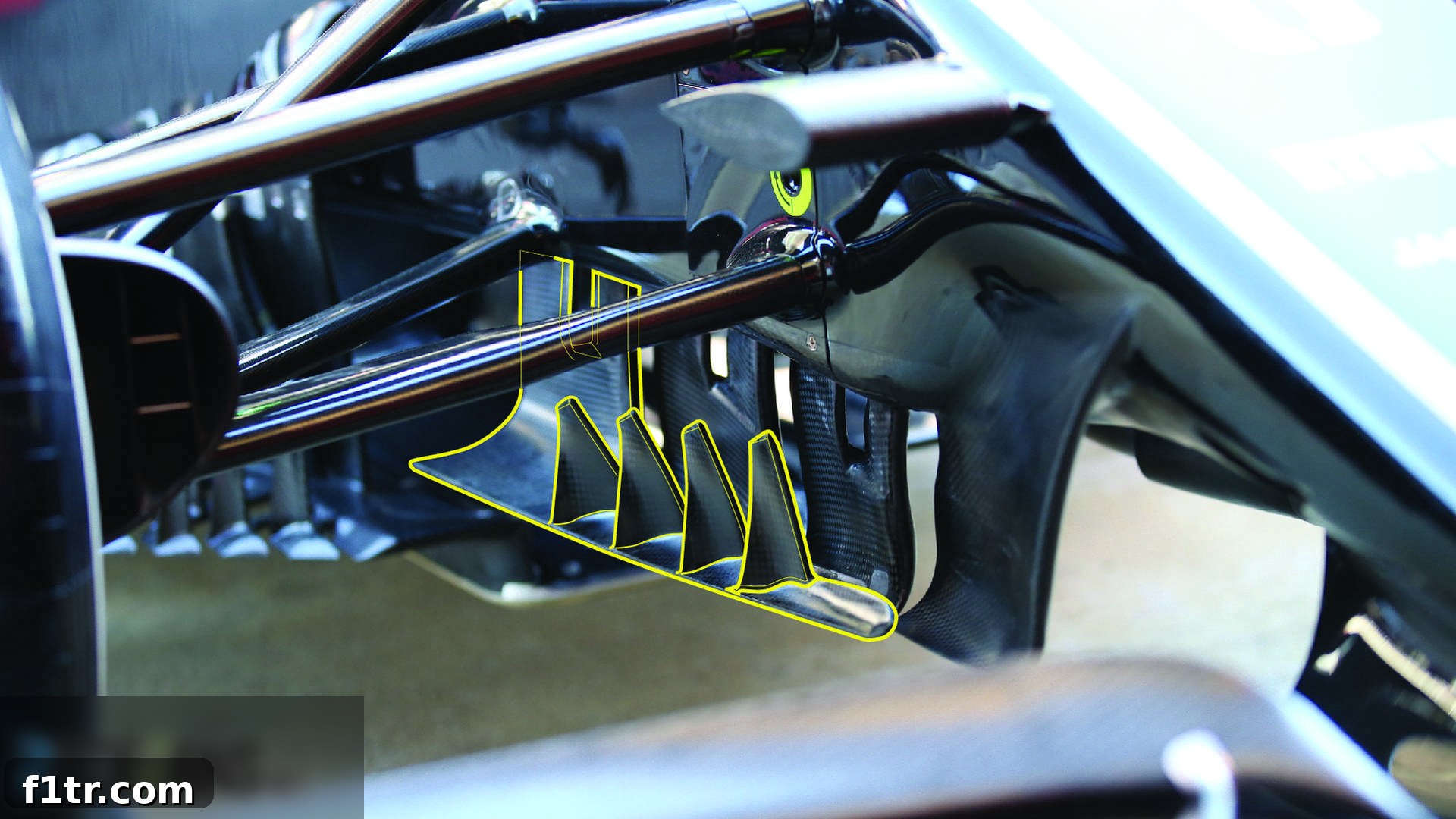
At Barcelona, Haas unveiled one of their most aggressive front-end modifications, focusing intensely on the turning vanes nestled beneath the front suspension. These components, rarely seen in such detail up close, are specifically designed to interact with and control the Y250 vortex. The standard Haas package at the time typically featured three hanging vanes with accompanying footplates. However, the updated VF-19 in Spain saw a significant augmentation: an additional set of four vertical vanes, likened to “teeth,” were meticulously mounted to the footplate area. These new elements weren’t merely aesthetic additions; they were precisely engineered as dedicated vortex generators. By creating a series of controlled mini-vortices, these “teeth” work in concert with the existing turning vane package to enhance the stability, strength, and direction of the crucial Y250 vortex, ensuring it more effectively guides airflow through the intricate front sections of the car and towards the main aerodynamic structures further back.
Mid-Car Flow Management: Evolving Bargeboard Complexity
Sharing the identical aim of optimizing the Y250 airflow and managing the turbulent wake from the front wheels, the VF-19’s bargeboards also received substantial revisions. Bargeboards are among the most complex and visually intricate aerodynamic components on an F1 car, positioned strategically between the front wheels and the sidepods. Their primary function is to condition and sculpt the airflow around the car’s midsection, preventing the highly disruptive turbulence from the front tyres from entering the critical airflow path towards the diffuser and rear wing. By generating their own vortices and directing air outwards, bargeboards help to create a cleaner, more efficient aerodynamic environment for the rest of the car.
The Barcelona updates to the main bargeboards were notable, with new top sections visibly fitted. The distinct split lines in the carbon fibre where these new sections were bonded clearly indicated the modifications. It is a common trend in modern Formula 1 aerodynamics for what was once a single, relatively simple bodywork panel to evolve into multiple, intricately slotted sections. This iterative process allows designers to maximize the generation and manipulation of vortices. In Haas’s case, the previous two main bargeboard sections were effectively reconfigured into four distinct elements, each meticulously designed to generate its own vortex. These additional vortices play a crucial role in energizing the airflow and further aiding the Y250 stream as it transitions along the car’s flanks. Furthermore, lower down on the bargeboard assembly, the footplate – a horizontal element that forms the base of the bargeboard – gained an extra tall-standing vane. This vertical addition, coupled with an increase in the number of footplate sections to three distinct elements, signifies a comprehensive effort to enhance the bargeboard’s ability to guide air more precisely and efficiently around the sidepods, minimizing drag and maximizing the desired aerodynamic interactions with the underfloor.
Advert | Become a RaceFans supporter andgo ad-free
Rear-End Efficiency: The Crucial Role of the Floor and Outwash
While much of the aerodynamic wizardry happens at the front and middle of the car, the rear is where a significant proportion of downforce is generated, primarily by the underfloor and diffuser. Maintaining a clean and consistent airflow to these areas is paramount. The concept of “outwash” is central here: pushing turbulent air from the wheels and sidepods outwards and away from the critical underbody sections, thereby maximizing the efficiency of the diffuser and overall downforce. The Haas VF-19 received a targeted update to its floor at the rear, specifically a new corner section fitted just ahead of the rear tyre.
This new metallic section, seamlessly bonded into the main floor structure, is highly influential in managing the complex airflow dynamics around the rear tyre. Rear tyres are massive generators of aerodynamic disturbance, creating turbulent wakes that can severely compromise the performance of the diffuser and rear wing. The revised floor section aims to mitigate this. The new version features a two-element winglet, a small but powerful aerodynamic device, strategically positioned to actively push airflow outwards and around the rear tyre. By creating this controlled “outwash” effect, the team seeks to reduce the detrimental impact of tyre wake on the diffuser’s performance, ensuring a more stable and powerful low-pressure area beneath the car, which translates directly into increased downforce and improved stability, particularly in high-speed corners.
Experimental Elements: The ‘Coat Hanger’ T-Wing
Beyond the more permanent structural changes, Formula 1 teams frequently experiment with additional bolt-on aerodynamic devices during practice sessions. These trials allow engineers to gather valuable data on potential performance gains or losses before committing to their full-time use. During the practice sessions in Spain, Haas was observed testing a distinctive two-element ‘coat hanger’ shaped T-wing. T-wings are small aerodynamic devices mounted high on the engine cover, typically just ahead of the rear wing, designed to generate a small but significant amount of additional downforce. Their effectiveness can be highly dependent on circuit characteristics and specific aerodynamic interactions with the main rear wing.
The appearance of this experimental T-wing for only a few trial runs during practice strongly suggested it was undergoing evaluation for potential deployment at upcoming races. Monaco, for instance, is notorious for demanding maximum downforce due to its incredibly tight, low-speed corners and lack of long straights. In such a unique environment, every last scrap of downforce becomes absolutely vital for lap time, making even a small T-wing a potentially valuable asset. Testing it in Barcelona allowed Haas to understand its aerodynamic characteristics and structural integrity in a more representative circuit environment before deciding on its introduction in the specific low-downforce configuration required for Monaco.
Advert | Become a RaceFans supporter andgo ad-free
The Bigger Picture: Balancing Pace and Tyre Performance
Ultimately, these extensive aerodynamic updates represent Haas F1 Team’s multifaceted approach to improving their overall competitiveness. While the primary goal of these specific modifications was to increase downforce and enhance aerodynamic efficiency, the underlying hope is that a more aerodynamically stable and powerful car will also provide greater consistency, which can in turn contribute to better tyre management. When a car is more predictable and generates consistent downforce through corners, drivers can extract performance more smoothly, putting less stress on the tyres and allowing them to operate within their optimal temperature window for longer periods. The challenges of Formula 1 tyre performance are complex, influenced by everything from track surface and ambient temperature to suspension setup and driver style, but aerodynamic stability is undeniably a cornerstone of success.
The iterative nature of F1 development means that these Barcelona updates were not a final solution but rather a critical step in an ongoing journey. Teams continuously collect data, analyze performance, and refine their designs throughout the season. For Haas, the battle on two fronts—for raw pace through sophisticated aerodynamics and for mastery over capricious tyre temperatures—highlights the intricate dance between engineering prowess and on-track execution that defines the pinnacle of motorsport. Success would hinge not just on the efficacy of these new components, but on the team’s ability to integrate them into a holistic package that delivered consistent performance across diverse circuit conditions and allowed their drivers to extract the maximum potential from the VF-19.
2019 F1 season
- Crying in the Melbourne car park at 2019 grand prix was my career low – Ocon
- McLaren Racing reports reduced £71 million loss in 2019
- Kvyat: Hockenheim podium last year was “my biggest achievement” so far
- How the FIA’s new encrypted fuel flow meter targets Ferrari’s suspected ‘aliasing’ trick
- “He smashed my office door”: 23 must-see moments from ‘Drive to Survive’ season two
Browse all 2019 F1 season articles