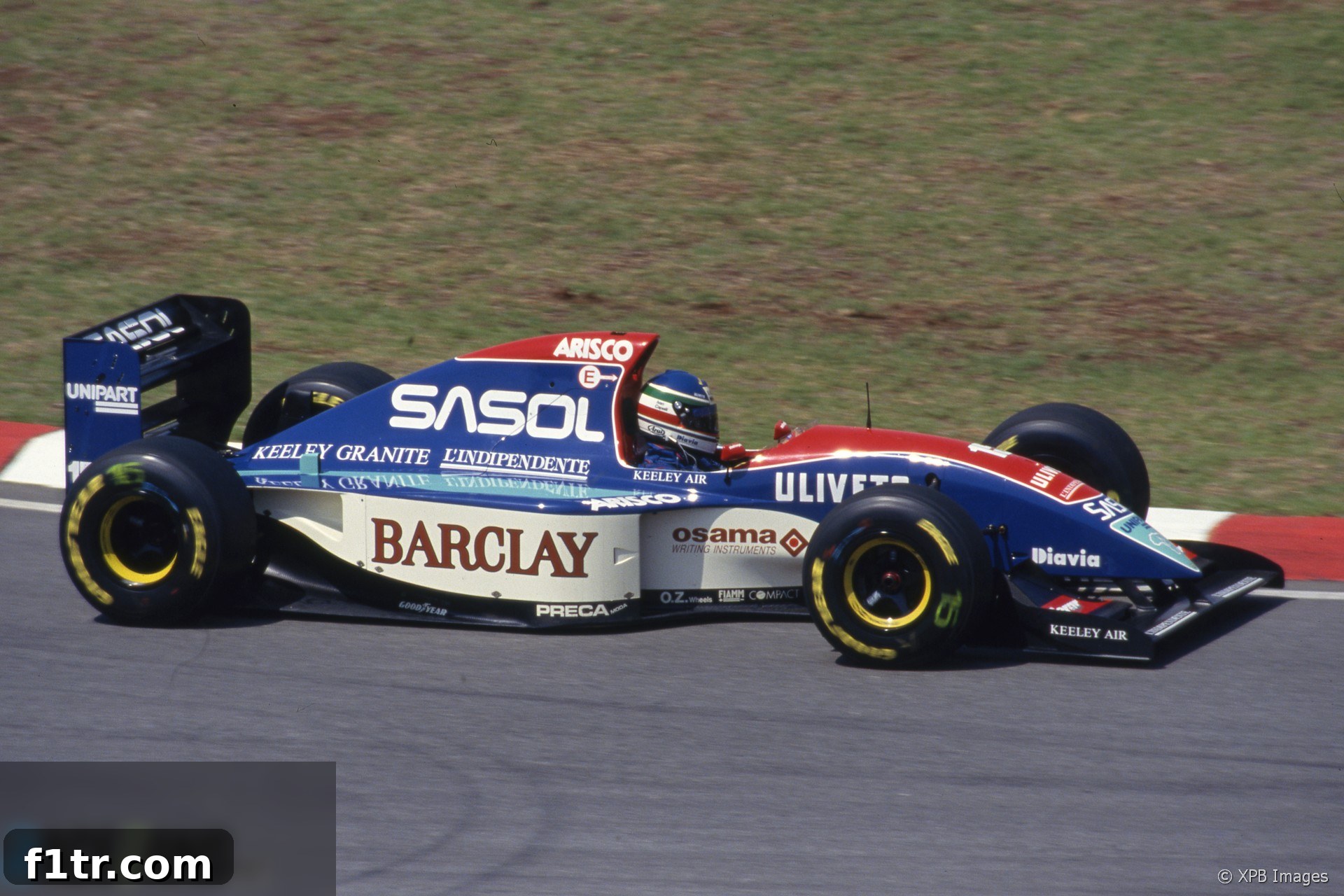
In the high-stakes world of Formula 1, where careers can be made or broken in a single race, the swift dismissal of a driver is a rare and often dramatic event. For a team to drop a driver just two rounds into a championship is almost unheard of, marking a significant inflection point in a racer’s journey. This drastic decision, as recently seen with Red Bull’s parting ways with Liam Lawson, echoes a moment from over three decades ago: the unceremonious exit of Ivan Capelli from the Jordan team in 1993. While the circumstances surrounding each case differ, the underlying pressure, expectation, and unforgiving nature of F1 remain constant, casting a long shadow over these brief, ill-fated tenures.
Advert | Become a Supporter & go ad-free
Red Bull’s decision concerning Liam Lawson, their promising new talent, has sent ripples through the paddock, reigniting discussions about the cut-throat environment of elite motorsport. The move, just two races into the season, positions Lawson alongside Capelli as one of the very few drivers to experience such an abrupt termination of their initial F1 opportunity. This prompts a deeper dive into Capelli’s equally challenging and short-lived stint, revealing how history often rhymes in the relentless pursuit of performance in Formula 1.
Ivan Capelli’s Brief Stint at Jordan in 1993: A Tale of Unmet Expectations
In 1993, the Jordan Grand Prix team, under the charismatic leadership of the late Eddie Jordan, sought to consolidate its position in Formula 1. After two seasons marked by flashes of brilliance and significant financial hurdles, Jordan aimed for greater stability and performance. Their strategy included pairing the highly regarded rookie Rubens Barrichello with an experienced hand who could help develop the car and guide the young Brazilian. That experienced hand was intended to be Ivan Capelli.
On paper, Capelli appeared to be a shrewd signing. He had previously driven for Ferrari, a team synonymous with Formula 1 royalty, and had come tantalisingly close to securing race victories in Adrian Newey’s ingenious Marches during the late 1980s. These earlier successes painted a picture of a driver with raw speed and potential. However, his most recent F1 campaign with Ferrari in 1992 had been nothing short of disastrous, marred by a woefully underperforming car. This left significant question marks hanging over his current pace and motivation, concerns that would unfortunately materialise.
Eddie Jordan, ever the optimist, initially harboured ambitious dreams of luring the legendary Ayrton Senna away from McLaren for the 1993 season. However, when the three-time world champion ultimately re-signed with McLaren, Jordan swiftly turned his attention to Capelli, seeing him as the next best option to provide the team with the necessary blend of experience and talent. This decision, made with high hopes, would soon prove to be one of the most short-lived driver partnerships in F1 history.
Challenges of the Jordan 193 and the Season Opener
The 1993 season was Jordan’s third in Formula 1, and with it came their third different engine supplier, a clear indication of the team’s ongoing struggle for stability and competitiveness. Reliability proved to be a persistent and crippling problem throughout the pre-season testing, a situation that continued right up until the team arrived at Kyalami for the season opener, the South African Grand Prix. More technical woes plagued Capelli’s car during practice sessions, severely limiting his track time and ability to familiarise himself with the new chassis and conditions.
Compounding these difficulties, the FIA abruptly halved the length of practice sessions to a mere 45 minutes, intensifying the pressure on drivers and teams to extract maximum performance in minimal time. For Capelli, already grappling with an unreliable car and a new environment, this change was particularly detrimental. He qualified a disappointing 18th, a full four places behind his rookie teammate, Barrichello, who demonstrated surprising adaptability. The race itself offered no respite: just two laps in, Capelli spun dramatically, demolishing the right-rear of his Jordan 193. This was a costly error, not only financially but also in terms of reputation, especially on a day when only five drivers managed to reach the chequered flag, highlighting the extreme attrition of the event.
Advert | Become a RaceFans supporter andgo ad-free
The Interlagos Disaster and the End of a Dream
If Kyalami was a setback, the Brazilian Grand Prix at Interlagos proved to be an unmitigated disaster for Capelli, irrevocably sealing his fate. The field dynamics had also changed that year; March had withdrawn from the championship, limiting the entry to 26 cars. Initially, 24 cars were permitted to start the race, but an agreement among teams expanded the grid to 25, meaning only one driver would fail to qualify. Tragically for Capelli, he became that driver.
Technical problems once again plagued his Jordan. In the crucial first practice session, his car stranded him at the far side of the circuit after completing just a single lap, costing him invaluable setup time. During the final qualifying session the following day, Capelli was visibly struggling with the car’s handling, unable to extract any meaningful pace. He ultimately ended up three-tenths of a second slower than Michele Alboreto, who secured the 25th and final grid slot. This stark failure to qualify, especially when Barrichello managed to lap over two seconds faster and secure 14th place on the grid, was an undeniable indictment of Capelli’s performance.
This humiliating failure marked the swift and brutal end of Ivan Capelli’s time at Jordan and, ultimately, his Formula 1 career. The team acted quickly, replacing him with another experienced driver, Thierry Boutsen, for the subsequent round. However, the struggles of the Jordan 193 were profound, and Boutsen, too, failed to see out the season. By the time the tumultuous 1993 season concluded, Jordan had cycled through an astonishing six different drivers, a testament to the team’s difficulties and the immense pressure to perform.
Beyond Capelli: Other Instances of Early Driver Changes
While Capelli remains the last instance of a driver being dropped so definitively after just two races at the start of a season, Formula 1 has seen numerous driver changes under various circumstances. Many drivers have come and gone from seats in two races or fewer since then, but often for reasons distinct from outright performance dismissal. For example, drivers like Ricardo Zonta (BAR, 1999) and Juan Pablo Montoya (McLaren, 2005) missed the third round of their respective seasons due to injuries sustained, not a direct team decision to replace them for lack of pace. Others, such as Jos Verstappen (Benetton, 1994), Mark Blundell (McLaren, 1995), Antonio Giovinazzi (Sauber, 2017), and Nico Hulkenberg (Aston Martin, 2022), started the first two races purely as substitute drivers, filling in for an injured or unavailable primary driver, with no expectation of a full season.
Smaller F1 teams, often operating on tighter budgets and with less stable driver lineups, have also made swift changes during seasons. These were typically one-off substitutions driven by injuries, bans, or contractual obligations. Some drivers were given single race appearances to prove themselves or fulfil commercial agreements, such as Karun Chandhok’s final start at Lotus in 2011 or Andre Lotterer’s solitary F1 outing with Caterham three years later. While these instances reflect the volatile nature of F1, they don’t quite align with the decisive, performance-based dismissal seen in the cases of Capelli and, more recently, Lawson.
Luca Badoer’s Ferrari Opportunity: A Modern Parallel
The only other driver whose situation bears significant comparison to the abrupt departures of Capelli and Lawson in the intervening period is Luca Badoer, during his brief and ill-fated stint at Ferrari in 2009. Badoer was thrust into the spotlight as a substitute for the severely injured Felipe Massa, who suffered a life-threatening accident at the Hungarian Grand Prix. This was a golden, albeit unexpected, opportunity for Badoer, a long-serving Ferrari test driver, to complete the season for the legendary Scuderia. However, despite the immense sentimental value and the team’s loyalty, his under-performance after just two races led to his swift replacement.
Advert | Become a RaceFans supporter andgo ad-free
To be fair to Ferrari, Badoer was not their first choice. Their initial and ambitious plan was to tempt the iconic Michael Schumacher out of retirement, allowing him to test one of their cars and potentially complete the season. However, testing regulations were extremely strict at the time, and rival teams unanimously refused to grant special dispensation for Schumacher to test. Furthermore, Schumacher himself later ruled out a return, having sustained a neck injury earlier in the year during a motorcycle accident, which rendered him physically unfit for the rigours of F1.
The team’s eventual choice of Badoer was a surprising one for many, as a full decade had passed since the veteran test driver’s last Formula 1 race start with Minardi. His lack of recent competitive F1 experience proved to be a critical factor. In his two-race stint for the Scuderia, he was disastrously uncompetitive, unable to adapt to the demands of the V8-era F1 machinery.
Performance Gap: Valencia and Spa
On his Ferrari debut at the European Grand Prix in Valencia, Badoer struggled profoundly. In the crucial Q1 session, he was almost one-and-a-half seconds slower than the next-slowest driver on the grid. He missed the cut for Q2 by a staggering two seconds and found himself two-and-a-half seconds adrift of his teammate, Kimi Raikkonen, who was already acclimatised to the car. To put that into perspective, when Liam Lawson competed in Melbourne this year (presumably in a comparison mentioned in the broader context of the source’s content for Lawson), he qualified 18th, ahead of the two Haas drivers, was only half a second off reaching Q2, and a second slower than his teammate, Max Verstappen. This highlights the vastly different performance gaps between these situations.
While Raikkonen brilliantly navigated the chaotic Valencia race to secure a podium finish in third place, Badoer was the last driver still running, finishing a distant 17th and a full lap down. His struggles continued a week later at the legendary Spa-Francorchamps circuit. Here, he again finished last, an astonishing one minute and 40 seconds behind Raikkonen, who remarkably took the victory. This proved to be Badoer’s final start in Formula 1; his place was taken by fellow Italian Giancarlo Fisichella, who then incredibly finished second to Raikkonen at Spa, further underscoring Badoer’s lack of pace.
The Ever-Present Pressure and Hope for Redemption
The narratives of Ivan Capelli and Luca Badoer serve as stark reminders of the brutal reality of Formula 1, where the margin for error is non-existent and the demands for immediate performance are paramount. For new talents like Liam Lawson, entering this unforgiving arena, the pressure is immense. While the circumstances of Capelli’s and Badoer’s exits were rooted in a mixture of technical woes, lack of experience, and undeniable performance deficits, the outcome was the same: a dream cut short, at least for the moment. Lawson’s recent experience with Red Bull, though undoubtedly a setback, offers a glimmer of hope that was perhaps less available to his predecessors.
In the modern F1 landscape, with intricate junior driver programs and sophisticated driver management, Lawson can at least console himself with the knowledge that he is still firmly within the Formula 1 ecosystem, albeit in a different capacity. His talent is recognized, and his prior substitute appearances showed significant promise. Unlike Capelli, whose F1 career ended with his Jordan dismissal, Lawson retains the chance to redeem himself, potentially returning to his former team or finding another opportunity, after his Red Bull dream unfolded so quickly. The F1 paddock is a place of constant change and unexpected turns, and while some doors may close abruptly, others may yet open for those who possess the talent and resilience to endure.
Miss nothing from RaceFans
Get a daily email with all our latest stories – and nothing else. No marketing, no ads. Sign up here:
Advert | Become a RaceFans supporter andgo ad-free
Formula 1 Insights
- The ‘throwback weekend’ is back in fashion. But it’s a flawed concept – especially for F1
- Is Formula 1’s double race cancellation a blessing in disguise?
- Todt admits Schumacher crashed on purpose – but did it really cost him two titles?
- 25 of the most memorable radio exchanges from the ‘Max and GP show’
- FIA explains next steps after first meeting to discuss fixes for 2026 F1 rules
Browse all Formula 1 articles