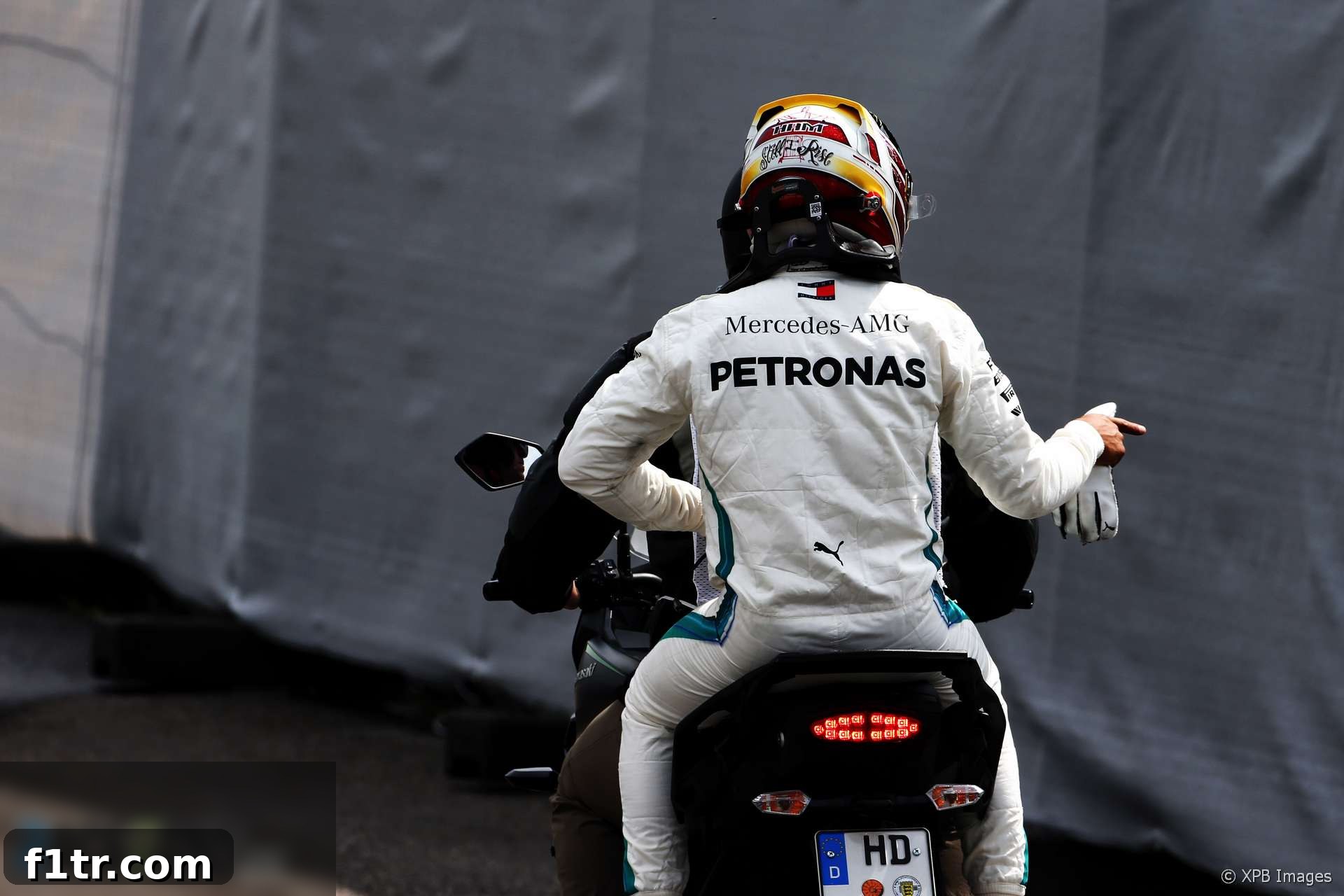
Lewis Hamilton says the bump he ran over at turn one didn’t trigger the hydraulic fault which forced him out of qualifying early in the German Grand Prix.
Advert | Become a Supporter & go ad-free
Hamilton’s Hockenheim Heartbreak: Hydraulic Failure Halts Qualifying Bid
The electrifying atmosphere of the German Grand Prix qualifying session at the Hockenheimring was abruptly dampened for Mercedes-AMG Petronas F1 Team driver Lewis Hamilton, whose Q1 outing ended prematurely due to an unforeseen hydraulic fault. The incident, which saw the four-time world champion grind to a halt on track, immediately cast a shadow over his weekend and the intensifying 2018 Formula 1 championship battle. Despite an earlier moment where his car visibly jolted after running wide over a kerb at Turn 1, Hamilton was swift to dismiss any direct correlation, asserting that the critical mechanical failure had manifested even before that minor excursion. This dramatic turn of events leaves him facing a formidable challenge, provisionally starting from 14th on the grid, while his closest title rival, Sebastian Vettel, savors a commanding pole position for Ferrari.
The Dramatic End to Hamilton’s Q1 Session
The qualifying session, a crucial determinant for grid positions, began with high stakes for all competitors. Lewis Hamilton, a driver renowned for his qualifying prowess, was on an early flying lap in Q1, pushing the limits of his Mercedes W09 EQ Power+ around the iconic Hockenheimring circuit. As he navigated Turn 1, a notoriously fast right-hander, Hamilton’s car drifted slightly wide, causing its right-hand wheels to run aggressively over the kerb. The impact was palpable, sending a noticeable jolt through the car’s chassis, an incident often attributed to drivers seeking to maximize track width and lap time. However, mere moments after this jolt, the gravity of the situation became apparent. The Mercedes driver ran wide over a kerb which jolted his car during Q1. His Mercedes began to lose power, ultimately coasting to a complete stop on the track shortly afterwards, effectively ending his participation in the session. The visible distress on the Briton’s face, captured by trackside cameras, perfectly encapsulated the disappointment of a driver robbed of a chance to compete at his full potential. Marshals were quickly dispatched to recover the stricken silver arrow, and the sight of Hamilton walking back to the pits, helmet in hand, signaled the profound setback for the reigning champion, rendering him unable to take part in Q2.
Hamilton Denies Kerb Caused Hydraulic Failure
Emerging from the Mercedes garage, a composed yet clearly frustrated Lewis Hamilton faced the media, keen to clarify the sequence of events. Addressing the speculation linking his car’s hydraulic failure to the earlier kerb impact, Hamilton was unequivocal. Asked whether the stoppage was caused by the bump he appeared to hit earlier, Hamilton said: “No. I think it failed before then.” This definitive statement suggests that the hydraulic issue was an underlying mechanical problem, potentially developing prior to or independently of the kerb incident. While running over kerbs is an inherent part of Formula 1 racing and can sometimes trigger or exacerbate existing weaknesses, Hamilton’s assertion indicates the team’s initial diagnosis pointed towards a more systemic failure rather than a direct consequence of driver error or track conditions. Such hydraulic failures can manifest in various critical systems, including the gearbox, power steering, or brake-by-wire, any of which would render a modern F1 car inoperable. For the Mercedes-AMG Petronas F1 Team, this unexpected malfunction necessitates a thorough investigation to understand its root cause and prevent recurrence, especially given the fierce championship battle they are embroiled in.
Championship Implications: Vettel on Pole, Hamilton Starts P14
The immediate consequence of Hamilton’s premature exit from qualifying was a provisional 14th place starting position, a stark contrast to his usual front-row presence. This placed him deep within the midfield pack, a treacherous environment rife with unpredictable race incidents and challenging overtaking opportunities. Compounding Hamilton’s woes, his primary championship rival, Sebastian Vettel, delivered a stellar performance for Ferrari, securing a crucial pole position. This dramatic reversal of fortunes handed Vettel a significant strategic advantage, with the potential to extend his lead in the drivers’ standings significantly. Heading into the German Grand Prix, the championship narrative was already taut, with only a few points separating the two titans. A strong result for Vettel and a compromised race for Hamilton could create a considerable points gap, adding immense pressure on the Briton for the remainder of the season. The Hockenheimring circuit, while offering some overtaking zones, is not universally regarded as one of the easiest tracks for charging through the field, making Hamilton’s task even more daunting.
Hamilton’s Resolve: Vowing a Recovery Drive at Hockenheim
Despite the palpable disappointment, Lewis Hamilton quickly shifted his focus to Sunday’s race, channeling his characteristic fighting spirit. When asked about his recovery prospects, a realistic Hamilton admitted, “I have no idea where I might be able to recover to.” This candid admission reflected the inherent unpredictability of starting so far back. However, his subsequent remarks underscored his unwavering determination. “It definitely was a tough one. But these things happen and all you can do is gather your thoughts and [take] any of the negative energy and out it towards trying to do your best the next day. Live to fight another day. Another opportunity to rise.” These words encapsulate the mindset of a champion who refuses to be defeated by adversity.
The path from 14th to the podium, let alone a victory, is fraught with challenges. Hamilton will need to carefully manage his tires, execute precise overtakes, and potentially rely on strategic pit stops or safety car interventions to climb through the order. He acknowledged the distinct difference between this situation and his miraculous recovery at Silverstone earlier in the season, where he started from pole and finished second after an early incident. “I’ll give everything tomorrow to see how high I can get up. But it’s not going to be like Silverstone,” he stated, recognizing the differing track characteristics and the nature of the challenge. At Silverstone, he had the pace advantage and a clear path; here, he will be battling against a congested midfield, where every position is hard-won. Yet, his final remarks conveyed a glimmer of hope: “I’m sure I’ll be able to get through to some point but to where I don’t know,” he added. This blend of realism and ambition sets the stage for what promises to be one of the most compelling recovery drives of his illustrious career. The Mercedes team will undoubtedly be working tirelessly overnight to provide him with the best possible strategy and a perfectly prepared car to maximize his chances of minimizing the damage.
Mercedes’ Strategic Challenge and Ferrari’s Golden Opportunity
For the Mercedes-AMG Petronas F1 Team, Hamilton’s hydraulic failure presents a dual challenge: first, to meticulously investigate and understand the failure to prevent future occurrences, and second, to devise an optimal race strategy for their star driver to salvage as many points as possible. Their constructors’ championship aspirations are equally tied to Hamilton’s performance. On the other side of the garage, Valtteri Bottas, who qualified P2, now carries the primary torch for Mercedes at their home race, tasked with challenging Vettel and scoring maximum points.
Meanwhile, Ferrari and Sebastian Vettel find themselves in an enviable position. With their main championship rival starting deep in the field, this is a golden opportunity to extend their lead in both the drivers’ and constructors’ championships. Vettel, starting from pole, will be aiming for a dominant lights-to-flag victory, free from the immediate threat of Hamilton. The German fans, eager for a home hero victory, will undoubtedly add to the pressure and excitement surrounding Vettel’s Sunday drive. The strategic battle between Mercedes and Ferrari will be intense, with both teams likely scrutinizing weather forecasts and potential safety car deployments to gain an advantage.
Anticipation Builds for a Thrilling German Grand Prix
The German Grand Prix was already anticipated to be a pivotal race in the 2018 Formula 1 season. Lewis Hamilton’s qualifying drama has only intensified that anticipation. Can the reigning world champion navigate the treacherous midfield and mount a spectacular recovery drive? Will Sebastian Vettel capitalize on his pole position and Hamilton’s misfortune to significantly boost his championship hopes? The Hockenheimring is poised for a dramatic Sunday, offering a testament to Hamilton’s resilience and the relentless, unpredictable nature of Formula 1 racing. Fans around the world will be watching keenly to see if Hamilton can once again defy the odds and turn a significant setback into a memorable performance, or if this moment marks a critical shift in the championship momentum. The stage is set for a thrilling German Grand Prix.
Advert | Become a RaceFans supporter andgo ad-free
Don’t miss anything new from RaceFans
Follow RaceFans on social media:
- Join RaceFans on Facebook
- Follow RaceFans on Twitter
- Get daily email updates from RaceFans
2018 F1 season
- F1 feared “death knell” for Drive to Survive after Ferrari and Mercedes snub
- McLaren staff told us we were “totally crazy” to take Honda engines in 2018 – Tost
- ‘It doesn’t matter if we start last’: How Red Bull’s junior team aided Honda’s leap forward
- Honda’s jet division helped F1 engineers solve power unit problem
- McLaren Racing losses rise after Honda split
Browse all 2018 F1 season articles