The Unseen Challenge: How Lost GPS Data Derailed Lewis Hamilton’s British Grand Prix Strategy
In the high-stakes world of Formula 1, where every millisecond and every byte of data can dictate the outcome, unforeseen technical glitches can have profound consequences. For a sport at the pinnacle of technological innovation, such breakdowns can turn meticulously planned strategies into desperate guesswork. This stark reality came into sharp focus at the recent British Grand Prix, where Lewis Hamilton’s performance was significantly compromised due to a critical and unexpected failure: Ferrari lost the vital GPS data trace from his car for the entirety of the race.
Frederic Vasseur, the pragmatic team principal for Ferrari, candidly revealed the extent of this issue, describing the team’s strategic decisions as being made “completely blind.” This wasn’t merely a minor inconvenience; it was a fundamental breakdown in the data stream that underpins modern F1 strategy, leaving the team unable to accurately track Hamilton’s position, monitor his competitors, or make informed real-time calls in a race already made challenging by unpredictable weather conditions.
The Indispensable Role of GPS Data in Modern F1 Race Strategy
To truly grasp the magnitude of Ferrari’s predicament, one must fully understand the indispensable role GPS data plays in contemporary Formula 1. Beyond simply showing a car’s location on a track map, GPS telemetry is a cornerstone of advanced race strategy. It provides continuous, real-time positional data, allowing teams on the pit wall to monitor their car’s exact coordinates, speed, and track progression down to fractions of a second. This stream of information is integrated with countless other data points—tire temperatures, wear rates, fuel consumption, engine performance, and even minute changes in track conditions—to create a holistic and dynamic picture of the race unfolding.
Precision Planning: From Pre-Race Simulations to Live Tactical Adjustments
Strategists leverage this precise data to execute complex simulations, predict tire degradation curves with astonishing accuracy, anticipate competitor pit windows, and evaluate the efficacy of various strategic permutations. In a sport where a tenth of a second can separate victory from defeat, having an accurate, up-to-the-minute understanding of every car’s position relative to others is not just helpful; it’s absolutely essential. It enables strategists to identify optimal pit stop timings, react instantly and decisively to safety car deployments or virtual safety car periods, and execute overtakes or defensive maneuvers with maximum efficiency. Without it, a team is effectively operating without one of its most critical senses, navigating a complex, high-speed chess match with a significant portion of the board obscured, leaving them vulnerable to rivals who possess full visibility.
The British Grand Prix: A Grueling Test of Adaptability Under Pressure
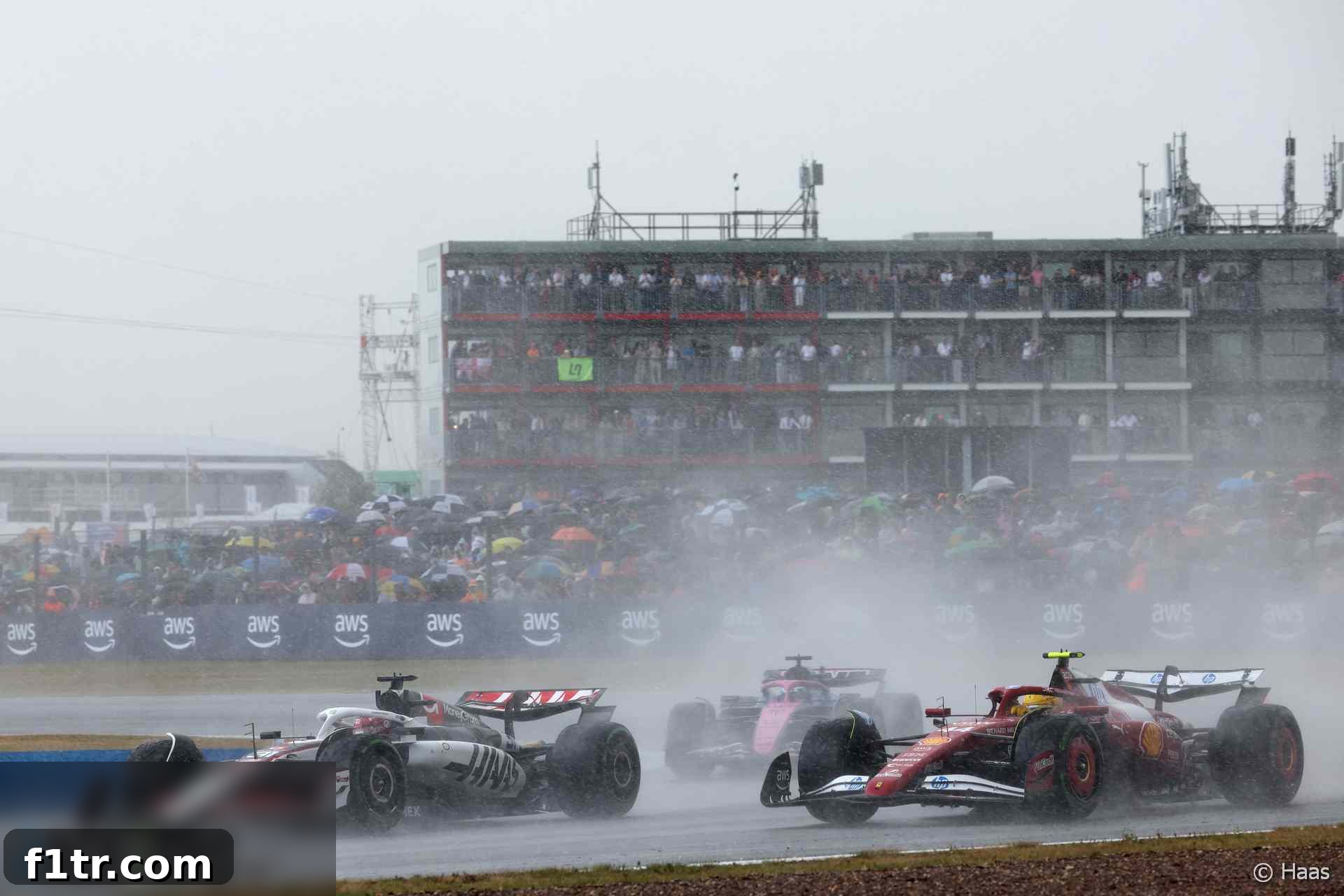
The British Grand Prix at Silverstone is renowned for its iconic layout, rich motorsport history, and often, its notoriously fickle weather. This particular race proved to be no exception, as rain played a significant and disruptive role, creating a dynamic and incredibly challenging environment for all competitors. Wet conditions inherently complicate race strategy, introducing rapidly changing grip levels, significant spray affecting driver visibility, and the crucial, high-stakes decision-making required when choosing between intermediate and slick tires as the track conditions fluctuate between wet, damp, and dry.
Navigating the Rain-Soaked Silverstone Without Key Positional Data
For Hamilton and Ferrari, these already intricate and demanding conditions were severely exacerbated by the complete absence of GPS data. While Hamilton commendably avoided a costly error made by his teammate—pitting for slicks too early during the formation lap, a strategic blunder in rain-hit races that can ruin an entire Grand Prix—the subsequent timing of his two crucial pit stops proved less than ideal. This was a direct consequence of the data blackout, as the team lacked the granular detail needed to make calls with absolute precision in a rapidly evolving track environment.
Vasseur highlighted the extreme difficulty of making these calls in real-time, under immense pressure. “You can say now that it was probably one lap too early [for slicks] also because he went straight on in turns three-four and he lost four or five seconds in these two corners,” Vasseur explained. This single miscalculation, directly linked to a lack of precise positional data and real-time competitor tracking, cost Hamilton valuable time and critically, track position. He lost further places when his first pit stop for a fresh set of intermediate tyres was made later than those around him, putting him instantly on the back foot against his rivals. Later in the race, the premature switch back to slick tyres, leading to him going off track twice, cemented the feeling that Ferrari was operating at a severe strategic disadvantage, unable to gauge the true readiness of the track for dry weather compounds.
Lewis Hamilton’s Race: A Struggle Against the Unknown
Lewis Hamilton’s British Grand Prix was, in many respects, a masterclass in resilience and raw driving talent, yet ultimately it served as a stark testament to the profound impact of unseen technical issues. Despite his immense skill and wealth of experience, the critical lack of real-time GPS data meant that his race strategy was, at best, an educated guess and, at worst, a shot in the dark. The consequences were tangible and immediate: he found himself battling not just fierce competitors on the track, but also the invisible handicap of his team’s strategic blindness, forced to react rather than proactively dictate his race.
Strategic Missteps and Their Cascading Costs
His initial pit stop for intermediates, executed later than his direct competitors, meant he rejoined the track with an instant deficit. In a race decided by razor-thin margins, even a single lap’s difference in tire degradation or critical track position can be insurmountable, costing valuable seconds that are impossible to regain. The subsequent, early switch to slick tyres was, in essence, a roll of the dice without sufficient information. As Team Principal Vasseur candidly acknowledged, hindsight is always 20/20. Hamilton’s two excursions off the track shortly after this crucial tire change weren’t necessarily driver errors, but rather the direct consequence of venturing onto a track that wasn’t quite ready for dry-weather compounds—a decision made without the benefit of critical data on evolving track conditions, surface grip levels, and precise competitor performance on various tire compounds.
These strategic missteps ultimately cost him vital time and crucial track position, allowing sharp competitors like Nico Hulkenberg to gain a decisive advantage. The gap created by these incidents proved decisive, as Hulkenberg ultimately clinched a podium position that Hamilton might otherwise have strongly contended for, had his team possessed the full suite of data. This incident powerfully underscores the razor-thin margins in Formula 1, where even minor data inconsistencies or outright failures can cascade into significant and irreversible race outcome alterations, impacting championships and driver standings alike.
The Pit Wall’s Ethical Dilemma: Hindsight vs. Real-Time Pressure
Frederic Vasseur’s reflections post-race offered a rare and invaluable glimpse into the immense pressure faced by strategists operating on the pit wall. His comments perfectly encapsulate the “hindsight trap” that often plagues analysis in Formula 1, where decisions made in a split second are then dissected and judged with the luxury of full information and slow-motion replays.
The Impossible Choice: Act Now or Risk Falling Behind?
“It’s the kind of situation where if you wait for others to do the move before you, it’s always too late,” Vasseur stated, articulating a fundamental paradox of F1 strategy. This highlights that being proactive is absolutely key to gaining an advantage, but proactive decisions inherently carry significant risks, especially when made without complete and accurate information. The example of Fernando Alonso, who pitted earlier and was already showing demonstrably improved pace in certain corners, perfectly illustrates this dilemma. Waiting to see if Alonso’s gamble paid off might have meant Hamilton losing even more critical ground, becoming reactive rather than proactive. Yet, moving too early, as proved to be the case with Hamilton’s slick tire switch, also had severe and costly repercussions, pushing him off the track.
Vasseur elaborated on this profound complexity: “It’s quite easy after the race to say that the first stop would have been better to step one lap before, and second pit stop to stop one lap later. But honestly on this when you have to take the decision on the pit wall, it’s very difficult because you have to be always in communication.” This constant communication, the barrage of incoming data (or in this case, the frustrating lack thereof), and the precious seconds ticking by make the pit wall a crucible of high-pressure, instantaneous decision-making. The absence of GPS data effectively stripped away a significant portion of their ability to communicate accurate, data-driven instructions, forcing them to rely on less precise methods, informed intuition, and gut feeling in a sport that strives for absolute scientific accuracy and measurable certainty.
Beyond Silverstone: The Broader Implications of Data Integrity in F1
The incident at the British Grand Prix involving Lewis Hamilton’s lost GPS data serves as a stark and sobering reminder of the fragile balance between human expertise and technological reliance in Formula 1. While teams invest astronomical sums in redundant systems, sophisticated telemetry, and advanced data analytics, such failures, though thankfully rare, powerfully underscore the inherent vulnerabilities present even in the most advanced and meticulously engineered sporting environments.
Ensuring Reliability: A Constant, Relentless Battle
For F1 teams, data integrity is not just important; it is absolutely paramount. They employ multiple communication channels, implement extensive backup sensors, and utilize robust error-checking protocols to ensure a continuous and accurate flow of information from their cars to the pit wall. Yet, as so dramatically demonstrated at Silverstone, even these intricate layers of protection can sometimes fail under race conditions. This incident will undoubtedly prompt Ferrari, and very likely other teams across the grid, to meticulously review and further reinforce their data acquisition systems, particularly concerning mission-critical telemetry like GPS positioning. The pursuit of marginal gains in F1 extends not just to aerodynamics, engine performance, or driver fitness, but also to the unwavering reliability and redundancy of every single sensor, communication link, and data processing unit.
The impact of a single technical glitch, seemingly minor or isolated in its origin, can reverberate profoundly throughout an entire race, influencing championship battles, constructors’ standings, and individual driver performances. It highlights that success in Formula 1 is a multifaceted, ever-evolving challenge, where cutting-edge technology must be perfectly married with human intuition, strategic brilliance, and lightning-fast adaptability, all while constantly guarding against the unpredictable and often unforgiving nature of complex, high-performance machinery operating at its absolute limit.
Conclusion: A Race Against the Invisible
Lewis Hamilton’s British Grand Prix experience stands as a compelling and cautionary narrative of a top-tier driver and an elite team battling against an invisible, yet profoundly impactful, foe: the absence of crucial data. Frederic Vasseur’s revelation about the lost GPS trace from Hamilton’s car sheds invaluable light on the profound strategic disadvantage Ferrari faced throughout the event. In a sport where every single decision is meticulously calculated and justified based on a deluge of real-time information, being “completely blind” in a rain-hit race is akin to asking a highly skilled pilot to navigate through a severe storm without the benefit of radar or critical instrumentation.
This incident serves as a powerful testament to the ever-increasing reliance on sophisticated technology in Formula 1 and the critical, often race-altering, impact its failure can have. While Hamilton’s resilience, adaptability, and sheer driving skill were undeniably evident as he fought tooth and nail for every position, the race underscored a fundamental truth: even the most talented drivers, supported by the most advanced teams, are ultimately constrained by the integrity and reliability of their data systems. It reinforces the notion that in F1, victory is not solely about raw pace, strategic genius, or flawless execution; it’s also about the unseen battles against technical glitches, and the relentless, uncompromising pursuit of flawless and uninterrupted data streams.
Don’t Miss a Lap! Get the Latest Race News Directly to Your Inbox
Stay updated with all our latest stories and exclusive insights – no marketing, no ads, just pure racing content. Sign up here:
More on the 2025 British Grand Prix:
- Tsunoda says the stewards have “not been nice to me” as penalty points mount up
- ‘I’ve considered Hulkenberg an exceptional talent for a very long time’ – Wheatley
- Alpine is now F1’s highest scoring last-placed team of all time: British GP stats
- Ferrari had no GPS data from Hamilton’s car throughout British Grand Prix
- “The risk for us is a Safety Car”: Why Norris’s win was in danger for six laps
Browse all 2025 British Grand Prix articles