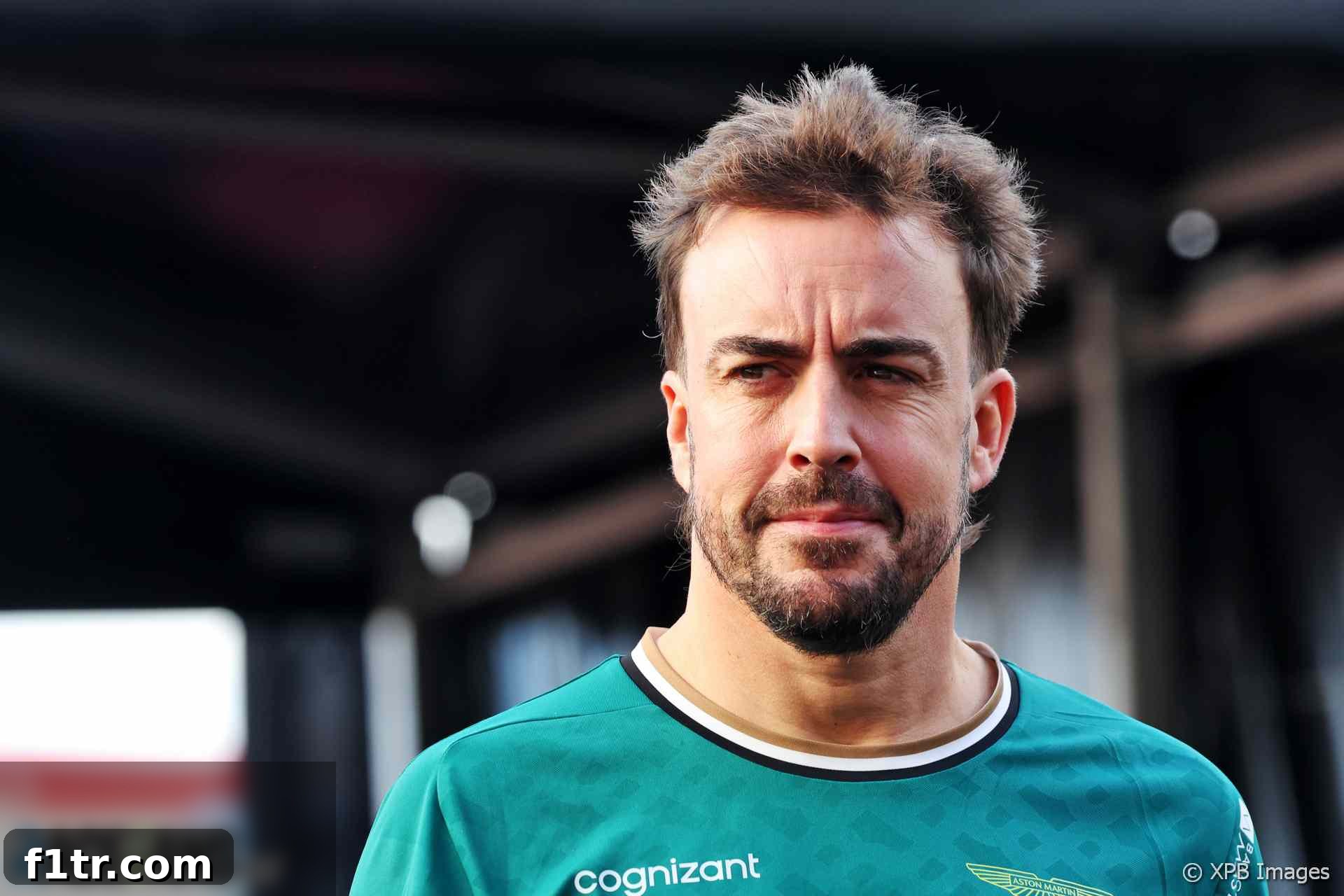
The 2024 Formula 1 season presented a stark contrast for Fernando Alonso compared to the soaring successes of his initial year with Aston Martin. What began with flashes of brilliance and the characteristic grit of the two-time world champion gradually transformed into a challenging campaign, as the Aston Martin team found itself increasingly out of touch with the front-runners and deeply entrenched in the fiercely competitive midfield.
Support Our Journalism | Become a Supporter & go ad-free
Even as he approached his 43rd birthday, Alonso’s commitment and raw speed remained undiminished. While there were moments when his performance seemed to waver in direct correlation with the team’s struggles, these dips were consistently temporary, a testament to his unparalleled resilience and unwavering focus. His ability to extract every ounce of performance from the AMR24, often exceeding its inherent capabilities, was a recurring theme throughout the season, even when the car itself lacked the pace to contend for podiums.
The season commenced with a promising outlook, mirroring some of the positive momentum from the previous year. Alonso consistently demonstrated his qualifying prowess, frequently positioning his AMR24 higher on the grid than its true pace suggested it should be. While this often meant a gradual slide back during the races as faster cars inevitably found their rhythm, Alonso’s exceptional race craft and strategic acumen allowed him to convert these strong starting positions into valuable points finishes. Notable among these early performances was a brilliant fifth place in Jeddah, where he masterfully held off competitors, finishing ahead of both Mercedes, a Ferrari, and a McLaren – a clear indicator of his enduring skill. A solid sixth place in Japan further underscored the team’s relatively strong start and Alonso’s capacity to deliver when the car was at its most competitive.
That fifth-place finish in Jeddah ultimately stood as Aston Martin’s best result of the entire year. Alonso achieved this by skillfully managing his tyres and defending against the charge of George Russell. However, his tactics became a subject of controversy in Australia. In an attempt to replicate his defensive strategy, Alonso was deemed to have slowed abruptly and unusually early at high speed in front of Russell, leading to a dangerous incident. The stewards, recognizing the severe safety implications of such a maneuver, issued him a significant penalty, sparking widespread debate about the boundaries of defensive driving. Later, in China, Alonso found himself embroiled in another stewards’ inquiry following a tangle with Carlos Sainz Jnr. While many observers viewed this as an unfortunate, clumsy racing incident rather than a cynical move, the harsh verdict left Alonso justifiably concerned about the accumulation of penalty points, which threatened to impact his eligibility for future races and underscored the heightened scrutiny he often faced from race officials.
The team’s season began to unravel significantly around the Miami Grand Prix. Despite starting from a challenging 15th on the grid, Alonso once again salvaged points, showcasing his relentless pursuit of every possible position. However, this marked the beginning of a challenging period. A costly crash in practice at Imola hampered his weekend performance, and he suffered a rare Q1 exit in Monaco, a circuit where driver skill can often mask car deficiencies. A puzzling off-weekend in Austria saw him involved in a collision with Zhou Guanyu, further highlighting the team’s diminishing competitive edge and the mounting frustrations within the garage. These incidents painted a picture of a team struggling to maintain consistency and a driver trying to compensate for an increasingly difficult car.
Fernando Alonso 2024 Season Snapshot
| Best | Worst | |
|---|---|---|
| GP Start Position | 3rd | 20th |
| GP Finish Position | 5th | 19th |
| Total Points Scored | 70 | |
Adding another layer of complexity to the season was the dynamic with teammate Lance Stroll. Surprisingly, Stroll managed to finish ahead of Alonso at Silverstone, a rare occurrence that raised eyebrows within the paddock. They finished in the same order again in Hungary, albeit under controversial circumstances. During the Hungarian Grand Prix, the team issued an instruction for Alonso to allow his teammate through, a common strategy to optimize team results. However, when ordered to give the place back later in the race, Stroll controversially refused, creating an awkward and tense situation that underscored the internal pressures and competitive spirit within the Aston Martin garage. This incident brought to the forefront discussions about team orders and the individual aspirations of both drivers, particularly given the team’s declining performance.
As the Aston Martin AMR24 progressively lost pace relative to its rivals, Alonso frequently found himself isolated in what could be described as a ‘no man’s land’ on the track. He was often too far ahead of the midfield to be challenged by them, yet simultaneously too distant from the leading quartet of cars to pose a meaningful threat for podium positions. This unique predicament meant he consistently battled his own car’s limitations and the ever-present challenge of extracting maximum performance without the prospect of truly fighting for top honors. Despite these frustrations, Alonso’s remarkable consistency allowed him to continue accumulating points with impressive regularity. However, the intensity of this challenge escalated significantly as the season entered its final quarter, with the car’s weaknesses becoming even more pronounced on specific circuits and in varying conditions. His ability to still secure points in most races, even when the car was struggling for grip and balance, highlighted his extraordinary talent and dedication.
The inherent difficulties Aston Martin faced with their car late in the season were starkly highlighted by Alonso’s performance, or lack thereof, in the challenging conditions of the Brazilian Grand Prix. A driver renowned for his wet-weather prowess, Alonso was unable to fully capitalize on the chaos, which spoke volumes about the car’s limitations rather than any deficit in his own ability. Earlier in the season, however, he had demonstrated his classic wet-weather flair at Montreal, securing a strong sixth-place finish in tricky conditions, reminding everyone of his mastery when the circumstances provided an opportunity for driver skill to shine through.
Despite the numerous obstacles and the team’s overall regression, Alonso rebounded impressively to conclude the year on a positive note, securing points in the final two races. This late surge was a characteristic display of his fighting spirit and unwillingness to yield, even when the stakes were lower for the team. Beyond that early dip in form during the mid-season struggles, the 2024 campaign, despite its disappointments, was another characteristically strong season from Fernando Alonso. His unwavering commitment, exceptional race craft, and ability to consistently outperform his machinery provided compelling evidence that Formula 1’s most experienced driver still possesses the talent, hunger, and capability to contend for another world title, given the right car and circumstances. His legendary status in the sport continues to be reinforced by seasons like these, where his individual brilliance shines even amidst team-wide challenges.
RaceFans’ comprehensive driver rankings are meticulously compiled based partly on the individual scores awarded to drivers for their performances in each round of the championship, alongside a careful consideration of numerous other influential factors throughout the season.
Support Independent F1 Journalism | Become a RaceFans supporter andgo ad-free
Discover More Formula 1 Content
- Was this truly one of F1’s greatest races ever, 15 years ago today? A retrospective look.
- “Overtaking is overtaking”: Stefano Domenicali addresses claims of “artificial” yo-yo racing in F1.
- F1’s efforts to prevent crashes: While rare, the inherent dangers remain undeniably obvious.
- F1’s potential return to India post-2027: Is it an ambitious wish or a plausible reality?
- Max Verstappen’s disdain for F1’s new generation of cars: How do his rivals truly feel about them?
Explore all Formula 1 articles and analyses