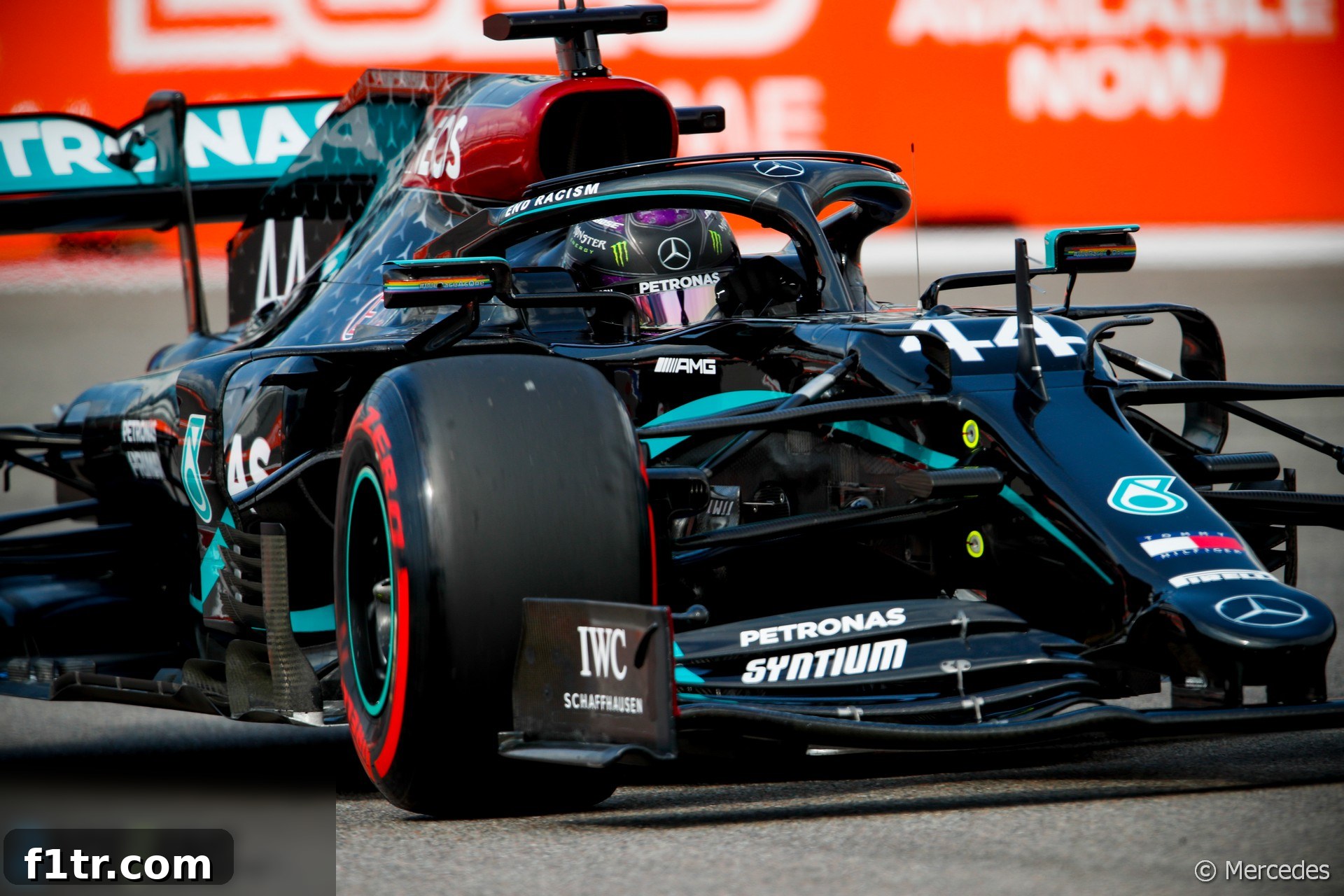
In a turn of events that sparked significant debate within the Formula 1 paddock, Lewis Hamilton, the dominant Mercedes driver, initially faced a penalty of two points on his super licence and two five-second time penalties during the 2020 Russian Grand Prix. These sanctions were imposed for alleged violations related to pre-race practice starts, specifically for performing them outside the designated zone as stipulated by the race director’s instructions. This incident, while seemingly minor, brought into sharp focus the intricate details of F1 regulations, the role of race stewards, and the ever-present pressure on championship contenders.
The controversy unfolded during Hamilton’s reconnaissance laps leading up to the Russian Grand Prix. Stewards observed the seven-time world champion conducting practice starts near the end of the pit lane exit, a location explicitly prohibited for such maneuvers. The official event notes, particularly item 19.1, clearly define the solitary permissible spot for practice starts: “on the right hand side” after the pit exit lights, distinct from the main track. This designated area, critical for ensuring safety and fair play, had been communicated to all teams and drivers, with adherence expected without exception. Hamilton’s choice to perform these starts in a non-compliant area led to the swift intervention of the race stewards.
Understanding the F1 Penalty Point System
The penalty point system in Formula 1 was introduced in 2014 with the clear objective of encouraging safer and more disciplined driving among competitors. Each driver holds a super licence, and accumulating penalty points on this licence can lead to severe consequences, including race bans. The system is designed to track a driver’s infractions over a 12-month rolling period. Should a driver accumulate 12 penalty points within this timeframe, they automatically incur a one-race suspension, a critical deterrent in a championship where every race counts.
Since its inception, the system has been a subject of ongoing discussion, with debates often centering on the consistency and proportionality of penalties. Drivers and teams alike are acutely aware of the delicate balance between aggressive racing and adhering to strict regulations. Historically, reaching a high number of penalty points has been rare in F1, underlining the gravity of Hamilton’s situation at the time of the Russian Grand Prix incident.
Before the stewards’ subsequent review, the two penalty points initially awarded for the practice start violations moved Hamilton’s total to an alarming 10 points within the current 12-month period. This placed him precariously close to the 12-point threshold that triggers an automatic race ban, a scenario no F1 driver had experienced since the system’s introduction. While Sebastian Vettel and Daniil Kvyat had previously reached 10 points, none had ever crossed the line into a suspension. This highlighted the immense pressure on Hamilton, not just from his competitors on track but also from the regulatory body.
For context, the system’s impact has been felt more acutely in feeder series. For instance, in Formula 2, driver Mahaveer Raghunathan famously accumulated 12 points on two separate occasions in 2019. However, due to a complex loophole in the regulations, he only served one ban, illustrating the intricacies and sometimes perceived inconsistencies within motorsport’s penalty framework across different categories.
Hamilton’s Immediate Reaction and Initial Consequences
Beyond the penalty points, Hamilton was also handed two five-second time penalties for his infringements, one for each illegal practice start. These penalties were to be served during his pit stop in the race, or added to his total race time if he didn’t pit. Upon being informed of the time penalties over the team radio, Hamilton’s frustration was palpable. He famously quipped, “Anything to slow me down,” a remark that quickly resonated with fans and media, highlighting his belief that the penalties were unduly harsh or perhaps strategically aimed at hindering his championship charge. Despite his evident displeasure, he added, “But it’s OK, I can take it,” displaying his characteristic resilience and determination to overcome adversity on track.
The immediate impact of these time penalties was significant. They fundamentally altered his race strategy and ultimately hampered his efforts to secure victory at the Russian Grand Prix. While his driving prowess often allowed him to recover from such setbacks, the incident cast a shadow over his performance and reignited discussions about the fairness and interpretation of F1’s extensive rulebook.
Hamilton’s Penalty Point Accumulation (Prior to Reversal)
To provide a clear picture of Lewis Hamilton’s penalty point history leading up to and including the initial decision at the 2020 Russian Grand Prix, the following table details the infractions that contributed to his cumulative total:
| Date | Incident Description | Penalty Imposed | Penalty Points Awarded |
|---|---|---|---|
| 17/11/2019 | Involved in an incident with Alexander Albon | Five-second time penalty | 2 |
| 5/7/2020 | Speeding under yellow flags | Three-place grid drop | 2 |
| 5/7/2020 | Involved in an incident with Alexander Albon | Five-second time penalty | 2 |
| 6/9/2020 | Entered a closed pit lane | 10-second stop-go penalty | 2 |
| 27/9/2020 | Performed practice start outside designated zone (Incident 1) | Five-second time penalty | 1 |
| 27/9/2020 | Performed practice start outside designated zone (Incident 2) | Five-second time penalty | 1 |
As per the initial ruling, these six incidents would have brought Hamilton’s total penalty points to 10, bringing him to the brink of a race ban.
Update: Stewards Revoke Penalty Points
In a significant development that underscored the dynamic nature of F1 stewarding, a subsequent review by the race stewards led to the cancellation of Hamilton’s two penalty points for the practice start violations. This decision, announced shortly after the initial penalties were handed down, was a rare but not unprecedented occurrence in Formula 1, often following further analysis of telemetry data, driver explanations, or clarification of race director instructions. While the two five-second time penalties remained, significantly affecting his race result, the removal of the penalty points was a crucial reprieve for Hamilton’s championship aspirations. It immediately reduced his accumulated points back to 8, moving him away from the precipice of a one-race suspension.
The rationale behind the stewards’ reversal often involves a deeper dive into the specifics of the incident, driver intent, and potential ambiguities in the regulations or their communication. Such instances spark broader discussions within the F1 community regarding the consistency of stewarding decisions and the process for appealing or reviewing penalties. While the initial ruling created a storm, the reversal brought a sense of relief to Hamilton and his team, allowing them to focus on the remaining races without the immediate threat of a ban looming over them. This incident, therefore, served as a potent reminder of the complexities of F1 regulations and the rigorous scrutiny applied to every aspect of competition.
This reversal highlighted the ongoing dialogue between drivers, teams, and the FIA regarding the interpretation and application of rules, ensuring that decisions are as fair and consistent as possible within the high-stakes environment of Formula 1. Ultimately, while the time penalties impacted Hamilton’s performance in the Russian Grand Prix, the cancellation of the penalty points averted a much more severe consequence for his championship campaign.
***
If you enjoy our in-depth F1 analysis and want to support independent motorsport journalism, consider becoming a RaceFans supporter. You can go ad-free and get exclusive benefits by supporting us today.
Further Reading: 2020 Russian Grand Prix
- Despite F1 drivers’ concerns, stewards don’t give penalty points for “minor infringements”
- 2020 Russian Grand Prix Star Performers
- “Slower” Ferrari only beat us because of Q3 tyre rule – Tost
- “I may not always get it right” says Hamilton after penalty criticism
- Why did the stewards make their second U-turn this year on a Hamilton penalty call?
Browse all 2020 Russian Grand Prix articles