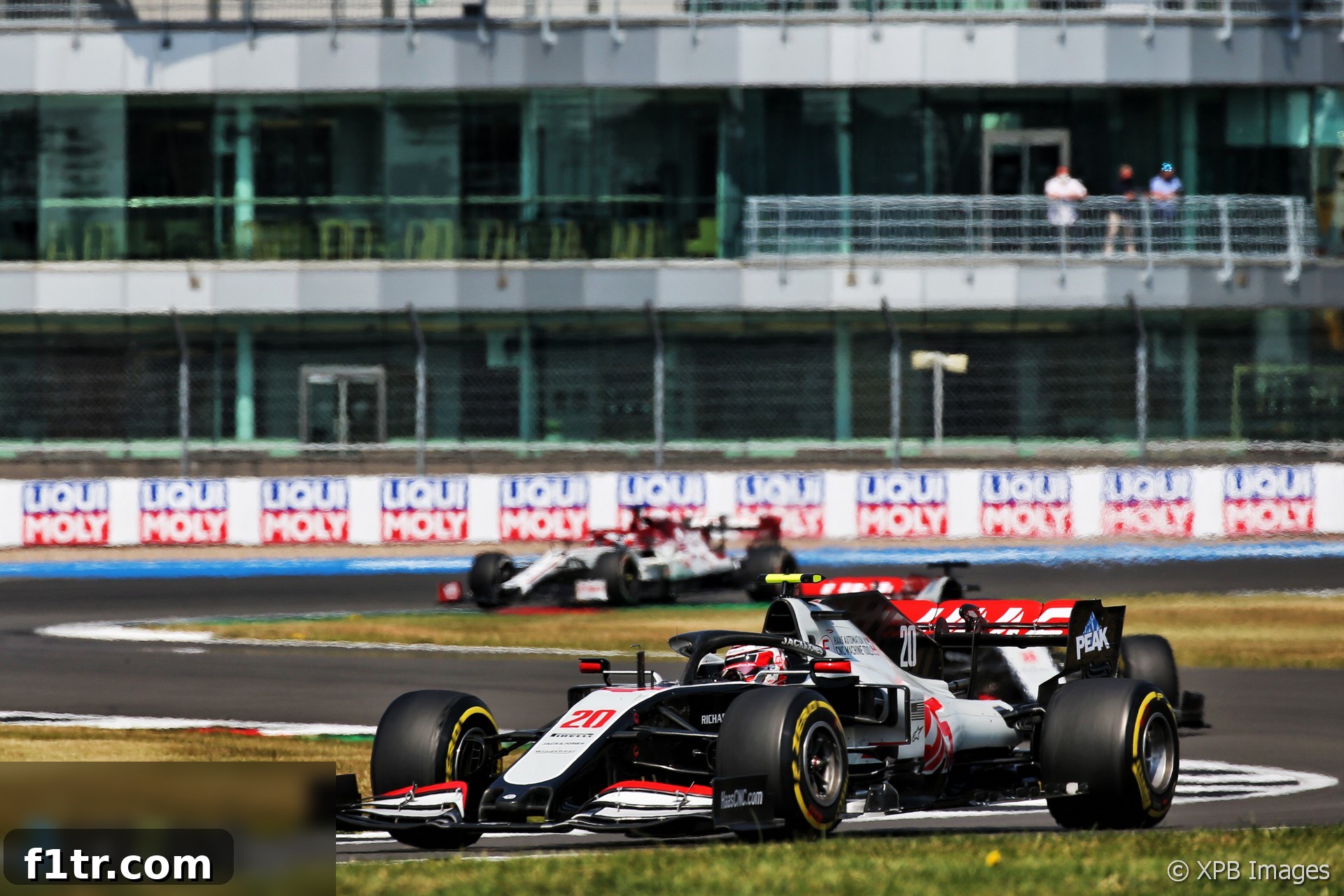
In a pivotal moment during the fiercely contested British Grand Prix at Silverstone, Haas driver Kevin Magnussen found himself under the scrutiny of the race stewards, ultimately receiving a penalty for an incident involving Williams’ Nicholas Latifi. The clash, which occurred at the high-speed Stowe corner, resulted in Magnussen being handed a five-second time penalty during the race and, more significantly, two penalty points on his Super Licence. This decision sparked considerable discussion among fans and pundits, highlighting the delicate balance between aggressive racing and adherence to Formula 1’s stringent rules on track limits and driver conduct.
The incident unfolded on what was already proving to be a challenging afternoon for many drivers during the 2020 Formula 1 season. As the British Grand Prix roared through its initial laps, intense wheel-to-wheel battles were commonplace across the iconic Silverstone circuit. It was during one such skirmish that Magnussen and Latifi came into contact. Nicholas Latifi, in his Williams Racing car, was attempting an overtake on the inside of Magnussen’s Haas F1 Team entry at Turn 15, commonly known as Stowe. This corner is renowned for its high-speed entry and crucial exit, making any defensive or offensive manoeuvre particularly fraught with risk and requiring absolute precision from the drivers.
According to reports and the official statement from the race stewards, Magnussen ran wide at the exit of the corner, leading him to momentarily leave the track boundaries. The contentious part of the manoeuvre arose when the Danish driver then rejoined the racing surface. The stewards deemed this rejoining action to be “aggressive,” resulting in contact with Latifi’s car. This contact, while not immediately race-ending for either driver, significantly impacted the trajectory and momentum of both vehicles, potentially compromising their subsequent race pace and positions. Such incidents often raise questions about driver conduct and the definition of a fair fight on track.
The race stewards wasted no time in investigating the matter. Utilizing a comprehensive array of data sources, including multiple video replays from various camera angles around the circuit, crucial onboard camera footage from both cars, and detailed telemetry data, they meticulously pieced together the sequence of events. Their findings confirmed that Magnussen had indeed left the track unnecessarily. Crucially, they determined that by leaving the track, Magnussen was able to maintain his position against Latifi, effectively gaining an unfair advantage before then rejoining the track in a manner that created an avoidable collision. The review process in Formula 1 is designed to ensure maximum fairness and safety, with stewards carefully weighing all available evidence before making a ruling.
Their official statement provided a clear rationale for the penalty: “Latifi was making a pass on the inside of Magnussen at turn 15. The stewards determined that at the exit of the corner, Magnussen left the track unnecessarily and then re-joined the track aggressively, striking Latifi’s car. Compounding this, the stewards felt that by leaving the track Magnussen was able to maintain his position.” This detailed explanation underscored the two-fold nature of Magnussen’s infringement: first, gaining an advantage by exceeding track limits, and second, an unsafe and aggressive rejoin that directly led to contact. This particular incident highlighted the importance of adhering to track limits not just for speed, but also for maintaining competitive fairness and avoiding dangerous situations.
The immediate consequence of the ruling was the five-second time penalty, which was applied during the race, affecting Magnussen’s final classification. However, the accompanying two penalty points on his Super Licence carry a longer-term implication within the world of Formula 1. This system is meticulously designed to monitor and manage driver conduct over a rolling 12-month period, ensuring a consistent standard of driving safety and sportsmanship. Accumulating 12 penalty points within this timeframe results in an automatic one-race ban, a severe sanction that can significantly disrupt a driver’s championship aspirations and team dynamics. With these two new points, Kevin Magnussen’s total tally now stands at three penalty points for the current 12-month period. While three points are far from the threshold for a ban, it serves as a crucial reminder for drivers to exercise caution and adhere strictly to the rules, as further incidents could swiftly bring them closer to a compulsory absence from a Grand Prix weekend. This system ensures that repeat offenders are held accountable and that standards of safe and fair racing are maintained across the grid, promoting responsible driving behavior at the pinnacle of motorsport.
For Magnussen and the Haas F1 Team, this penalty added another layer of complexity to an already challenging 2020 Formula 1 season. Haas, like many midfield teams, operates on fine margins, and any incident, penalty, or compromised race result can have significant consequences for their championship aspirations and financial standing. The additional penalty points are a concern not just for Magnussen personally, but also for the team, as losing a key driver for a race weekend can severely impact their performance and strategic planning. Magnussen’s aggressive driving style, while often praised for its tenacity and entertainment value and a characteristic of his competitive spirit, occasionally pushes the boundaries of what is acceptable within the sporting regulations. This incident at Stowe provided a clear example of where that boundary was deemed to have been crossed by the meticulous scrutiny of the race stewards.
From Nicholas Latifi’s perspective, the incident was undoubtedly frustrating and disruptive to his race. As a rookie driver, gaining experience, building confidence, and demonstrating consistent performance are paramount to establishing a long-term career in Formula 1. Unnecessary contact with competitors, particularly when the other party is deemed at fault, disrupts race rhythm, can lead to lost track positions, and even cause car damage, hindering a driver’s ability to maximize their potential in a race. Williams Racing, perpetually battling at the back of the grid during this period, can ill afford any setbacks that further compromise their already difficult fight for points and improved performance. Every position gained or lost, and every bit of damage sustained, has magnified importance for teams striving to climb the competitive ladder.
The decision also reignited broader debates within the Formula 1 community regarding the consistency of stewarding decisions and the interpretation of “track limits” and “aggressive driving.” While drivers and teams often voice their opinions on the subjectivity of certain rulings, the FIA stewards are tasked with making swift, informed decisions under immense pressure, utilizing the best available technology and a strict application of the sporting regulations. Incidents like Magnussen’s serve as critical case studies, shaping future interpretations and setting precedents for how similar situations will be adjudicated in subsequent races. The ongoing dialogue surrounding these decisions is a testament to the high standards and intense scrutiny under which Formula 1 operates, aiming to ensure fair play and safety at all times.
Ultimately, the incident at Stowe between Kevin Magnussen and Nicholas Latifi was a microcosm of the intense, high-stakes nature of Formula 1 racing. It underscored the importance of precision, strict adherence to rules, and the fine line between bold, assertive racing and rule infringements that compromise safety or fairness. For Magnussen, the two penalty points are a clear signal from the authorities to exercise greater caution, ensuring that his undeniable fighting spirit remains within the bounds of fair play as defined by the FIA sporting regulations. As the 2020 F1 season progressed, every point, every position, and every penalty became increasingly significant in the broader championship narrative, making such decisions critical for all involved in the fiercely competitive world of Formula 1. This incident serves as a lasting reminder of the constant vigilance required from drivers and the unwavering commitment of the stewards to uphold the integrity of the sport.
2020 F1 Season: Key Moments and Developments
The 2020 Formula 1 season was an unprecedented year, heavily impacted by global events, leading to a condensed and reshuffled calendar. Despite the challenges, it delivered plenty of on-track drama, record-breaking achievements, and intense competition. Drivers and teams had to adapt quickly to new protocols and a relentless schedule, making every Grand Prix a crucial test of endurance and skill. The season saw remarkable performances, surprising upsets, and the continued dominance of certain individuals and constructors, alongside thrilling battles in the midfield and at the back of the grid. Incidents like the one involving Magnussen and Latifi, while seemingly minor in the grand scheme, contributed to the rich tapestry of the season’s unfolding narrative, highlighting the constant pressure and competitive spirit inherent in Formula 1 racing.
- Grosjean to make F1 test return tomorrow for first time since Bahrain horror crash
- Pictures: Wrecked chassis from Grosjean’s Bahrain fireball crash to go on display
- Bottas vs Rosberg: Hamilton’s Mercedes team mates compared after 78 races each
- F1 revenues fell by $877 million in Covid-struck 2020 season
- Hamilton and Mercedes finally announce new deal for 2021 season
Browse all 2020 F1 season articles