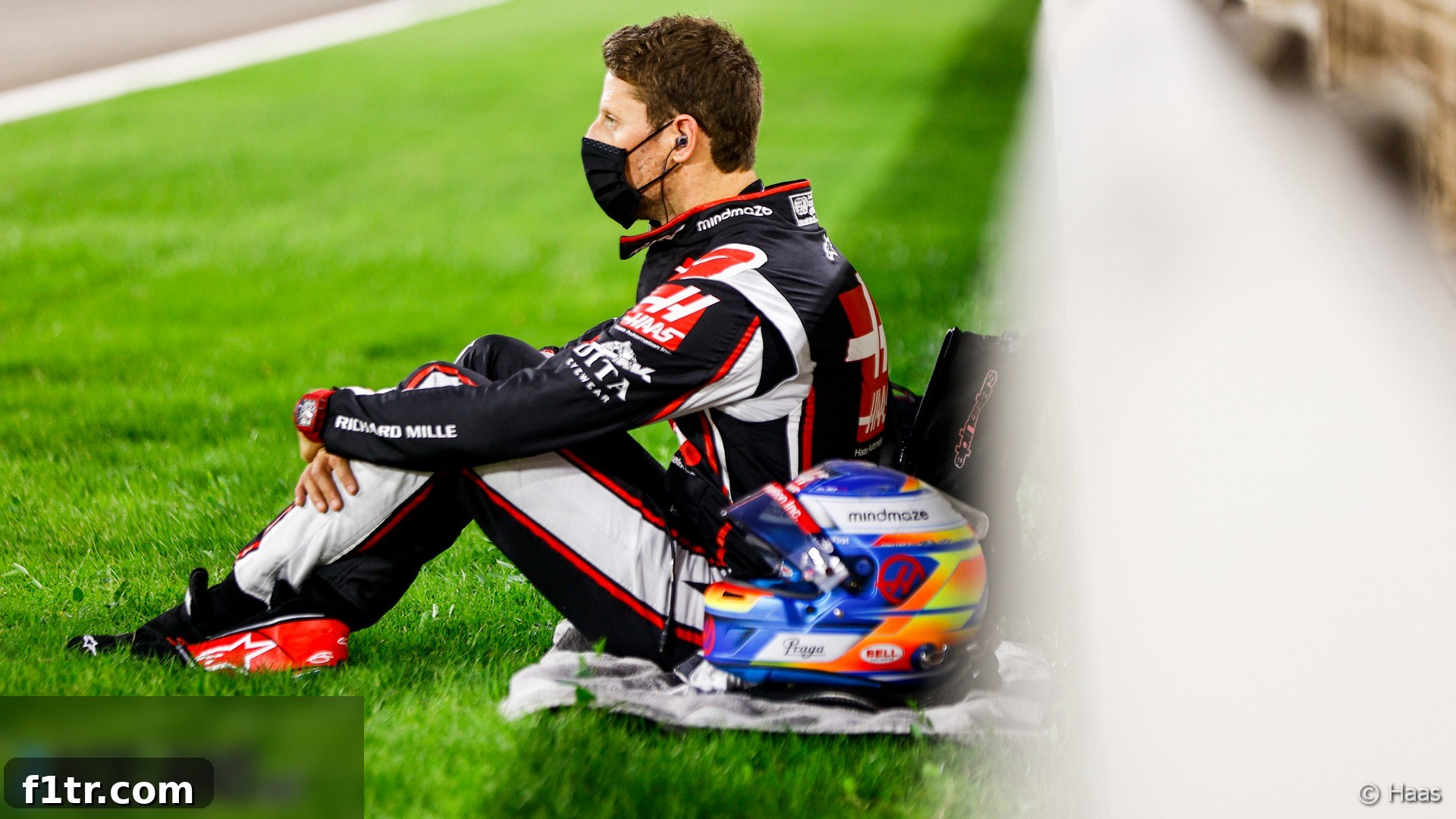
In the terrifying inferno that engulfed his Haas VF-20 following a catastrophic 53G impact at the 2020 Bahrain Grand Prix, Formula 1 driver Romain Grosjean endured a harrowing 28-second struggle to extricate himself from the wreckage. What felt like an eternity for Grosjean and millions watching worldwide was, in fact, a testament to decades of relentless innovation in motorsport safety. His miraculous escape from the fiery crash, with relatively minor injuries, underscored the critical role played by advanced driver safety equipment, particularly his crash helmet, supplied by Bell.
Advert | Become a Supporter & go ad-free
At the heart of a racing driver’s protection lies their helmet, designed to withstand extreme forces, high temperatures, and the unpredictable hazards of competitive motorsport. Grosjean’s Bell helmet, similar to those worn by many other drivers on the grid, performed beyond expectations in an incident that initially seemed unsurvivable. Bell CEO Stephane Cohen confirmed in an interview with RaceFans that the manufacturer’s initial inspection revealed the helmet’s interior and exterior “performed exactly as it was expected to perform in such circumstances,” a remarkable outcome given the severity of the crash and the prolonged exposure to fire.
One of the most striking images from the crash footage was Grosjean emerging with an opaque visor, leading many to believe it had melted from the intense heat. However, Cohen clarified this misconception, explaining that it was the tear-off strips, applied to the external side of the visor for clear vision during a race, that had succumbed to the flames. “In terms of the fire resistance everything behaved normally,” he stated. “The visor was perfectly fine. The only thing that melted were the tear-offs that were stuck on the external side of the visor. That rendered the visor quite opaque, especially on the left side of the helmet when the fire was coming.” This detail highlights the sophisticated layering of protection and the subtle yet crucial distinctions in how different components react under extreme stress.
Grosjean himself recounted the desperate struggle, requiring three attempts to free himself from the burning chassis. During those critical seconds, he faced not only the immediate threat of extreme heat but also the insidious danger of smouldering particles, ash, and toxic fumes. The helmet, working in conjunction with his multi-layered fireproof racing suit, provided essential respiratory protection, preventing the kind of severe lung damage that tragically affected Niki Lauda during his horrific Nurburgring crash in 1976. This historical comparison powerfully illustrates the monumental leaps made in driver safety equipment over four decades.
Advert | Become a RaceFans supporter andgo ad-free
Stephane Cohen expressed immense pride in the helmet’s performance in this specific aspect of fire and inhalation protection. “Once you are standing still there is very little circulation of air coming from outside to the inside of the helmet which is a very important area for us. That’s where Bell can proudly say that not only do we meet but we exceed the standard expectation.” He emphasized the critical importance of preventing the inhalation of hot gases and vaporized fumes, which could cause irreparable lung damage. “Because in this kind of accident, when you stay more than 25 seconds in the fire, you’re liable to inhale some hot gases, vapour fumes that will create lung damage. And it didn’t happen. Nothing went inside the helmet. So we are very happy with the way the helmet performed in these unexpected conditions.” This highlights the meticulous engineering and advanced material science that goes into modern F1 helmets, designed to create a self-contained protective environment even in the most extreme circumstances.
Romain Grosjean’s remarkable survival is a compelling testament to a multitude of safety advancements, with his helmet playing a pivotal role. The incident immediately prompted a thorough investigation by the FIA, Formula 1’s governing body, whose experts meticulously analyzed every piece of evidence, including the remains of the helmet and chassis. The goal of such investigations is always to understand the precise sequence of events, identify any potential weaknesses, and implement further improvements to safeguard drivers in future incidents. This continuous cycle of accident analysis and safety enhancement is a cornerstone of modern motorsport, ensuring that lessons learned from every major incident contribute to an ever-safer sport.
Cohen reiterated the collective sense of achievement within the motorsport safety community. “As a community – the FIA, the helmet manufacturers and everybody involved in safety – we can be proud that although there was a massive deceleration, Romain was always conscious.” The ability of the helmet to absorb such a severe impact (53G) without rendering the driver unconscious was paramount. “He wasn’t knocked out by the impact and he was able to walk out of the car, as everybody knows. Can you imagine if he had been unconscious? It would have been a totally different result.” Driver consciousness is a critical factor in self-extrication, allowing the driver to react and escape dangerous situations, particularly fires. This underscores the comprehensive nature of F1 safety, where every component, from the helmet to the survival cell, is designed to ensure the driver remains as protected and aware as possible.
Grosjean’s crash also highlighted the efficacy of other integral safety features in Formula 1. The survival cell, the rigid structure surrounding the driver, remained largely intact despite the car splitting in half. The HANS (Head and Neck Support) device limited head movement during the deceleration, preventing severe neck injuries. Even the controversial HALO device, while not directly impacting the fire, provided crucial structural integrity, likely preventing more severe head trauma from barrier impacts during the initial crash. Furthermore, the rapid response of the medical team, led by Dr. Ian Roberts and Alan van der Merwe, was instrumental in getting to Grosjean within seconds, ready to administer aid. This multi-layered approach to safety, involving everything from advanced materials to highly trained personnel, collectively contributed to averting a tragedy.
Advert | Become a RaceFans supporter andgo ad-free
The remarkable outcome of Romain Grosjean’s fiery crash serves as a powerful validation of the relentless pursuit of safety in Formula 1. It showcased how cutting-edge technology, rigorous testing, and a collective commitment from organizations like the FIA and manufacturers such as Bell, can turn a potentially fatal incident into a story of incredible survival. His helmet, a marvel of engineering, stood as a silent guardian, demonstrating its indispensable role in protecting life when all other elements seemed to conspire against it. The lessons learned from Bahrain will undoubtedly continue to shape the future of motorsport safety, ensuring that every driver can push the limits of performance with the utmost confidence in their protective gear.
Join the RaceFans Supporters Drive!
If you’ve valued RaceFans’ comprehensive motor sport coverage throughout 2020, we invite you to take a moment and discover more about our Supporter Drive.
Our objective is to welcome 3,000 new Supporters to help sustain RaceFans, enabling us to continue delivering high-quality, original, and independent motorsport coverage. Learn more about our mission, what we’re striving for, and how you can contribute by signing up:
- Join the RaceFans Supporters Drive and support independent motorsport journalism!
Further Reading: The 2020 F1 Season & Beyond
- Grosjean set for emotional F1 test return tomorrow, first time since Bahrain horror crash
- Pictures: Wrecked chassis from Grosjean’s Bahrain fireball crash to go on public display
- Bottas vs Rosberg: Comparing Hamilton’s Mercedes team mates after 78 races each
- F1 revenues plummeted by $877 million during the Covid-affected 2020 season
- Hamilton and Mercedes officially confirm new deal for 2021 season
Browse all articles related to the 2020 F1 season