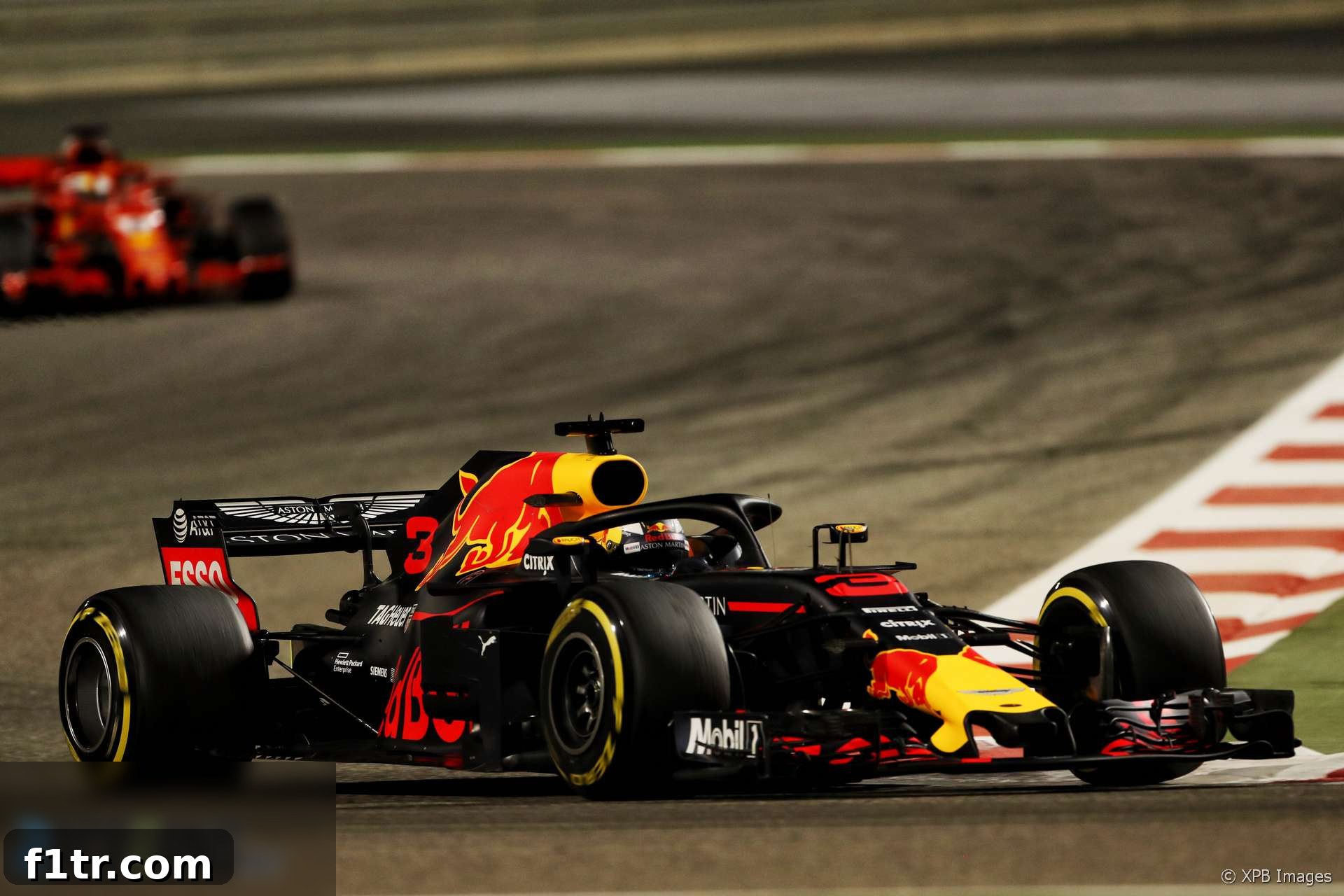
Daniel Ricciardo, one of Formula 1’s most revered and charismatic drivers, offered a refreshingly honest perspective on Red Bull Racing’s qualifying session at the 2018 Bahrain Grand Prix. Despite navigating his RB14 machine to a highly competitive grid slot, placing him within a mere half-second of the pole position, Ricciardo was resolute in his assessment: Red Bull simply lacked the fundamental pace to truly contend for the top spot. His insights provided a vivid snapshot of the intricate dance between driver skill, car performance, and the relentless competitive landscape of Formula 1.
The Pursuit of Pole: A Close Battle, Yet a Clear Gap
The Bahrain International Circuit is known for its demanding layout, combining high-speed straights with technical sections, making it a true test of a car’s overall package. In the intense Q3 session, Ricciardo initially looked like a genuine threat, clocking a lap that placed him just three-tenths of a second away from provisional pole. This incredibly tight margin underscored his ability to extract every ounce of performance from the car. However, as the session progressed and competitors unleashed their ultimate qualifying pace, the gap to the front-runners, notably Ferrari and Mercedes, became more pronounced.
Ricciardo’s subsequent run, though robust, saw him drop further back, solidifying his belief that even an impeccably executed lap wouldn’t have been sufficient to claim pole position. “I guess part of me is frustrated because I’m still on the tail of that pack,” Ricciardo commented, reflecting on the qualifying outcome. “And you look at four tenths and [think] it’s only four tenths but realistically I didn’t lose pole today, personally. The middle sector on my last lap was a tenth or two slower, I could have been maybe a tenth up the road but it still didn’t change the outcome.” This statement is crucial, as it separates driver performance from car capability. Ricciardo was confident he had delivered close to his maximum, implying the deficit was inherent in the machinery, especially when pitted against the raw power of the Ferrari and Mercedes engines.
Tight Margins and High Hopes: The Competitive Thrill
The 2018 Formula 1 season was already showcasing an intense rivalry between three top teams, and Bahrain’s qualifying only amplified this narrative. The fact that the top five cars were separated by just four-tenths of a second was a testament to the era’s fierce competition and the drivers’ exceptional talent. For Ricciardo, this closeness was a source of excitement, promising an enthralling race. “Generally I was pretty happy with it and to see the top five around four tenths its been a while since we saw that. Hopefully it stays like that in the race, we can bang wheels and have some fun.” His characteristic optimism shone through, anticipating fierce on-track duels where driver bravery and strategic prowess would be paramount.
However, beneath the surface of thrilling proximity, lay the cold hard facts of Formula 1 engineering. Red Bull’s chassis, renowned for its aerodynamic brilliance and exceptional handling through corners, consistently faced the challenge of a power unit that couldn’t quite match the output of its Ferrari and Mercedes counterparts. This power deficit was particularly magnified on circuits like Bahrain, with its long, high-speed straights that demand peak engine performance, often exposing the Achilles’ heel of the Red Bull package.
Rival Analysis: Ferrari’s Consistency and Mercedes’ Enigma
Ricciardo’s observations extended to his rivals, providing an interesting window into the perceived strengths and weaknesses of the other front-running teams. He admitted to not being surprised by Ferrari’s impressive pace around the Bahrain International Circuit, acknowledging the Italian team’s historical strength at the venue. “I’m not surprised Ferrari’s quick around here – weirdly it’s always been a strong track for them, at least from my memory.” This recognition highlights how certain tracks can inherently suit a particular car’s characteristics or a team’s operational philosophy, be it through tire management, aero balance, or power delivery strategies.
Conversely, the performance of Mercedes, the reigning constructors’ champions, presented a more puzzling picture for the Australian driver. The Silver Arrows, typically formidable in qualifying, seemed to be battling more than anticipated throughout the weekend. “But I thought Mercedes would’ve been quicker in quali. Looked like they were struggling a bit throughout the weekend for their standards. I thought in quali they would’ve turned it up.” This comment naturally led to speculation about the use of specific “qualifying modes” – high-power engine settings deployed for a single lap – which teams often reserve for the most critical moments. Ricciardo even mused about a potential strategic play from Mercedes, suggesting they might have intentionally held back. “Maybe they chose not to use that mode this weekend to take the attention off, maybe they’re just playing the game.” While purely speculative, such theories underscore the high-stakes chess match that often unfolds behind the scenes in Formula 1, where perception and psychological warfare can be as important as raw speed.
Red Bull’s Sectoral Breakdown: The Engine vs. Chassis Conundrum
The core of Red Bull’s qualifying challenge, according to Ricciardo’s granular analysis, was largely confined to specific sections of the track. The most significant time loss was observed in Sector 1, a segment characterized by two long straights where maximum engine power is the dominant performance differentiator. “I guess we lose all our time in sector one. I think they were doing 27.9 or 28.0 and I was like a 28.3. Most of the lap time was there.” This specific numerical comparison laid bare the stark reality of Red Bull’s power unit deficit, demonstrating how a significant portion of a lap’s time could be surrendered purely due to straight-line speed.
However, the narrative shifted dramatically in the subsequent sectors. “I think second and third sector we’re pretty close. It’s encouraging, the car seems decent, like it was in Melbourne, the chassis seems alright.” Sectors 2 and 3 of the Bahrain track are more intricate and winding, placing a greater emphasis on aerodynamic efficiency, mechanical grip, and transient responses – areas where Red Bull’s Adrian Newey-designed chassis typically excelled. Ricciardo’s positive feedback on the car’s balance and handling in these technical sections reaffirmed the team’s strong foundation in chassis development. This consistent pattern of strong cornering performance offset by straight-line speed limitations became a defining characteristic of Red Bull’s challenge during the V6 hybrid era.
Race Day Dynamics: The Equalizing Effect of Engine Modes
One of the most keenly discussed aspects of Formula 1 in 2018 was the distinction between qualifying engine performance and race-day engine settings. Teams often employed aggressive, short-burst “quali modes” that extracted maximum power for a single lap but were either unsustainable or prohibited for the full race distance due to concerns about reliability or fuel consumption. Ricciardo placed considerable hope on the absence of these extreme settings for Sunday’s race, anticipating a more level playing field.
“With the engines not using quali mode tomorrow I would hope that it brings it really close,” he declared. The expectation was that a more uniform engine performance across the grid, without the peak power advantage seen in qualifying, would allow Red Bull’s strong chassis and aerodynamic package to shine more brightly. This potential equalization of power output could transform the Bahrain Grand Prix into a tactical battle, where tire management, race strategy, and driver skill would become even more pivotal. For Daniel Ricciardo and his teammate Max Verstappen, a reduced power differential offered a tangible opportunity to challenge for podium finishes or even a coveted victory against their formidable Ferrari and Mercedes rivals. The strategic implications of engine modes were, therefore, a crucial element in Red Bull’s race weekend planning and a significant source of optimism for Ricciardo.
In conclusion, Daniel Ricciardo’s articulate and insightful comments from Bahrain qualifying provided a comprehensive overview of Red Bull Racing’s standing in the fiercely competitive 2018 Formula 1 season. While the team boasted a world-class driver and an aerodynamically potent chassis, the persistent power unit deficit remained a formidable obstacle to outright pole position. Yet, his perspective was one of determined optimism, focusing on the potential for a more compressed and exciting race thanks to the dynamic changes in engine modes, setting the stage for what promised to be a thrilling Bahrain Grand Prix weekend.
Go ad-free for just £1 per month>> Find out more and sign up
2018 F1 season
- F1 feared “death knell” for Drive to Survive after Ferrari and Mercedes snub
- McLaren staff told us we were “totally crazy” to take Honda engines in 2018 – Tost
- ‘It doesn’t matter if we start last’: How Red Bull’s junior team aided Honda’s leap forward
- Honda’s jet division helped F1 engineers solve power unit problem
- McLaren Racing losses rise after Honda split
Browse all 2018 F1 season articles