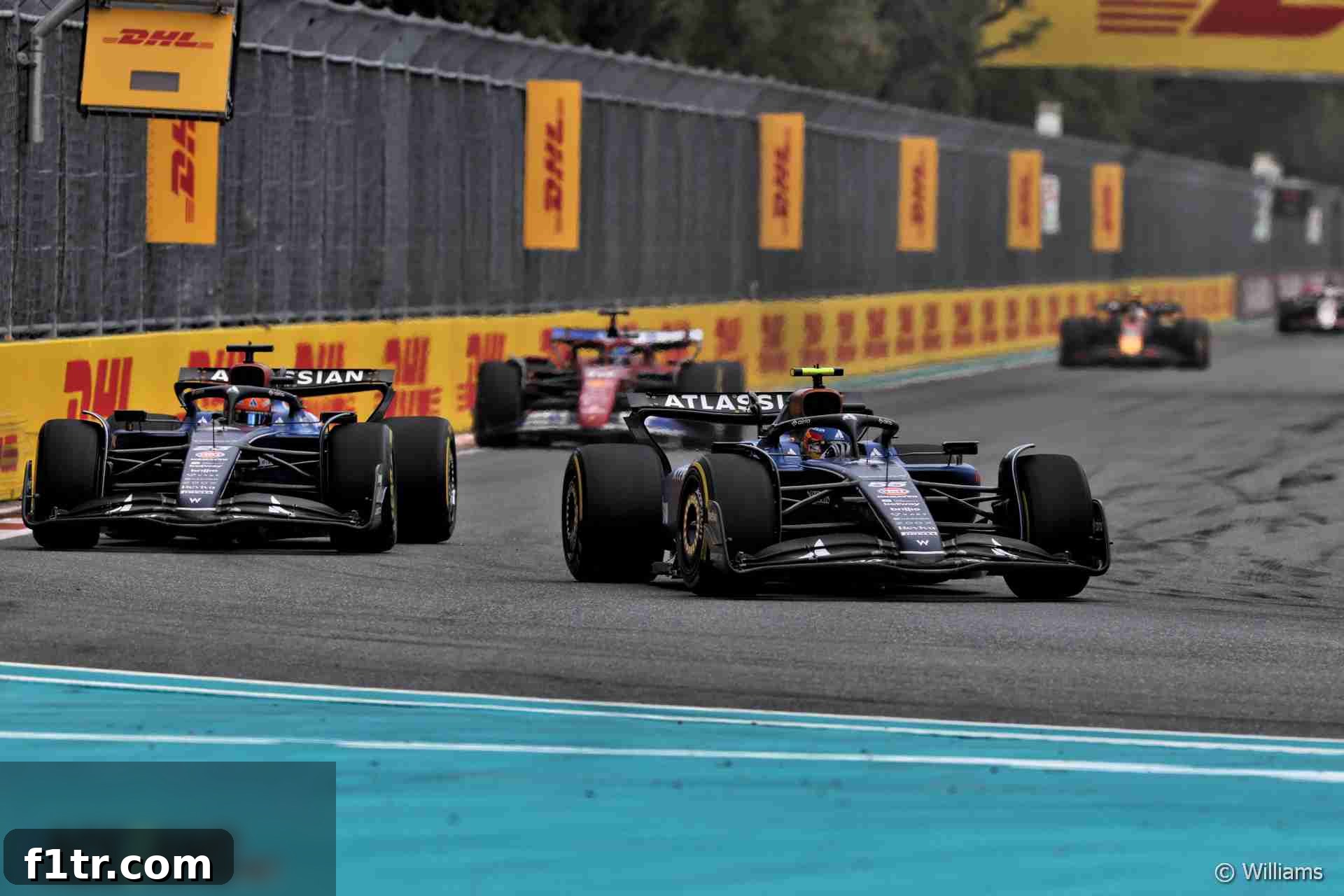
The thrilling spectacle of Formula 1 often brings moments of high drama, not just on the track, but also within the teams themselves. Such was the case at the Miami Grand Prix, where a seemingly straightforward on-track manoeuvre by Alexander Albon on his Williams teammate Carlos Sainz Jnr ignited a fierce radio exchange and sparked considerable debate. Williams team principal James Vowles has since offered a comprehensive explanation for the confusion, shedding light on the communication breakdown that led to Sainz’s critical radio messages and his subsequent disillusionment.
Advert | Become a Supporter & go ad-free
The incident unfolded when Alexander Albon, in a commendable drive, found himself in a position to overtake Carlos Sainz Jnr. As Albon made his move, Sainz was under the distinct impression that his teammate had been instructed not to pass. This belief was rooted in previous team communications, leading to a palpable sense of frustration and bewilderment from the Spanish driver. Albon ultimately finished an impressive fifth, securing valuable points for Williams, while Sainz crossed the line in ninth, clearly hampered and disheartened by the events.
The immediate aftermath of Albon’s pass saw a heated exchange on the Williams team radio. “You told me he’s been told,” Sainz retorted to his race engineer, Gaetan Jego, reflecting his disbelief and anger. Jego’s reply, “I know, let’s be the bigger one, okay?” did little to quell Sainz’s rising temper, instead hinting at an underlying issue that was not immediately apparent to the driver. Post-race, Sainz’s frustration boiled over. “That’s not how I go racing, guys,” he lamented, his voice tinged with disappointment. “I don’t care. I’ve lost a lot of confidence here on everything.” This candid outburst underscored the depth of his feeling, indicating a breach of trust or understanding within the team dynamics that threatened to overshadow the racing performance.
James Vowles, known for his transparent and analytical approach, openly admitted that the situation was “the part that frustrated me the most from the race weekend.” His acknowledgment highlighted the severity of the communication lapse and the significant impact it had on the drivers and the team’s morale. Vowles’ detailed explanation, later released in a video by the team, provided crucial context that was missing for Sainz during the heat of the race.
According to Vowles, Albon’s car was grappling with an overheating issue, a critical problem that could lead to significant reliability concerns or even retirement if not addressed promptly. To mitigate this, the team decided to instruct their drivers to maintain a specific distance from each other, allowing Albon’s car to get some much-needed airflow into its radiators. “A message was communicated to both race engineers, effectively that Alex had a reliability problem and we needed to get some air into the radiators,” Vowles explained. “That was communicated to both with the decision of just making a little gap between the cars for the time being to make sure we do that.”
Advert | Become a RaceFans supporter andgo ad-free
However, the execution of this crucial instruction was deeply flawed. Vowles conceded that “that message wasn’t clear in its construct. It wasn’t even clear on whether overtaking was possible or not. The primary function is getting the car cool to move forward.” This lack of clarity proved to be the root cause of the entire misunderstanding. In the high-stakes, rapid-fire environment of an F1 race, ambiguous instructions can have immediate and far-reaching consequences, leading to misinterpretations that undermine driver confidence and team cohesion.
The true complexity of the communication breakdown became evident when comparing the messages received by each driver. “To Carlos the message was communicated: ‘Alex won’t attack you’,” Vowles revealed, clearly outlining why Sainz felt betrayed. Conversely, Albon was indeed told he wasn’t to overtake Sainz, but critically, this instruction arrived only once his DRS (Drag Reduction System) was already open and he was effectively alongside Sainz, in the process of completing the overtake. This delayed and poorly timed communication meant that by the time Albon received the ‘no overtake’ order, the action was already in motion. Therefore, as Vowles emphatically stated, “this isn’t Alex going against team orders, this is on us as a team as an organisation to significantly tighten up how we communicate to the engineers and how quickly we communicate to the drivers.” This admission of organizational responsibility is a crucial step towards preventing future recurrences and rebuilding trust.
Vowles, a seasoned figure in Formula 1 with a reputation for meticulous detail, expressed his determination to avoid any repeat of such communication failures. “What I can assure everyone is it simply won’t happen again,” he declared, signaling a clear commitment to reviewing and refining Williams’ internal communication protocols. In a sport where milliseconds and clear instructions can mean the difference between victory and defeat, ensuring seamless and unambiguous information flow is paramount. This incident, while regrettable, serves as a stark reminder of the pressures and complexities involved in real-time F1 race management.
Adding another layer to the intricate situation, Vowles also disclosed an important detail about Sainz’s car that further contextualized Albon’s ability to overtake. He admitted that even if the immediate overheating issue had been stabilized, the team would likely have inverted the cars very quickly anyway. The reason for this strategic consideration was significant: “Carlos had sustained damage from that lap one incident and it was getting worse and worse.” The damage, specifically to the floor of Sainz’s car, was progressively deteriorating his pace, making it increasingly difficult for him to maintain his position. Floor damage, often invisible to the casual observer, can severely impact a car’s aerodynamics, reducing downforce and grip, and consequently, outright speed.
Advert | Become a RaceFans supporter andgo ad-free
“We could see the floor was deteriorating, that’s part of the reason why Alex was getting closer and closer to him and able to re-overtake,” Vowles clarified. The performance loss was mounting, reaching “a couple of tenths by this point,” which in Formula 1, is a substantial amount. This revelation highlights the multi-faceted decision-making process within an F1 team, where driver performance, car reliability, and strategic imperatives all converge. Thus, while the communication around Albon’s overtake was flawed, the underlying data suggested that a change in track position was almost inevitable. “So more than likely we would have done that, but again that would be a team decision rather than a driver not expecting to be attacked.” This nuanced explanation emphasizes that while the method of position change was problematic, the outcome – Albon being ahead of Sainz – was strategically justified.
Vowles also expressed his full understanding of Sainz’s passionate reaction during and after the race. “I’d be disappointed if we didn’t have drivers being frustrated by what happens out on-track,” he remarked, acknowledging the immense dedication and emotional investment drivers pour into their sport. For a driver like Sainz, who was “there fighting for a fifth place on merit,” being caught off-guard by a teammate’s pass, especially under a perceived team order, is bound to elicit a strong emotional response. “In the circumstance where something catches you off-guard and you’re not sure whether it was the driver or anything else going on, it can frustrate you,” Vowles elaborated. However, he was quick to frame this frustration positively: “But his passion is exactly why I want him in this team and in the car.” This statement not only validates Sainz’s feelings but also reinforces Vowles’ appreciation for competitive spirit and unwavering commitment.
The team principal confirmed that extensive discussions took place following the incident. “We spent quite a bit of time post-race and again on Monday talking through it – the incident actually was just a few minutes, but more importantly [on] how we as a team move forward from that and do a better job altogether in the future.” These debriefs are crucial for team development, allowing for a thorough analysis of what went wrong, learning from mistakes, and implementing corrective measures. For Williams, a team on an upward trajectory, every lesson learned contributes to their continuous improvement and ambition to climb further up the constructors’ championship standings.
Miss nothing from RaceFans
Get a daily email with all our latest stories – and nothing else. No marketing, no ads. Sign up here:
Advert | Become a RaceFans supporter andgo ad-free
2025 Miami Grand Prix
- Nothing for Ferrari to learn from Miami team orders episode – Vasseur
- Hamilton proud of Ferrari as ‘we’re taking a beating from media and people’s comments’
- McLaren legality never in doubt says Piastri as FIA’s post-race check clears car
- Albon did not disobey team orders in Miami says Vowles after Sainz’s complaint
- McLaren score their most emphatic win since Hamilton’s 2008 Silverstone triumph
Browse all 2025 Miami Grand Prix articles