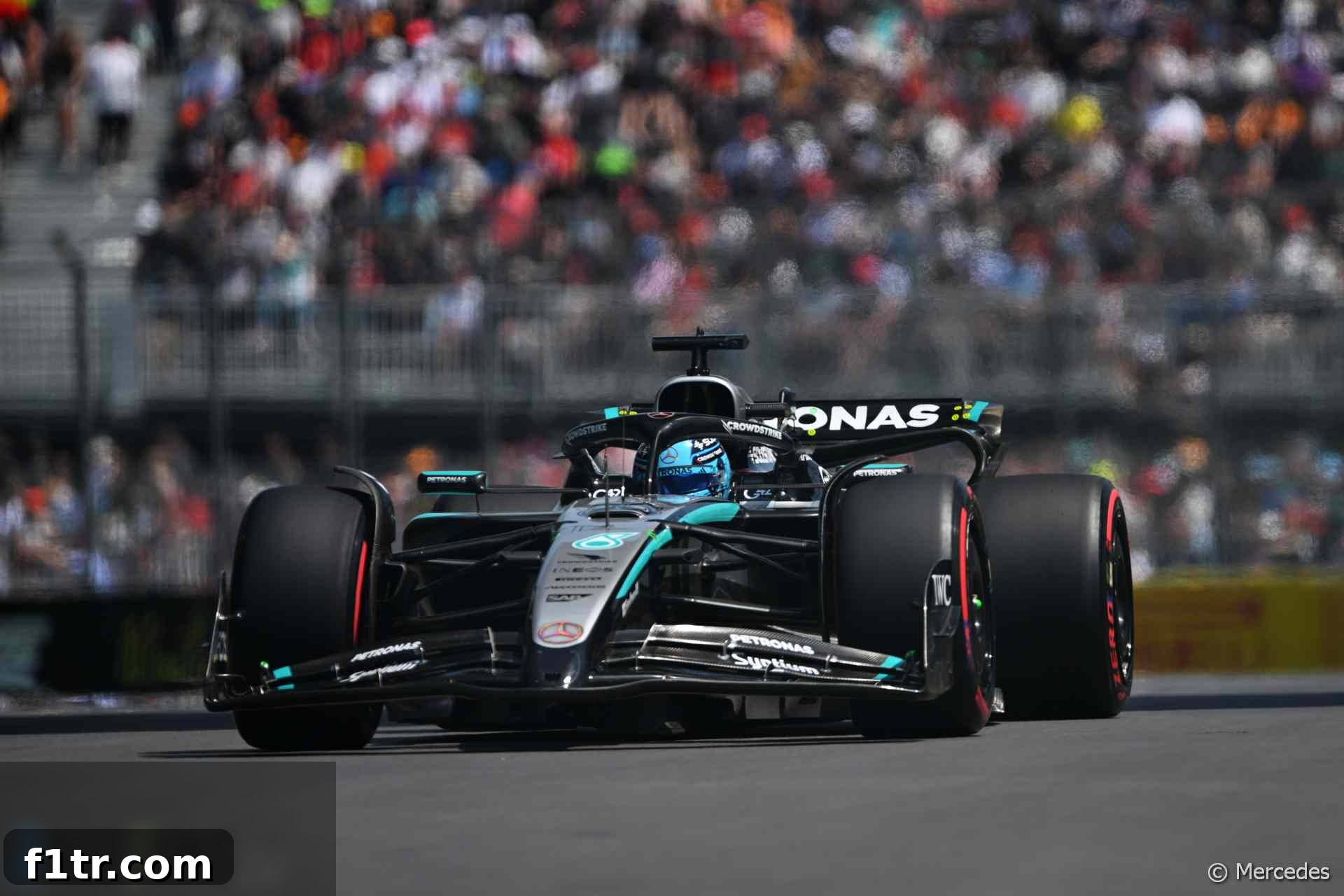
In a surprising turn of events that has set the tone for an unpredictable weekend, George Russell expertly navigated the challenging Circuit Gilles Villeneuve to top the second practice session for the 2025 Canadian Grand Prix. What made his performance particularly noteworthy was achieving this feat without deploying the softest tyre compound available, signaling strong underlying pace for Mercedes.
The British driver, piloting his W16, laid down a commanding lap time of 1’12.123 on the medium compound tyres. This blistering pace was a mere tenth of a second shy of his pole position time from the previous year, underscoring Mercedes’ significant step forward in performance and setup refinement on a circuit known for its unforgiving nature. The Circuit Gilles Villeneuve, a semi-permanent track on Notre Dame Island, demands a unique blend of straight-line speed and precision through its chicanes, often punishing even the slightest error. Russell’s ability to extract such performance from the more durable medium tyre hints at a potent package that could challenge for both qualifying honors and race victory.
The session proved to be a strong showing for Mercedes-powered machinery across the grid, with a remarkable seven cars equipped with their engines occupying the top seven positions. This dominant display suggests a significant advantage in power unit performance or superior adaptation to the circuit’s demands, which heavily favors engine power and effective braking into slow corners. The consistent performance of these customer teams, alongside the factory Mercedes squad, paints a promising picture for the German manufacturer this weekend.
Lando Norris, representing McLaren-Mercedes, emerged as Russell’s closest challenger, finishing a mere two hundredths of a second adrift. Norris achieved his time on the soft compound tyres, highlighting the nuanced tyre strategies at play. The proximity in lap times between Russell on mediums and Norris on softs will undoubtedly spark intense debate and analysis regarding optimal tyre choices for qualifying and the race. The soft compound, while offering immediate grip, typically degrades faster, making its deployment a critical strategic consideration.
Adding another layer to Mercedes’ impressive session, rising star Andrea Kimi Antonelli secured third place, ensuring both Mercedes factory cars featured prominently at the top of the leaderboard. Antonelli, also on soft tyres, demonstrated remarkable composure and speed for a driver still finding his footing in the top tier of motorsport. His consistent performance alongside an established talent like Russell is a strong indicator of his potential and the efficacy of Mercedes’ development program. This strong showing from Antonelli adds an exciting dynamic to the Mercedes camp, with implications for future driver lineups and championship aspirations.
Beyond the top three, other Mercedes-powered teams continued to impress. Alexander Albon continued to showcase Williams’ improved form, guiding his FW47 to an excellent fourth place. Williams has been on an upward trajectory this season, and Albon’s consistent ability to maximize their package on circuits that suit its characteristics is proving invaluable. His performance here, ahead of more established rivals, further cements Williams’ claim as a genuine midfield contender. Fernando Alonso, ever the strategist, placed his Aston Martin-Mercedes fifth, demonstrating the team’s ability to extract performance even when not in the absolute front-running contention. McLaren’s second driver, Oscar Piastri, secured sixth, solidifying the Woking-based team’s strong presence in the upper echelons of the practice standings.
Rounding out the top seven of Mercedes-engined cars was Carlos Sainz Jnr in a Williams-Mercedes. While his teammate Hamilton was in the lone Ferrari, Sainz’s strong run indicates the potential of the Williams chassis on this specific track layout. His performance, coupled with Albon’s, highlights the significant progress made by the team, offering a glimmer of hope for consistent points finishes in the upcoming races. The collective strength of the Mercedes power unit across multiple teams suggests they have found a sweet spot for the Circuit Gilles Villeneuve, which rewards both raw power and drivability through its iconic sections.
However, the session was not without its drama, particularly for another Mercedes-powered driver, Lance Stroll. The Canadian driver, eager to perform on home soil, endured a frustrating early exit from the session. Stroll’s Aston Martin suffered a significant impact with the wall on the outside of Turn 7, a notoriously tricky corner where drivers often brush the barriers. The incident occurred shortly after the session began, and the immediate consequence was a collapsed front-left suspension on his AMR25. Stroll managed to guide his severely damaged car to a stop at Turn 10, but the extent of the damage was clear.
A new rule introduced this year regarding damaged cars presented an additional layer of complexity for Stroll and his Aston Martin team. His race engineer, Gary Gannon, was compelled to inform Stroll that he was explicitly prohibited from driving the damaged car back to the pits. The rule, enacted to enhance safety and prevent further debris on track or unnecessary risks to marshals, dictates that cars with significant structural damage, particularly to suspension components, must not be driven. Stroll’s perplexed “Why?” was met with Gannon’s concise explanation: “We can’t drive back in this condition, it’s not allowed any more.” This incident highlights the immediate impact of new safety regulations, creating challenges for teams in terms of repair time and potential penalties for component changes. For Aston Martin, the lost track time for Stroll ahead of qualifying is a considerable setback, forcing them to rely heavily on Alonso’s data for setup adjustments.
The latter half of the top ten saw a mix of contenders, albeit with some surprising performances. Lewis Hamilton, driving the sole Ferrari in the session due to teammate Charles Leclerc’s earlier incident, secured eighth position. His performance offers some insight into Ferrari’s capabilities, even under challenging circumstances. Following him was reigning champion Max Verstappen, who struggled significantly in his Red Bull-Honda RBPT, finishing a relatively distant ninth. Verstappen, typically a dominant force, voiced multiple complaints over the team radio regarding his car’s “ride,” suggesting an underlying issue with the car’s suspension or aerodynamic setup that prevented him from finding a comfortable balance. This unexpected difficulty for Red Bull could open the door for their rivals to challenge for pole position, something that has been a rare occurrence in recent seasons. Rounding out the top ten was Liam Lawson of Racing Bulls, putting in another solid and consistent performance that continues to impress within the Red Bull junior program.
A significant absentee from the session was Charles Leclerc. The Ferrari driver had unfortunately damaged his SF-25 during the first practice session after a crash, necessitating extensive repairs. Ferrari confirmed that his car required a fresh “survival cell,” a critical structural component of the chassis designed for driver protection. The need for a new survival cell is a major undertaking, effectively meaning a substantial rebuild of the car’s core. This repair job means Leclerc will be sidelined until final practice, losing crucial track time for setup optimization and long-run data collection. Furthermore, such extensive repairs often lead to replacements of other components, potentially incurring grid penalties later in the weekend, which would be a significant blow to Ferrari’s championship hopes.
Despite a reduced number of cars on track for much of the session, with only 18 circulating for extended periods, complaints about traffic were surprisingly prevalent. The short and narrow Circuit Gilles Villeneuve, combined with varied speeds between cars on different tyre compounds and program phases, often leads to congestion. Drivers such as Gabriel Bortoleto, Pierre Gasly, and both Racing Bulls drivers expressed frustration over being impeded by slower rivals during their flying laps. While the stewards opted not to investigate most of these reported incidents, they are scrutinizing an action by George Russell. Specifically, they are looking into whether Russell rejoined the track correctly after briefly cutting the final chicane on one particular lap. This potential infringement could result in a penalty, adding another layer of intrigue to an already eventful practice day.
2025 Canadian Grand Prix – Second Practice Result
| P. | # | Driver | Team | Model | Time | Gap | Laps |
|---|---|---|---|---|---|---|---|
| 1 | 63 | George Russell | Mercedes | W16 | 1’12.123 | 33 | |
| 2 | 4 | Lando Norris | McLaren-Mercedes | MCL39 | 1’12.151 | 0.028 | 32 |
| 3 | 12 | Andrea Kimi Antonelli | Mercedes | W16 | 1’12.411 | 0.288 | 33 |
| 4 | 23 | Alexander Albon | Williams-Mercedes | FW47 | 1’12.445 | 0.322 | 36 |
| 5 | 14 | Fernando Alonso | Aston Martin-Mercedes | AMR25 | 1’12.458 | 0.335 | 31 |
| 6 | 81 | Oscar Piastri | McLaren-Mercedes | MCL39 | 1’12.562 | 0.439 | 32 |
| 7 | 55 | Carlos Sainz Jnr | Williams-Mercedes | FW47 | 1’12.631 | 0.508 | 37 |
| 8 | 44 | Lewis Hamilton | Ferrari | SF-25 | 1’12.653 | 0.530 | 34 |
| 9 | 1 | Max Verstappen | Red Bull-Honda RBPT | RB21 | 1’12.666 | 0.543 | 31 |
| 10 | 30 | Liam Lawson | Racing Bulls-Honda RBPT | 02 | 1’12.751 | 0.628 | 30 |
| 11 | 6 | Isack Hadjar | Racing Bulls-Honda RBPT | 02 | 1’12.799 | 0.676 | 31 |
| 12 | 10 | Pierre Gasly | Alpine-Renault | A525 | 1’12.874 | 0.751 | 34 |
| 13 | 5 | Gabriel Bortoleto | Sauber-Ferrari | C45 | 1’12.896 | 0.773 | 32 |
| 14 | 27 | Nico Hulkenberg | Sauber-Ferrari | C45 | 1’12.914 | 0.791 | 33 |
| 15 | 22 | Yuki Tsunoda | Red Bull-Honda RBPT | RB21 | 1’12.939 | 0.816 | 35 |
| 16 | 87 | Oliver Bearman | Haas-Ferrari | VF-25 | 1’13.080 | 0.957 | 36 |
| 17 | 31 | Esteban Ocon | Haas-Ferrari | VF-25 | 1’13.175 | 1.052 | 33 |
| 18 | 43 | Franco Colapinto | Alpine-Renault | A525 | 1’13.898 | 1.775 | 33 |
| 19 | 18 | Lance Stroll | Aston Martin-Mercedes | AMR25 | No time | 2 |
Looking Ahead to Qualifying and the Race
The second practice session has set the stage for a truly captivating Canadian Grand Prix weekend. George Russell’s commanding performance on medium tyres firmly positions Mercedes as a front-runner, potentially challenging for their first pole position and victory of the season. Their impressive pace, coupled with the strong showing from other Mercedes-powered cars, suggests a significant gain on their rivals. However, the true test will come in qualifying, where the softer compounds will be pushed to their limits, and tyre degradation will be less of a factor.
McLaren, with Lando Norris’s blistering pace on softs, remains a formidable threat, and their strategic choices regarding tyre allocation will be crucial. The battle between Mercedes and McLaren promises to be a highlight of Saturday’s qualifying session. Red Bull’s struggles, particularly with Max Verstappen’s discomfort with his car’s ride, present an unexpected opportunity for the chasing pack. If Red Bull cannot resolve their setup issues overnight, it could dramatically alter the grid order and potentially open up the race for a non-Red Bull winner, a scenario that has been rare in recent times.
Ferrari faces a significant challenge with Charles Leclerc’s extensive repairs and lost track time, putting immense pressure on Lewis Hamilton to carry the team’s hopes. The impact of Leclerc’s potential grid penalties could further complicate Ferrari’s race strategy. Meanwhile, the midfield battle, spearheaded by a resurgent Williams and the ever-present Fernando Alonso, will be fiercely contested, with every point proving vital in the constructors’ championship. The stewards’ investigation into Russell’s track rejoin adds another layer of suspense, with any penalty potentially reshuffling the order before qualifying even begins. As the teams head into the final practice and crucial qualifying sessions, all eyes will be on how these narratives unfold, promising an exhilarating conclusion to the 2025 Canadian Grand Prix weekend.