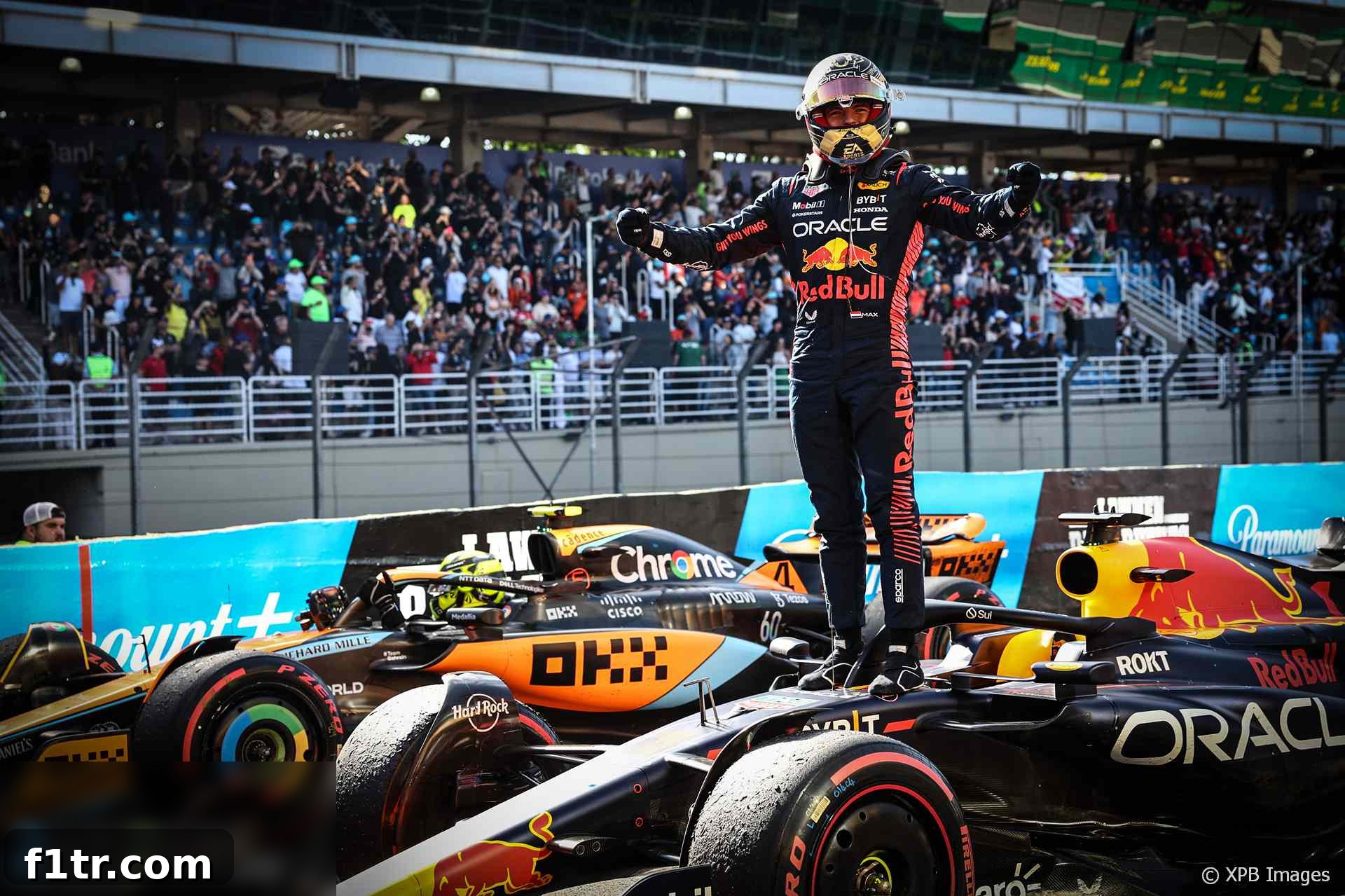
In a display of unparalleled dominance that has defined his championship-winning season, Max Verstappen once again commanded the Formula 1 stage, leading nearly every lap of the dramatic Brazilian Grand Prix. His spectacular performance at the Autódromo José Carlos Pace secured his 17th grand prix victory of the year, a new benchmark for single-season wins, as he crossed the finish line ahead of a spirited Lando Norris and the evergreen Fernando Alonso. The race, held on the challenging Interlagos circuit, was a rollercoaster of emotions, marked by high-octane action, strategic masterstrokes, and nail-biting finishes that captivated fans worldwide.
Advert | Become a Supporter & go ad-free
The Dutchman’s victory, while seemingly comfortable in its margin, was anything but straightforward. He adeptly managed a crucial restart after an early red flag stoppage, fending off the persistent challenge from Norris’s McLaren. Throughout the remainder of the 71-lap contest, Verstappen controlled the pace with masterful precision, eventually building an eight-second gap to secure a well-deserved win. The true spectacle, however, unfolded behind him, where Fernando Alonso, demonstrating his remarkable tenacity and experience, claimed the final podium position in third. This came after an epic, race-long duel with Sergio Perez, which was ultimately decided by an astonishing five-hundredths of a second on the very last lap, providing an unforgettable climax to an already thrilling event.
A Chaotic Start to the Brazilian Grand Prix
Even before the green lights illuminated the iconic Brazilian track, drama unfolded. As the entire field embarked on the formation lap, almost every driver opted for soft compound tyres, with the exception of Logan Sargeant towards the rear. However, the pre-race routine was abruptly disrupted as Charles Leclerc, starting from a promising second position, suffered a catastrophic hydraulic failure in his Ferrari while navigating the Ferradura corner. The sudden loss of control sent his car spinning violently into the outside barriers. While Leclerc managed to regain some motion, the damage was terminal, forcing him to park his car and become the race’s first retirement – a heartbreaking end before the competition had even truly begun. Despite the incident, the start was not delayed, and once Leclerc’s car was cleared, the grid prepared for the initial getaway.
The drama continued immediately as the lights went out. On the frantic sprint towards Turn One, a multi-car collision erupted involving the two Haas drivers, Kevin Magnussen and Nico Hulkenberg, alongside Alexander Albon of Williams. The contact was severe, sending both Magnussen and Albon hurtling into the outside tyre barrier, ending their races on the spot. The impact scattered significant debris across the track, causing damage to Daniel Ricciardo’s AlphaTauri and Oscar Piastri’s McLaren. This chain of events necessitated the immediate deployment of the Safety Car. Given the extent of the barrier damage and the considerable amount of carbon fibre strewn across the racing line, race control made the inevitable decision to red-flag the race on just the second lap, bringing proceedings to a halt and triggering a 25-minute delay while repairs were undertaken.
The Restart and Early Battles for Position
Following the lengthy delay for barrier repairs, the tension on the grid was palpable as Verstappen led the remaining field back out to line up for the standing restart. Norris, having made an absolutely brilliant getaway at the initial start, had vaulted several positions and now found himself in second place, poised to challenge the reigning world champion. Lewis Hamilton held third, with the two Aston Martins of Fernando Alonso and Lance Stroll occupying fourth and fifth positions, respectively, showcasing strong early pace from the British team.
As the lights went out for the second time, Verstappen demonstrated his characteristic composure and skill, executing a flawless launch and comfortably maintaining his lead into Turn One. Norris, equally adept, held onto second place, cementing his strong position. However, behind them, the battle for third intensified. Fernando Alonso, ever the opportunist, launched a daring dive past the Mercedes of Lewis Hamilton into Descida do Lago, snatching third place with a decisive move that highlighted his aggressive yet precise driving style. With the DRS system activated at the start of lap five, Norris remained within striking distance of Verstappen, using the aerodynamic aid to keep the pressure on. The leading duo quickly began to pull away from Alonso, establishing a significant gap as the race settled into a rhythm.
Advert | Become a RaceFans supporter andgo ad-free
Norris continued his relentless pursuit, launching another spirited challenge on Verstappen using DRS into the Senna Esses and Descida do Lago on lap eight. Despite his best efforts, Verstappen showcased his defensive prowess, holding off the McLaren driver with a firm but fair defence. Crucially, Verstappen then unleashed a burst of pace through the middle sector of the circuit, enabling him to break out of Norris’s DRS range by the end of the lap, providing him with a much-needed moment of respite. From this point, Verstappen steadily extended his advantage to just over two seconds, where it stabilized, giving him a comfortable, though not unassailable, lead.
Mid-Race Strategy and Mercedes’ Struggles
While Verstappen managed his lead at the front, the midfield witnessed intense strategic battles and overtakes. Sergio Perez, after a challenging start to his weekend, began his determined climb through the field. On lap 15, he made a decisive move on George Russell into the Senna Esses, claiming fifth place and effectively splitting the two Mercedes cars. Just a few laps later, Perez continued his charge, executing a similar, well-judged overtake on Lewis Hamilton to seize fourth position. In response to Perez’s relentless pace and their own car’s performance, Mercedes opted to pit both their drivers for medium compound tyres. Perez followed suit a lap later, also switching to mediums. Upon rejoining the track, Perez initially found himself behind Hamilton, but the Red Bull driver’s superior pace on the new tyres quickly told. He wasted no time in repassing Hamilton on lap 24, moving back ahead and continuing his pursuit of the podium contenders.
The pit stop window for the leaders soon opened. Fernando Alonso was the first of the front runners to dive into the pits for medium tyres. Crucially, the two leading drivers, Verstappen and Norris, then pitted together on the same lap for their own sets of mediums. This coordinated stop ensured that Verstappen emerged back on track still in the lead, maintaining a healthy five-second buffer over Norris, who in turn held a five-second advantage over Alonso in third. The Mercedes team, unfortunately, struggled to find pace on the medium compound tyres. Both Hamilton and Russell found themselves vulnerable, eventually being overtaken by Lance Stroll and Carlos Sainz Jnr, causing them to drop to seventh and eighth positions respectively, highlighting the challenges faced by the Silver Arrows throughout the race.
The Final Stint and a Podium Thriller
Through the middle stint of the race, Max Verstappen meticulously maintained his lead, oscillating between five and six seconds over Lando Norris. Both drivers continued to pull away from Fernando Alonso in third, creating a significant gap to the rest of the field. However, Sergio Perez, having steadily made up ground, was now pursuing Alonso with fierce determination. The strategic game intensified towards the final quarter of the race when Red Bull brought Perez in for fresh soft tyres at the end of lap 46, signaling their intent to attack for the podium. Aston Martin reacted swiftly, pitting Alonso on the very next lap to also switch to softs, a crucial move that allowed him to rejoin the track just ahead of the charging Red Bull, setting the stage for an epic showdown.
Verstappen then made his final pit stop for soft tyres, temporarily handing the lead to Norris. Red Bull initially suspected that Norris might attempt to run to the finish on his current set, but McLaren eventually brought him in for a second stop, also switching to softs. This strategic decision returned the lead to Verstappen, solidifying his position at the front. In the closing laps, Norris gradually began to chip away at Verstappen’s advantage, showing impressive pace on his fresh softs. While he narrowed the gap, it was ultimately not enough to pose a significant threat to the leader. Verstappen confidently completed the 71st and final lap, securing his remarkable 17th grand prix victory of the season, with Norris crossing the line a strong eight seconds behind.
However, the real drama, the one that had fans on the edge of their seats, was unfolding in the battle for third place between Fernando Alonso and Sergio Perez. The two veterans engaged in a fierce, wheel-to-wheel contest over the final laps, a true masterclass of defensive and attacking driving. On the penultimate lap, Perez managed to get ahead of Alonso, seemingly securing the podium spot. But Alonso, refusing to yield, launched an immediate counter-attack on the very final lap, reclaiming third with incredible bravery and skill. The climax came on the run to the finish line, where the two cars sprinted side-by-side, their engines screaming. In a breathtaking photo finish, Alonso just edged out Perez, securing third place by an astonishing half a tenth of a second, a margin so infinitesimal it had to be seen to be believed, sending the Interlagos crowd into raptures.
Beyond the Podium: Other Notable Performances
Beyond the spectacular podium battle, other drivers delivered strong performances. Lance Stroll claimed a commendable fifth place for Aston Martin, marking his best finish since the Australian Grand Prix earlier in the season and reinforcing the team’s competitive showing. Carlos Sainz Jnr brought his Ferrari home in a solid sixth position, contributing valuable points to the Scuderia. Pierre Gasly had an excellent outing for Alpine, securing seventh place, a significant result for the French team in a challenging season. Lewis Hamilton, despite his team’s struggles with tyre pace, managed to salvage eighth place. Yuki Tsunoda for AlphaTauri and Esteban Ocon for Alpine completed the top ten, earning the final points-paying positions. The race also saw another retirement in its final third, as George Russell was called into the pits by Mercedes due to dangerously high power unit temperatures, concluding a difficult day for the German manufacturer.
Advert | Become a RaceFans supporter andgo ad-free
2023 Brazilian Grand Prix: Related Content and Analysis
For more in-depth coverage and analysis of the 2023 Brazilian Grand Prix and its implications, explore the links below:
- Perez’s missed “open goal” in Miami was turning point in title fight – Horner
- F1 drivers insist new rules to prevent impeding in qualifying don’t work
- McLaren surprised by margin over rivals at track Norris thought would be “tough”
- “Follow Fernando’s line” – How Red Bull tried everything to get Perez past Alonso
- Mercedes’ Brazilian GP set-up was “conservative” after US GP disqualification
Browse all 2023 Brazilian Grand Prix articles