The fast-paced world of Formula 1 demands precision, speed, and unwavering focus from drivers and teams alike. Every session, from the initial practice laps to the final checkered flag, is a relentless pursuit of performance. However, sometimes, even the most meticulous planning and innovative strategies can lead to unforeseen incidents, particularly when pushing the boundaries of what’s possible. Such was the case during the second free practice session for the Styrian Grand Prix at the challenging Red Bull Ring, where Mercedes-AMG Petronas F1 Team driver Valtteri Bottas found himself in a precarious situation that ultimately resulted in a grid penalty.
Advert | Become a Supporter & go ad-free
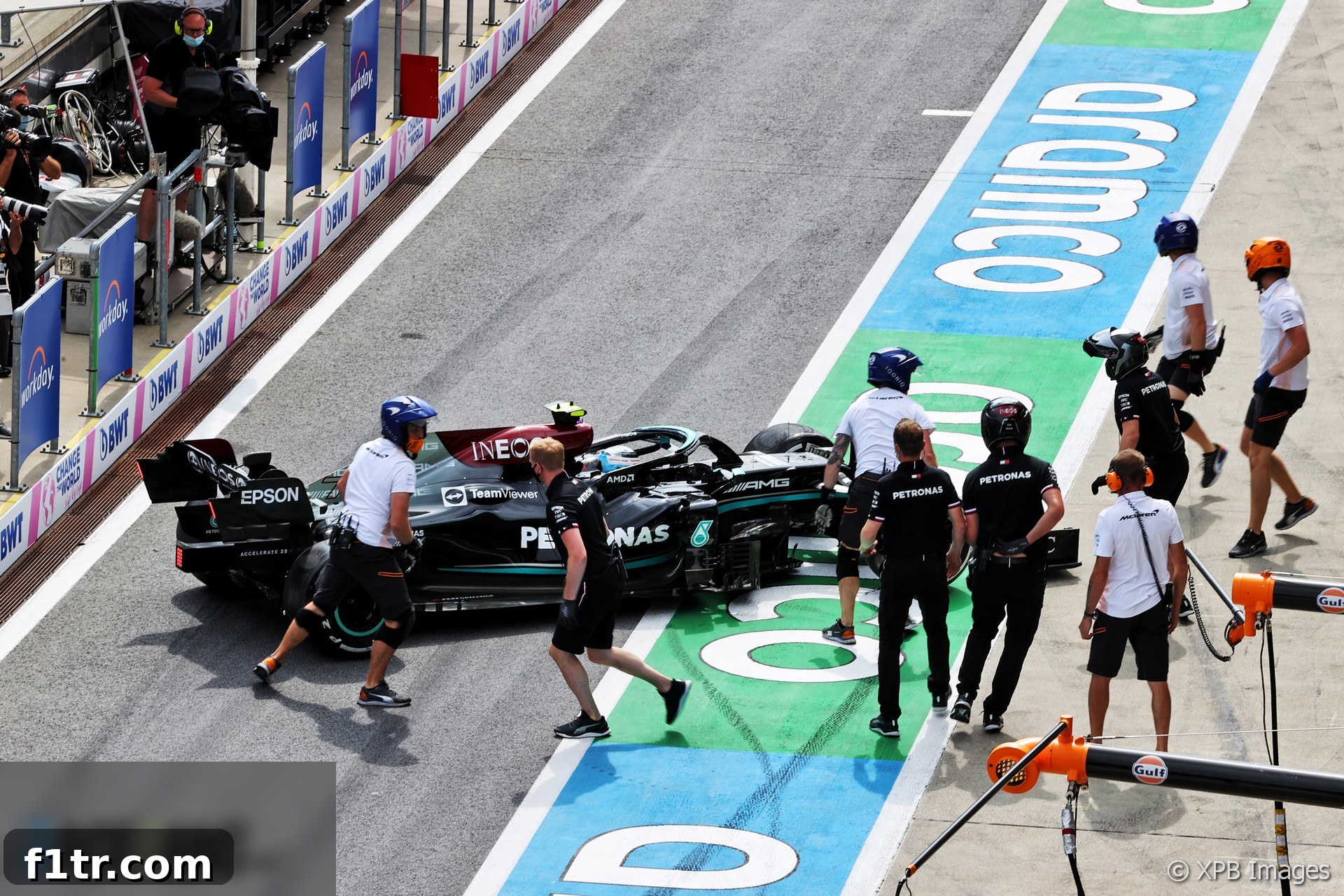
The incident, which unfolded in the confined and bustling pit lane, saw Bottas lose control of his Mercedes W12 as he attempted to depart from his designated pit box. What followed was a momentary lapse of grip, an unexpected spin, and his car coming to an abrupt halt dangerously close to a group of McLaren mechanics. This seemingly innocuous, albeit alarming, spin during a routine practice departure quickly caught the attention of the FIA stewards, who launched an immediate investigation into the circumstances surrounding the event. The gravity of the situation was clear: any incident in the pit lane, especially one involving uncontrolled vehicle movement near personnel, is treated with the utmost seriousness due to the inherent safety risks involved.
Valtteri Bottas’s Pit Lane Incident: A Deep Dive into the Styrian GP Penalty
The second free practice session is often a testing ground, a crucial period for teams to experiment with setup changes, tire compounds, and even novel strategies that might offer a marginal gain on race day. For Valtteri Bottas and the Mercedes team, this particular Friday afternoon at the Red Bull Ring was intended for such experimentation, specifically focusing on optimizing pit departure times. However, the outcome was far from optimal. As Bottas exited his pit bay, the rear of his car snapped violently, sending the Mercedes spinning across the fast lane, a designated area where cars are meant to accelerate or decelerate safely. The car came to rest perpendicular to the flow of traffic, in very close proximity to the pit box of a rival team, McLaren, where their mechanics were actively working. This near-miss highlighted the extreme dangers present in the pit lane, a place where high-performance machinery and human personnel operate in close quarters under immense time pressure.
The Stewards’ Verdict: Understanding the Three-Place Grid Penalty
Following a thorough review and a hearing involving Valtteri Bottas and Mercedes team representatives, the FIA stewards issued their verdict. Bottas was handed a three-place grid penalty for the Styrian Grand Prix, a decision that would significantly impact his starting position for Sunday’s main event. Furthermore, in an additional measure emphasizing the severity of the offense, the Finnish driver also received two penalty points on his Super Licence. While two points might seem minor individually, F1 drivers accumulate these points over a 12-month period, and reaching a total of 12 points within that timeframe results in an automatic race ban. For Bottas, these were his first penalty points in the current 12-month cycle, but they served as a stark reminder of the rigorous safety standards enforced by the sport’s governing body.
The official stewards’ report deemed Bottas’s actions as “potentially dangerous driving,” a classification that underscores the FIA’s uncompromising stance on safety, particularly within the bustling and high-risk environment of the pit lane. The report meticulously detailed the sequence of events: “When [Bottas] pulled away from his designated pit stop position, he lost control of the car when he turned into the fast lane. He oversteered, spun and came to a stop across the fast lane near the McLaren pits.” This precise description left no room for ambiguity regarding the nature of the infraction. The penalty serves as a clear message to all drivers and teams that while pushing limits is inherent to Formula 1, compromising safety, especially where personnel are present, will always lead to strict repercussions.
Mercedes’ Quest for Speed: The Second Gear Experiment
The root cause of the incident lay in Mercedes’ ongoing efforts to shave precious milliseconds off their pit stop procedures. In Formula 1, every aspect of performance is scrutinized, and pit stops are no exception. A tenth of a second saved on a pit departure can translate into a significant advantage over the course of a race. During the hearing, Bottas openly stated that the team had been “losing time in the pit departure” and was actively “trying something new.” This innovation involved departing the pit box in second gear rather than the conventional first gear. Typically, first gear offers maximum torque and control for a standing start, allowing for a smooth and controlled launch. However, starting in a higher gear like second can, in theory, reduce the time spent accelerating through lower gears, potentially offering a quicker getaway if executed perfectly.
However, this high-risk, high-reward strategy proved to be Bottas’s undoing on this occasion. The stewards’ report elaborated on the technical aspect: “As a result, the wheel spin was much higher and the result unexpected. Therefore he didn’t manage to control the car properly into the fast lane.” Using a higher gear for a standing start reduces the effective torque delivered to the wheels, making it more challenging to manage the immense power of an F1 engine and prevent excessive wheelspin. The sophisticated traction control systems in modern F1 cars are finely tuned for specific launch procedures, usually optimized for first gear starts. When confronted with the altered dynamics of a second-gear departure, especially on cold tires and potentially within the slick confines of the pit lane, the car’s behavior became unpredictable. This incident vividly illustrates the razor-thin margins that Formula 1 teams operate within, where even a seemingly minor adjustment to a procedure can have significant, unintended consequences.
Bottas’s Take and the Pressure Cooker of F1
For Valtteri Bottas, the incident and subsequent penalty added an unwelcome layer of complexity to his Styrian Grand Prix weekend. As a seasoned Formula 1 driver, he is no stranger to pressure, but a grid penalty before qualifying even begins is a significant setback. Bottas’s candid admission during the hearing—that the team was experimenting and the outcome was “unexpected”—showcased a level of transparency. It highlighted the constant pursuit of perfection that defines F1, where even experienced drivers and top-tier teams are continuously pushing limits and exploring novel approaches to gain an advantage. The incident also served as a reminder that even within a highly controlled environment like Formula 1, human error and the unpredictable nature of machinery at the absolute limit can always lead to mistakes. The intense scrutiny from fans, media, and especially within his own team, adds immense pressure, making every error, no matter how small, amplified on the global stage.
Upholding Safety: The FIA’s Stance on Pit Lane Protocols
The FIA, as the governing body of motorsport, places paramount importance on safety. Over the decades, Formula 1 has implemented numerous regulations and technological advancements to enhance driver, team, and spectator safety, particularly in the notoriously dangerous pit lane. The pit lane, with its mixture of high-speed cars, stationary vehicles, fast-moving mechanics, sensitive equipment, and often media personnel, is inherently a high-risk area. Incidents like Bottas’s spin, even if no one was hurt, are critical reminders of the constant vigilance required. The presence of McLaren mechanics in close proximity to Bottas’s spinning car was a key factor in the stewards’ decision, underscoring that potential harm to individuals is treated with the utmost seriousness. Past incidents in F1’s history have led to significant changes in pit lane protocols, from speed limits to designated working areas, all aimed at minimizing risk. The penalty issued to Bottas reinforces the message that strict adherence to safety protocols is non-negotiable, and any deviation that creates a “potentially dangerous” situation will be met with decisive action to maintain the integrity and safety standards of the sport.
Impact on the Styrian Grand Prix Weekend
The three-place grid penalty profoundly impacted Valtteri Bottas’s prospects for the Styrian Grand Prix. Instead of starting from his qualifying position, he would drop three places, making his race significantly more challenging. This meant he would have to work harder to make up positions on track, a task made more difficult at the Red Bull Ring, which can be tricky for overtakes depending on car performance. For a driver consistently aiming for podium finishes and supporting his team’s championship efforts, a grid penalty is a substantial hurdle. It not only affects his individual race outcome but also has broader implications for Mercedes in their constructors’ championship battle against rivals. The incident served as a stark reminder that in Formula 1, even a small mistake in practice can have lasting consequences that resonate throughout the entire race weekend, forcing teams and drivers to adapt their strategies and fight even harder for every point.
Advert | Become a RaceFans supporter andgo ad-free
2021 Styrian Grand Prix Articles
- Sainz praises Ferrari “teamwork” with Mercedes after unlapping himself from Hamilton
- W Series boss says it will not become a “billionaire girls’ club”
- Mercedes has more than just aerodynamic upgrades coming for 2021 car
- Alonso: F1 rule to ‘improve the show’ helps the big teams
- Is stamping out ‘burn-out’ celebrations a killjoy over-reaction?
Browse all 2021 Styrian Grand Prix articles