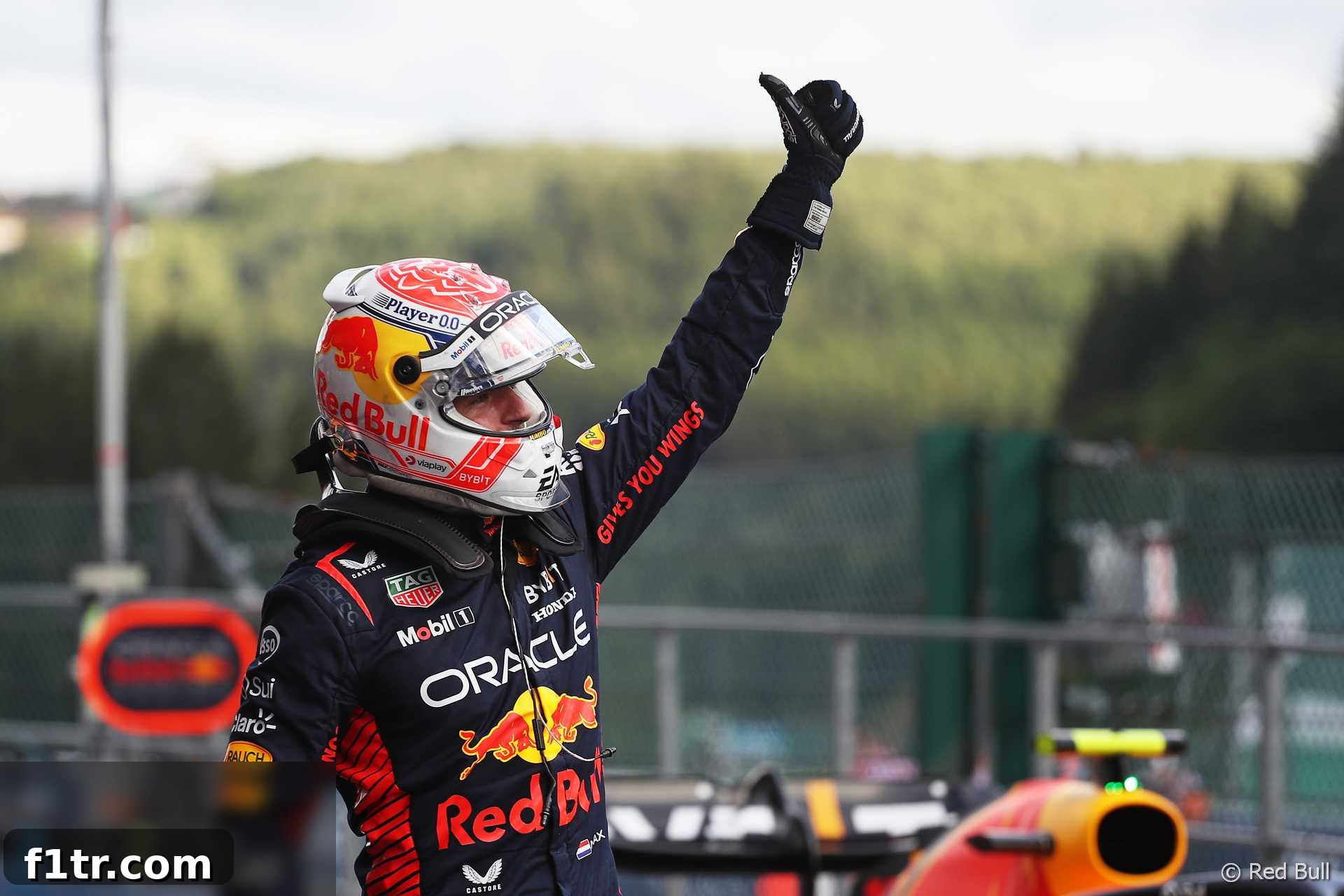
In a display of sheer dominance at the iconic Spa-Francorchamps circuit, Max Verstappen unequivocally showcased why he stands at the pinnacle of Formula 1. During a challenging qualifying session for the Belgian Grand Prix, where track conditions evolved rapidly, Verstappen set a blistering pace that left his competitors trailing by an astonishing margin. Even Lewis Hamilton, a seven-time world champion and one of the sport’s most decorated drivers, acknowledged Verstappen’s performance as “pretty impressive,” as no rival managed to get within eight-tenths of a second of the Dutchman’s fastest lap. This significant gap underscored Red Bull’s formidable package and Verstappen’s unparalleled ability to extract maximum performance, even under immense pressure.
Despite his qualifying heroics, Verstappen will not start Sunday’s Grand Prix from pole position. A grid penalty, incurred for exceeding his allocation of gearbox components for the season, means he will line up in sixth place. This penalty, a standard procedural consequence in Formula 1 when teams introduce more power unit or gearbox elements than permitted, adds an intriguing dynamic to the race. For Lewis Hamilton, who initially qualified fourth, this setback for Verstappen effectively promotes him to a third-place start, providing a more advantageous position from which to challenge for podium honours.
Hamilton vividly described the qualifying session as “definitely very hectic,” a sentiment echoed by many drivers navigating the treacherous conditions. The session saw the track transition from thoroughly wet to increasingly dry over the course of Q1, Q2, and Q3, demanding constant adaptation from both drivers and engineers. “It was very slippery at the beginning and difficult to see,” Hamilton explained, highlighting the sensory overload and precision required. The challenge was exacerbated by the knowledge that “every lap is going to be faster than the next lap,” due to the rapidly drying surface. This dynamic placed a premium on track position and quick turnarounds by the pit crew. “So making sure you’re just out, that’s why we were at the end of the pit lane each session. The team did a great job in getting us out and quick turn-around,” Hamilton praised, emphasizing the crucial teamwork involved.
Reflecting on his own performance, Hamilton expressed satisfaction with his third-place start. “I was just head down, just maximising as much as I could at the end. At the end, still a good chunk off Max – pretty impressive, but I’m really happy with the result we got,” he concluded. His comments underscored the reality of Red Bull’s current performance advantage, even as Mercedes continues its relentless development push. Starting P3 at Spa offers Mercedes a strong platform, especially considering the unpredictable nature of the Ardennes weather and the strategic opportunities that may arise.
Verstappen’s Calculated Risk-Taking Amidst Evolving Grip
Max Verstappen, despite his significant advantage, acknowledged the inherent difficulties of the session. He admitted to taking more risks on his crucial final lap in Q3, a calculated gamble as the track reached its optimal dry state. “It’s more about not actually finding the limit, because then it’s very easy to make a mistake and hit the wall, it’s all about just trying to leave your margins and just build up to it, basically,” Verstappen explained, offering insight into the delicate balance between pushing hard and avoiding costly errors. This approach is fundamental in mixed conditions, where grip levels change not just corner-to-corner but meter-to-meter.
The Dutchman further elaborated on the complexities: “But it seemed like it was a bit tougher today, I think also because the sun was out at one point, so the track was drying really quickly, lap after lap.” The rapid drying meant that reference points and braking zones were constantly shifting, adding another layer of mental and physical strain to an already demanding task. The Spa-Francorchamps circuit, known for its microclimates, often experiences such dramatic changes, making it a true test of a driver’s adaptability and intuition.
“It’s quite hectic out there,” Verstappen reiterated, painting a picture of the chaotic nature of the session. “It’s still only one dry line, in some places you’re still not even doing the full dry line. So it felt alright but honestly I didn’t know where I was until I looked on the screens.” This highlights the often-surreal experience of driving an F1 car at the limit in such conditions – relying more on feel and instinct than precise visual cues. The single dry line demanded extreme precision, as straying even slightly onto the damp tarmac could instantly compromise a lap.
Verstappen’s final Q3 lap was indeed exceptional. “But Q3 that final lap I think was very good. I just risked a bit more compared to all the other laps [when I was] leaving a bit of margin, which almost knocked me out in Q2. So it was tough out there today to get everything right.” This near-miss in Q2 served as a stark reminder of the fine line between heroics and disaster, underscoring the mental fortitude required to then push even harder when it truly mattered.
The Timing Advantage and Track Evolution
A significant factor in Verstappen’s remarkable advantage, beyond his intrinsic skill and the Red Bull RB19’s capabilities, was the timing of his final run. He believes that completing his last Q3 lap later than most of his rivals, when the track was at its absolute best, played a crucial role. “Honestly, I do know that we have a very good car,” said Verstappen, acknowledging the foundation of his performance. “But I think it’s more just having a bit more luck with the line or the grip. I think if it would have been a full dry qualifying, I think the gap wouldn’t have been like this.” This candid assessment suggests that while his pace was undeniable, the unique circumstances of the drying track amplified his advantage, allowing him to exploit the optimal conditions more effectively than others.
Verstappen pinpointed specific sections of the circuit where he found critical time on his final attempt. He revealed taking more risks at Bruxelles (Turn 8) and the subsequent turn of Speaker’s Corner (Turn 9), two demanding corners that test a driver’s nerve and car setup. “I was incredibly slow there before because I had a few moments,” he admitted, highlighting his earlier struggles. “I almost crashed in [turn] nine in Q2. Even in Q3, my first run, I was very slow there. So then on my second attempt I just went a lot faster there.” This iterative process of learning, pushing the limits, making mistakes, and then refining the approach is a hallmark of elite motorsport and demonstrated Verstappen’s continuous adaptation throughout the session.
Implications for the Race and Championship Landscape
Max Verstappen’s dominant qualifying performance, even with a grid penalty, sets the stage for an electrifying Belgian Grand Prix. Starting from sixth, his raw pace and the formidable capabilities of the Red Bull RB19 suggest he will swiftly carve his way through the field. The long run down to Eau Rouge and Raidillon from the start offers prime overtaking opportunities, and Verstappen has a proven track record of making rapid progress from lower grid positions.
For Lewis Hamilton, starting third provides a golden opportunity to challenge for victory or a strong podium finish. With Verstappen starting further back, Hamilton and Mercedes will be eager to maximize their position, particularly if the race conditions remain mixed or provide strategic nuances. The battle for the lead in the early laps will be crucial, with drivers like Charles Leclerc (starting P1 due to Verstappen’s penalty) and Sergio Perez also in contention. This grid shake-up ensures that Sunday’s race at Spa will be far from a procession, promising high-stakes drama and intense wheel-to-wheel action.
More broadly, Verstappen’s performance at Spa further cements his status as the championship leader and the benchmark driver in Formula 1. His ability to perform under pressure and extract such a significant advantage in challenging conditions reiterates Red Bull’s current supremacy. While the grid penalty adds a twist, the underlying message from qualifying is clear: Verstappen and Red Bull remain the combination to beat, regardless of the circuit or the weather.
Bringing the F1 news from the source
RaceFans strives to bring its readers news directly from the key players in Formula 1. We are able to do this thanks in part to the generous backing of our RaceFans Supporters.
By contributing £1 per month or £12 per year (or the equivalent in other currencies) you can help cover the costs involved in producing original journalism: Travelling, writing, creating, hosting, contacting and developing.
We have been proudly supported by our readers for over 10 years. If you enjoy our independent coverage, please consider becoming a RaceFans Supporter today. As a bonus, all our Supporters can also browse the site ad-free. Sign up or find out more via the links below:
- Become a RaceFans Supporter
- RaceFans Supporter FAQ
Advert | Become a RaceFans supporter andgo ad-free
2023 Belgian Grand Prix
- Haas drivers fear losing battle for seventh after “grim weekend” in Spa
- Mercedes optimistic they’re “in the right place for winter” with development plan
- Ferrari not convinced by call to equalise engines: ‘Renault is not so far away’
- Ferrari staying “calm” amid swings in performance from race to race
- Pirelli proposes new “super-intermediate” to address wet weather tyre problems
Browse all 2023 Belgian Grand Prix articles