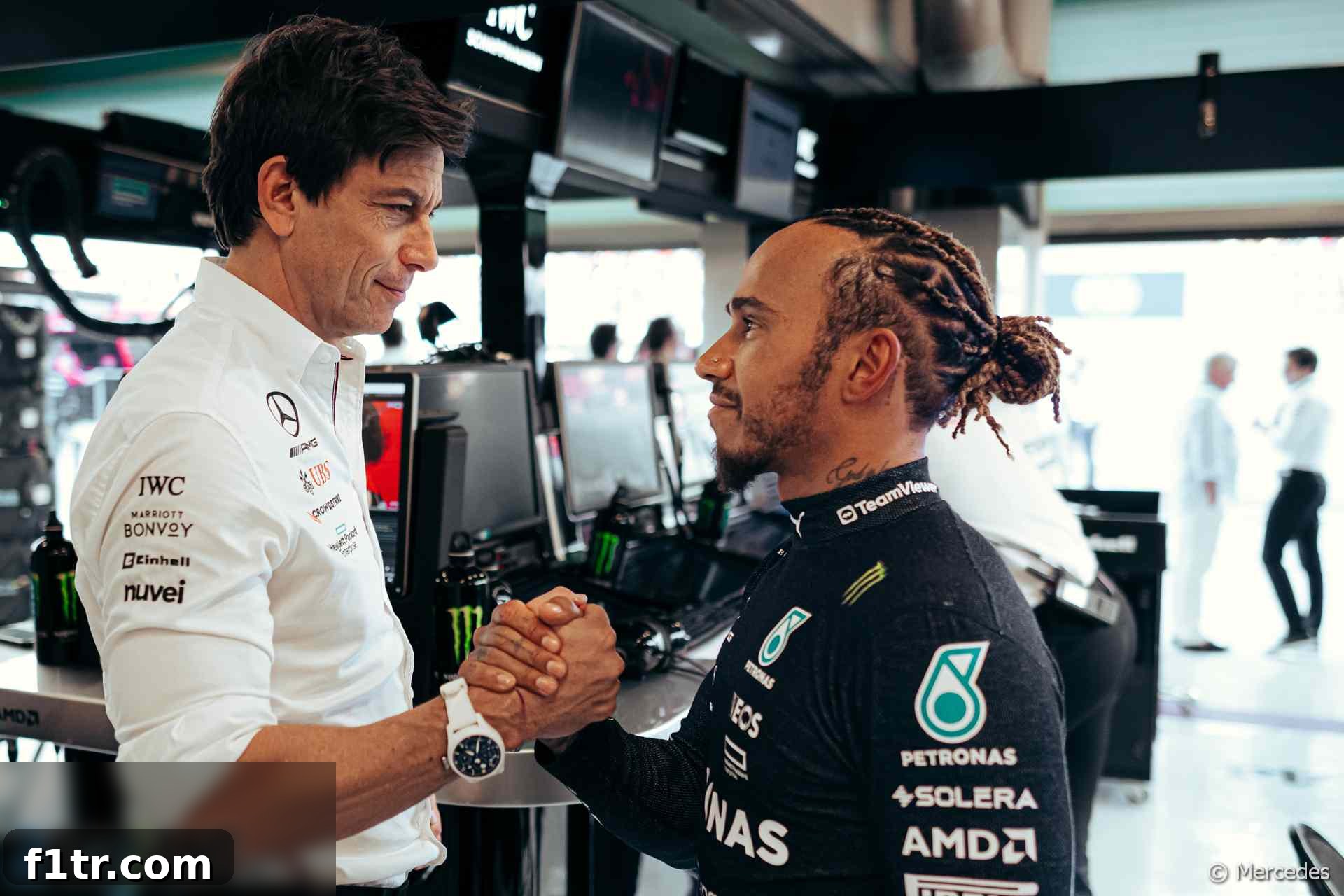
The world of Formula 1 was recently rocked by the seismic announcement that Sir Lewis Hamilton, one of the sport’s most decorated drivers, will depart from Mercedes-AMG Petronas F1 Team at the close of the 2024 season to join Scuderia Ferrari in 2025. This sensational news marks the end of an unparalleled partnership that redefined success in modern Formula 1 and sets the stage for a dramatic shift in the competitive landscape.
Mercedes Team Principal Toto Wolff, a figure synonymous with Hamilton’s incredible journey at the Silver Arrows, has responded to the departure with a blend of understanding, pragmatism, and undeniable respect. Despite the magnitude of the news and the emotional weight it carries, Wolff stated that he holds no ill will or grudge against Hamilton for his decision, framing it as an understandable move by a driver seeking a fresh challenge at a pivotal moment in his illustrious career.
An End of an Era: Hamilton’s Unprecedented Mercedes Legacy
Lewis Hamilton’s tenure at Mercedes, which began in 2013, has been nothing short of historic. Together, they forged what is widely considered the most successful driver-team partnership in the history of Formula 1. Over a decade, this formidable duo clinched an incredible eight Constructors’ Championships, a testament to their combined engineering prowess and driving talent. Hamilton himself secured six of his record-equalling seven Drivers’ Championship titles during this period, establishing himself as a living legend of the sport.
From the hybrid era’s dawn in 2014, Mercedes and Hamilton became the benchmark, dominating the sport with a relentless pursuit of excellence. They broke countless records, achieved an astounding number of race wins, and set new standards for performance and consistency. This era of dominance saw Hamilton solidify his status as a global icon, transcending the boundaries of motorsport. However, the last two seasons have presented a new challenge for the team, with Mercedes struggling to adapt to the latest aerodynamic regulations. During this period, Hamilton has uncharacteristically not added to his record tally of race victories, a stark contrast to the preceding years of relentless success. This recent slump, while not diminishing their past achievements, undoubtedly provided a backdrop against which Hamilton’s decision was made.
Toto Wolff’s Candid Reaction: Understanding and Strategic Acumen
In the wake of the announcement, Toto Wolff addressed the media, offering a remarkably composed and insightful perspective on Hamilton’s decision. He revealed that the seeds for such a move were sown during their most recent contract negotiations. “When we signed the contract with Lewis, we opted for a shorter term,” Wolff explained, indicating that an early exit clause was a mutually agreed-upon possibility. Therefore, the notion of Hamilton moving on was not entirely unforeseen, though the timing certainly caught many by surprise.
Wolff recounted the moment Hamilton informed him of his decision. The conversation took place just two days before the public announcement, over coffee at Wolff’s home in Oxford. “He said to me that he had decided to race for Ferrari in 2025. And that was, that was basically it. Then we had a conversation and this is where we are,” Wolff stated, emphasizing the directness of the communication. Hamilton conveyed his desire for a new challenge, expressing a need for a different environment to reinvigorate his motivation and career trajectory.
The Allure of Ferrari: A “Last Possibility” for a Legend
Wolff acknowledged the profound appeal of Scuderia Ferrari for any racing driver, particularly for a champion like Hamilton who, at 40 next year, is approaching the twilight of his F1 career. “How he framed it to me is perfectly understandable, that he needed a new challenge, that he was looking for a different environment and that it was maybe the last possibility to do something else,” Wolff elaborated. This perspective highlights the unique prestige of the Italian team – F1’s most historic and iconic marque – and the potent desire to experience its legendary status from within, especially as a potentially career-defining final chapter.
For Hamilton, the move to Ferrari represents more than just a team change; it’s an opportunity to write a new, perhaps final, glorious chapter in red. The chance to lead the Scuderia back to championship glory, a feat not achieved by a driver since Kimi Räikkönen in 2007, would cement his legacy in an even more extraordinary fashion. It is a calculated risk, a “rolling the dice” moment, as Wolff aptly put it, driven by the ambition to conquer perhaps the greatest challenge in Formula 1.
Decoding the Contractual Clause and Mutual Respect
The contractual framework around Hamilton’s departure underscores the mature and respectful relationship between driver and team principal. Mercedes had announced in August that Hamilton had agreed to terms to continue driving for them in 2024 and 2025. However, the recent confirmation revealed that Hamilton had indeed exercised an escape clause embedded within that contract. This clause, a result of both parties’ foresight, allowed for flexibility and demonstrated a mutual understanding of the dynamic nature of Formula 1 careers.
“We’re big boys, we knew that by signing a short-term contract, it could be of benefit for both sides. We couldn’t commit for a longer period. And he’s taken the option to exit. So we totally respect that you can change your mind. There’s different circumstances,” Wolff affirmed. This statement not only speaks to the sophisticated nature of top-tier F1 contracts but also to the deep trust and transparency that characterized the Hamilton-Wolff relationship. The decision, while impactful, was made within the established boundaries of their agreement, preserving their bond despite the professional separation.
The Pragmatic Approach: Managing Mercedes’ Future
Wolff’s initial reaction to Hamilton’s revelation was notably pragmatic and focused on the team’s welfare. “When he told me first my next thought was pragmatic. What does it mean? When are we communicating this? What are the pressure points? How are we managing the season going forward and what is it we are going to do in terms of driver line up? So the team’s mind kicked in,” he explained. This immediate strategic response highlights Wolff’s leadership ethos: prioritizing the team’s stability and future planning above personal sentiment.
The departure of a driver of Hamilton’s calibre opens up a coveted seat at one of Formula 1’s premier teams. The driver market will undoubtedly be electrified by this vacancy, with numerous talents potentially vying for the opportunity. Mercedes now faces the monumental task of identifying a successor who can not only deliver on track but also integrate seamlessly into the team’s culture and contribute to their ambitious goals for the new regulations cycle in 2026. This period will demand agility and strategic acumen from Wolff and the entire Mercedes management.
Personal Bond Endures Beyond Professional Separation
Beyond the immediate pragmatic implications, Wolff also reflected on the deeper, personal aspect of their decade-long collaboration. “Having slept a few nights upon it, it means that our professional journey comes to an end, of working together, but it doesn’t mean that our personal relationship ends. I’ve found a friend, we’ve built a relationship over the last 10 years,” Wolff shared, revealing the profound connection forged over years of shared triumphs and challenges. He acknowledged the immense difficulty Hamilton faced in making such a career-altering decision, especially one that meant stepping away from a partnership so deeply entwined with his success.
Wolff’s empathy shines through as he stated, “He faced a very, very difficult situation, taking of taking a decision of where to drive, maybe for the first time since 10 years without being able to brainstorm with me. Therefore, I will always respect the difficulty of the situation that he faced and in the future we will discuss whether this could have been done in a different way or not. But I hold no grudge.” This sentiment underscores a professional respect that transcends loyalty to a specific team, acknowledging Hamilton’s autonomy and the unique pressures faced by top-tier athletes.
A Pivotal Shift for Formula 1
Lewis Hamilton’s move to Ferrari is more than just a driver transfer; it’s a pivotal moment in Formula 1 history. It signals the conclusion of an extraordinary chapter for Mercedes, challenging them to redefine their future without their talismanic driver. For Hamilton, it represents a bold, perhaps final, gambit to achieve another monumental feat: bringing championship glory back to Maranello. And for the sport itself, it guarantees an electrifying narrative, injecting renewed excitement and intrigue into the seasons ahead. As the 2024 season unfolds, the world will watch with bated breath, anticipating the dawn of a new era with Lewis Hamilton in the iconic red of Ferrari, and a reinvigorated Mercedes determined to prove its enduring strength.