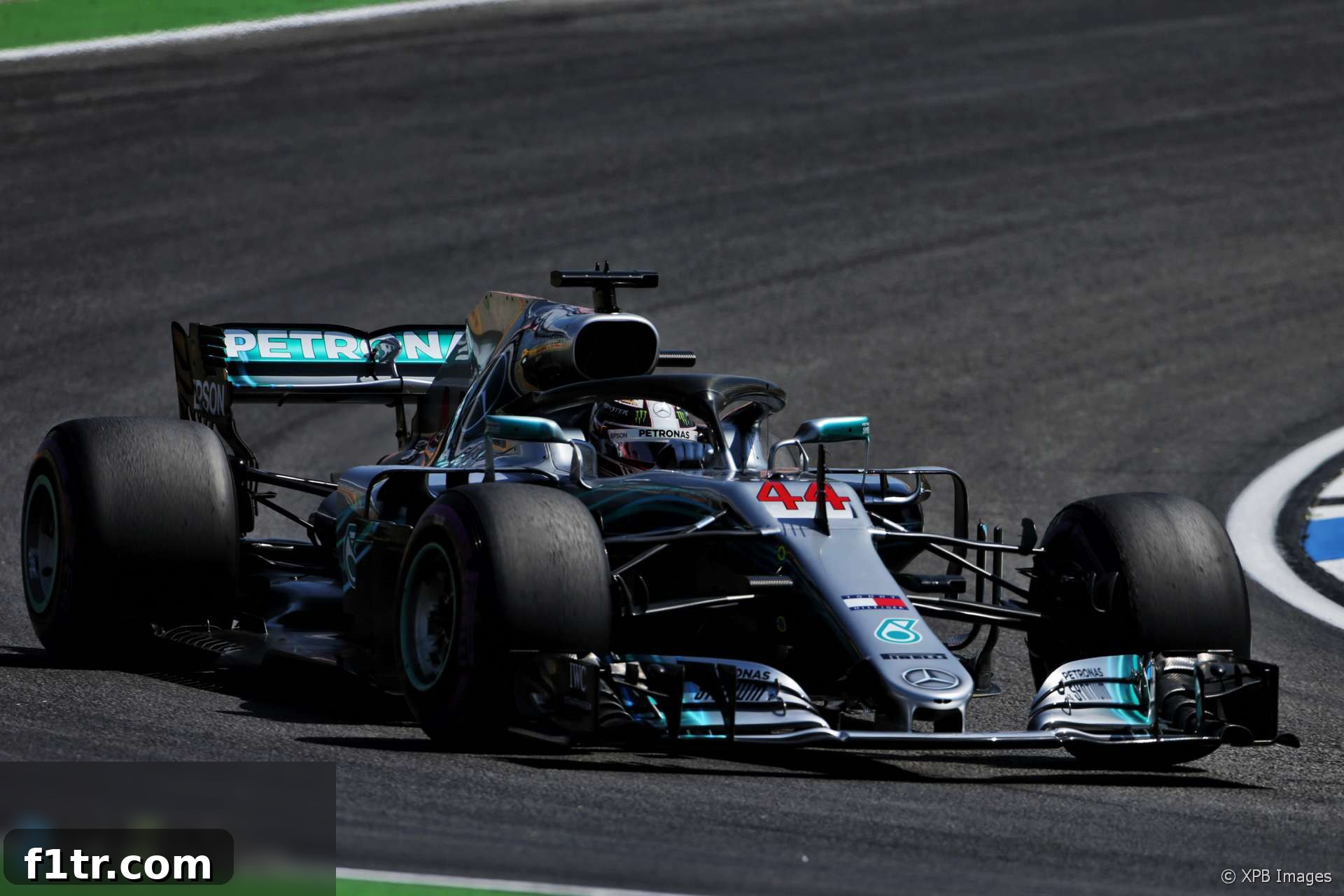
Controversial Victory: Lewis Hamilton Under FIA Investigation After Dramatic German Grand Prix
In a turn of events that sent shockwaves through the Formula 1 paddock, Lewis Hamilton, fresh off a spectacular victory at the German Grand Prix, found himself summoned before the stewards. The reason? A contentious pit entry incident during the race that could potentially strip him of his hard-fought win. The investigation centers on whether the Mercedes driver breached Appendix L, Chapter IV, Article 4(d) of the FIA International Sporting Code by “crossing the line separating the pit entry and the track” – a rule designed to ensure safety and fair play within the highly regulated environment of a Grand Prix.
The Dramatic Context: A Rain-Soaked German Grand Prix
The 2018 German Grand Prix at Hockenheim was an unpredictable and thrilling spectacle, marked by changing weather conditions that played a pivotal role in the outcome. Mercedes’ home race began under clear skies, but a looming threat of rain kept teams on edge. Ferrari’s Sebastian Vettel started from pole position, seemingly on course for a dominant victory and extending his championship lead over Hamilton. However, fate had other plans.
Hamilton, starting a challenging 14th after a hydraulic issue sidelined him in qualifying, embarked on a remarkable recovery drive. His sheer pace and strategic brilliance saw him steadily climb through the field. As the race progressed, the heavens opened, transforming the track into a treacherous surface and triggering a flurry of pit stops for intermediate or wet tyres. This sudden change in conditions dramatically reshaped the race, turning strategies on their head and creating opportunities for those brave enough to seize them.
The climax of the race arrived when Sebastian Vettel, leading comfortably, slid off the track at the Sachskurve complex, colliding with the barriers and retiring from his home Grand Prix. This monumental error brought out the Safety Car, bunching up the field and handing the lead to Hamilton, who had by this point navigated his way into contention. What followed was a nail-biting finish, with Hamilton managing to hold off a charging Valtteri Bottas, his Mercedes teammate, by less than five seconds.
The Incident: A Split-Second Decision Under Pressure
It was amidst this chaos and high-stakes racing that the controversial pit entry incident occurred. As the rain intensified and the Safety Car was deployed, multiple drivers, including Hamilton, were called in for tyre changes. Mercedes initially instructed Hamilton to pit, but a last-minute change of heart or a miscommunication over the team radio led him to abort the pit entry. In a moment of intense pressure and rapid decision-making, Hamilton committed to the pit lane, only to then veer back onto the track, effectively driving over the white line that clearly delineates the pit entry from the main racing line.
The FIA International Sporting Code’s Appendix L, Chapter IV, Article 4(d) explicitly states: “Except in cases of force majeure (accepted as such by the stewards), the crossing, in any direction, of the line separating the pit entry and the track by a car entering the pit lane is prohibited.” This rule is fundamental for maintaining safety, preventing collisions between cars entering the pits and those remaining on track, and ensuring a clear, predictable flow of traffic during high-speed racing.
FIA Stewards and the Weight of the Decision
The role of the FIA stewards in Formula 1 is critical. They are tasked with enforcing the vast and intricate rulebook, investigating potential infringements, and applying penalties where necessary. Following the German Grand Prix, Hamilton’s incident was flagged for review. The stewards meticulously examine all available evidence, which typically includes onboard camera footage, telemetry data, team radio communications, and eyewitness accounts. Their objective is to determine whether a clear breach of the rules occurred and if there were any mitigating circumstances, such as genuine force majeure, that could excuse the action.
The decision facing the stewards was monumental. A violation of Article 4(d) often results in a time penalty, which, given Hamilton’s narrow winning margin over Bottas, could easily cost him the victory. The implications extend far beyond a single race result; it could significantly impact the constructors’ championship for Mercedes, Hamilton’s lead in the drivers’ championship over Vettel (who retired from the race), and indeed, the very narrative of a season defined by intense rivalry.
Understanding the FIA International Sporting Code
The FIA International Sporting Code is the bedrock of motorsport governance, ensuring fair competition and, most importantly, driver and spectator safety. The rule prohibiting crossing the pit entry line is a prime example of this. The pit lane, with its reduced speed limits and high concentration of personnel and equipment, is a dangerous area. Drivers entering and exiting must do so predictably to avoid accidents. Crossing the white line blurs this predictability, introducing an element of risk to both drivers on the main track and those already committed to the pit lane.
In previous instances, similar infringements have resulted in varying penalties, from reprimands to five-second time penalties, and in more severe cases, drive-through penalties or even grid drops for subsequent races. The consistency of these decisions is paramount for maintaining the integrity of the sport and ensuring that all competitors are held to the same standards. The stewards must weigh the specific context of Hamilton’s incident – the rapidly changing conditions, the sudden instruction change from his team, and the potential safety implications – against the strict letter of the law.
The Potential Ramifications: A Victory on the Line
If the stewards were to impose a time penalty on Lewis Hamilton, even a five-second penalty would be sufficient to relegate him to second place, handing the German Grand Prix victory to his teammate Valtteri Bottas. Such an outcome would not only be a significant blow to Hamilton personally, but it would also have considerable ramifications for the championship battle. Losing 25 points from a victory would tighten the standings, especially if his main rival, Sebastian Vettel, had not retired from the race. While Vettel’s DNF lessened the immediate impact on the points gap, the precedent set by such a decision would be profound.
For fans and pundits alike, the incident sparked a heated debate. Some argued that Hamilton’s action, while a clear technical infringement, was a genuine mistake made under extreme pressure and should be treated leniently. Others insisted that rules are rules, and the integrity of the sport demands strict adherence, regardless of the driver’s stature or the dramatic context of the race. The outcome of the stewards’ investigation was eagerly anticipated, as it had the power to dramatically alter the narrative of a truly memorable German Grand Prix.
Hamilton’s victory, celebrated with raw emotion and a sense of disbelief at his incredible comeback, stood precariously on the brink. The wait for the stewards’ verdict added another layer of tension to an already unforgettable weekend of Formula 1 racing, reminding everyone that in this sport, the battle isn’t over until the final decision is rendered.
2018 F1 season
- F1 feared “death knell” for Drive to Survive after Ferrari and Mercedes snub
- McLaren staff told us we were “totally crazy” to take Honda engines in 2018 – Tost
- ‘It doesn’t matter if we start last’: How Red Bull’s junior team aided Honda’s leap forward
- Honda’s jet division helped F1 engineers solve power unit problem
- McLaren Racing losses rise after Honda split
Browse all 2018 F1 season articles