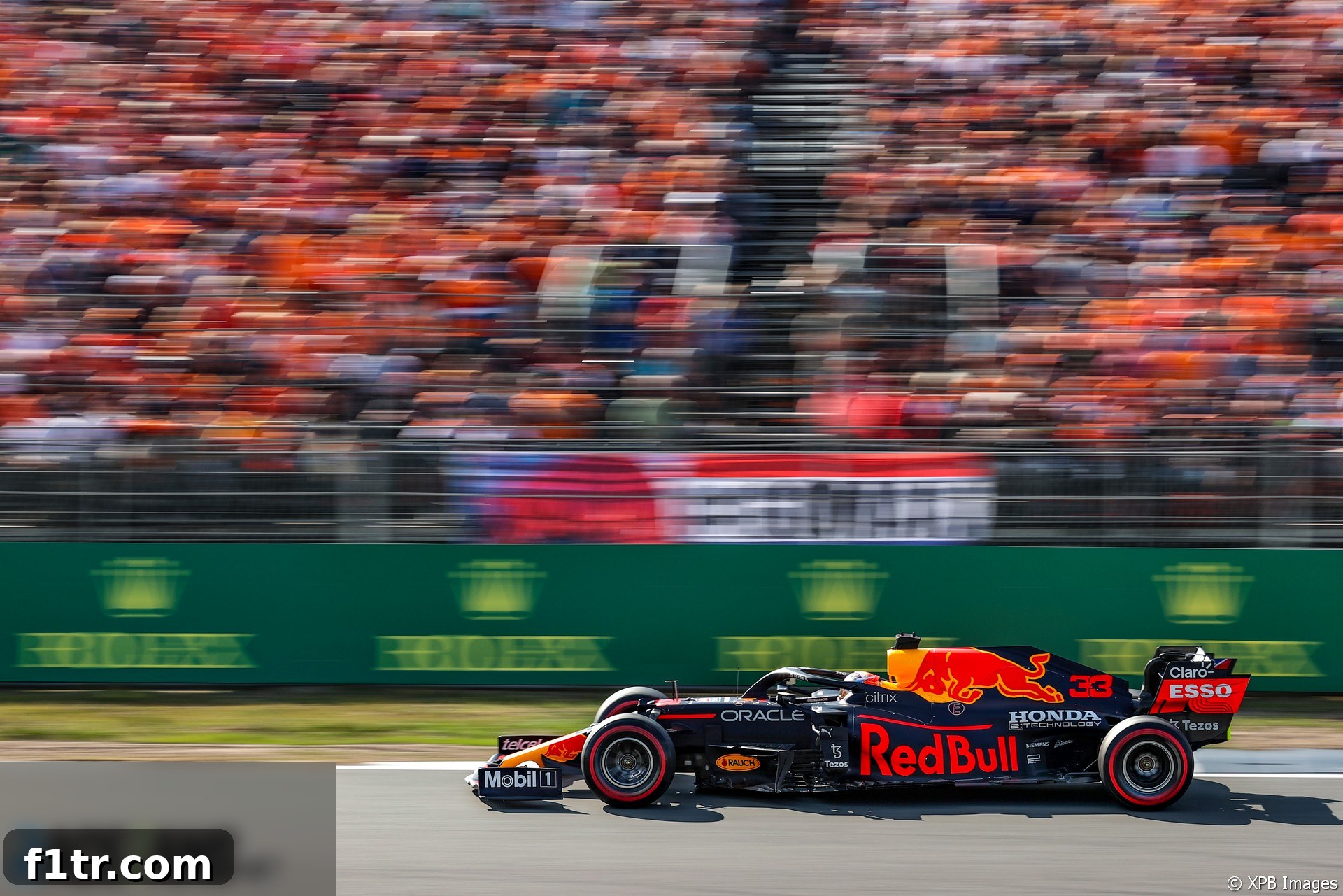
The roar of an impassioned home crowd echoed through the historic dunes of Zandvoort as Max Verstappen delivered a sensational performance to secure pole position for the Dutch Grand Prix. In a thrilling qualifying session that kept fans on the edge of their seats, the Red Bull ace narrowly outpaced his fierce rival Lewis Hamilton by a mere half a tenth of a second, setting the stage for what promised to be an electrifying race on Sunday. Verstappen’s blistering lap time of 1’08.885 marked a historic moment, earning him the first pole position at Zandvoort since the legendary Nelson Piquet achieved the feat way back in 1985, cementing his status as the local hero.
Despite a fleeting issue with his DRS out of the final corner on his decisive lap, Verstappen’s raw speed and precision proved insurmountable. Valtteri Bottas, in the second Mercedes, secured a respectable third spot on the grid, ensuring both Mercedes cars would start within the top three. Pierre Gasly continued his impressive form, steering his AlphaTauri to a brilliant fourth place, comfortably outperforming both Ferrari contenders and establishing himself as a significant threat for the race.
The return of Formula 1 to Zandvoort after decades brought with it an atmosphere thick with anticipation, and the qualifying session did not disappoint, delivering drama, excitement, and unexpected twists at every turn. From the track’s challenging banking to its narrow, unforgiving corners, every driver was pushed to their absolute limit, creating a spectacle that perfectly encapsulated the thrill of Formula 1 at its finest.
Q1: Chaos and Close Calls on the Evolving Zandvoort Circuit
The opening segment of qualifying, Q1, was anticipated to be a chaotic affair, a prediction that quickly materialized on the fast-evolving Zandvoort circuit. For the first Dutch Grand Prix qualifying in almost 40 years, the atmosphere was electric, with the vast majority of the orange-clad faithful cheering every move of their local hero, Max Verstappen. True to form, the Red Bull driver wasted no time in laying down an early benchmark, instantly sending a wave of delight through the grandstands as he topped the timesheets ahead of championship leader Lewis Hamilton.
A notable strategic play came from the Mercedes duo, Lewis Hamilton and Valtteri Bottas, who bravely opted to navigate Q1 on the yellow-walled medium tyres. They were the only team to attempt this, successfully securing their passage through to Q2 without having to resort to the faster but less durable soft compound. This bold decision highlighted Mercedes’ confidence in their car’s pace and their long-term race strategy, aiming to preserve their soft tyre allocation for later in the session or the race itself.
Meanwhile, Carlos Sainz Jnr faced an anxious start to his weekend after a significant crash at Hugenholtz during third practice. Thankfully, his Ferrari team worked tirelessly, releasing him from the garage with precious minutes to spare, allowing him to salvage his weekend from being severely compromised. Sainz demonstrated remarkable resilience, quickly finding pace despite the earlier setback. Robert Kubica, who had been parachuted into Kimi Raikkonen’s Alfa Romeo at short notice due to unforeseen circumstances, showed commendable effort. He momentarily climbed out of the drop zone by utilizing a second set of soft tyres, a testament to his experience, before inevitably falling back down the field as the track rapidly rubbered in and lap times continued to tumble across the grid.
As the minutes ticked away, the track evolution proved to be dramatic, with every passing moment offering better grip and faster lap times. This led to a furious scramble in the final moments of Q1. Both Ferraris made significant improvements, with Charles Leclerc surging to the top of the timesheets ahead of his teammate Sainz, showcasing the Scuderia’s improving performance. Antonio Giovinazzi of Alfa Romeo and Nicholas Latifi of Williams also delivered impressive laps, both managing to temporarily break into the top ten, a strong indicator of their car’s potential on this unique circuit.
However, the rapidly improving conditions and the sheer volume of cars on track inevitably led to traffic issues, which proved disastrous for some. Sebastian Vettel, on a crucial flying lap, arrived at the final corner only to find a cluster of cars waiting to start their own laps. Forced to slam on the brakes to avoid collision with the Haas pair of Nikita Mazepin and Mick Schumacher, his lap was irrevocably ruined. This unfortunate incident saw the four-time world champion eliminated in a disappointing 17th position, a harsh blow given his team’s potential. Compounding the traffic chaos, Sergio Perez, in the second Red Bull, also found himself caught up in the melee. He heartbreakingly failed to cross the line to begin his final attempt before the chequered flag was waved, forcing him to watch helplessly as first Esteban Ocon, then Lando Norris, improved their times. This pushed Perez down into 16th, prematurely ending his qualifying session and marking a significant upset for Red Bull.
The dramatic conclusion of Q1 also sparked an investigation by the stewards. Both Mazepin and Schumacher, the Haas teammates, were scrutinized for their actions at the end of the session. Mazepin vocally complained over the team radio that Schumacher had overtaken him immediately after they left the pits, and it appeared Schumacher was attempting to pass his teammate at Turn 13 when Vettel encountered the pair. This incident underscored the intense pressure and the fine margins at play on the tight Zandvoort circuit.
The drivers eliminated in Q1 painted a picture of unexpected struggles for some, and the brutal reality of Formula 1 qualifying for others. Sergio Perez’s 16th place was a major surprise, followed by Sebastian Vettel in 17th due to the traffic. Robert Kubica, despite his valiant effort, ended up 18th, ahead of the two Haas cars, with Mick Schumacher leading Nikita Mazepin on the back row of the grid. Their elimination highlighted the unforgiving nature of the Zandvoort circuit and the fierce competition throughout the field.
| 16 | Sergio Perez | Red Bull-Honda | 1’10.530 |
| 17 | Sebastian Vettel | Aston Martin-Mercedes | 1’10.731 |
| 18 | Robert Kubica | Alfa Romeo-Ferrari | 1’11.301 |
| 19 | Mick Schumacher | Haas-Ferrari | 1’11.387 |
| 20 | Nikita Mazepin | Haas-Ferrari | 1’11.875 |
Q2: Red Flags, Crashes, and Unexpected Casualties
As the second qualifying session, Q2, commenced, Max Verstappen and Red Bull wasted no time asserting their dominance. Taking advantage of the relatively quiet track, Verstappen immediately headed out to lay down an early banker lap. His astonishing 1’09.071 was over a full second faster than his best time in Q1 and left him more than six-tenths quicker than both Mercedes drivers, Lewis Hamilton and Valtteri Bottas, after their initial attempts on the soft tyre. This early display of raw pace sent a clear message to his rivals: Verstappen was truly in a class of his own on home soil.
Pierre Gasly continued to be one of the standout performers of the weekend. The AlphaTauri driver impressively jumped up to third fastest, positioning himself ahead of both Mercedes and behind Charles Leclerc’s Ferrari, further cementing his dark horse status. However, Gasly’s teammate, Yuki Tsunoda, struggled to match his pace, finding himself languishing at the rear of the field after his initial run, illustrating the significant gap in performance between the two AlphaTauri drivers.
The session took a dramatic turn when George Russell, keen to improve on his provisional 11th place, pushed his Williams to the absolute limit. Entering the penultimate corner with too much aggression, he spun backwards into the gravel trap, making contact with the tyre barriers with the rear of his car. The red flag was immediately deployed, bringing the session to a temporary halt. Despite the impact, Russell showcased remarkable car control and determination, managing to drive his damaged Williams out of the gravel, around the banked final corner, and back into the pit lane, a testament to his skill and the robustness of the car.
Despite his heroic return to the garage, Russell was unfortunately unable to rejoin the track when the session eventually resumed with just under four minutes remaining. The brief resumption of Q2 immediately brought a new challenge: drivers, eager to avoid the potential chaos of heavy traffic on the narrow circuit, formed a queue at the pit lane exit, taking turns to join the circuit for their out-laps. This strategic jockeying for clear air highlighted the critical importance of a clean run on a track where track position was paramount.
With the ever-present risk of dramatic track evolution meaning no position was truly safe, both Red Bull and Mercedes opted to send their cars back out in the dying minutes for one final lap. The tension was palpable as the clock ticked down. However, fate intervened once more. Just as drivers were preparing for their crucial flying laps, the session was stopped for a second time. This time, it was Russell’s Williams teammate, Nicholas Latifi, who spun on the entry to the fast right-hand kink of Turn 8 while attempting to overtake Lewis Hamilton’s Mercedes. Latifi crashed heavily into the barriers, bringing the session to an abrupt and final halt.
Thankfully, Latifi was unhurt and able to climb out of his wrecked car, but with only one minute and 38 seconds left on the clock, race control made the decision not to restart the session. This untimely conclusion had significant repercussions, creating unexpected casualties in Q2. Lando Norris, a strong contender throughout the weekend, became a surprise victim, eliminated in 13th place after being unable to complete his final flying lap. George Russell, despite his earlier accident, was credited with 11th place, just missing out on Q3, while Lance Stroll found himself knocked out in 12th. Nicholas Latifi, whose crash ended the session, was placed 14th, with Yuki Tsunoda rounding out the eliminated drivers in 15th position. The chaotic nature of Q2, punctuated by two red flags, proved to be a harsh mistress for several talented drivers.
| 11 | George Russell | Williams-Mercedes | 1’10.332 |
| 12 | Lance Stroll | Aston Martin-Mercedes | 1’10.367 |
| 13 | Lando Norris | McLaren-Mercedes | 1’10.406 |
| 14 | Nicholas Latifi | Williams-Mercedes | 1’11.161 |
| 15 | Yuki Tsunoda | AlphaTauri-Honda | 1’11.314 |
Q3: Verstappen’s Masterclass Secures Home Pole
The anticipation for the final shootout for pole position, Q3, was intensified by an extended delay as marshals diligently repaired the barriers at Turn 8 following Nicholas Latifi’s heavy crash at the very end of Q2. The Zandvoort crowd, undeterred by the wait, maintained their fervent energy, eager to witness history unfold. When Q3 finally got underway, all ten remaining cars meticulously filed out of the pit lane, each driver leaving enough space to ensure unimpeded fast laps, a crucial strategy on the narrow, unforgiving circuit.
Max Verstappen, fueled by the roar of his home fans, immediately ignited the timing screens with a scorching pace. His initial run, a remarkable 1’08.923, instantly propelled him to the top, setting a formidable benchmark for his rivals. Valtteri Bottas, in the Mercedes, was nearly three-tenths slower than the Red Bull ace, while his teammate Lewis Hamilton found himself an additional half a tenth behind Bottas, slotting into third. This early advantage for Verstappen signaled his intent and demonstrated his exceptional comfort and speed on his home track.
Beyond the top three, Pierre Gasly continued his stellar performance, delivering an impressive first effort in Q3 that was good enough for fourth place. He once again positioned his AlphaTauri ahead of both Ferraris, with Charles Leclerc leading Carlos Sainz Jnr on the provisional third row. Veteran Fernando Alonso secured seventh place for Alpine, just ahead of Antonio Giovinazzi in the Alfa Romeo, Daniel Ricciardo in the McLaren, and Esteban Ocon in the second Alpine, rounding out a highly competitive top ten.
A period of hushed anticipation descended upon the track as teams prepared for the decisive final runs. The silence was broken with just over three minutes remaining, as all ten cars once again emerged onto the circuit. Max Verstappen led the charge, with the two Mercedes of Bottas and Hamilton strategically positioning themselves at the rear of the train of cars, aiming to maximize slipstream benefits and ensure a clear track for their flying laps.
The tension was palpable as Verstappen began his final assault. He brilliantly lit up the middle sector with a fastest time, carrying immense speed through the challenging corners. Crossing the finish line, he improved on his own provisional pole time by an agonizingly close three-hundredths of a second, an incremental but crucial gain. Bottas, despite a strong effort, was unable to find any further improvement, leaving Lewis Hamilton as the sole contender with a realistic chance to deny the jubilant home fans their desired Dutch pole sitter. Hamilton pushed his Mercedes to the absolute limit, delivering a stunning final sector that showcased his legendary skill and determination. However, even his incredible effort wasn’t quite enough; he fell short of Verstappen’s best time by just under four-hundredths of a second. The slim margin underscored the breathtaking intensity of their rivalry and ultimately ensured that Max Verstappen would indeed be the first Dutch driver in history to claim pole position for the Dutch Grand Prix, sending the Zandvoort crowd into rapturous celebration.
With the final times locked in, Hamilton demoted Bottas to third place, securing a front-row start for Mercedes. Pierre Gasly’s phenomenal weekend continued as he improved to secure a well-deserved second-row start for AlphaTauri, a testament to his consistent pace. The Ferraris of Charles Leclerc and Carlos Sainz Jnr will occupy the third row, showcasing the Italian team’s progress. Antonio Giovinazzi clinched a strong seventh, followed by Esteban Ocon in eighth, Fernando Alonso in ninth, and Daniel Ricciardo completing the top ten, setting the stage for an unforgettable race on Sunday.
| 1 | Max Verstappen | Red Bull-Honda | 1’08.885 |
| 2 | Lewis Hamilton | Mercedes | 1’08.923 |
| 3 | Valtteri Bottas | Mercedes | 1’09.222 |
| 4 | Pierre Gasly | AlphaTauri-Honda | 1’09.478 |
| 5 | Charles Leclerc | Ferrari | 1’09.527 |
| 6 | Carlos Sainz Jnr | Ferrari | 1’09.537 |
| 7 | Antonio Giovinazzi | Alfa Romeo-Ferrari | 1’09.590 |
| 8 | Esteban Ocon | Alpine-Renault | 1’09.933 |
| 9 | Fernando Alonso | Alpine-Renault | 1’09.956 |
| 10 | Daniel Ricciardo | McLaren-Mercedes | 1’10.166 |
2021 Dutch Grand Prix
- “So many people love him”: Raikkonen’s rivals pay tribute to retiring champion
- Alonso studied junior series, not IndyCar, for Zandvoort banking clues
- 2021 Dutch Grand Prix Star Performers
- Paddock Diary: Dutch Grand Prix part two
- Verstappen makes the Netherlands 12th country to produce a home F1 winner
Browse all 2021 Dutch Grand Prix articles