When the partnership between Toro Rosso and Honda power units was first announced in September of last year, widespread skepticism overshadowed any potential for the team’s success in the 2018 Formula 1 season. Many within the paddock and among fans alike were quick to write off their chances, recalling Honda’s arduous and largely unsuccessful three-year stint with McLaren. The Japanese manufacturer had become synonymous with reliability issues, performance deficits, and a general inability to compete at the sharp end of the grid, a stark contrast to McLaren’s glorious history.
Concerns were further exacerbated by Toro Rosso’s comparatively modest budget, especially when contrasted with McLaren’s substantial financial resources. Despite the implicit backing of the mighty Red Bull organization, Toro Rosso operates as a junior team, typically without the same level of spending power as its senior counterpart. Adding to this challenging equation, the team embarked on the 2018 campaign with arguably the two least experienced drivers on the entire grid, a factor that many believed would be an insurmountable handicap. The combination of an underperforming engine supplier, a limited budget, and rookie drivers painted a bleak picture for the Italian squad.
Advert | Become a Supporter & go ad-free
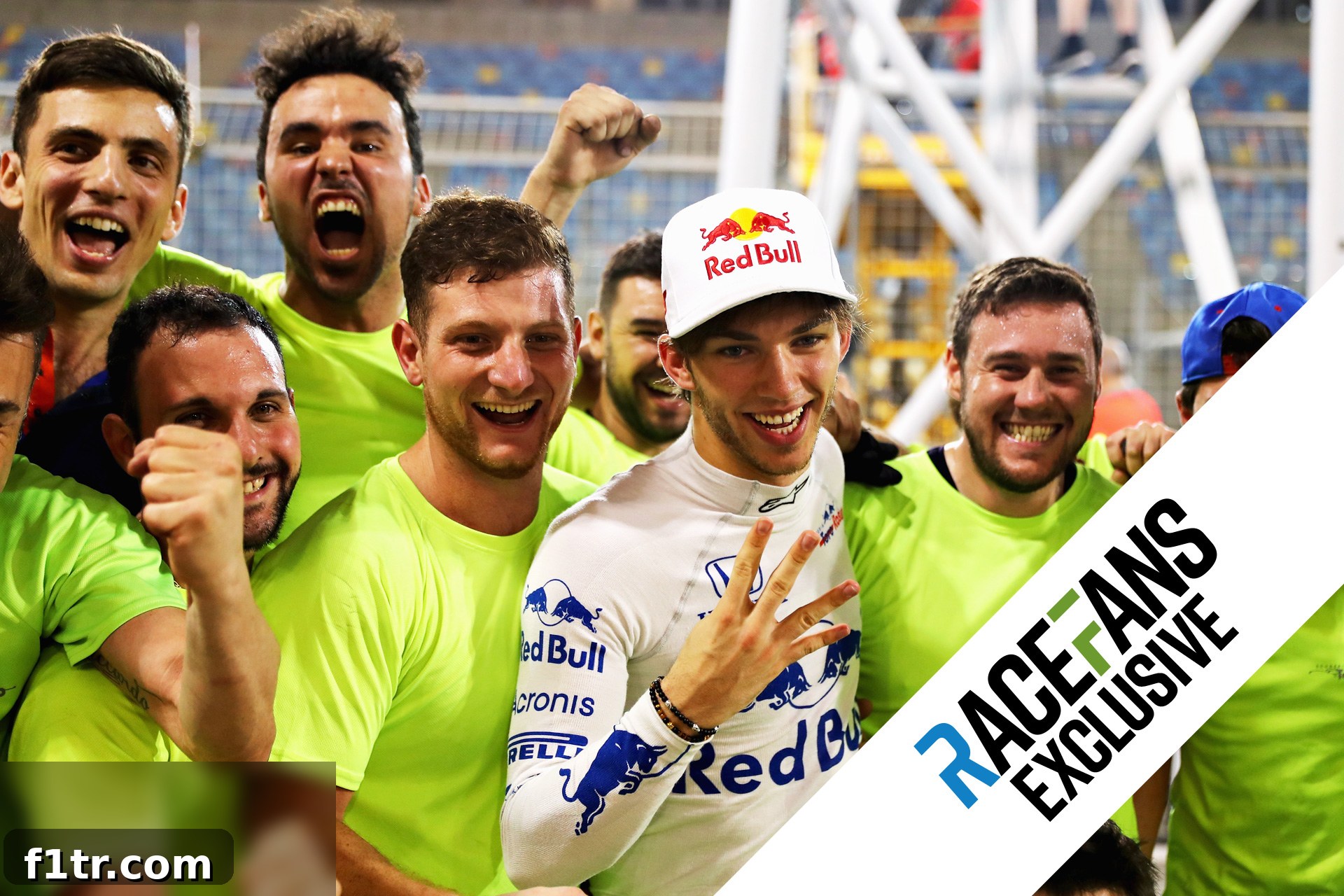
Initial expectations seemed to be grimly confirmed during the season opener in Australia, a race that saw one Toro Rosso-Honda STR13 car retire after little more than a dozen laps, while the other limped home in last position. The team’s performance mirrored the pre-season predictions, leaving many to wonder if this would be another year of struggle. However, the narrative took a dramatic and unexpected turn in the very next race. In only the second Grand Prix of the season, Pierre Gasly delivered a sensational performance, guiding his Toro Rosso-Honda STR13 to a stunning fourth-place finish at the Bahrain Grand Prix. This remarkable result placed him behind only a single Ferrari and two Mercedes cars, a truly exceptional feat that sent shockwaves through the Formula 1 community.
The sudden leap in performance from Australia to Bahrain left many questioning whether the result surprised the team as much as it did the rest of the paddock. Speaking exclusively to RaceFans, James Key, Toro Rosso’s Technical Director at the time, offered valuable insights into this remarkable turnaround. He acknowledged that their significant step forward in Bahrain was somewhat flattered by their particularly poor showing in Australia. Key explained that the perceived “enormous leap” was largely a consequence of having a genuinely “bad race” followed by an exceptionally “good race,” creating a magnified sense of progress.
“The steps we made since Australia, both on chassis/mechanical set-up and new aerodynamic bits we’ve introduced, appear to complement each other and work quite well,” Key explained. He further elaborated, “So we felt Bahrain was going to be a better circuit for us than Australia. In Australia we under-performed terribly so the leap looks enormous but it was really because we had a bad race [followed by] a good race. But probably we got more from the combination of work than we expected. When we got there and we started running we realised the balance of the car [had] improved a lot.” This nuanced perspective suggests that while the Australian result was an anomaly, the improvements implemented between races were genuinely effective, revealing an underlying potential that had yet to be fully unlocked.
Once the team realized the significant improvements in the car’s balance and overall performance during the Bahrain practice sessions, it became a matter of executing a perfect race strategy to capitalize on their newfound potential. Key confirmed that the ultimate race result, while impressive, did not catch them entirely off guard after seeing the car’s pace during the weekend. “The result didn’t [surprise us] because by that point we kind of felt we had a reasonable understanding of our performance level,” he stated. The team’s strategy, which focused on ensuring Gasly had “free air” to run in, proved to be highly effective, allowing the young Frenchman to maximize the car’s performance without being hindered by traffic. This strategic acumen, combined with the driver’s skill and the car’s improved characteristics, culminated in the sensational fourth-place finish.
Another crucial element contributing to Toro Rosso’s surprising success was the exceptionally tight and competitive nature of the 2018 midfield battle. In an era where the front-running teams often enjoyed a significant performance advantage, the fight among the rest of the grid was incredibly intense. Key highlighted this aspect, explaining that even marginal gains in lap time could dramatically alter a team’s grid position or race outcome. “It’s so tight in the midfield all of the grid positions. If you look at lap time two-tenths is in reality nothing but it’s front-to-back of the midfield battle,” he elaborated. This meant that a relatively small improvement in the car’s performance, combined with optimal strategy and driver execution, could yield multiple positions, transforming a potential points finish into a top-five result. This inherent volatility of the midfield added another layer of unpredictability and excitement to the season, allowing teams like Toro Rosso to punch above their weight on certain weekends.
The delicate balance of power within the midfield was, and remains, highly susceptible to various factors. Key pointed out that the competitive landscape could shift significantly depending on the specific characteristics of each circuit, the inherent strengths and weaknesses of the different cars, and how well individual drivers adapted to particular tracks. Tyres also played a pivotal role, with varying compounds and track temperatures often dictating performance nuances. “So I think the balance of power will shift around depending on circuits, how good the drivers are at particular circuits, and the tyres. All these aspects that play into a weekend’s performance,” Key explained. This dynamic environment means that consistency across all circuits is a challenge, and teams must be adept at optimizing their package for each unique venue. Furthermore, the presence of inexperienced drivers, as was the case for Toro Rosso, added another layer of complexity. As Key noted, “If our drivers are new to a track and they have to learn it, Friday’s going to be a learning day so we’re not really going to see full performance at the end of it, necessarily,” underscoring the crucial role of track familiarity in a closely contested championship.
Toro Rosso has long been affectionately known as Red Bull’s “kindergarten,” a description often used by team principal Franz Tost, due to its role as a proving ground for young talent. Consequently, the team possesses extensive experience in nurturing and working with inexperienced drivers. In 2018, this was particularly evident with Pierre Gasly and his team mate Brendon Hartley, both of whom had made their Formula 1 debuts late in the previous season. As the 2018 season began, the pair had a combined total of only nine F1 starts between them, making them by far the least experienced duo on the grid. While their F1 mileage was limited, both drivers had already demonstrated their exceptional pedigree in other highly competitive categories. Gasly, for instance, was a former GP2 (now Formula 2) champion, a title that signifies immense talent and race craft. Hartley, on the other hand, brought a different kind of endurance and speed, being a Le Mans 24 Hours winner and a World Endurance Champion. Their diverse yet impressive backgrounds suggested a strong foundation despite their F1 rookie status.
James Key believes that having inexperienced drivers is less of a handicap in modern Formula 1 than it might have been in previous eras, largely due to the pervasive influence of data-driven car development. “I think there’s ways of working with those drivers to circumvent the lack of experience they have to a certain extent,” he explains, highlighting the sophisticated tools and processes now available to teams. While the engineers bear a greater burden, the availability of vast amounts of telemetry and simulation data allows teams to develop the car more independently. “It puts more pressure on the engineering side but you can still do that. There’s a lot of data thrown at cars now, you’re not relying on the driver to develop the car or anything like that you can do it yourself.” This shift means that while raw speed and race craft remain paramount, the intricate process of car development is now less reliant on a seasoned driver’s subjective feedback for fundamental changes and more on objective data analysis. However, the driver’s unique role still lies in their ability to detect subtle nuances and trends that data alone cannot always capture.
Advert | Become a RaceFans supporter andgo ad-free
Where the driver truly excels, especially during critical race weekends, is in their capacity to identify specific trends or situations that demand immediate attention and adaptation. This is where their intuition and feel for the car become indispensable. “Where the driver really plays a role, particularly at race weekends, is identifying a certain trend of situation,” Key elaborated. He gave an example: “When a driver goes half a second slower than you expect but he says ‘don’t worry, by the time I get to qualifying (I know where it is) you’ve got this level of feedback you need.” This ability to articulate precise sensations, pinpoint issues, and provide nuanced feedback is invaluable for fine-tuning the car to extract maximum performance. Key drew a parallel to an experienced driver like Carlos [Sainz Jnr], who had reached that level of sophisticated feedback by the time he departed Toro Rosso, underscoring the developmental trajectory young drivers undergo within the team. This dual approach, combining data analytics with refined driver feedback, allows Toro Rosso to successfully integrate and develop its young talent.
Engine suppliers since 2014
| Team | 2014 | 2015 | 2016 | 2017 | 2018 |
|---|---|---|---|---|---|
| Mercedes | Mercedes | ||||
| Ferrari | Ferrari | ||||
| Red Bull | Renault | ||||
| Force India | Mercedes | ||||
| Williams | Mercedes | ||||
| Renault* | Renault | Mercedes | Renault | ||
| Toro Rosso | Renault | Ferrari | Renault | Honda | |
| Haas | Ferrari | ||||
| McLaren | Mercedes | Honda | Renault | ||
| Sauber | Ferrari | ||||
*Lotus in 2014-15
The team’s unique expertise isn’t confined to developing young drivers; it also extends to a profound familiarity with frequently changing engine brands. Since the introduction of the current V6 hybrid turbo regulations in 2014, Toro Rosso has demonstrated an unparalleled adaptability, a necessity born from a series of power unit supplier changes. Incredibly, they have only maintained the same engine supplier from one season to the next on a single occasion, a stark contrast to most of their rivals who have enjoyed far greater consistency with their power unit partners. This constant flux means that Toro Rosso operates in a state of perpetual adaptation, a challenge that few other teams in the highly specialized world of Formula 1 have faced to the same extent.
Switching engine suppliers in the era of highly complex V6 hybrid turbo power unit installations is an immensely daunting and resource-intensive task. As McLaren famously discovered when transitioning from Honda to Renault, such changes require significant redesigns, reconfigurations, and a complete recalibration of a car’s fundamental architecture. However, for Toro Rosso, this process has become remarkably familiar. “This is the third engine in three years, no other team does anything like that,” says James Key, underscoring the unique nature of their challenge. Each engine manufacturer has its own unique installation requirements, cooling demands, and integration specifications, making each change a bespoke engineering project. “They’re all different installations so we’ve been through the mill with that. As a result we know how to work together to deal with that. McLaren had the same challenge in reverse, I suppose.” Key’s comments highlight that this constant adaptation, while challenging, has forged an exceptional internal flexibility and a finely-tuned process for managing these transitions. It speaks volumes about the engineering resilience and logistical prowess of the team based in Faenza.
Toro Rosso’s approach to managing these frequent engine changes is a testament to their refined internal processes and inherent flexibility. Key elaborated on their methodical strategy: “We’ve got a method of doing it, we go through our planning process, we delay things as much as we can, we re-plan everything. I think we’ve changed the order of things as well so what had to be an early release before becomes a late release, we compensate for it.” This intricate planning involves postponing design freezes, reallocating engineering resources, and adjusting development schedules to accommodate the varying demands of each new power unit. Every department, from chassis design to cooling systems and electronics, must be in lockstep to ensure a seamless (or as seamless as possible) integration. This constant evolution has instilled in the team a remarkable ability to pivot quickly and efficiently, a trait that has become a defining characteristic of Toro Rosso and a significant advantage in a sport where adaptability is key.
The transition from being a customer team to securing a works engine supply, as was the case with Honda, brought with it a host of additional opportunities and advantages. A works partnership entails a much closer collaboration with the engine manufacturer, allowing for bespoke integration, tailored solutions, and greater input into the power unit’s development trajectory. Key highlighted some of these benefits, such as the ability to conduct more extensive dyno testing, which provides invaluable data for optimization. He also mentioned “all the things we haven’t done before which takes resources and time and design effort.” This deeper level of engagement meant Toro Rosso could optimize their entire package with Honda in a way that wasn’t possible with customer engines. However, this deeper integration also demanded greater changes within the team, even more so than their previous switches between Ferrari and Renault customer units, signifying the increased scope of the partnership.
Advert | Become a RaceFans supporter andgo ad-free
While the benefits of a works deal were significant, its implementation also presented unique challenges, particularly for a team not traditionally structured for such a partnership. “Taking on a works deal for the first time is working at the moment reasonably well and we’re enjoying it but we’re not set up to do that,” Key admitted. This transition necessitated a degree of internal reorganization, requiring numerous individuals across the team to put in “lots of extra hours” to facilitate the closer collaboration and increased workload. In this respect, it was far from an easy undertaking. However, the very flexibility that Toro Rosso had cultivated over years of frequent engine and driver changes proved to be their greatest asset. Key emphasized this point: “But equally the flexibility we’ve developed internally with the fact that we have to be flexible because the engine change comes at the last minute or there might be a driver change, means that we’ve got enough flexible resource to move people around and just go do it.” This inherent adaptability allowed the team to absorb the demands of a works partnership and continue its development trajectory.
The performance of the Toro Rosso-Honda partnership in 2018 was not merely a point of interest for Formula 1 fans; it was also under intense scrutiny from Red Bull Racing. Red Bull had made no secret of their active monitoring of Honda’s progress with their junior team, with a clear strategic objective in mind: a potential switch to Honda power units for their senior team in the following season. If the Honda power units could demonstrate competitive performance, at least matching, if not surpassing, the Renault engines Red Bull was currently using, it would unlock a significant opportunity. Such a move would allow Red Bull to forge a closer, ‘works’ relationship with a manufacturer, providing a level of integration and collaboration that a customer supply simply cannot offer. This closer working relationship could yield bespoke solutions, shared development resources, and a more streamlined technical partnership, all of which are highly coveted advantages in Formula 1.
A scenario where both Red Bull and Toro Rosso were to utilize the same engine partner once more would also open up discussions about the adoption of the ‘listed parts’ model for Toro Rosso, a concept famously championed and successfully implemented by Haas F1 Team. Under this model, certain non-listed components, typically including everything from gearboxes to suspensions, could be sourced directly from the senior team, rather than being designed and manufactured independently. However, James Key harbored mixed feelings about whether this was a desirable route for Toro Rosso to pursue, and indeed, whether it was a positive direction for the sport as a whole. His perspective highlights a fundamental tension between business pragmatism and the competitive spirit inherent in Formula 1 engineering.
From a purely business perspective, Key conceded that the listed parts model offered compelling advantages. “If you put your business hat on, yes it is [positive], because it allows new teams like Haas to come on board and have a competitive car [and] they don’t have to spend a ridiculous amount of money to replicate what everyone else has done.” This model significantly reduces the entry barrier and operational costs for smaller or newer teams, fostering a more diverse grid. However, Key’s “engineering hat” presented a contrasting viewpoint. “With your engineering hat on, no, because it really is a competition between manufacturers as well as drivers.” For an engineer, the essence of Formula 1 lies in the relentless pursuit of innovation, the challenge of designing and building every component, and the pride of outperforming rivals through superior engineering. Adopting listed parts, while financially prudent, could dilute the unique engineering identity and the pure competitive challenge that drives many F1 professionals. It would shift the focus from a full-scale engineering battle to one primarily centered around engine and aerodynamic development, diminishing the scope for independent innovation.
If Toro Rosso were to evolve into the Red Bull-Honda equivalent of Haas, heavily relying on shared components, the satisfaction derived from achievements like the sensational fourth-place finish in Bahrain might indeed feel less profound. Key underscored this sentiment, revealing the deep-seated competitive drive within the engineering community of Formula 1. “I think what’s often missed is engineers, particularly in F1, are very competitive people,” he emphasized. This competitive spirit fuels the relentless innovation and dedication seen in the sport. On a personal level, Key articulated his aspiration: “On a personal level I would like to be the best team leader and team player that I can on my terms and go and win championships.” This reflects the intrinsic motivation of engineers to achieve success through their own ingenuity and hard work. Yet, the realities of funding and business strategy cannot be ignored. “But from a company point of view and a business point of view if the listed parts route is more sensible then given that we’re funded by a company and a business who’s extremely generous towards us, you look at it that way.” This balancing act between personal engineering ambition and corporate strategic imperatives is a constant challenge for teams like Toro Rosso, much like the analogy of a driver aspiring to be a ‘number one’ but often fulfilling a ‘number two’ role for the benefit of the team. The Bahrain result was a testament to independent achievement, a source of immense pride that highlighted the competitive drive of every individual involved.
Go ad-free for just £1 per month>> Find out more and sign up
2018 F1 season
- F1 feared “death knell” for Drive to Survive after Ferrari and Mercedes snub
- McLaren staff told us we were “totally crazy” to take Honda engines in 2018 – Tost
- ‘It doesn’t matter if we start last’: How Red Bull’s junior team aided Honda’s leap forward
- Honda’s jet division helped F1 engineers solve power unit problem
- McLaren Racing losses rise after Honda split
Browse all 2018 F1 season articles