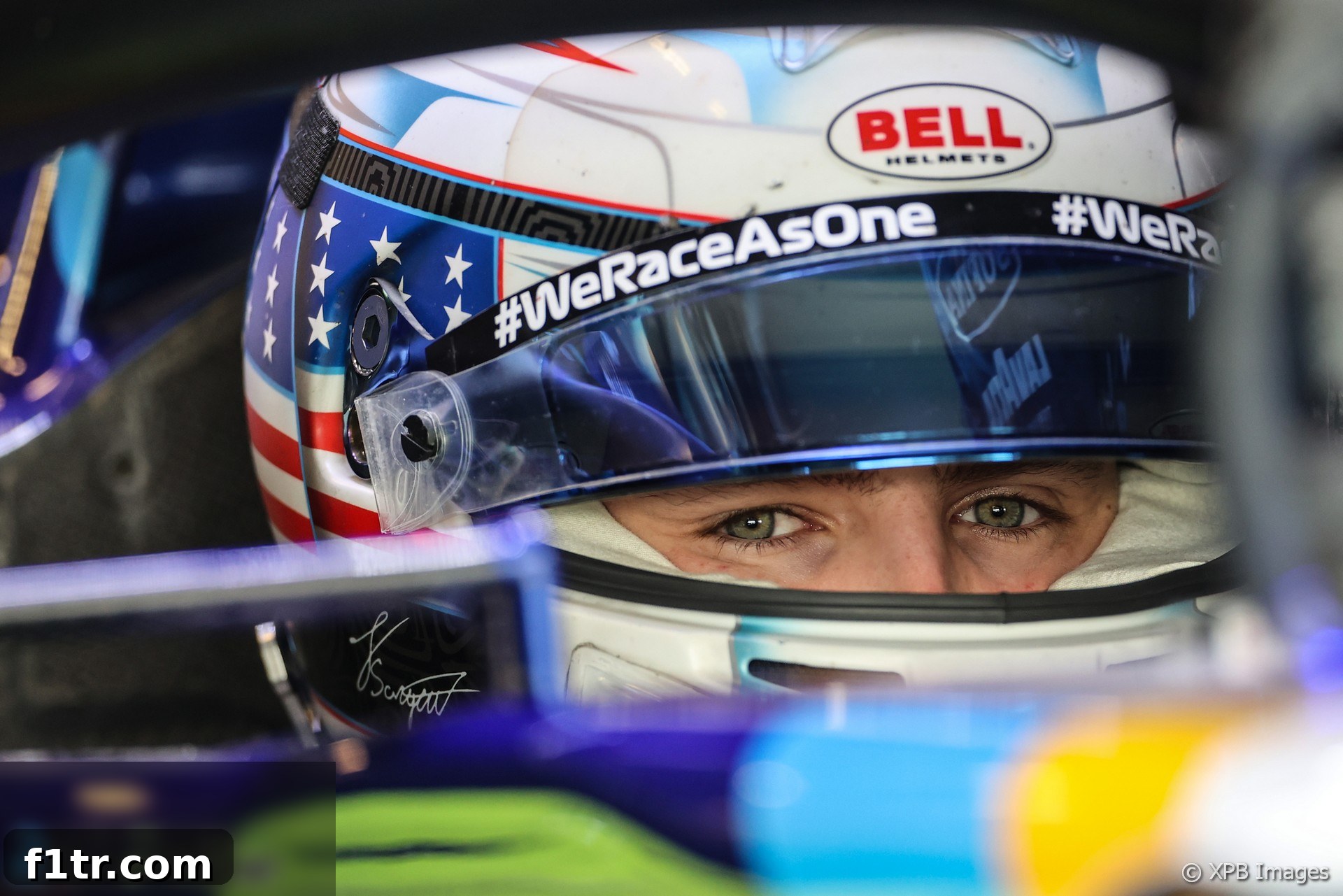
In the high-octane world of Formula 1, dreams are forged and careers are made. For aspiring American drivers, the path to the pinnacle of motorsport has historically been fraught with unique challenges, often requiring a full immersion into the European racing landscape. While recent headlines have buzzed with speculation about Andretti Global’s potential entry into F1 and the highly anticipated move of IndyCar star Colton Herta, it’s easy to overlook a quiet but determined talent already making significant strides just one tier below Formula 1. This is the story of Logan Sargeant, a Williams-backed American driver, who in 2022 embarked on his inaugural Formula 2 season with Carlin, firmly positioning himself as one of the most promising American prospects for a coveted F1 seat.
As a key member of the prestigious Williams Driver Academy, Sargeant’s journey is a testament to perseverance and unwavering commitment. RaceFans recently had the opportunity to sit down with the 21-year-old Floridian during the Miami Grand Prix weekend to discuss his challenging yet rewarding transition into Formula 2, his long-term aspirations, and the unique sacrifices required to chase the Formula 1 dream from across the Atlantic. His narrative is not just one of speed and skill, but also of strategic decisions, financial hurdles, and the profound personal dedication necessary to climb the motorsport ladder.
The American Dream: Closer to F1 Than Ever Before
With the rising interest in Formula 1 across the United States, fueled by events like the Miami Grand Prix and Netflix’s “Drive to Survive,” the spotlight on American talent has never been brighter. Logan Sargeant finds himself in an enviable position, often touted as the closest American driver to breaking into Formula 1. When asked about this distinction, Sargeant’s focus remains singularly on performance and achieving his ultimate goal.
Sargeant emphasized, “I don’t mind if I’m the first or second or whatever – as long as I make it there, that’s all that matters. Obviously, being in Formula 2 now, the path is there, it just comes down to performance.” This statement underscores his professional mindset, prioritizing results over labels. He added, “I feel like Carlin’s doing a really good job to give me a fast car at the moment so we can take advantage of that.” This belief in his team and equipment is crucial for any driver aiming for success in the intensely competitive Formula 2 championship. His pragmatic approach highlights the immense pressure on young drivers, where every race, every overtake, and every championship point can significantly impact their future prospects. Securing a Super Licence and demonstrating consistent top-tier performance are the critical benchmarks that stand between him and a coveted F1 drive.
Conquering the Formula 2 Challenge: A Steeper Learning Curve
The step up from Formula 3 to Formula 2 is widely regarded as one of the most significant leaps in a junior driver’s career. The cars are more powerful, heavier, and require a distinct driving style, demanding a comprehensive adaptation from drivers. Sargeant elaborated on the core challenges he faced in his rookie F2 season, shedding light on the technical and strategic adjustments required to master this demanding category.
“The biggest challenge switching between the two series is, one, wrapping your head around the weight of the car – it requires a slightly different driving style,” Sargeant explained. The F2 cars, being significantly heavier and more robust than their F3 counterparts, necessitate a nuanced approach to braking points, corner entry speeds, and tire management. Drivers must adapt to the increased inertia, the more powerful engine’s torque delivery, and the way the car reacts to sudden inputs. This physical difference directly influences race craft and requires a more sophisticated understanding of vehicle dynamics, including how to maximize performance from the larger, more complex machinery.
Beyond the technical aspects, Sargeant highlighted the “extremely chaotic races” as another major hurdle. Formula 2 races are notorious for their unpredictable nature, often featuring multiple safety car periods, aggressive overtaking maneuvers due to the DRS and push-to-pass systems, and a higher incidence of incidents compared to F3. Navigating this chaos while maintaining position, preserving equipment, and executing flawless pit stops is a skill honed over time and through intense pressure. “As long as you have good pace, keep your nose clean, a good pit stop, you should be right there to fight at the end,” he noted, emphasizing the multifaceted demands of F2 racing where not just raw speed, but also strategy, discipline, and a bit of luck play crucial roles. This intense environment serves as a vital training ground, preparing drivers for the even more cutthroat competition of Formula 1, where every decision and every tenth of a second can be career-defining.
From Doubt to Destiny: A Career-Defining Decision
Logan Sargeant’s current trajectory towards Formula 1 seemed anything but certain just a short time ago. The story of his career almost taking a drastically different turn after the 2020 season reveals the harsh realities of junior motorsport, where exceptional talent alone is often not enough without substantial financial backing and strategic opportunities. This period of uncertainty became a true test of his resilience and commitment.
“It is pretty crazy to even think about from my side,” Sargeant reflected on the precariousness of his position. “At the end of 2020 it looked very, very down. We didn’t really have many options. The budget wasn’t there to go to Formula 2.” This candid admission highlights a common struggle faced by many promising drivers who, despite their on-track prowess and strong results – Sargeant had finished third in the 2020 F3 championship, a remarkable achievement – find their careers stalled by a lack of funding for the next crucial step. Without the necessary budget, the traditional progression to F2, a natural move for a top F3 contender, seemed impossible.
A lifeline came in the form of a “really good offer” from Charouz to race in F3 again. This presented a difficult and unconventional choice: repeat a category he had already excelled in, a move often seen as a step back, or potentially pivot to an entirely different racing series outside the F1 ladder. “But even still, I nearly didn’t accept that, I nearly moved on to a different category,” he revealed. This was a critical juncture, where a different decision could have fundamentally altered the course of his motorsport career, potentially sending him down a path that would not lead to Formula 1. “But looking back at it, I’m very glad I took that and set me up for where we’re at now,” he concluded, acknowledging the profound impact of that seemingly small decision to stick with the European single-seater path. His eventual return to F3 in 2021, though less successful in terms of championship standing, kept him in the European spotlight, allowed him to gain further experience, and ultimately paved the way for his inclusion in the Williams Driver Academy and subsequent F2 debut. This period truly underscores the “sliding doors” moments in a racing driver’s journey, where persistence against the odds can unlock unforeseen opportunities.
The European Immersion: A Non-Negotiable Path to F1
For an American driver with Formula 1 aspirations, the consensus has long been that a complete commitment to living, training, and racing in Europe is not just beneficial, but essential. Sargeant unequivocally agrees with this sentiment, viewing it as an indispensable part of his development and preparation for the pinnacle of motorsport. This strategic relocation is a fundamental requirement to truly understand and thrive within the F1 ecosystem.
“I do,” he stated firmly. “I mean, I think coming through Formula 3, Formula 2, we’re using Pirelli tyres, we’re already getting well acquainted with all the circuits in F1, the way the tyres react, we’re just sort of being built up to the pinnacle of motorsport.” This pathway provides a meticulously structured environment that precisely mirrors Formula 1. By racing on the same tracks as F1, often on the same Grand Prix weekends, and exclusively using Pirelli tires – the sole supplier to Formula 1 – drivers gain invaluable, directly transferable experience. They learn the nuances of tire degradation, complex management strategies under race conditions, and the specific characteristics of iconic European circuits, all of which are critical for success at the highest level. The FIA junior series are intentionally designed as a direct feeder system, ensuring a seamless transition for those who prove their mettle.
This European immersion is about more than just track time; it’s about a complete cultural integration into the F1 ecosystem. It involves understanding the intricate team dynamics, navigating intense media scrutiny, and adapting to the relentless travel schedule that defines a Formula 1 career. Sargeant sees his choice as strategic and necessary: “So I think I’ve made the adjustment and I feel like that was the right decision and I feel like I put myself in the best position possible to get to Formula 1.” This reflects a mature understanding of the global F1 landscape, where international experience, cultural adaptability, and a deep understanding of European racing traditions are as important as raw speed. Unlike the distinct pathways offered by American series like NASCAR or IndyCar, the European junior formulae are specifically designed to cultivate F1-ready talent, making the commitment to Europe a non-negotiable step for true F1 aspirants.
The Origins of an F1 Dream: Why Not NASCAR or IndyCar?
Given his American roots, particularly growing up in Florida, it’s natural to wonder why Logan Sargeant chose the arduous European F1 ladder over the more prevalent and accessible American racing series such as NASCAR or IndyCar. His response suggests an organic progression driven by the inherent attraction of F1, rather than a definitive, early decision to actively shun other disciplines.
“I got asked that the other day actually,” Sargeant remarked, indicating it’s a frequent inquiry that speaks to the different motorsport cultures across the Atlantic. “I just felt like Formula 1 is obviously always in your mind but you just take each step at a time. And I feel like it just sort of led to this point. I don’t think there’s a real answer to it.” This highlights that for many young drivers, the ultimate dream of F1, while perhaps initially distant, guides their choices incrementally. While Formula 1 may be a grand aspiration, the immediate focus is always on winning the next race, succeeding in the current championship, and making the next logical step up the ladder. For Sargeant, each successful karting season and each progression up the European single-seater ladder naturally brought him closer to the F1 dream, solidifying his commitment to that particular, highly specialized path without necessarily having to consciously reject others. The unique blend of cutting-edge technology, global reach, and the prestige of Grand Prix racing makes F1 an unparalleled magnet for talent like his.
Early Laps: Florida Roots and Karting Beginnings
Every racing driver has a starting point, a foundational experience where the passion for speed and competition first took hold. For Logan Sargeant, this formative period began on the vibrant, sun-drenched karting tracks of his native Florida, a region known for producing top racing talent.
“My first racing experience was between Homestead, the karting track down there and also PBIR [Palm Beach International Raceway] which no longer exists, which is kind of sad to see,” he recalled. These early days of karting are fundamental for any driver, teaching them essential skills such as precise car control, intricate race craft, the art of overtaking, and instilling a fierce competitive spirit from a very young age. Karting provides the rawest form of racing, where talent and aggression are paramount, and it serves as the universal breeding ground for future champions across all motorsport disciplines. The mention of PBIR’s closure is a poignant reminder of the evolving motorsport landscape and the critical importance of preserving grassroots facilities that nurture the next generation of racing stars. These tracks served as the crucible where Sargeant’s talent was first forged, laying the groundwork for his future ambitions on the international stage and his eventual pursuit of the Formula 1 dream.
When Racing Became a Career: The Evolving Dream
For many young athletes, the transition from a passionate hobby to a dedicated profession is a gradual realization, often evolving as their skill and commitment deepen. Sargeant’s journey into professional racing followed a similar organic trajectory, where the pure joy of competition slowly crystallized into a clear, albeit challenging, career path.
“I can only speak from how I remember it, but the way I remember we were just having fun and we just wanted to keep racing,” he explained. This sentiment resonates with many successful athletes who started their careers driven purely by intrinsic passion for the sport. The competitive nature of racing, the thrill of victory, the continuous desire to improve, and the sheer enjoyment of pushing limits fueled his early ambitions. “I don’t think we were really too worried about the future when we were at that age,” he added, indicating that the initial focus was on the present joy of the sport rather than long-term career planning.
As he progressed through various categories, from karting to junior single-seaters, the stakes naturally increased, and the professional aspect became more pronounced. “It just keeps stacking up and as you keep going into other series and the competition grows, it just all sort of falls in line.” This incremental progression, where each successful step leads to a more competitive and demanding environment, gradually forces drivers to continuously evaluate their potential, embrace professionalism, and commit more deeply to the sport. The increasing demands, both on and off the track, financially and personally, gradually transform a childhood pastime into a serious pursuit, requiring unwavering dedication, strict discipline, and a professional outlook that understands the high stakes involved in reaching the elite levels of motorsport.
The 2022 F2 Campaign: On the Cusp of Breakthrough
Entering his first full season in Formula 2, Logan Sargeant showed promising flashes of speed and raw potential, despite the formidable challenge of adapting to a new car, a new team, and a grid packed with highly experienced competitors. His outlook on his early 2022 F2 campaign reflected a strong belief that a significant breakthrough result was not just possible, but imminent.
“I think we’re right on the cusp of a big result,” Sargeant confidently stated, even after just three rounds of the championship. This optimism was firmly rooted in the performance of his Carlin car, which he felt was consistently competitive and capable of fighting at the front. “I feel like Carlin’s been giving us a really quick car. So we need to take advantage of that.” This underscores the critical partnership between driver and team in motorsport, where optimal performance relies heavily on effective collaboration, a strong technical package, and the ability to extract maximum potential from the machinery. The trust in his engineering team and the car’s capabilities was a key factor in his confidence.
He also acknowledged the inherent learning curve and the need to minimize small errors in a championship where every point counts and the margins are incredibly fine. “When you cut out these minor mistakes that we’ve had in the first three rounds and one feature race win, you’re back in the hunt.” This self-awareness and focus on refinement are hallmarks of a driver destined for greater things. The F2 season is a marathon, not a sprint, and consistency, coupled with the ability to capitalize on opportunities and avoid unnecessary incidents, is paramount. His early season performance, including a solid sixth-place finish in Bahrain, demonstrated his raw potential and ability to run with the front-runners, setting the stage for future podiums and victories in the latter half of the season, which ultimately would prove crucial in his pursuit of an F1 Super Licence and a future Grand Prix seat.
A Home Race Dream: F2 in the USA
With Formula 1’s expanding presence and skyrocketing popularity in the United States, featuring Grand Prix events in iconic locations like Miami and Austin, the idea of a Formula 2 event on American soil becomes increasingly appealing, especially for drivers like Logan Sargeant. While the 2022 F2 calendar did not feature a US flyaway round, the prospect of one is a popular topic among fans, promoters, and drivers alike, symbolizing a closer connection between the American motorsport scene and the global F1 ladder.
“Here or Austin, that’d be awesome. I’d love to see an American race on the F2 calendar,” Sargeant expressed with genuine enthusiasm. A home race would not only be a tremendous morale boost for him and any other American drivers competing in the series but also a fantastic opportunity to showcase the direct F1 feeder series to a burgeoning US fanbase. It would provide American audiences with a clearer, more tangible understanding of the path to F1, allowing them to follow their homegrown talents more closely and connect with the broader European motorsport ladder. Such an event would further solidify the link between the thriving American motorsport scene and the elite global F1 stage, inspiring a new generation of American racers and fans. It would also offer a unique marketing opportunity for F2, tapping into the rapidly growing US market.
Navigating the American-to-European Ladder: A Unique Challenge?
Making the significant jump from the American junior racing scene, with its distinct car philosophies and race formats, to the highly competitive FIA European ladder can be a daunting prospect for any young driver. The driving styles, car characteristics, tire compounds, and even the cultural aspects of racing differ significantly. However, Sargeant feels fortunate to have been well-supported throughout his challenging transition.
“I feel like all the teams I’ve been with throughout my junior career have always had my back and they’ve always believed in me,” he reflected. This consistent support network, from his early karting days through to his current F2 team, Carlin, and the Williams Driver Academy, has been instrumental in his development. “They’ve always given everything for me to have a good chance of winning. I feel like I’ve had it pretty well.” This speaks to the crucial role of robust team infrastructure, dedicated engineers, and supportive management in nurturing talent and providing the resources necessary for success. While the challenges of crossing continents and adapting to a completely new racing culture are undeniable, having a strong foundation of trust and belief from his teams has undoubtedly eased his journey and allowed him to focus on what he does best: performing on track. This unwavering backing is a rare and invaluable asset in the cutthroat world of junior motorsport.
The Ultimate Sacrifice: Moving to Europe
Beyond the technical and competitive adjustments required for elite motorsport, the biggest challenge for any young driver pursuing the European F1 dream is the profound personal sacrifice involved in moving continents. For Logan Sargeant, trading his familiar life in Florida for the demanding environment of European racing was undoubtedly the hardest part of his journey, a commitment that speaks volumes about his ambition.
“That’s by far the hardest part, leaving everything behind,” Sargeant admitted with a candidness that reveals the emotional toll. “Now I don’t live with my family and all my friends that I grew up with. That’s definitely the most challenging part.” This emotional weight of separation from loved ones, familiar surroundings, and an established social circle is often underestimated but profoundly impacts a young athlete’s well-being and mental resilience. The dedication required to pursue such a demanding career at a global level means sacrificing many aspects of a “normal” youth, including proximity to a support system and the comforts of home. It highlights the immense mental fortitude, singular focus, and unwavering determination that defines those who reach the upper echelons of motorsport. This sacrifice is not merely a choice but a testament to his absolute commitment to his F1 ambition, demonstrating a willingness to endure personal hardship for professional glory.
Strategic Career Choices: F1 vs. IndyCar
The decision to commit to the European single-seater ladder over the American Indy Lights and IndyCar programs is a significant strategic choice for any aspiring driver from the United States. Sargeant’s rationale underscores the perceived difficulty of transitioning from American open-wheel racing to Formula 1, a pathway less trodden and often requiring a complete re-adaptation.
“It’s just one of those that – you know you can always come back to America, whereas I feel like it’s much harder to go from America to there,” Sargeant explained. This perspective reflects the reality that while an F1 career often involves starting in Europe and progressing through its feeder series, successful European-based drivers can relatively easily transition to IndyCar later in their careers if F1 doesn’t materialize or if they seek a new challenge. Conversely, making the jump from IndyCar to F1 is a far less common and more challenging feat, often requiring a complete re-adaptation to different car philosophies, tire compounds, and track types, as well as navigating the complex politics of F1. “So it’s just a sacrifice at this point. But at the end of the day, it’s the best chance to make F1. And if not you can always come back.” This strategic calculation reveals a pragmatic and forward-thinking approach to his career, prioritizing the direct F1 pipeline while keeping alternative paths open as a contingency. His valuable F1 test with Williams further solidified his connection to the F1 world, offering a tangible glimpse of his ultimate goal and reinforcing the wisdom of his chosen path.
Life in the UK: Adjusting to a New Home
Trading the sunny beaches and laid-back lifestyle of Florida for the bustling streets and often-grey skies of London represents a significant lifestyle change for Logan Sargeant. He candidly discussed his daily life in the UK and the numerous adjustments he’s made to thrive in a foreign land while pursuing his demanding career.
“I’m pretty much in the heart of London,” he shared, painting a picture of urban living distinctly different from his Floridian upbringing. “On a day to day basis I normally deal with the rain and cold.” While the weather is a stark contrast, his routine is meticulously driven by his professional commitments. “I just try and stay as active as I can in the gym, I try to get to both Carlin and Williams to be on the sim as much as possible, just to keep my mind going. I try to try to fill the time so I don’t get bored. That’s the biggest bit.” This highlights the rigorous training regimen of a modern racing driver, encompassing physical fitness to endure G-forces and extensive simulator work to hone skills, learn tracks, and prepare for races. The challenge of combating boredom and maintaining razor-sharp focus in a foreign land, far from his familiar support system, is a testament to his discipline and mental strength.
A recent acquisition significantly improved his daily logistics and sense of freedom: “I actually just got my first car over there recently, which has made things a lot better. Easier, because now I can just drive myself to the gym, get myself to Williams, Carlin. It’s definitely – you feel like you have a bit of freedom.” This seemingly simple convenience can make a world of difference for someone navigating a new country and a demanding schedule, reducing reliance on public transport and providing a much-needed sense of independence.
Despite the challenges and homesickness, Sargeant also appreciates the unique perks of his new home. “I miss the water from Florida and the beaches and the nice weather, but it definitely has its perks. I feel like there’s so many amazing restaurants, the city is obviously beautiful.” This balanced perspective shows his adaptability and willingness to embrace new experiences, crucial traits for a global athlete. London offers a vibrant cultural scene, historical richness, and culinary diversity that contrasts sharply with the laid-back Florida lifestyle, adding another layer to his rich experience as an aspiring Formula 1 driver. His ability to find positives in a challenging environment speaks volumes about his character and determination.
The Road Ahead for Logan Sargeant: An American Hope in F1
Logan Sargeant’s journey in motorsport is a compelling narrative of ambition, resilience, and strategic choices. From his early karting days on Florida tracks to his current position as a leading American talent in Formula 2, backed by an iconic team like Williams, his path exemplifies the profound dedication required to reach Formula 1. His ability to overcome financial hurdles, adapt to entirely new environments, and continuously refine his driving style and race craft positions him strongly for a future in F1, potentially becoming the first full-time American F1 driver in decades.
As Formula 1 continues to expand its global footprint, particularly in the United States, the emergence of homegrown talent like Sargeant becomes increasingly significant. He is not just chasing a personal dream; he is carrying the hopes and expectations of a nation eager to see one of its own compete at the pinnacle of motorsport. With performance as his ultimate metric, an unwavering commitment to the demanding European path, and the invaluable support of the Williams Driver Academy, Logan Sargeant stands firmly on the cusp of fulfilling his Formula 1 ambition, proving that the American dream can indeed find its ultimate expression on the Grand Prix circuits of the world. His story serves as an inspiration, highlighting that with enough talent, perseverance, and strategic sacrifice, the seemingly impossible dream of Formula 1 can become a tangible reality for an American driver.
Further Reading: Insights into the 2022 F1 Season
For those interested in the broader context of the Formula 1 landscape during Logan Sargeant’s pivotal 2022 season, these articles offer additional perspectives on the key events and discussions from that period:
- Mercedes told me “you’re wrong” about 2022 car’s problems – Hamilton
- FIA confirms all 10 F1 teams complied with 2022 cost cap
- Steiner “not ashamed” of panning “slow” Schumacher in Drive to Survive
- Albon believes year out of F1 improved him as a driver
- Hamilton sees diversity gains in F1 years on from his ‘traumatising’ experience of racism
Browse all 2022 F1 season articles