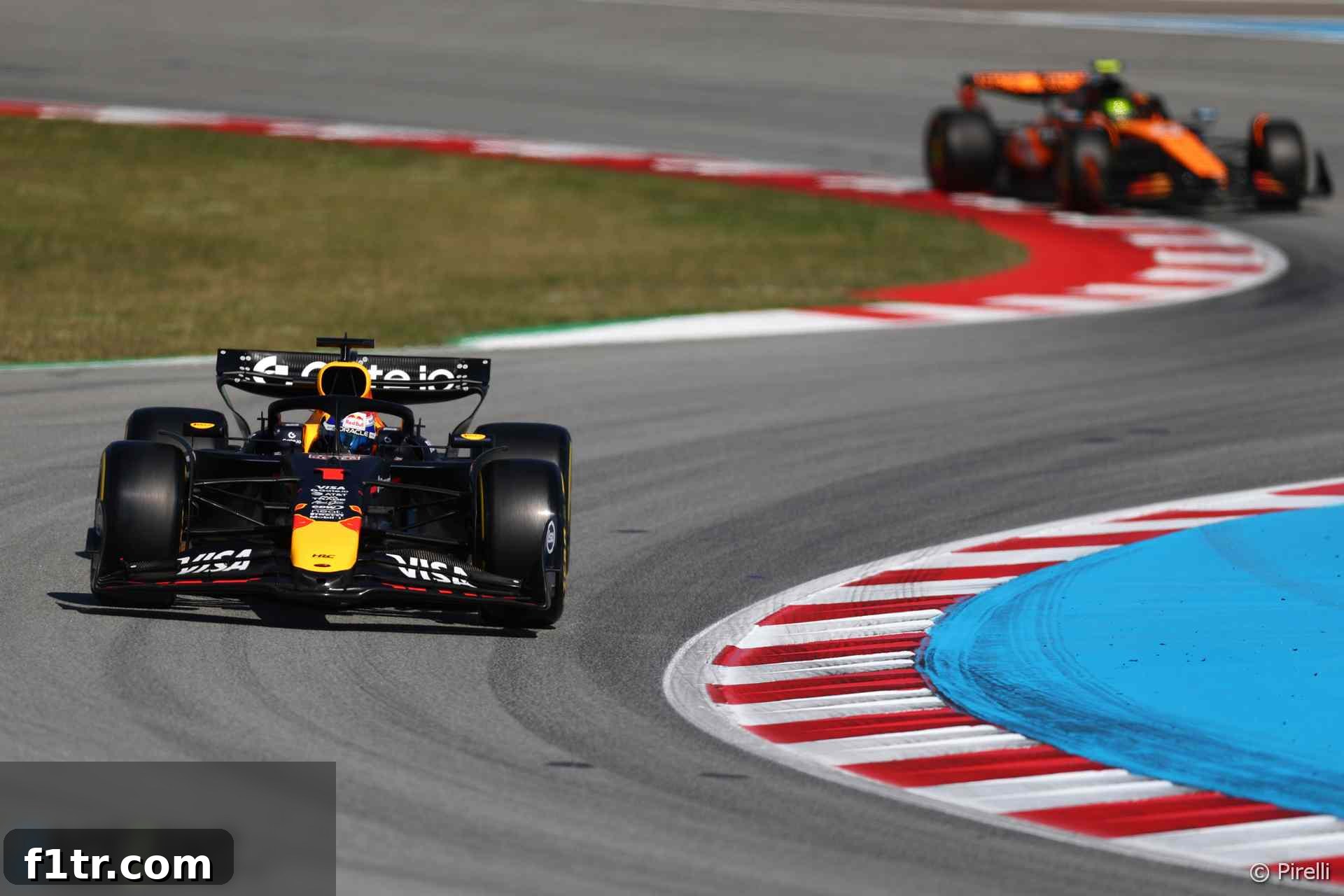
The anticipation for the Spanish Grand Prix is palpable, particularly for McLaren, who have secured a coveted front-row lockout with Oscar Piastri and Lando Norris. This remarkable achievement marks a significant moment for the Woking-based outfit, underscoring their impressive resurgence in the Formula 1 pecking order and setting the stage for a thrilling race day. However, the Circuit de Catalunya, known for its demanding layout and strategic complexities, presents a unique challenge, especially given its notoriously long run to Turn 1. This initial sprint often sparks concerns among teams and drivers about maintaining grid positions, yet McLaren team principal Andrea Stella remains remarkably unconcerned about his drivers potentially losing their hard-earned top two spots at the start of today’s race.
The Circuit de Catalunya’s main straight, stretching over 600 meters from the start line to the braking zone of Turn 1, is one of the longest on the Formula 1 calendar. This extensive distance provides ample opportunity for cars starting further back to capitalize on slipstream advantages, strong initial launches, and aggressive overtaking maneuvers. The pressure on the front-row starters, therefore, is immense, as a slight misstep or a momentary lapse in concentration can quickly see them swarmed by rivals aiming to gain crucial early positions. Recent history at this very circuit serves as a stark reminder of this phenomenon. Last year, for instance, Mercedes’ George Russell, starting from fourth on the grid, made a sensational start to momentarily snatch the lead from pole position, demonstrating the potential for significant positional changes in the opening seconds of the race. Coincidentally, Russell finds himself in the exact same starting position this year, adding another layer of intrigue and anticipation to the pre-race narratives.
Moreover, the memory of the Emilia-Romagna Grand Prix just two weeks prior is fresh in everyone’s minds, highlighting the unpredictable nature of race starts. There, Max Verstappen, despite qualifying third, managed to outmaneuver Oscar Piastri at the start, ultimately converting that early advantage into a dominant victory. Such examples naturally fuel speculation about the vulnerability of front-row starters, particularly when rival teams demonstrate strong race pace and strategic prowess. Yet, Andrea Stella’s composure in the face of these historical precedents and track characteristics speaks volumes about McLaren’s internal assessment of the race dynamics. His confidence isn’t born out of complacency but rather a deep understanding of the strategic levers available and a trust in his team’s preparation.
Stella firmly believes that today’s victory at the Spanish Grand Prix will hinge less on the immediate outcome of the Turn 1 scramble and more on sophisticated race strategy, particularly concerning tyre management and stint length. “Especially here in Barcelona, with the level of tyre degradation that we have, I think actually the order at the end of lap one will not be that decisive,” he told Viaplay, offering a revealing insight into McLaren’s considered strategic thinking. This statement signals a shift in focus from a purely reactive, start-dependent approach to a more proactive, long-game strategy that emphasizes consistent performance over an entire stint rather than just the intensity of the first few corners.
The Circuit de Catalunya is notorious for its abrasive tarmac and a challenging mix of high-speed corners and technical sections, which collectively contribute to significant tyre wear. This makes tyre degradation a paramount factor, often forcing teams to manage their compounds meticulously throughout the race. Stella elaborated on this critical aspect, explaining, “If somebody can do a better job on tyre degradation, can go a couple of laps longer in the first stint and then maybe a couple more laps longer on the second one, then you can attack in the final.” This highlights the tactical advantage of extending stints – a strategic move that can create an ‘overcut’ opportunity, where a car on fresher tyres after pitting later can gain significant ground on a car that has already stopped and might be struggling for grip on older rubber.
This perspective from McLaren’s team principal underscores a fundamental truth about modern Formula 1: races are rarely won or lost in the first lap alone, especially on tracks with inherently high degradation. Instead, they are often decided by optimal strategy, precise pit stops executed with split-second timing, and the drivers’ exceptional ability to extract maximum performance from their machinery while preserving their fragile tyres. Stella’s belief that “There’s so many ways in which you can win this race. I think it would be too much of a reduction to only think about what happens in qualifying,” serves as a philosophical anchor for McLaren’s comprehensive approach. It suggests a holistic view, where every aspect from car setup and driver feedback to pit wall decisions and compound choices, plays a crucial and interconnected role in determining the ultimate outcome of a Grand Prix.
Echoing his team principal’s sentiments, Oscar Piastri also suspects that today’s race in Barcelona will diverge significantly from many of the earlier rounds this season, where gaining clean air from the outset proved to be an almost decisive advantage. In several previous races, drivers who managed to break away from the immediate pack enjoyed reduced tyre degradation, better aerodynamic efficiency, and superior overall pace, effectively allowing them to manage their lead with relative ease. However, Piastri anticipates a distinctly different narrative for the Spanish Grand Prix. “Trying to get a good start and keep the lead is a good idea, probably, but there’s going to be some strategy involved tomorrow,” he commented after Saturday’s qualifying session, hinting at the layers of complexity and tactical considerations that lie ahead.
The Australian driver further elaborated on the challenges posed by the track conditions during pre-race preparations. “The long runs yesterday were pretty painful for everyone, I think. So it’s going to be a different race to a lot of the races we’ve had this year. Hopefully, a bit different to last weekend.” This observation about the ‘painful’ long runs is a critical indicator for race day. It suggests that teams universally struggled significantly with tyre wear and overheating during extended practice runs, which directly translates into an incredibly demanding race scenario. Drivers will need to employ sophisticated and disciplined techniques to conserve their tyres, meticulously managing their pace, braking points, and acceleration zones to minimize degradation over long stints. This isn’t a race where raw, unbridled speed alone will guarantee success; intelligent driving, strategic foresight, and exceptional tyre management will be equally vital, perhaps even more so.
Piastri’s insightful forecast points to a race day filled with intricate tactical maneuvers and tight battles throughout the field, far removed from a straightforward lights-to-flag victory procession. “I think it will be an interesting race still and it’s not as simple as take the lead at the start and cruise from there. It’s going to be a challenge to manage the tyres, timing your stops right. There’s going to be a lot going on.” His words paint a vivid picture of a dynamic event where team strategists will be working overtime, constantly evaluating tyre performance, anticipating rival moves, and making split-second decisions on pit stop timings and compound choices. This intricate dance between driver and pit wall, involving constant communication and adaptation, will likely define the ultimate winner, perhaps more profoundly than at any other race on the calendar.
The significance of a robust and adaptable strategic approach at Circuit de Catalunya cannot be overstated. With multiple DRS zones and a demanding mix of high-speed sweeps and slower, technical sections, the track offers various opportunities for both attack and defense. However, effective use of these opportunities is heavily reliant on tyre condition and the overall strategic picture. A driver with significantly fresher tyres, even if starting from a slightly disadvantaged track position, can often make up ground rapidly in the final sector or on the main straight where DRS can be deployed. Conversely, a driver attempting to hold onto a lead on overly worn tyres becomes a sitting duck, vulnerable to both undercut and overcut strategies from faster, better-tyred cars.
McLaren’s confidence, therefore, stems from a well-founded belief in their strategic capabilities and their drivers’ exceptional ability to execute complex race plans under pressure. Lando Norris, starting from pole position, and Oscar Piastri, alongside him on the front row, are both highly capable of delivering not just raw pace but also the nuanced tyre management and strategic awareness required for this particular circuit. Their recent performances, including strong showings and podium finishes, have clearly shown a growing understanding of their car’s characteristics and how to extract optimal performance under various demanding race conditions. This strategic depth, combined with their blistering qualifying speed, positions McLaren as strong contenders not just for the start, but for the entire duration of the Grand Prix.
The battle at the Spanish Grand Prix is shaping up to be a true test of strategic acumen as much as raw speed and driving talent. While the long run to Turn 1 will undoubtedly provide an initial burst of excitement and potential positional changes, the true narrative of the race will unfold over many demanding laps, dictated by tyre wear rates, carefully managed pit stop windows, and the overarching strategic decisions made by each team’s pit wall. McLaren’s leadership, led by Andrea Stella, seems to have thoroughly embraced this complexity, preparing their drivers not just for an immediate fight at the start, but for a calculated chess match over the course of the entire Grand Prix. This measured, strategic approach might just be the key to converting their front-row lockout into a triumphant double podium, or even a double victory, proving once again that in modern Formula 1, winning is often more about superior strategy and intelligent execution than just blazing speed off the line.
The Spanish Grand Prix promises to be a captivating spectacle, showcasing the intricate balance between aggression, strategy, and sheer driving talent. As the lights go out, while eyes will be glued to Turn 1 for the initial drama, the real story will unfold as teams and drivers navigate the demanding 66 laps, vying for supremacy through cunning strategies and flawless execution. McLaren’s composed stance sets the stage for what could be a masterclass in strategic racing, potentially redefining the importance of the opening lap in the broader context of a full-length Formula 1 Grand Prix.
Related Formula 1 Articles and Analysis
- Verstappen: Don’t Blame Spanish GP Penalty for Hitting Russell if I Narrowly Lose Title
- Russell’s Radio Comments Influenced Red Bull’s Decision to Let Him Past Verstappen
- Verstappen Says He Won’t Make Any Changes to His Driving to Avoid a Ban
- ‘No Issues’ with Verstappen but ‘It’d Be Different if He’d Taken Me Out’ – Russell
- Ferrari “Don’t Want Us to Talk Much” About “Massive” Spanish GP Problems – Hamilton
Browse all Formula 1 Grand Prix Analysis articles