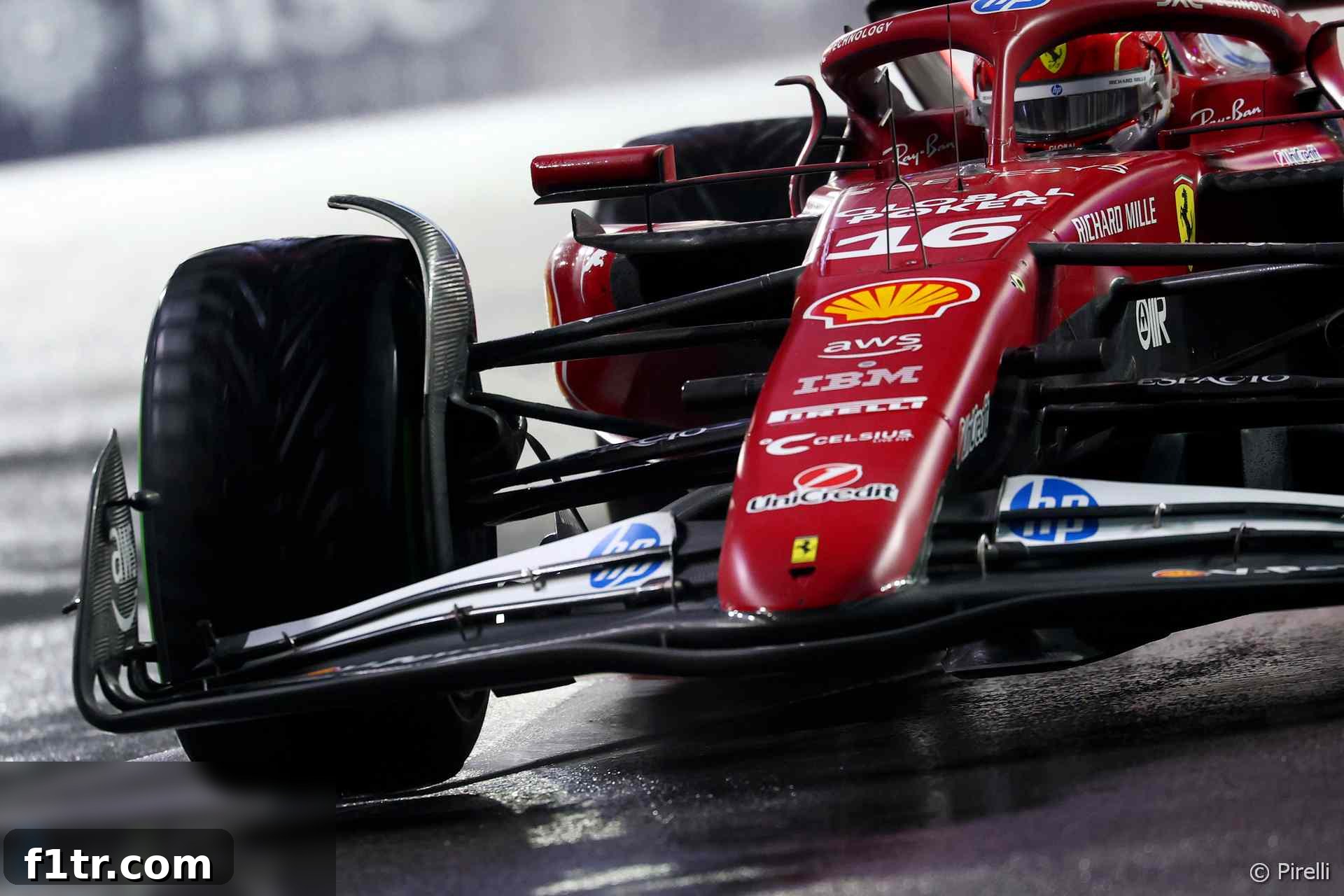
Leclerc’s Frustration Boils Over: Ferrari’s Chronic Wet Weather Struggle Exposed in Las Vegas
Charles Leclerc once again found himself grappling with profound disappointment following Ferrari’s persistent struggles in wet conditions, a factor that relegated him to a lowly ninth position in qualifying for the highly anticipated Las Vegas Grand Prix. This qualifying session served as yet another stark reminder of an Achilles’ heel that has plagued the Scuderia for years, leaving both drivers and fans bewildered by their consistent lack of pace when rain dampens the circuit.
Advertisement | Support Independent F1 Journalism – Go Ad-Free!
The extent of Ferrari’s challenge was further underscored by the performance of his esteemed teammate, Lewis Hamilton, who unexpectedly bowed out in the initial round of qualifying. Both elite drivers voiced similar complaints, citing an alarming and unpredictable absence of grip as the primary culprit behind their struggles. This echoed a familiar narrative, a recurring nightmare for the Maranello-based team whenever the skies open up.
A Decades-Old Enigma: Ferrari’s Wet Weather Achilles’ Heel
“It’s been like that since I joined the team,” a visibly frustrated Leclerc confessed to reporters after the session, highlighting the longevity and systemic nature of the problem. “We’ve been struggling massively at finding the grip in those kind of conditions.” The Monegasque driver, now in his seventh season donning the iconic red overalls, articulated a deep-seated belief that Ferrari is fundamentally “doing something wrong.” This isn’t merely a fleeting issue or a one-off setup glitch; it appears to be an intrinsic characteristic of their car design and operational philosophy, especially when faced with the unforgiving demands of a rain-soaked track.
Leclerc’s personal history makes this struggle all the more galling. Throughout his formative years in junior categories, driving in the wet was often considered his biggest strength, a domain where his exceptional car control and natural talent shone brightest. To now be consistently undermined by his machinery in conditions he once mastered represents a significant blow to his confidence and an immense source of frustration. This stark contrast between his inherent ability and the car’s performance underscores the severity of Ferrari’s underlying issue, pointing towards a fundamental flaw in their engineering approach to adverse weather.
The Search for Answers: A Conundrum Despite Expert Input
The depth of Ferrari’s predicament is magnified by their inability to pinpoint the root cause, despite exhaustive efforts. “I have no idea what that is because we’ve turned the car upside-down,” Leclerc elaborated in an interview with the official Formula 1 channel. This statement paints a vivid picture of a team that has meticulously explored every conceivable setup change, aerodynamic tweak, and mechanical adjustment, yet remains elusive in finding a consistent solution to their wet weather woes. Their engineers have tirelessly experimented with damper settings, spring rates, ride heights, and wing angles, all to no avail when the track is glistening with rain.
Adding another layer of complexity to this ongoing saga is the input from experienced drivers joining the team. Leclerc specifically mentioned that neither Lewis Hamilton nor his previous teammate, Carlos Sainz Jnr, both highly accomplished drivers with diverse experiences across different F1 constructors, have been able to shed definitive light on the problem. “We’ve had Lewis and obviously Carlos before that also joined from other teams that could tell us the feelings they had with the other cars, but it’s just extremely difficult to find the grip with our car,” Leclerc explained. This collective struggle among top-tier talent suggests a deeply ingrained car characteristic rather than a driver adaptation issue, reinforcing the systemic nature of Ferrari’s challenge in these specific conditions.
Unpredictability: The Silent Killer of Confidence
Beyond the sheer lack of grip, Leclerc pinpointed another critical factor: the car’s inherent unpredictability. “It’s very, very unpredictable as well, which causes us to do a lot of mistakes.” In wet conditions, where the margin for error is razor-thin and track limits are unforgiving, an unpredictable chassis robs a driver of confidence. This forces them into a defensive driving style, preventing them from pushing the car to its absolute limits and inevitably leading to errors. This lack of consistent feedback from the car makes it nearly impossible for drivers to extract maximum performance, resulting in significant deficits compared to rivals who boast more stable and predictable platforms in the rain.
Advertisement | Elevate Your F1 Experience: Become a RaceFans supporter andenjoy an ad-free journey
A Cycle of Hope and Disappointment: Ferrari’s Wet Weather Rollercoaster
The journey to resolve this issue has been a disheartening cycle of fleeting hope followed by bitter disappointment for Ferrari. Leclerc candidly admitted that the team has “had some, few, positive surprises sometimes” with the car in wet conditions. These rare glimpses of competence would ignite a flicker of optimism, suggesting that a breakthrough was imminent or that a particular setup configuration had finally unlocked the elusive wet weather potential. However, this optimism has consistently proven to be short-lived, often dissolving in the very next wet session.
“But for some reason whenever we thought we had understood something we were proved wrong the session after in the wet,” Leclerc lamented. This frustrating pattern indicates that any perceived solutions have either been circumstantial, track-specific, or simply not transferable to different circuits or varying rain intensities, leaving the underlying problem fundamentally unaddressed. It highlights a deeper engineering challenge that current iterative adjustments are failing to solve.
“F**king Embarrassing”: A Driver’s Raw Emotion
Leclerc’s exasperation reached a peak during the qualifying session itself. His radio message to race engineer Bryan Bozzi was a raw, unfiltered outpouring of frustration, encapsulating the sheer futility he felt behind the wheel. The expletive-laden declaration that the car’s performance was “fucking embarrassing” perfectly conveyed the depth of his dismay and the immense pressure he operates under. “I don’t get how can we be so off the pace. There’s like zero grip. Zero fucking grip,” he stressed, his voice laced with incredulity and despair. This highly emotional moment highlighted not just the competitive disadvantage but also the profound mental toll such chronic issues take on a driver striving for championship glory, pushing their limits in a machine that refuses to cooperate.
Technical Nuances: Why Wet Weather Grip is So Elusive in F1
The complexities of generating grip in wet conditions are multifaceted in Formula 1. Unlike dry conditions, where aerodynamic downforce is paramount and consistent, wet tracks introduce a myriad of dynamic variables. The intricate interaction between the tire, the standing water, and the track surface becomes critical. Intermediate and full wet tires are meticulously designed to evacuate water through intricate tread patterns, but if the car’s suspension geometry, weight distribution, or aerodynamic balance is not precisely optimized for this unique environment, the tires struggle to reach their optimal operating temperature and pressure, leading to a dramatic underperformance. Furthermore, reduced visibility and the constant risk of aquaplaning demand a chassis that is inherently stable, predictable, and confidence-inspiring – qualities Ferrari seemingly lacks in these specific circumstances.
The impact of wet weather extends beyond pure mechanical grip and tire performance. Aerodynamic efficiency, which is meticulously optimized for dry conditions, can paradoxically become a hindrance in the rain. Water spray affects crucial airflow over the car’s surfaces, and intricate aerodynamic elements designed to create maximum downforce might paradoxically become less effective or even generate detrimental drag in saturated conditions. Teams spend countless hours in simulations and wind tunnels perfecting dry weather performance, but the dynamic and unpredictable nature of rain often exposes underlying weaknesses in chassis design and aerodynamic philosophy that are far harder to replicate and resolve in a controlled, off-track environment.
Ferrari’s Path Forward: Addressing a Fundamental Flaw
For Ferrari, resolving this pervasive wet weather issue is not just about isolated race results; it is fundamental to their championship aspirations. In a sport where every point counts, consistently losing out in unpredictable wet sessions can have significant long-term consequences, impacting constructor and driver standings. The team’s engineers, led by their technical director, face an arduous task that demands more than incremental changes. It requires a holistic approach, revisiting fundamental design principles, re-evaluating their simulation tools and methodologies, and perhaps even rethinking their development priorities to ensure the car performs optimally across the full spectrum of track conditions, not just in the dry.
The feedback from highly sensitive and analytical drivers like Charles Leclerc, Lewis Hamilton, and Carlos Sainz Jnr will be invaluable in this process. Their detailed insights, combined with rigorous data analysis and innovative engineering solutions, will be crucial in unlocking the secrets to consistent wet weather performance. Only by addressing this deep-seated flaw can Ferrari truly challenge for top honors in every race, regardless of what the unpredictable skies might bring, finally allowing their prodigious talent behind the wheel to shine in all conditions.
Don’t Miss a Single Lap from RaceFans!
Get a daily email with all our latest stories – absolutely no marketing, no ads, just pure F1 content. Sign up here:
More from the 2025 Las Vegas Grand Prix
- Losing win through strategy error “hurts more” than Las Vegas disqualification – Piastri
- FIA feels McLaren’s Las Vegas GP disqualification is “draconian”, claims Brown
- Why did McLaren’s messages to Norris and Piastri not mention plank problems?
- McLaren explain Las Vegas disqualifications – including their “counterproductive” reaction
- McLaren’s first double disqualification ended their second-longest points streak
Browse all 2025 Las Vegas Grand Prix articles