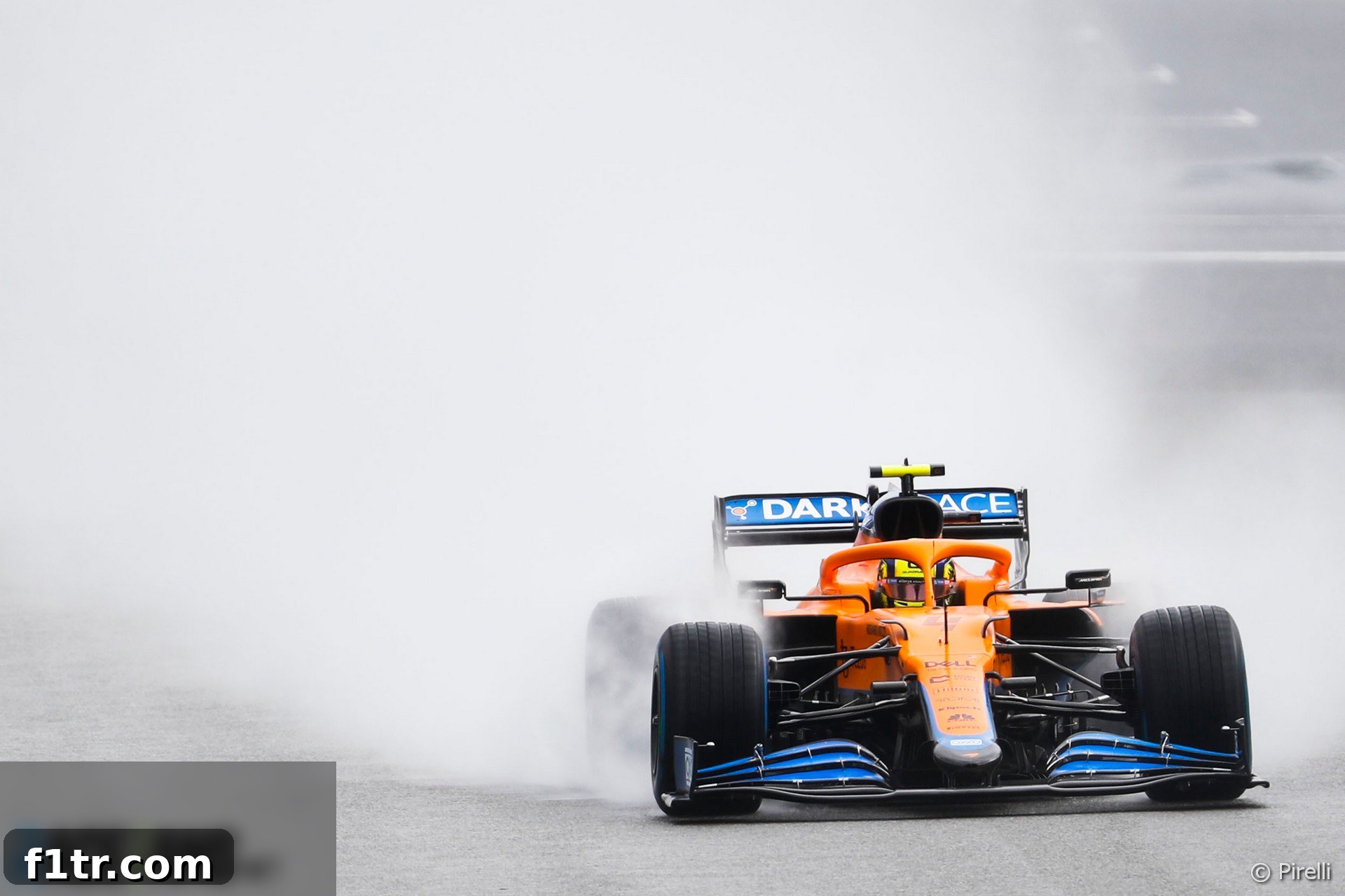
The unforgiving asphalt of Spa-Francorchamps often serves as a crucible for Formula 1 drivers, testing not just their skill but also their mental fortitude. Few incidents from the 2021 season encapsulate this better than Lando Norris’s spectacular, yet ultimately confidence-boosting, crash during qualifying for the Belgian Grand Prix. The McLaren driver, a rising star in the sport, found himself in the barriers at the iconic Raidillon corner during a treacherous wet Q3 session. Despite the severity of the shunt, Norris swiftly reassured fans and media alike that the incident had done little to deter his unwavering belief in his abilities, a testament to his burgeoning maturity in the fiercely competitive world of F1.
Advert | Become a Supporter & go ad-free
The crash, a high-speed impact in challenging conditions, might have profoundly shaken a less experienced driver. However, Norris, entering his third year in Formula 1, articulated a calm and measured perspective on the event. He openly acknowledged that such an incident earlier in his career could have significantly impacted his confidence. Yet, his current mental state, fortified by accumulated experience and a deeper understanding of his craft, allowed him to process the event not as a failure, but as a consequence of pushing the boundaries in pursuit of ultimate performance. This insight underscores a crucial aspect of top-tier motorsport: the ability to learn from adversity without succumbing to self-doubt.
“It’s my third year, I’m a lot more experienced but more importantly I have a lot more confidence this year that I did the last two,” Norris stated, reflecting on his journey. “I’m just in a better place mentally and just with my state of where I am in Formula 1. Now I know it was more because – well, I was pushing and taking risks and stuff and I know it was for a ‘good’ reason in a way that I crashed.” This explanation highlights a key psychological shift. For a seasoned competitor, taking calculated risks in pursuit of a pole position in challenging conditions is part of the job. The crash, in this context, becomes an occupational hazard rather than an error born of incompetence, allowing the driver to maintain a positive self-assessment and move forward.
The qualifying session at Spa that day was a masterclass in meteorological unpredictability. The track conditions evolved rapidly, transitioning from damp to thoroughly soaked within minutes, demanding constant adaptation from the drivers. As the Q3 session progressed and the rain intensified, Norris, known for his prowess in adverse conditions, was on a blistering lap. He admitted to taking significant risks on that fateful run, acknowledging the increasing dangers as the circuit became slicker. Yet, crucially, he remained satisfied with his approach, asserting that he had done nothing fundamentally wrong. This self-assurance is a hallmark of elite athletes who have a deep understanding of their capabilities and the fine margins they operate within.
“I just feel like coming into this weekend if it was last year or year one I would have been a lot more worried and maybe then taking it a lot more cautious and things like that,” he elaborated. “But I don’t feel like I did anything wrong with my approach to that qualifying or that lap or anything. And I’m happy to do exactly the same and take the same risks this weekend.” This declaration not only speaks volumes about his current confidence but also serves as a potent reminder of the inherent risk-taking nature of Formula 1. To achieve greatness, drivers must consistently operate at the very edge of control, a boundary that, on occasion, will inevitably be crossed. Norris’s willingness to re-engage with that risk demonstrates a true champion’s mindset, focused squarely on performance rather than the fear of past failures.
Before his dramatic exit from qualifying, Norris had been an absolute standout. He topped both Q1 and Q2, demonstrating exceptional pace and control in the treacherous conditions. His McLaren MCL35M seemed perfectly dialled in, responding precisely to his inputs. This immediate prior success undoubtedly contributed to his post-crash composure. He felt “at one with the car,” a sensation that every racing driver covets. This synergy between man and machine allows a driver to extract every ounce of performance, to push beyond conventional limits with an almost intuitive understanding of the vehicle’s capabilities. It’s in these moments of profound connection that truly extraordinary laps are set.
Advert | Become a RaceFans supporter andgo ad-free
Wet conditions in Formula 1 are often referred to as the “great equalizer.” Unlike dry races, where the inherent performance differences between cars are more pronounced, rain tends to level the playing field, allowing raw driver talent and bravery to shine through. Norris, as he noted, has a long-standing history of excelling in these challenging scenarios, tracing back to his formative years in Formula 3. “The wet conditions are where more drivers can show a bit more their potential and it’s not as dependent on the car as compared to what the dry conditions are. So it’s where you can make big differences and sometimes you can take bigger risks and things like that,” he explained.
This innate ability to master a slippery track gives drivers like Norris a crucial advantage. It’s a combination of delicate throttle control, precise braking points, exceptional car placement, and the mental fortitude to trust the car’s grip even when visual cues suggest otherwise. His confidence in the wet at Spa was not merely an emotional state but was built on a foundation of past success and a deep understanding of how to exploit such conditions. “I was just in a very confident place. I was there in Formula 3 in the wet and it was pretty quick. So my knowledge and my confidence was just high and I knew what I needed to do to be quick,” he added. This self-awareness and historical proof reinforce his belief that his approach, even with its inherent risks, was justified by his skill set and experience.
The confidence in his McLaren was also a critical factor. Norris emphasized that the car itself was providing him with the necessary feedback and stability to push the limits. “Until that point I didn’t feel like I was taking any extraordinary risks or anything. It was just I was at one with the car and confident with the braking and things like that, which can make a massive difference in the wet. The car was giving me that confidence, obviously, to be able to do it.” In Formula 1, the relationship between driver and machine is paramount. When a car communicates effectively and responds predictably, it empowers the driver to explore the very edge of its performance envelope. This symbiotic relationship explains why Norris felt empowered, not reckless, in his pursuit of pole.
Despite the strong performance and the tantalizing prospect of a pole position, and potentially even a race victory, Norris demonstrated a pragmatic approach to the ‘what if’ scenarios. He resisted the urge to dwell excessively on what could have been, understanding the fluid nature of motorsport, especially in variable conditions. While acknowledging the disappointment of missing out on a strong result, his focus remained on the learning and the broader picture. “I don’t know if I would have got pole or not. Every situation is different. The conditions were changing and so on. But it tended to be the wetter it was, the better we were and the quicker we were relative to other people. And I want to be confident I could have had a very good result.”
The sting of an opportunity lost, particularly when one feels they were performing at their peak, is a difficult emotion for any competitor. Norris candidly admitted, “I would hate to say I could have been pole because I just felt I missed out on, not like a win because I wouldn’t class it as an outright win, but just a good result and ending up 14th or whatever I was makes me feel a lot sadder.” This honest reflection underscores the drive for excellence that defines elite athletes. The disappointment wasn’t just about the crash itself, but the lost chance to convert stellar qualifying pace into a meaningful grid position, ultimately starting the controversial “race” from 14th.
Advert | Become a RaceFans supporter andgo ad-free
Lando Norris’s experience at the 2021 Belgian Grand Prix qualifying serves as a powerful narrative of resilience, self-belief, and the relentless pursuit of performance in Formula 1. His ability to compartmentalize the incident, extract lessons, and maintain an unwavering belief in his capabilities is a clear indicator of his growth as a driver. Far from being derailed by the spectacular crash, Norris emerged with his confidence intact, ready to continue pushing the boundaries, understanding that sometimes, the greatest leaps forward in performance come hand-in-hand with the inherent risks of the sport. His maturity and unwavering commitment to his craft solidify his position as one of Formula 1’s most exciting and promising talents.
2021 Belgian Grand Prix
- Spa spectators who saw no racing offered prize draw for 2022 tickets
- ‘Wrong to award points for a couple of laps behind the Safety Car’ – Horner
- Hamilton offers “exclusive gift” to fans who attended Belgian GP wash-out
- Change rules to give points for qualifying if race can’t happen – Seidl
- “I apologised to the entire team for my mistake” – Perez
Browse all 2021 Belgian Grand Prix articles