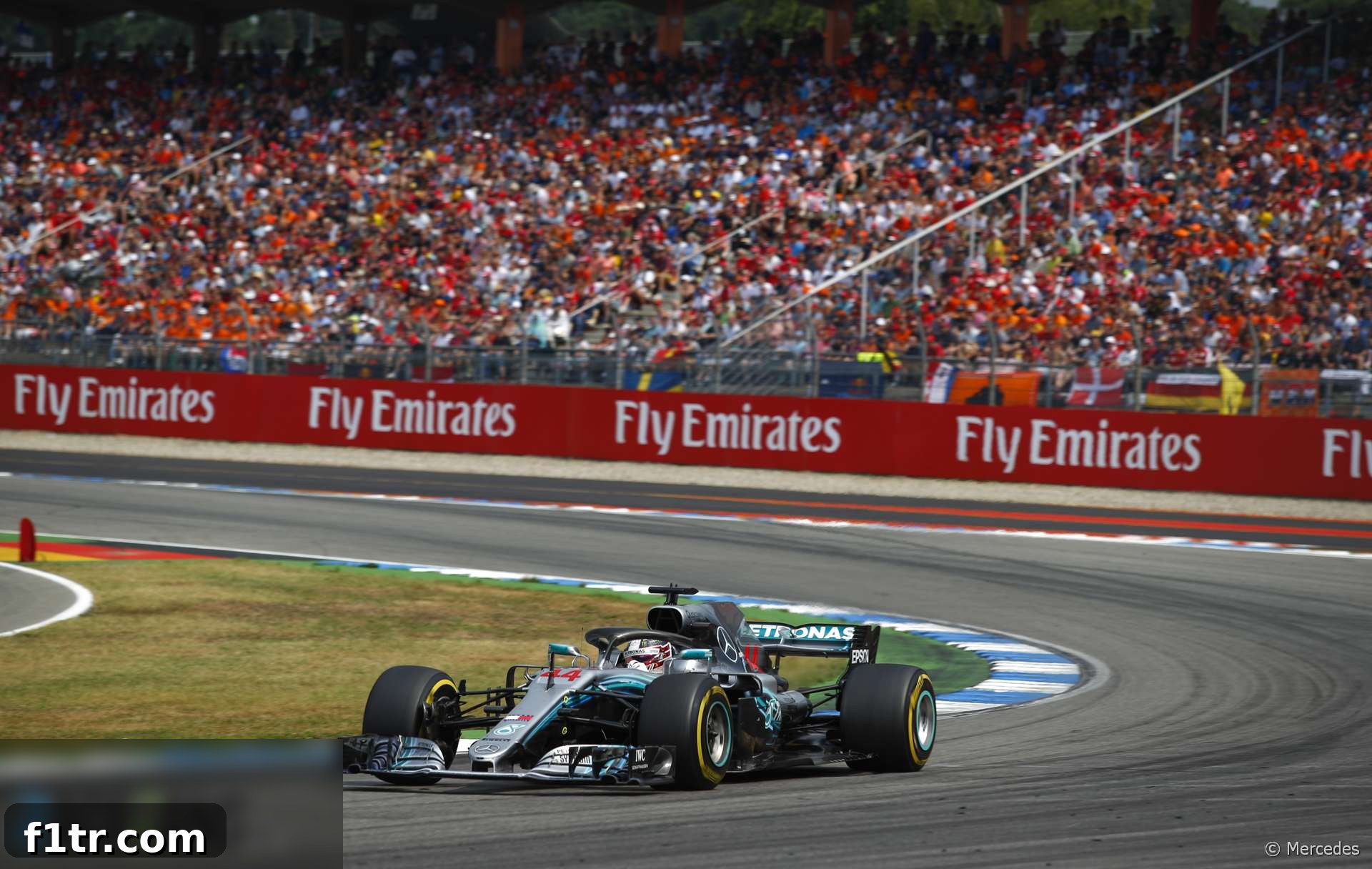
Lewis Hamilton, one of Formula 1’s most decorated drivers, found himself at the center of a media discussion following the 2018 German Grand Prix. While his performance on track was remarkable, it was his subsequent comments regarding the television coverage that sparked widespread debate. Hamilton voiced concerns that the nuanced brilliance of his drive, particularly under challenging conditions, was largely overlooked by commentators, leading to a public clarification of his feelings at the Hungaroring. This incident highlighted the often-complex relationship between elite athletes, sports broadcasting, and the critical analysis of their performance.
The German Grand Prix: A Masterclass Under Scrutiny
The 2018 German Grand Prix at Hockenheim was a race filled with drama, unpredictable weather, and a spectacular comeback drive from Lewis Hamilton. Starting 14th on the grid due to a hydraulic issue in qualifying, Hamilton delivered a performance that many lauded as one of his career best. The race took a dramatic turn when rain began to fall, transforming the circuit into a slippery challenge that tested every driver’s skill and nerve. It was during this pivotal phase that Hamilton truly shone, navigating the treacherous conditions with an almost balletic precision, rapidly ascending through the field.
Hamilton’s victory, snatched from Sebastian Vettel who crashed out while leading, was a testament to his exceptional car control and strategic acumen. Yet, despite the triumph, a sense of dissatisfaction lingered for the Mercedes driver. He felt that the sheer quality and technical brilliance of his driving during those critical moments were not adequately conveyed or appreciated by the broadcast commentary, particularly from former F1 drivers.
Hamilton’s Initial Outcry and Subsequent Clarification
Immediately following the race, Hamilton took to social media, expressing his disappointment with remarks made by ex-F1 drivers on Sky UK’s coverage. In a post that was later deleted, he stated, “Not a single one of them could find a good word to say. Whatever the reason is, it’s OK I forgive you.” This initial outburst, while quickly retracted, underscored a deeper frustration that he later elaborated upon.
Advert | Become a Supporter & go ad-free
Speaking to media at the Hungaroring yesterday, Hamilton explained his reaction to the coverage. He clarified that his concern wasn’t about a lack of praise, but rather an absence of in-depth, expert insight into the intricacies of his performance, especially when it mattered most. “I just watched this race that felt so great in my heart,” Hamilton explained, indicating the personal pride he took in his drive. He perceived that the nuances of his performance were “not being perceived that way by who’s reporting it,” and critically, that “things [were] missed.”
The Missing Technical Detail: A Plea for Deeper Analysis
Hamilton pinpointed a specific instance during the German Grand Prix where the television coverage fell short of his expectations for analytical depth. He recounted the moment when rain intensified, and he was able to extract significant performance advantages over his rivals. “There was a point when it started to rain, I was three seconds quicker than the other drivers but for some reason there on the TV screen there was only the gaps between us there was no times being shown so people couldn’t see the difference.” This omission, he argued, prevented viewers from truly grasping the exceptional pace he was able to generate under those conditions. Without the lap times displayed, the magnitude of his advantage, and thus the brilliance of his driving, remained obscured to the average viewer.
Beyond just the numbers, Hamilton expressed a desire for commentators, especially those with firsthand experience in Formula 1, to articulate the subtle yet crucial techniques he employed. “And also it wasn’t being explained the difference I was making, the different lines that I would choose. Being that we had racing drivers commentating I would have thought they would pick those things out but they didn’t.” This highlights a fundamental expectation from a driver of his caliber: that former racers, possessing an intimate understanding of the sport, should be uniquely positioned to dissect and explain the intricate details of a driver’s craft. The choice of racing lines, throttle application, braking points, and car positioning – especially in variable conditions – are hallmark signs of a driver operating at the peak of their abilities. Hamilton noted that he himself, when watching a race, pays close attention to how rivals like Sebastian Vettel “enters the corner and positions the car,” suggesting this level of observation is fundamental to understanding top-tier racing.
The Role of Ex-Drivers in Commentary: A Sports-Wide Debate
Hamilton’s comments open up a broader discussion about the role and quality of expert commentary in sports broadcasting. He drew a parallel to other sports, specifically tennis, to illustrate his point. “There’s drivers that I grew up watching and succeed and it’s interesting. It seems a little bit different how they sometimes commentate – it’s different from race to race – how they commentate as opposed to when you watch an ex-tennis player commentate on the technicality of a tennis player, how they do fast balls or they work well on grass as opposed to sand. I don’t see that happen as much, but I don’t watch all the races.”
This comparison is telling. In many sports, former athletes are lauded for their ability to break down complex techniques, strategy, and mental game for the audience. They offer a unique perspective that general sports journalists or presenters cannot. For Formula 1, a sport of immense technical complexity and razor-thin margins, the insights of former drivers should, in theory, be invaluable. They have experienced the G-forces, the pressure, the split-second decisions, and the subtle feedback from a high-performance racing machine. Hamilton’s critique suggests that this potential is not always fully realized in F1 commentary, arguing for a more analytical and less descriptive approach.
The expectation is that former drivers bring an unparalleled depth of knowledge, capable of explaining *why* a particular strategy was chosen, *how* a driver executed a difficult maneuver, or *what* makes one line through a corner faster than another. Such detailed analysis not only enriches the viewing experience for seasoned fans but also educates new audiences about the intricacies and demands of the sport. When commentary focuses solely on overt actions or general observations without delving into the ‘how’ and ‘why’, it risks simplifying the sport and failing to adequately convey the true skill involved.
The Challenges of Live Broadcast and Athlete Expectations
It is important to acknowledge the immense challenges faced by live sports commentators. They must process vast amounts of information in real-time, often under immense pressure, while simultaneously engaging a diverse audience. The need to balance entertainment, information, and critical analysis is a tightrope walk. Hamilton himself recognized this, stating, “In the end there was some good comments from some drivers. But they have a tough job to report what’s going on in the race, so I respect that.” This sentiment indicates that his criticism stems from a desire for improvement and a higher standard, rather than outright condemnation of the commentators themselves.
The incident also sheds light on the evolving relationship between athletes and the media. In an era where social media provides a direct channel for athletes to express themselves, their expectations of traditional media scrutiny are becoming more vocal. Hamilton, like many other top athletes, desires his efforts to be understood and dissected with the same level of professionalism and insight that he himself applies to his craft. For a driver who consistently pushes the boundaries of performance, having that dedication reflected in the analysis adds another layer of validation and appreciation.
Conclusion: A Call for Deeper F1 Analysis
Lewis Hamilton’s complaints following the 2018 German Grand Prix serve as a significant reminder of the value of insightful, technical commentary in Formula 1. His plea for former drivers to offer more profound analysis – explaining not just what happened, but how and why it occurred – resonates with many fans who seek a deeper understanding of the sport. While recognizing the inherent difficulties of live broadcasting, Hamilton’s perspective underscores the potential for expert commentators to elevate the viewer’s experience by providing the kind of detailed, nuanced breakdown that truly celebrates the extraordinary skill and strategic thinking required to compete at the pinnacle of motorsport. This ongoing dialogue between athletes and broadcasters ultimately pushes for a richer, more informative, and more appreciative portrayal of Formula 1’s unparalleled athleticism and technical brilliance.
Advert | Become a RaceFans supporter andgo ad-free
2018 F1 season
- F1 feared “death knell” for Drive to Survive after Ferrari and Mercedes snub
- McLaren staff told us we were “totally crazy” to take Honda engines in 2018 – Tost
- ‘It doesn’t matter if we start last’: How Red Bull’s junior team aided Honda’s leap forward
- Honda’s jet division helped F1 engineers solve power unit problem
- McLaren Racing losses rise after Honda split
Browse all 2018 F1 season articles