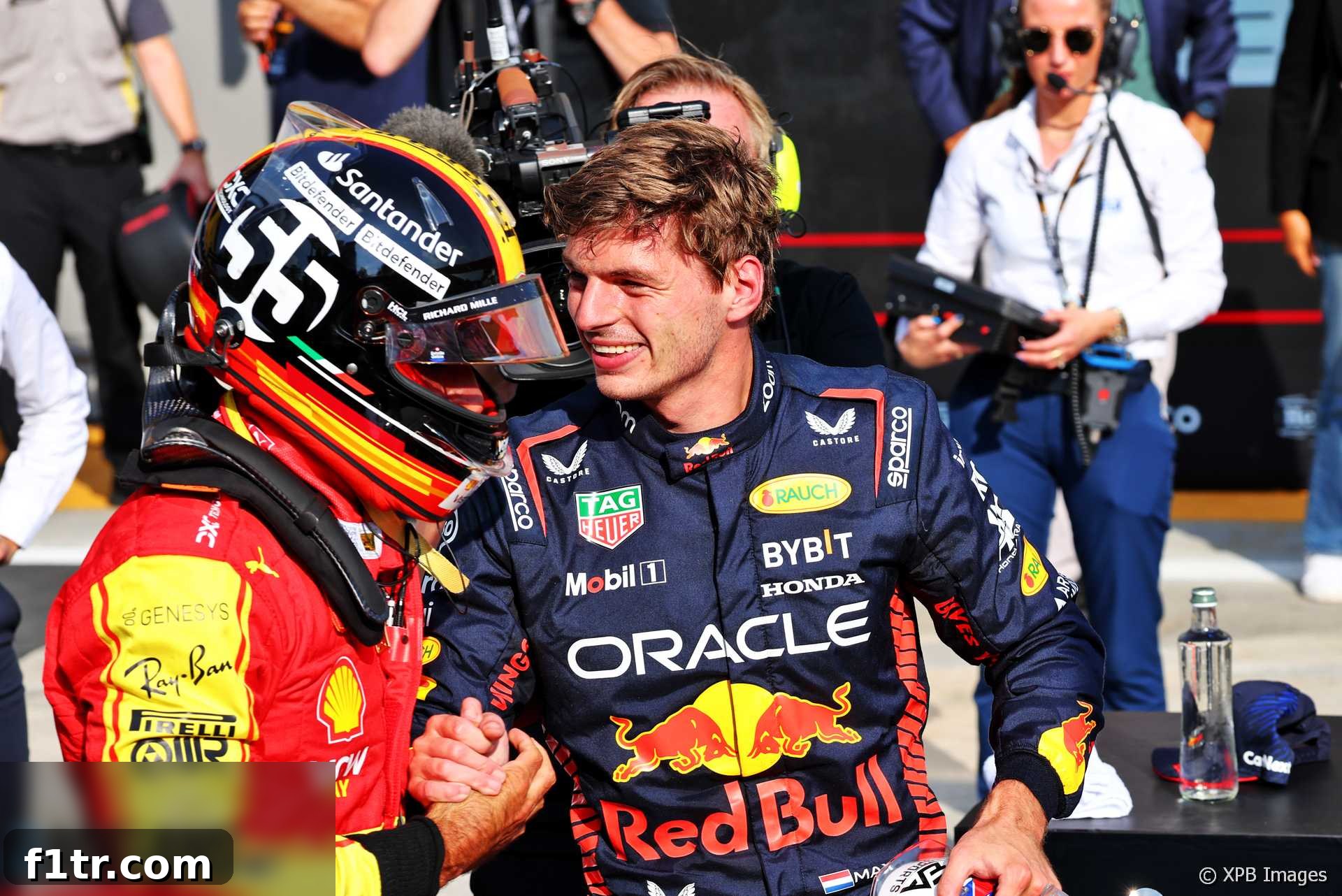
Max Verstappen, the reigning Formula 1 world champion and current championship leader, expressed little surprise following Ferrari’s pole position at the iconic Italian Grand Prix. Despite narrowly missing out on the top spot himself, Verstappen remained composed, attributing the Scuderia’s single-lap advantage to the inherent differences in car philosophy and aerodynamic optimization tailored for the unique challenges of Monza’s “Temple of Speed.” His calm demeanor, even after being edged out for pole, underscored his deep understanding of Formula 1’s intricate technical landscape and his unwavering confidence in Red Bull’s overall package for the race.
The qualifying session at Monza proved to be an exhilarating affair, showcasing the razor-thin margins that define elite motorsport. Carlos Sainz Jnr, driving for Ferrari in front of their fervent home crowd, snatched pole position from Verstappen by an incredibly slender margin of just 13 thousandths of a second. His teammate, Charles Leclerc, was equally competitive, finishing a mere five-hundredths of a second behind the Red Bull driver, highlighting the intense battle at the very front of the grid. This tight competition underscored the effectiveness of Ferrari’s package on a circuit renowned for its high-speed straights, where even fractional gains in top speed can translate into significant lap time advantages.
Advert | Become a Supporter & go ad-free
When asked about Ferrari’s potent qualifying performance, Verstappen conveyed his lack of astonishment, drawing parallels to their speed in previous seasons at this very venue. “They were quick also last year,” he remarked, underscoring a consistent trend for the Italian team at their home race. His assessment delved into the technical nuances of Formula 1 car design, particularly the aerodynamic configurations adopted by rival teams for specific track characteristics. Monza, with its predominantly long straights, iconic chicanes, and minimal high-speed corners, places a premium on outright straight-line speed and minimizing aerodynamic drag to cut through the air with maximum efficiency.
Verstappen specifically pointed to Ferrari’s rear wing design as a critical factor in their qualifying prowess. He explained, “When you look at their rear wing, it seems like it’s quite well-optimised for Monza, where I think our wing, especially for one lap, is maybe not the best optimisation but for the race normally it should be better. So nothing shocking to be honest.” This statement reveals a calculated strategic compromise in Red Bull’s setup philosophy. While Ferrari might have opted for a highly specialized low-drag rear wing to maximize speed through Monza’s iconic straights – a choice that delivers exceptional single-lap pace and excites the Tifosi – Red Bull likely pursued a more balanced approach. Their design, while perhaps conceding a fraction of top speed in qualifying, is engineered to provide superior stability, optimize tire management, and enhance overall efficiency over a full race distance, which typically features more varied conditions, higher fuel loads, and strategic pit stops.
The intricate art of F1 car setup involves constant trade-offs, a delicate balancing act that F1 engineers manage with incredible precision. Teams meticulously analyze track layouts, predict tire degradation patterns, and factor in expected weather forecasts to find the optimal balance between downforce and aerodynamic drag. High downforce generates more grip in corners, allowing higher cornering speeds and improved traction, but simultaneously creates more drag, which acts as a brake on straight-line speed. Conversely, a low-drag setup maximizes top-end speed, crucial for circuits like Monza, but can compromise cornering performance, stability under braking, and tire life. For a track as unique and demanding as Monza, which stands out on the F1 calendar due to its extreme high-speed nature, finding this perfect equilibrium is even more critical and often dictates a team’s competitiveness. Ferrari’s decision to lean heavily towards a low-drag configuration for qualifying at their home race was a calculated risk that ultimately paid off with pole position, igniting the passion of their loyal fans.
Throughout Q1 and Q2, Verstappen consistently found himself at the sharp end of the timing sheets, often setting the quickest laps. However, the margins were consistently minuscule, signaling a fiercely contested session where every thousandth of a second counted. “It was just very tight,” he recounted, reflecting on the intensity and competitive nature of the qualifying runs. “You could see Q1, Q2, Q3 every run you could see that we were very closely matched.” This level of competition demands absolute precision and flawless execution from both driver and machine. In such tight battles, even the slightest error, a momentary lapse in concentration, or a sub-optimal setup choice can mean the difference between pole position and several grid spots lower. The challenge for Red Bull, a team often lauded for its robust, adaptable, and dominant car, was evident in these incredibly tight margins at a circuit that tests unique aspects of car performance.
Adding to the complexity for Verstappen, he admitted that getting the RB19 perfectly dialed in for Monza had not been as straightforward as it often is at other venues during their remarkably successful season. “This weekend for us, especially from my side, I think Friday was a little bit more tricky,” he confessed, hinting at initial struggles to find the optimum balance. He then contrasted this experience with a string of recent races where the car felt “easy going” and “really well set-up” from the outset, allowing him to quickly find his rhythm. This highlighted the specific demands of Monza, where the unique aerodynamic requirements and the overriding emphasis on straight-line speed can challenge even the most dominant teams and cars, forcing engineers to work overtime to unlock peak performance.
Verstappen further elaborated on the difficulties encountered during the practice sessions: “It seemed like here it was just a little bit more difficult to find the right trade-off for downforce for us.” This “trade-off” is the crux of F1 engineering specifically for Monza. Teams must meticulously decide how much downforce to sacrifice for sheer straight-line speed, and vice-versa. Too little downforce can lead to instability under braking, reduced grip in the few corners, and increased tire wear, while too much will significantly blunt the car’s speed on the long, power-dominated straights. Finding the elusive sweet spot – one that allows for competitive top speed without compromising too much on tire degradation, braking stability, or cornering grip – is a painstaking process involving countless hours of simulation, rigorous track testing, and invaluable driver feedback. Despite the initial struggles and the demanding nature of the circuit, Verstappen expressed satisfaction with the progress made: “But I was very happy this morning, I thought the car was working well on one lap and on the long run as well.” This suggests Red Bull’s highly skilled engineers successfully refined the setup, improving both qualifying pace and, crucially, potential race performance, setting the stage for a strong Sunday showing.
Despite starting from second place, a position many drivers would covet, Verstappen conveyed a strong sense of confidence for the race ahead. “So I’m happy with second, to be honest. Here in Monza it’s always very tight. Sometimes you might jump ahead, sometimes you’re just behind. But I’m confident for tomorrow.” This confidence stems from several well-founded factors. Red Bull has consistently demonstrated superior race pace, exceptional tire management, and strategic brilliance throughout the 2023 season. Their car, while perhaps not always the ultimate qualifying machine at every single circuit, often comes alive on Sunday, maintaining strong performance over long stints and adapting remarkably well to varying fuel loads and tire wear. Furthermore, the strategic flexibility afforded by starting on the front row, combined with the potential for slipstreaming and effective DRS overtakes on Monza’s long straights, offers multiple avenues for victory, even from P2.
Monza, often celebrated as the spiritual home of Italian motorsport and affectionately known as the “Temple of Speed,” presents a truly unique challenge on the Formula 1 calendar. Its high-speed nature means that even marginal differences in car performance or setup can be significantly amplified, leading to the incredibly close qualifying times witnessed. The circuit’s iconic layout, featuring the demanding Curva Parabolica and the fast chicanes, demands a specific blend of raw power, aerodynamic efficiency, and driver precision. Over the years, Monza has consistently delivered thrilling races, characterized by intense strategic battles, dramatic slipstreaming maneuvers, and last-lap heroics. For Max Verstappen and Red Bull, starting second might even offer a subtle strategic advantage, allowing them to react to Ferrari’s moves and potentially exploit their superior race pace without the immediate pressure of defending from pole position at the very start. The long run down to Turn 1 often leads to jostling for position, where starting P2 can sometimes be less vulnerable than P1.
As the championship leader with a commanding points advantage, Verstappen is not under immense pressure to risk everything for a single victory. However, his fiercely competitive spirit ensures he will be pushing for the win, irrespective of his championship standing. His calm, analytical assessment of Ferrari’s qualifying strength, coupled with his deep-seated confidence in Red Bull’s formidable race craft and strategic prowess, sets the stage for what promises to be a captivating Italian Grand Prix. The battle between Ferrari’s raw single-lap speed, optimized for Monza’s unique characteristics, and Red Bull’s renowned race-day consistency and tire management will be a highlight to watch as the lights go out. The strategic chess match on Sunday will ultimately reveal whether Ferrari’s home advantage translates into a triumphant victory or if Red Bull’s calculated, race-focused approach proves superior over the grueling course of the Grand Prix, adding another chapter to their dominant season.
Bringing the F1 news from the source
RaceFans strives to bring its readers news directly from the key players in Formula 1. We are able to do this thanks in part to the generous backing of our RaceFans Supporters.
By contributing £1 per month or £12 per year (or the equivalent in other currencies) you can help cover the costs involved in producing original journalism: Travelling, writing, creating, hosting, contacting and developing.
We have been proudly supported by our readers for over 10 years. If you enjoy our independent coverage, please consider becoming a RaceFans Supporter today. As a bonus, all our Supporters can also browse the site ad-free. Sign up or find out more via the links below:
- Become a RaceFans Supporter
- RaceFans Supporter FAQ
Advert | Become a RaceFans supporter andgo ad-free
2023 Italian Grand Prix
- Despite close battles at Monza, F1 drivers want more powerful DRS
- Monza “frustrating” for Alonso but Aston Martin expect better form in coming races
- F1 changed rules to stop Mercedes in 2021 but we won’t ‘cry foul’ now – Wolff
- McLaren will bring ‘follow-up to Austria upgrade’ before focusing on 2024 car
- Magnussen explains why his driving style rarely works with the Haas VF-23
Browse all 2023 Italian Grand Prix articles